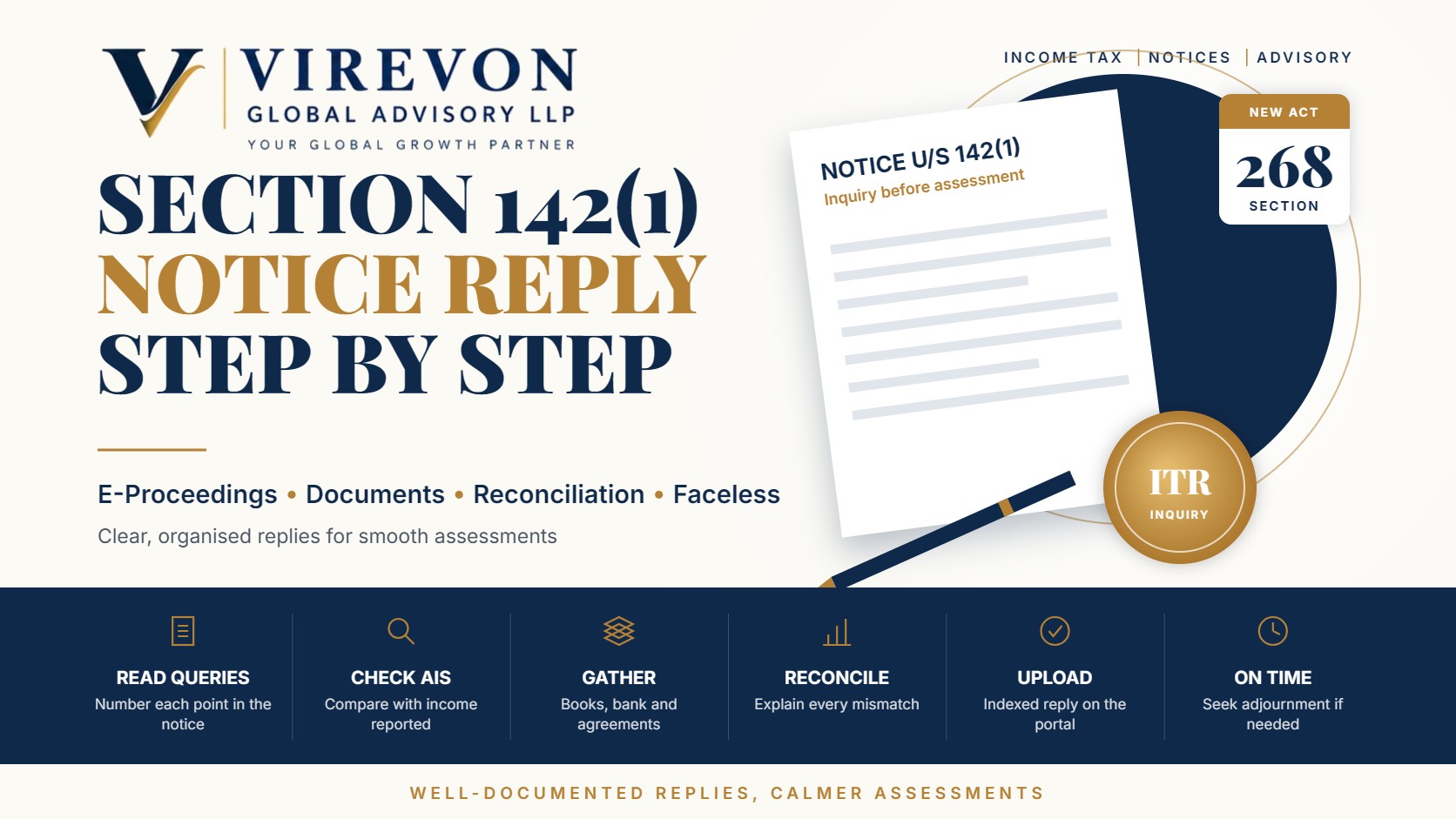
A section 142(1) notice is the Assessing Officer’s tool for gathering information before completing an assessment. It may ask you to file a return you have not filed, produce books and documents, or give written explanations on specific points. It is a routine, structured step, and a well-prepared reply usually keeps the assessment focused and short.
Assessments for years up to FY 2025-26 continue under the Income-tax Act 1961, so notices for those years still refer to section 142(1). Under the Income-tax Act 2025, in force from 1 April 2026, the same power sits in section 268(1), and the procedure is essentially unchanged. This guide covers what the notice can ask for, how to reply through the e-filing portal, and how to avoid the consequences of non-compliance.
Key takeaways
- A section 142(1) notice can require you to file a return, produce accounts and documents, or furnish information in writing, including a statement of assets and liabilities in certain cases.
- Replies are filed online through e-Proceedings; most assessments now run under the faceless scheme, without any personal visit.
- Always respond by the date given, or seek an adjournment with reasons before that date.
- Non-compliance can lead to a best judgment assessment, penalty and, in serious cases, prosecution.
- A structured reply with an index, reconciliations and supporting documents is the most effective approach.
What a section 142(1) notice can ask for
The notice is issued to a person who has filed a return or to whom time to file has expired. The three broad types of request are summarised below.
| Type of request | What it looks like | What to do |
|---|---|---|
| File a return | Notice to furnish a return of income for a year where no return was filed | Prepare and file the return in the correct ITR form within the time given |
| Produce accounts and documents | Ledger extracts, bank statements, invoices, agreements, contract notes | Upload clean, indexed copies relevant to the question asked |
| Furnish information in writing | Explanations on specific items, sources of deposits, loans, investments | Give a point-wise written reply with supporting evidence |
A statement of all assets and liabilities, whether or not included in the accounts, can also be called for, though this needs prior approval of a senior officer. The notice cannot require production of accounts relating to a period more than three years before the year under assessment.
How it fits into the assessment process
Where a return has been filed and selected for scrutiny, a notice under section 143(2) is issued first, followed by one or more notices under section 142(1) seeking specific details. Our guide on section 143(2) scrutiny notices explains the first stage.
Where no return has been filed, a notice under section 142(1) may directly call for the return. In that case, filing the return is the first priority, followed by answering any information requests.
How to reply: a practical checklist
A careful reply follows a clear sequence:
- Read every question. Number each query in the notice and note the due date and assessment year.
- Check the portal. Log in and open Pending Actions > e-Proceedings to view the notice and any annexures, including questionnaires in spreadsheet form.
- Gather records. Collect the books, bank statements, Form 26AS and AIS, invoices, agreements and confirmations relevant to each query.
- Reconcile first. Where the notice highlights a mismatch, for example between AIS and income reported, prepare a reconciliation before writing the explanation.
- Draft point-wise. Answer each query under its own heading, refer to the annexure number of each document, and avoid unrelated information.
- Upload and verify. Combine documents into logically named files within the portal’s size limits, submit, and download the acknowledgement.
When you need more time
If documents are not ready, request an adjournment through the portal before the due date, giving a brief reason and a realistic new date. Adjournments are commonly granted for genuine reasons, but repeated requests without progress should be avoided.
An example
A trader’s return shows turnover of ₹1.2 crore, while AIS shows bank credits of ₹1.6 crore. A section 142(1) notice asks for an explanation of the difference. The reply includes a bank-wise reconciliation showing ₹25 lakh of inter-account transfers, ₹10 lakh of a secured loan from a bank, and ₹5 lakh of GST collected and paid, with the loan sanction letter and bank statements attached. The officer can verify the reconciliation easily, and the query is closed without addition.
What happens if you do not comply
Failure to comply with a section 142(1) notice has consequences that are best avoided:
- Best judgment assessment: the officer may complete the assessment under section 144 (section 271 of the 2025 Act) based on available material, which usually works against the taxpayer.
- Penalty: a penalty for failure to comply with the notice can be levied for each default.
- Prosecution: wilful failure to produce accounts or documents can, in serious cases, lead to prosecution.
- Weak appeal position: later explanations at the appeal stage face closer scrutiny if they were not offered during assessment.
Tips for an effective reply
- Be consistent with the return, audit report and earlier replies. Inconsistency invites further questions.
- Stay within the question. Provide what is asked, clearly and completely, without volunteering unrelated material.
- Use evidence, not assertions. Confirmations, agreements and bank trails are more persuasive than general statements.
- Keep a compliance log of every notice, reply and acknowledgement for the year.
- Request a hearing by video conference under the faceless scheme if a draft or show cause notice proposes a significant addition and a written reply alone may not be enough.
If the return has also been processed with adjustments, our article on the section 143(1) intimation explains how to review them.
Frequently asked questions
Is a section 142(1) notice the same as scrutiny?
Not exactly. It is a power to call for information, used within scrutiny or where no return has been filed. Receiving one means the officer wants specific details before completing the assessment.
How many days do I get to reply?
The time is stated in the notice itself. If it is not enough, request an adjournment on the portal before the due date.
Can I reply offline or visit the office?
Most assessments are faceless, so replies are submitted online through e-Proceedings. Personal hearings, where allowed, are held by video conference.
What is the new section for 142(1) under the Income-tax Act 2025?
The equivalent power is in section 268(1) of the Income-tax Act 2025. Notices for years governed by the 1961 Act continue to refer to section 142(1).
If you have received a section 142(1) notice and would like help organising a clear, well-documented reply, our team would be pleased to support you.
This article is general information based on the law as of September 2026, and is not legal or tax advice. Please check the facts of your own case with a professional before acting.
Leave a Reply