
Category: Income Tax Notices

  • Income Tax Scrutiny Notice under Section 143(2): What It Means and How to Respond

    Income Tax Scrutiny Notice under Section 143(2): What It Means and How to Respond

    A notice under section 143(2) means your income tax return has been selected for scrutiny. It is not an accusation. It means the department wants to verify specific items in the return. Scrutiny is now largely faceless: notices, replies and video hearings run through the e-filing portal. A clear, well-documented response is usually the difference between an assessment accepted as filed and a large addition to income.

    Which law applies in 2026?

    The Income-tax Act, 2025 came into force on 1 April 2026, but proceedings for earlier assessment years continue under the Income-tax Act, 1961. So most scrutiny notices issued during 2026 still cite section 143(2) and questionnaires under section 142(1). The equivalent scrutiny provisions in the new Act apply to later tax years.

    Time limits

    • Scrutiny notice: must be served within 3 months from the end of the financial year in which the return was filed. A notice served later is invalid.
    • Assessment order: generally due within 12 months from the end of the relevant assessment year, with extensions in specified cases.

    Why returns get selected

    • High-value transactions in the AIS/TIS not reflected in the return (property, cash deposits, securities)
    • Large refund claims or sharp changes in income
    • Deductions and exemptions that look out of line
    • Information from other agencies, surveys or third-party reports
    • Random computer-aided selection (CASS)

    Responding step by step

    1. Log in and read everything under Pending Actions > e-Proceedings, including the questionnaire, which lists the specific issues.
    2. Check validity: date of service, DIN, and the issues under limited or complete scrutiny.
    3. Reconcile AIS, TIS and Form 26AS with your books and bank statements, item by item.
    4. Prepare a structured submission: an index, point-wise answers, and annexures that are clearly labelled and paginated.
    5. Ask for time early if you need it. Adjournment requests are made on the portal.
    6. Respond to the show cause notice / draft order if one follows. This is your last chance to change the outcome at assessment stage. Use the video hearing option where facts need explaining.

    Mistakes that lead to additions

    • Missing the response date, which leads to a best judgment assessment under section 144
    • Uploading bulk documents without explanation or reconciliation
    • Answering only some questions
    • Not replying to the show cause notice before the final order

    After the order

    If additions are made, you can appeal to the CIT(A) or JCIT(A) within 30 days of the demand notice, apply for a stay of demand, and file for rectification of apparent mistakes. Penalty proceedings under section 270A usually start alongside, and they deserve a separate, careful reply.

    Received a scrutiny notice? Share it on WhatsApp. We handle faceless assessments for taxpayers across India.

    Read more: Income tax notice reply services · Reassessment notices under section 148A / 281

    This article is general information and is not legal advice.
  • Income Tax Reassessment Notice: Section 148A / 148 and New Sections 281 / 280 Explained

    Income Tax Reassessment Notice: Section 148A / 148 and New Sections 281 / 280 Explained

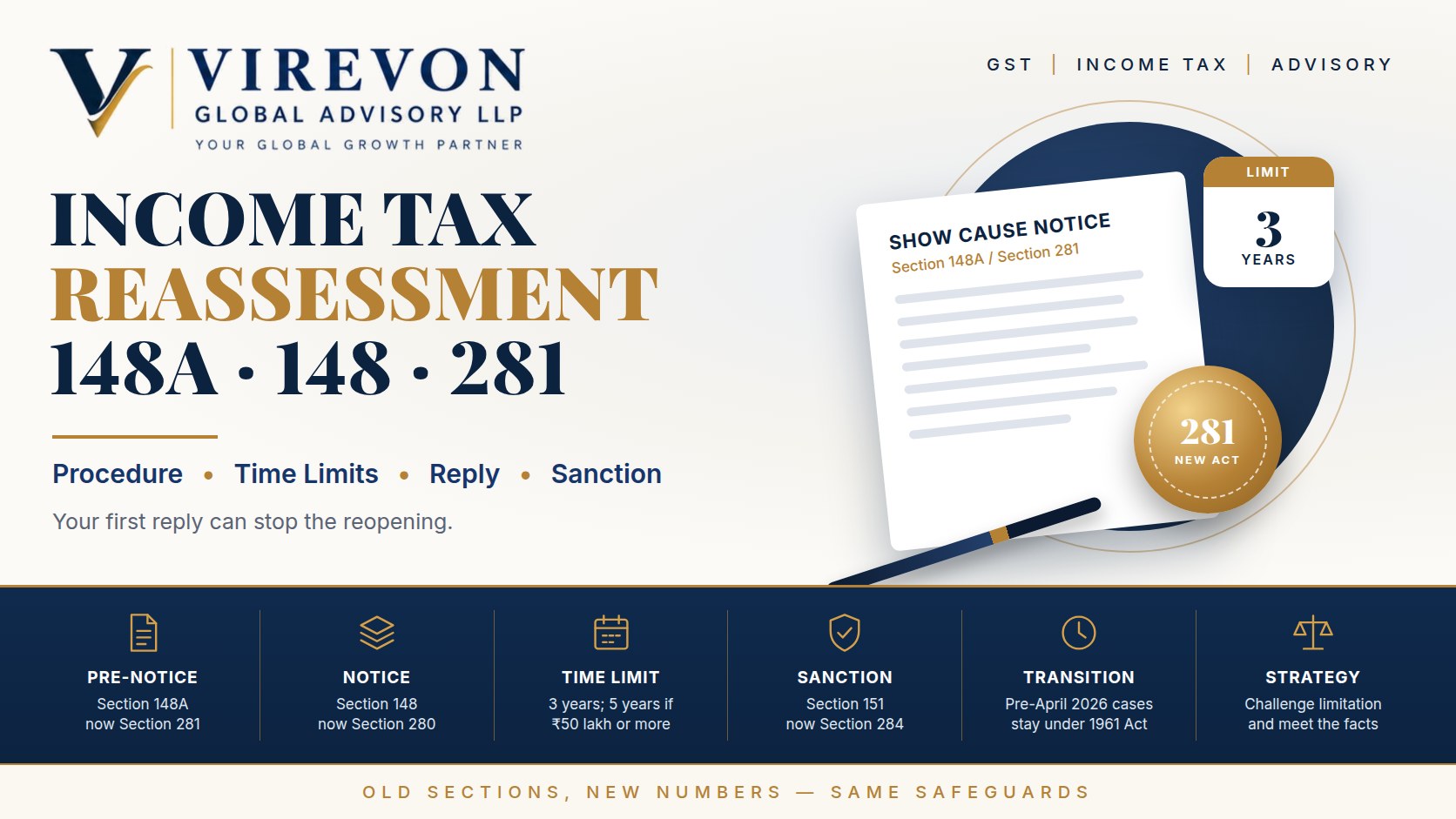
    Reassessment, or “reopening”, lets the Assessing Officer revisit a year that is already closed if they have information suggesting that income escaped assessment. It starts with a show cause notice, and your reply at that first stage is your best chance to stop the reopening altogether. This guide covers the procedure under section 148A of the Income-tax Act, 1961 and its successor provisions, sections 279 to 286 of the Income-tax Act, 2025.

    Old and new section numbers

    • Power to reassess: section 147 → section 279
    • Reassessment notice: section 148 → section 280
    • Pre-notice show cause procedure: section 148A → section 281
    • Time limits: section 149 → section 282
    • Sanction: section 151 → section 284

    Proceedings that began before 1 April 2026 continue under the 1961 Act until they conclude. Notices for older years can therefore still cite section 148A and 148 after that date.

    How the procedure works

    1. Information. The officer holds information suggesting escaped income: AIS entries, reports from other agencies, search or survey material, audit objections.
    2. Show cause notice (148A / 281). You are given the information relied on and asked why a reassessment notice should not be issued. The time to reply is stated in the notice.
    3. Order. After considering your reply, the officer passes a reasoned order, with the prescribed sanction, deciding whether it is a fit case.
    4. Reassessment notice (148 / 280). If the answer is yes, a notice issues along with that order, and you are required to file a return for the year.
    5. Assessment. The reassessment then proceeds, usually faceless, much like scrutiny.

    Time limits

    Under the 1961 Act as amended from 1 September 2024, a notice can generally issue within 3 years from the end of the relevant assessment year. It can issue up to 5 years only where the escaped income, in the form of an asset, expenditure or book entry, is ₹50 lakh or more. Limitation is one of the strongest grounds against reopening, so always compute it first.

    How to reply to the show cause notice

    • Demand the full information. The notice must disclose the material relied on, not just state that information exists.
    • Challenge limitation and sanction: the right year count, the ₹50 lakh threshold where invoked, and approval from the correct authority.
    • Meet the information on the facts. For example, show that the cash deposit came from recorded sales, or that the property purchase was funded by an already-taxed source, with documents.
    • Point to earlier scrutiny where the same issue was already examined.
    • File within the time allowed and keep the acknowledgement.

    If the reassessment notice still issues

    File the return within the time stated in the notice, generally under protest, and ask for the reasons and the order if they were not supplied. Keep objections on jurisdiction alive through the assessment. Where the order is plainly without jurisdiction, a writ petition before the High Court may be possible.

    Received a reopening notice? Send it to us on WhatsApp. We handle reassessment replies online for taxpayers across India.

    Read more: Income tax notice reply services · Scrutiny notices under section 143(2)

    This article is general information and is not legal advice. Time limits depend on the year involved and the Act that governs it.