Tag: Assessment

  • Penalty for Under-reporting and Misreporting of Income: Section 270A and Immunity under 270AA

    Penalty for Under-reporting and Misreporting of Income: Section 270A and Immunity under 270AA

    When an assessment increases your income, the order often ends with a line initiating penalty under section 270A for under-reporting or misreporting of income. The difference between the two matters a great deal: under-reporting attracts a penalty of 50 percent of the tax on the under-reported income, while misreporting attracts 200 percent.

    The law also offers a clean exit. Section 270AA lets a taxpayer seek immunity from penalty by accepting the assessment, paying the tax and not appealing. This guide explains how the penalty works, what counts as misreporting, how immunity operates, and what changed with the Income-tax Act 2025 and Budget 2026.

    Key takeaways

    • Under-reporting attracts a penalty of 50 percent of the tax payable on the under-reported income; misreporting attracts 200 percent.
    • Misreporting covers specific acts, such as suppressing facts, unsubstantiated expense claims, false entries and unrecorded receipts or investments.
    • Several exceptions apply, including where you gave a bona fide explanation and disclosed all material facts.
    • Immunity under section 270AA is available if you pay the tax and interest demanded within the time allowed, do not appeal and apply within one month from the end of the month in which the order is received.
    • Under the Income-tax Act 2025 these provisions appear as sections 439 and 440, and Budget 2026 announced wider immunity, including for misreporting cases on payment of additional tax.

    How the penalty under section 270A works

    A person is treated as having under-reported income when, broadly:

    • the assessed income is higher than the income in the return processed under section 143(1);
    • no return was filed and the assessed income exceeds the basic exemption limit;
    • the income reassessed is higher than the income assessed or reassessed earlier; or
    • a loss or deemed income is reduced or altered to the taxpayer’s disadvantage.

    The penalty is computed on the tax payable on the under-reported income, not on the income itself. The law has specific rules on how that tax is calculated in each situation.

    Under-reporting vs misreporting

    AspectUnder-reportingMisreporting
    Penalty rate50% of tax on under-reported income200% of tax on under-reported income
    NatureDifference in income without specified wrongful actsArises from specified acts listed in the law
    Typical examplesDisallowance on a debatable interpretation, estimatesSuppression of facts, false entries, unrecorded receipts
    Immunity under 270AAAvailable on conditionsTraditionally not available; wider relief announced in Budget 2026

    The law lists the situations that amount to misreporting:

    1. misrepresentation or suppression of facts;
    2. failure to record investments in the books of account;
    3. claim of expenditure not substantiated by any evidence;
    4. recording of any false entry in the books of account;
    5. failure to record any receipt in the books of account having a bearing on total income;
    6. failure to report an international transaction or a specified domestic transaction to which transfer pricing provisions apply.

    The assessment order and penalty notice should specify the particular limb invoked. Clarity on this point is important when replying.

    Situations excluded from under-reporting

    Certain amounts are not treated as under-reported income. The most relevant are:

    • where you offer an explanation that the officer finds bona fide and have disclosed all material facts to substantiate it;
    • where the addition is based on an estimate and your accounts are correct and complete, but the method used does not allow proper deduction of income;
    • certain additions based on transfer pricing adjustments where documentation was maintained and transactions were disclosed.

    A worked example

    Assume an assessment adds ₹10 lakh to a company’s returned income by disallowing a claim, and the tax on that ₹10 lakh works out to about ₹2.5 lakh.

    • If treated as under-reporting, the penalty is 50 percent, around ₹1.25 lakh.
    • If treated as misreporting, the penalty is 200 percent, around ₹5 lakh.
    • If the company accepts the addition, pays tax and interest within the demand notice period, does not appeal and applies for immunity within time, the under-reporting penalty can be avoided altogether.

    The choice between appeal and immunity is therefore a real commercial decision. Where the disallowance is on a genuinely arguable legal issue, an appeal may be worth pursuing. Where the addition is small or weak to contest, immunity may cost less overall.

    Immunity under section 270AA: step by step

    1. Review the order and decide whether you accept the additions.
    2. Pay the tax and interest demanded within the time given in the demand notice.
    3. Do not file an appeal against the assessment order. If an appeal has been filed, the immunity route is generally not available.
    4. Apply in Form 68 within one month from the end of the month in which the assessment order was received.
    5. Wait for the order: the officer decides within one month from the end of the month in which the application is received, after giving an opportunity of being heard before any rejection.

    Immunity also covers prosecution under the specified provisions for wilful evasion and non-filing linked to that assessment, which adds to its value.

    What changed in 2026

    From 1 April 2026, the Income-tax Act 2025 carries these provisions forward as section 439 (penalty) and section 440 (immunity) with the same core structure. Assessments of earlier years under the 1961 Act continue to refer to sections 270A and 270AA.

    Budget 2026 announced two reforms aimed at reducing litigation: integrating assessment and penalty into a common order, and extending immunity to misreporting cases where the taxpayer pays additional income-tax, announced at 100 percent of the tax on the under-reported income, in place of penalty. Check the enacted wording and effective date carefully against your assessment year before relying on either reform.

    If you decide to appeal instead, our guides on section 143(2) scrutiny replies and the section 142(1) notice show how a strong assessment record helps at every later stage.

    Replying to a penalty show cause notice

    • Identify the limb: ask whether the notice alleges under-reporting or misreporting, and on which specific ground.
    • Show bona fides: point to disclosures in the return, audit report and assessment replies.
    • Challenge vague notices: a notice that does not specify the charge may be questioned.
    • Keep appeal timelines in view: the penalty order is separately appealable.

    Frequently asked questions

    What is the penalty rate under section 270A?

    It is 50 percent of the tax payable on under-reported income, and 200 percent where the under-reporting results from misreporting.

    Can I get immunity if I have filed an appeal?

    Generally no. Immunity requires that no appeal is filed against the assessment order and that tax and interest are paid within time.

    What is the time limit to apply for immunity?

    The application in Form 68 must be made within one month from the end of the month in which the assessment order is received.

    What are the new section numbers?

    Under the Income-tax Act 2025, the penalty is in section 439 and immunity in section 440.

    If you have received an assessment order with penalty proceedings and would like help weighing immunity against an appeal, we would be glad to discuss your options.

    This article is general information based on the law as of September 2026, and is not legal or tax advice. Please check the facts of your own case with a professional before acting.
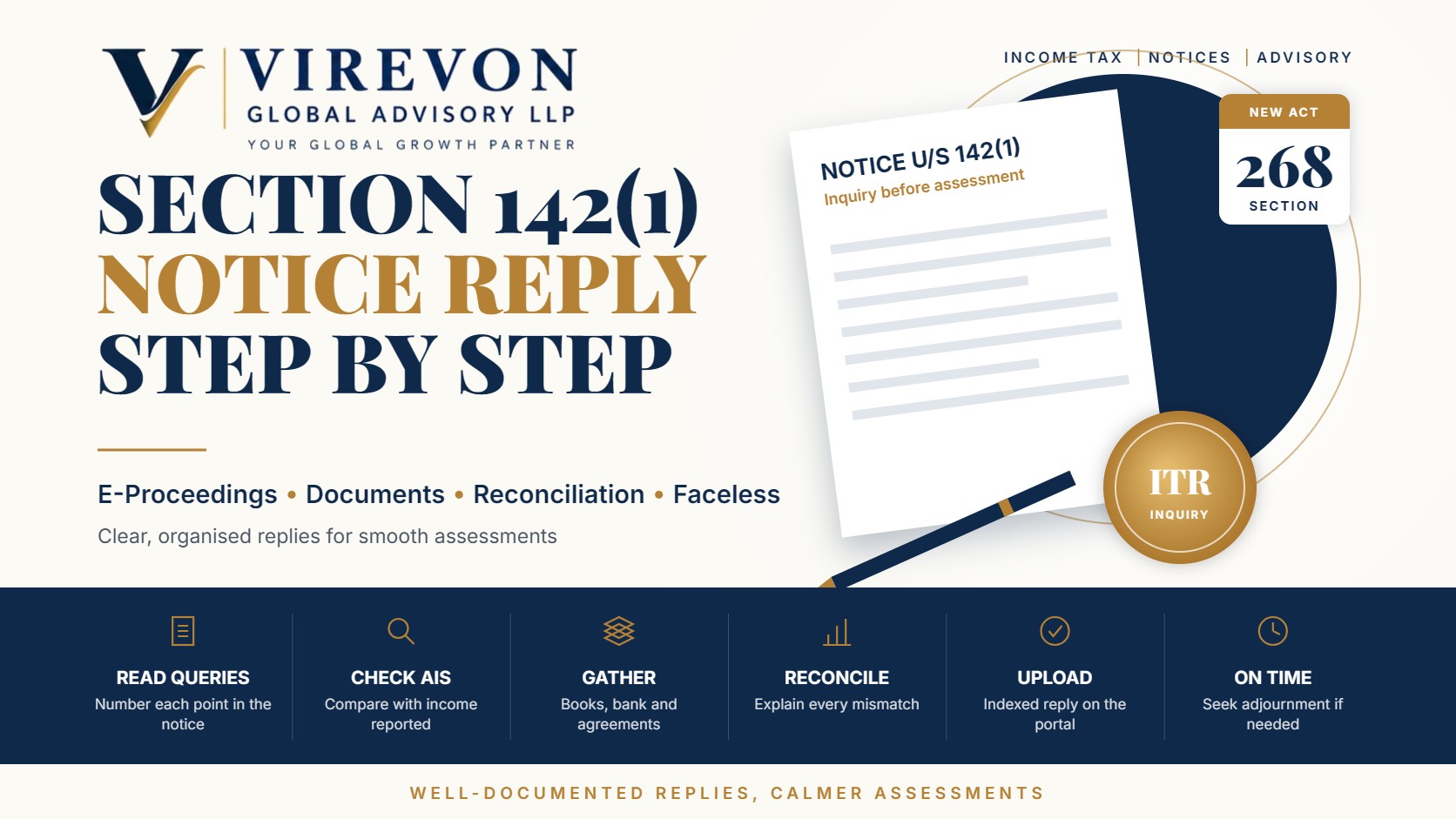
  • Section 142(1) Notice: Inquiry Before Assessment and How to Reply

    Section 142(1) Notice: Inquiry Before Assessment and How to Reply

    A section 142(1) notice is the Assessing Officer’s tool for gathering information before completing an assessment. It may ask you to file a return you have not filed, produce books and documents, or give written explanations on specific points. It is a routine, structured step, and a well-prepared reply usually keeps the assessment focused and short.

    Assessments for years up to FY 2025-26 continue under the Income-tax Act 1961, so notices for those years still refer to section 142(1). Under the Income-tax Act 2025, in force from 1 April 2026, the same power sits in section 268(1), and the procedure is essentially unchanged. This guide covers what the notice can ask for, how to reply through the e-filing portal, and how to avoid the consequences of non-compliance.

    Key takeaways

    • A section 142(1) notice can require you to file a return, produce accounts and documents, or furnish information in writing, including a statement of assets and liabilities in certain cases.
    • Replies are filed online through e-Proceedings; most assessments now run under the faceless scheme, without any personal visit.
    • Always respond by the date given, or seek an adjournment with reasons before that date.
    • Non-compliance can lead to a best judgment assessment, penalty and, in serious cases, prosecution.
    • A structured reply with an index, reconciliations and supporting documents is the most effective approach.

    What a section 142(1) notice can ask for

    The notice is issued to a person who has filed a return or to whom time to file has expired. The three broad types of request are summarised below.

    Type of requestWhat it looks likeWhat to do
    File a returnNotice to furnish a return of income for a year where no return was filedPrepare and file the return in the correct ITR form within the time given
    Produce accounts and documentsLedger extracts, bank statements, invoices, agreements, contract notesUpload clean, indexed copies relevant to the question asked
    Furnish information in writingExplanations on specific items, sources of deposits, loans, investmentsGive a point-wise written reply with supporting evidence

    A statement of all assets and liabilities, whether or not included in the accounts, can also be called for, though this needs prior approval of a senior officer. The notice cannot require production of accounts relating to a period more than three years before the year under assessment.

    How it fits into the assessment process

    Where a return has been filed and selected for scrutiny, a notice under section 143(2) is issued first, followed by one or more notices under section 142(1) seeking specific details. Our guide on section 143(2) scrutiny notices explains the first stage.

    Where no return has been filed, a notice under section 142(1) may directly call for the return. In that case, filing the return is the first priority, followed by answering any information requests.

    How to reply: a practical checklist

    A careful reply follows a clear sequence:

    1. Read every question. Number each query in the notice and note the due date and assessment year.
    2. Check the portal. Log in and open Pending Actions > e-Proceedings to view the notice and any annexures, including questionnaires in spreadsheet form.
    3. Gather records. Collect the books, bank statements, Form 26AS and AIS, invoices, agreements and confirmations relevant to each query.
    4. Reconcile first. Where the notice highlights a mismatch, for example between AIS and income reported, prepare a reconciliation before writing the explanation.
    5. Draft point-wise. Answer each query under its own heading, refer to the annexure number of each document, and avoid unrelated information.
    6. Upload and verify. Combine documents into logically named files within the portal’s size limits, submit, and download the acknowledgement.

    When you need more time

    If documents are not ready, request an adjournment through the portal before the due date, giving a brief reason and a realistic new date. Adjournments are commonly granted for genuine reasons, but repeated requests without progress should be avoided.

    An example

    A trader’s return shows turnover of ₹1.2 crore, while AIS shows bank credits of ₹1.6 crore. A section 142(1) notice asks for an explanation of the difference. The reply includes a bank-wise reconciliation showing ₹25 lakh of inter-account transfers, ₹10 lakh of a secured loan from a bank, and ₹5 lakh of GST collected and paid, with the loan sanction letter and bank statements attached. The officer can verify the reconciliation easily, and the query is closed without addition.

    What happens if you do not comply

    Failure to comply with a section 142(1) notice has consequences that are best avoided:

    • Best judgment assessment: the officer may complete the assessment under section 144 (section 271 of the 2025 Act) based on available material, which usually works against the taxpayer.
    • Penalty: a penalty for failure to comply with the notice can be levied for each default.
    • Prosecution: wilful failure to produce accounts or documents can, in serious cases, lead to prosecution.
    • Weak appeal position: later explanations at the appeal stage face closer scrutiny if they were not offered during assessment.

    Tips for an effective reply

    • Be consistent with the return, audit report and earlier replies. Inconsistency invites further questions.
    • Stay within the question. Provide what is asked, clearly and completely, without volunteering unrelated material.
    • Use evidence, not assertions. Confirmations, agreements and bank trails are more persuasive than general statements.
    • Keep a compliance log of every notice, reply and acknowledgement for the year.
    • Request a hearing by video conference under the faceless scheme if a draft or show cause notice proposes a significant addition and a written reply alone may not be enough.

    If the return has also been processed with adjustments, our article on the section 143(1) intimation explains how to review them.

    Frequently asked questions

    Is a section 142(1) notice the same as scrutiny?

    Not exactly. It is a power to call for information, used within scrutiny or where no return has been filed. Receiving one means the officer wants specific details before completing the assessment.

    How many days do I get to reply?

    The time is stated in the notice itself. If it is not enough, request an adjournment on the portal before the due date.

    Can I reply offline or visit the office?

    Most assessments are faceless, so replies are submitted online through e-Proceedings. Personal hearings, where allowed, are held by video conference.

    What is the new section for 142(1) under the Income-tax Act 2025?

    The equivalent power is in section 268(1) of the Income-tax Act 2025. Notices for years governed by the 1961 Act continue to refer to section 142(1).

    If you have received a section 142(1) notice and would like help organising a clear, well-documented reply, our team would be pleased to support you.

    This article is general information based on the law as of September 2026, and is not legal or tax advice. Please check the facts of your own case with a professional before acting.