Tag: Income Tax Notice

  • Section 142(1) Notice: Inquiry Before Assessment and How to Reply

    Section 142(1) Notice: Inquiry Before Assessment and How to Reply

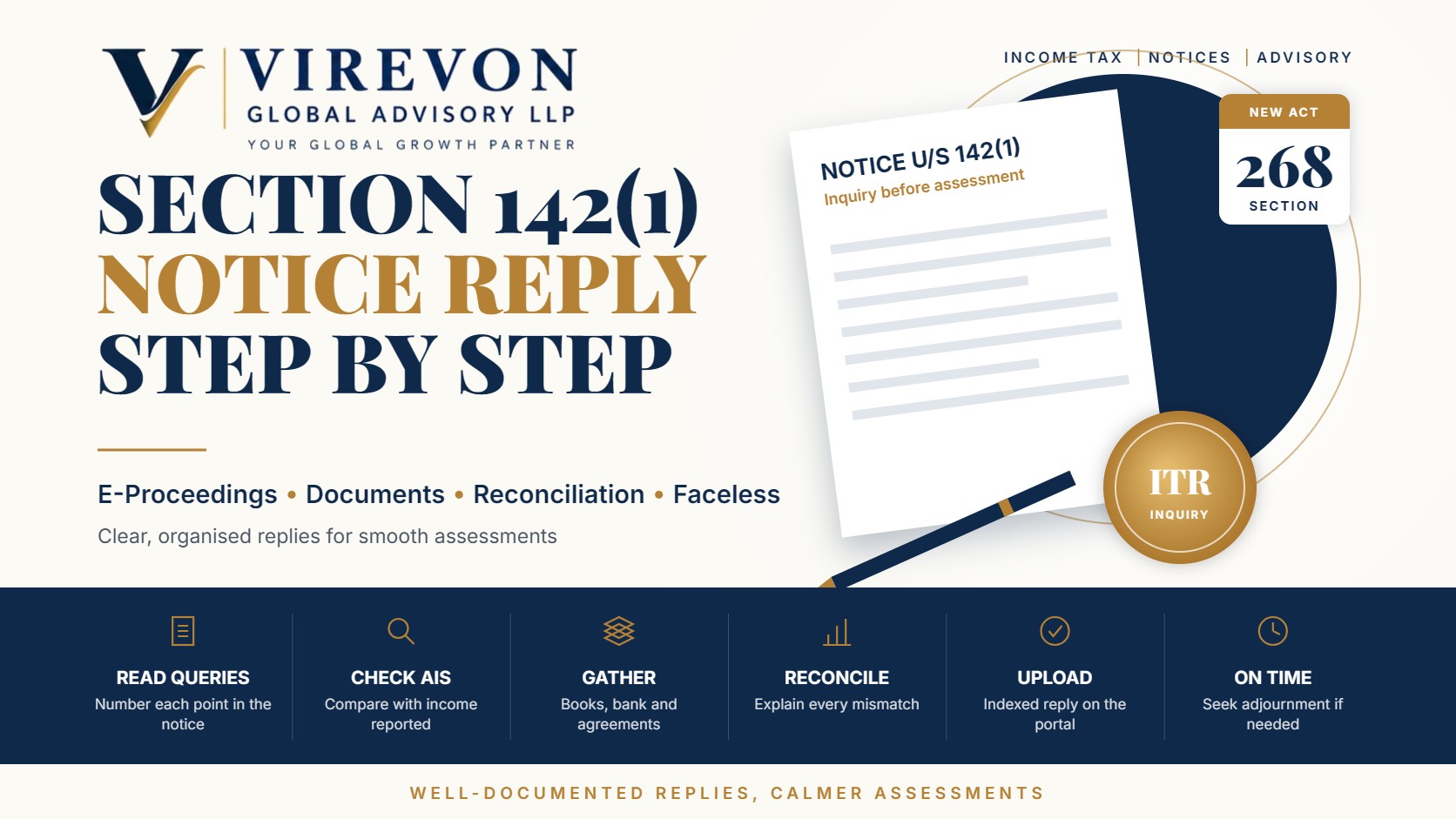
    A section 142(1) notice is the Assessing Officer’s tool for gathering information before completing an assessment. It may ask you to file a return you have not filed, produce books and documents, or give written explanations on specific points. It is a routine, structured step, and a well-prepared reply usually keeps the assessment focused and short.

    Assessments for years up to FY 2025-26 continue under the Income-tax Act 1961, so notices for those years still refer to section 142(1). Under the Income-tax Act 2025, in force from 1 April 2026, the same power sits in section 268(1), and the procedure is essentially unchanged. This guide covers what the notice can ask for, how to reply through the e-filing portal, and how to avoid the consequences of non-compliance.

    Key takeaways

    • A section 142(1) notice can require you to file a return, produce accounts and documents, or furnish information in writing, including a statement of assets and liabilities in certain cases.
    • Replies are filed online through e-Proceedings; most assessments now run under the faceless scheme, without any personal visit.
    • Always respond by the date given, or seek an adjournment with reasons before that date.
    • Non-compliance can lead to a best judgment assessment, penalty and, in serious cases, prosecution.
    • A structured reply with an index, reconciliations and supporting documents is the most effective approach.

    What a section 142(1) notice can ask for

    The notice is issued to a person who has filed a return or to whom time to file has expired. The three broad types of request are summarised below.

    Type of requestWhat it looks likeWhat to do
    File a returnNotice to furnish a return of income for a year where no return was filedPrepare and file the return in the correct ITR form within the time given
    Produce accounts and documentsLedger extracts, bank statements, invoices, agreements, contract notesUpload clean, indexed copies relevant to the question asked
    Furnish information in writingExplanations on specific items, sources of deposits, loans, investmentsGive a point-wise written reply with supporting evidence

    A statement of all assets and liabilities, whether or not included in the accounts, can also be called for, though this needs prior approval of a senior officer. The notice cannot require production of accounts relating to a period more than three years before the year under assessment.

    How it fits into the assessment process

    Where a return has been filed and selected for scrutiny, a notice under section 143(2) is issued first, followed by one or more notices under section 142(1) seeking specific details. Our guide on section 143(2) scrutiny notices explains the first stage.

    Where no return has been filed, a notice under section 142(1) may directly call for the return. In that case, filing the return is the first priority, followed by answering any information requests.

    How to reply: a practical checklist

    A careful reply follows a clear sequence:

    1. Read every question. Number each query in the notice and note the due date and assessment year.
    2. Check the portal. Log in and open Pending Actions > e-Proceedings to view the notice and any annexures, including questionnaires in spreadsheet form.
    3. Gather records. Collect the books, bank statements, Form 26AS and AIS, invoices, agreements and confirmations relevant to each query.
    4. Reconcile first. Where the notice highlights a mismatch, for example between AIS and income reported, prepare a reconciliation before writing the explanation.
    5. Draft point-wise. Answer each query under its own heading, refer to the annexure number of each document, and avoid unrelated information.
    6. Upload and verify. Combine documents into logically named files within the portal’s size limits, submit, and download the acknowledgement.

    When you need more time

    If documents are not ready, request an adjournment through the portal before the due date, giving a brief reason and a realistic new date. Adjournments are commonly granted for genuine reasons, but repeated requests without progress should be avoided.

    An example

    A trader’s return shows turnover of ₹1.2 crore, while AIS shows bank credits of ₹1.6 crore. A section 142(1) notice asks for an explanation of the difference. The reply includes a bank-wise reconciliation showing ₹25 lakh of inter-account transfers, ₹10 lakh of a secured loan from a bank, and ₹5 lakh of GST collected and paid, with the loan sanction letter and bank statements attached. The officer can verify the reconciliation easily, and the query is closed without addition.

    What happens if you do not comply

    Failure to comply with a section 142(1) notice has consequences that are best avoided:

    • Best judgment assessment: the officer may complete the assessment under section 144 (section 271 of the 2025 Act) based on available material, which usually works against the taxpayer.
    • Penalty: a penalty for failure to comply with the notice can be levied for each default.
    • Prosecution: wilful failure to produce accounts or documents can, in serious cases, lead to prosecution.
    • Weak appeal position: later explanations at the appeal stage face closer scrutiny if they were not offered during assessment.

    Tips for an effective reply

    • Be consistent with the return, audit report and earlier replies. Inconsistency invites further questions.
    • Stay within the question. Provide what is asked, clearly and completely, without volunteering unrelated material.
    • Use evidence, not assertions. Confirmations, agreements and bank trails are more persuasive than general statements.
    • Keep a compliance log of every notice, reply and acknowledgement for the year.
    • Request a hearing by video conference under the faceless scheme if a draft or show cause notice proposes a significant addition and a written reply alone may not be enough.

    If the return has also been processed with adjustments, our article on the section 143(1) intimation explains how to review them.

    Frequently asked questions

    Is a section 142(1) notice the same as scrutiny?

    Not exactly. It is a power to call for information, used within scrutiny or where no return has been filed. Receiving one means the officer wants specific details before completing the assessment.

    How many days do I get to reply?

    The time is stated in the notice itself. If it is not enough, request an adjournment on the portal before the due date.

    Can I reply offline or visit the office?

    Most assessments are faceless, so replies are submitted online through e-Proceedings. Personal hearings, where allowed, are held by video conference.

    What is the new section for 142(1) under the Income-tax Act 2025?

    The equivalent power is in section 268(1) of the Income-tax Act 2025. Notices for years governed by the 1961 Act continue to refer to section 142(1).

    If you have received a section 142(1) notice and would like help organising a clear, well-documented reply, our team would be pleased to support you.

    This article is general information based on the law as of September 2026, and is not legal or tax advice. Please check the facts of your own case with a professional before acting.
  • Defective Return Notice under Section 139(9): Causes and How to Fix It

    Defective Return Notice under Section 139(9): Causes and How to Fix It

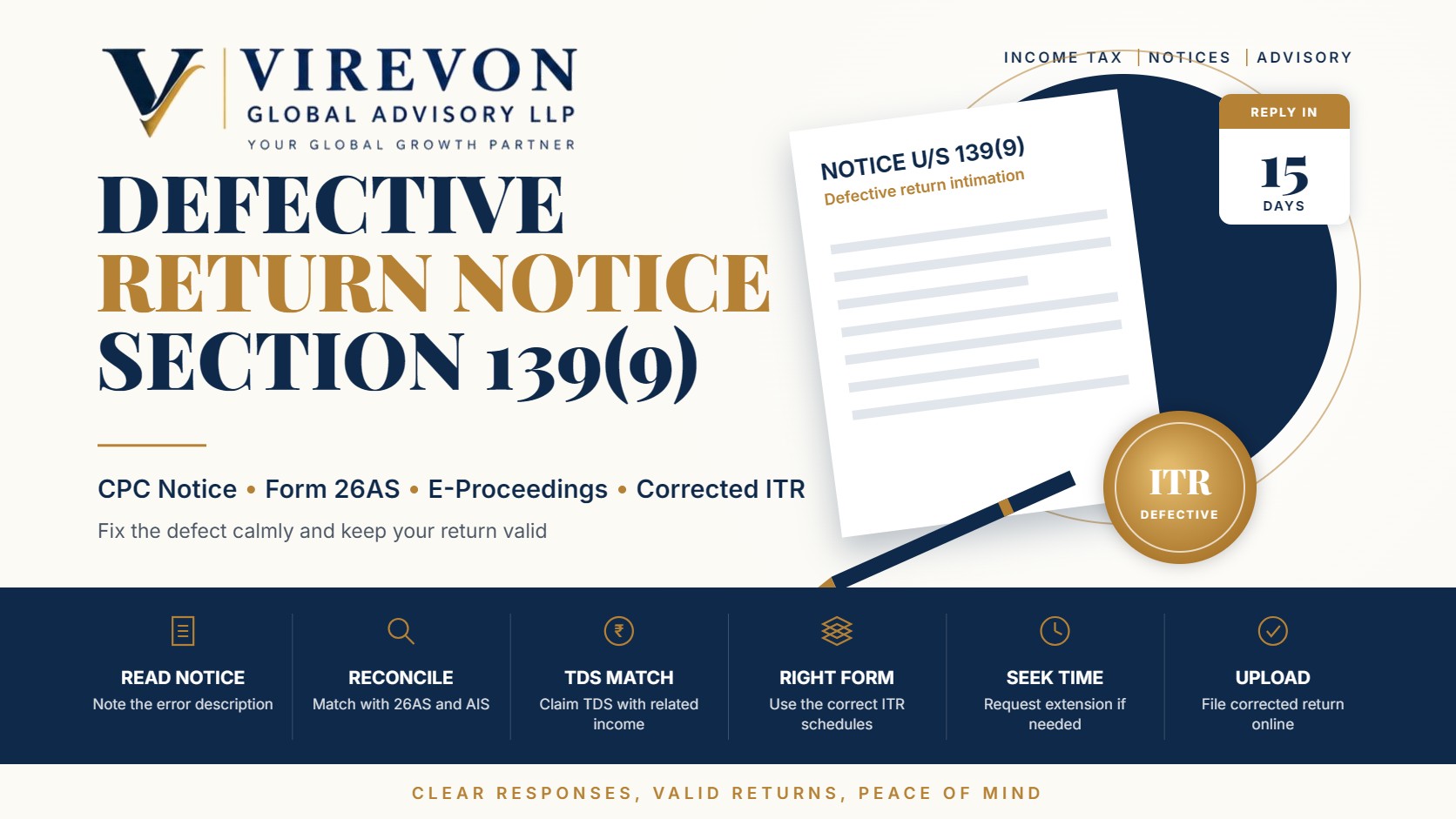
    A defective return notice under section 139(9) can look alarming when it lands in your inbox, but in most cases it is simply the Centralized Processing Centre (CPC) telling you that something in your income tax return is incomplete or inconsistent. The law gives you a short window to correct it, and once the correction is filed, the return is treated as if it had been valid from the start.

    This guide explains the common reasons returns are flagged as defective, how to read the notice, how to respond on the e-filing portal, and how to avoid the problem next year. Returns for FY 2025-26 were filed under the Income-tax Act 1961, so section 139(9) continues to govern these notices; the Income-tax Act 2025 carries the same idea forward in its section on return of income.

    Key takeaways

    • A defective return notice under section 139(9) gives you 15 days from receipt of the notice to fix the defect; you can ask for more time if you need it.
    • If the defect is not cured in time, the return can be treated as invalid, as though it was never filed, which may affect loss carry-forward, refunds and interest.
    • Most defects are technical: TDS claimed without matching income, gross receipts lower than those in Form 26AS, missing balance sheet or profit and loss details, or a name mismatch with PAN.
    • The response is filed online through e-Proceedings on the income tax portal by uploading a corrected return.
    • A careful pre-filing check against Form 26AS and AIS prevents most defect notices.

    What a defective return notice under section 139(9) means

    Section 139(9) allows the Assessing Officer (in practice, CPC Bengaluru for most returns) to treat a return as defective where essential information is missing or where the return does not match the basic requirements of the ITR form. The notice sets out the defect, the error description and what is expected from you.

    The important point is that a defective return is not the same as a tax demand. The department is not saying that you owe more tax. It is saying that the return, as filed, cannot be processed properly until the gap is fixed. If you correct it within the time allowed, the corrected return is treated as the original, filed on the original date.

    Common reasons a return is marked defective

    Most notices fall into a handful of patterns. The table below lists the ones seen most often and how they are usually resolved.

    Defect flaggedWhy it happensTypical fix
    TDS credit claimed but related income not shownSalary, interest or professional receipts appear in Form 26AS but the income head is blank or lowerReport the income under the correct head, or reduce the TDS claim to what matches
    Gross receipts lower than receipts in Form 26ASBusiness or professional turnover in the return is below the amounts on which tax was deductedReconcile and report the full receipts, explaining timing or GST differences in your working
    Tax payable shown with nil incomeComputation error or an income schedule left incompleteComplete the income schedules so that the computation is consistent
    Balance sheet or P&L not filledBusiness income declared under regular provisions without financial statement detailsFill the balance sheet and profit and loss schedules, or opt for presumptive taxation where genuinely eligible
    Name mismatch with PANName in the return differs from the PAN databaseCorrect the name or update PAN records before refiling
    Audit details missingTax audit applicable but report details not givenEnsure the audit report is uploaded and its particulars are quoted

    How to respond on the e-filing portal

    The response is simple once you have the corrected figures ready. Follow these steps:

    1. Log in to the income tax e-filing portal and open Pending Actions > e-Proceedings.
    2. Select the notice under section 139(9) and read the error description and the probable resolution given.
    3. Choose whether you agree that the return is defective. If you agree, prepare the corrected ITR in the same form (or a different form if the defect relates to the wrong form being used).
    4. Upload the corrected return against the notice, quoting the same acknowledgement details the portal prompts for.
    5. Verify the response (Aadhaar OTP, EVC or DSC, as applicable) and save the submission receipt.

    If you disagree with the defect, you can say so and give reasons. This is appropriate where the CPC has misread something, for example where income was correctly shown but under a different schedule. Keep the explanation short and factual, and attach a reconciliation where it helps.

    When you need more time

    If you cannot gather documents within 15 days, request an adjournment through the same e-Proceedings screen before the time runs out. A short, reasoned request, such as awaiting a corrected TDS statement from the deductor, is usually the best approach.

    What happens if you do not respond

    If the defect is not rectified within the period allowed, the return may be treated as invalid. The practical effects can include:

    • losing the ability to carry forward business or capital losses, since those need a valid return filed within time;
    • delay or loss of refund, because an invalid return is not processed;
    • interest for delay in filing, and a possible late fee, if a fresh return then has to be filed;
    • exposure to proceedings for non-filing if no valid return remains on record.

    Where a correction is made after the 15-day period but before any assessment is completed, the law allows the Assessing Officer to condone the delay and treat the return as valid. It is still far better to act within the window.

    A practical example

    A consultant files ITR-3 reporting professional receipts of ₹18 lakh. Form 26AS shows ₹21 lakh on which TDS under section 194J was deducted, because two clients deducted tax on invoices that the consultant booked in the next financial year. The CPC issues a defective notice citing receipts lower than those in Form 26AS.

    The fix is not necessarily to pay tax on ₹21 lakh. The consultant reconciles the two invoices, reports receipts as per the books, and claims only the TDS relating to income offered this year, carrying the balance TDS to the year in which the income is offered. The corrected return is uploaded through e-Proceedings with a short explanation. Handled this way, the return becomes valid and processing continues normally. If the return is later processed with adjustments, our guide on the section 143(1) intimation explains what to check next.

    How to avoid defect notices next year

    A few habits prevent most notices:

    • Reconcile income with Form 26AS and the Annual Information Statement (AIS) before filing, not after.
    • Match TDS claimed to the income offered in the same year, and use the TDS carry-forward option where timing differs.
    • Choose the correct ITR form for your income type; business income under regular provisions needs full balance sheet and P&L schedules.
    • Where a tax audit applies, file the audit report first and quote its details correctly. Our tax audit checklist for FY 2025-26 covers the sequence.
    • Keep the name, date of birth and bank details on the portal consistent with PAN.

    Frequently asked questions

    What is the time limit to reply to a notice under section 139(9)?

    The notice normally allows 15 days from the date of receipt. You can request an extension through e-Proceedings before the period ends.

    Do I have to pay any fee to correct a defective return?

    No fee is payable for responding to a defective return notice. Tax, if any becomes payable because of the correction, must be paid before uploading the corrected return.

    Can I file a revised return instead of responding to the notice?

    If the time for filing a revised return is still open, a revised return can also cure the issue. In most cases, responding directly to the notice is the cleaner route because it links the correction to the defect raised.

    Will a defective return notice lead to scrutiny?

    Not by itself. It is a processing issue. Once the corrected return is accepted, it is processed like any other return, although normal selection rules for scrutiny still apply.

    If you have received a defective return notice and would like help reconciling your figures and filing a clean response, we would be glad to assist.

    This article is general information based on the law as of September 2026, and is not legal or tax advice. Please check the facts of your own case with a professional before acting.

  • Section 143(1) Intimation: Understanding Adjustments and How to Respond

    Section 143(1) Intimation: Understanding Adjustments and How to Respond

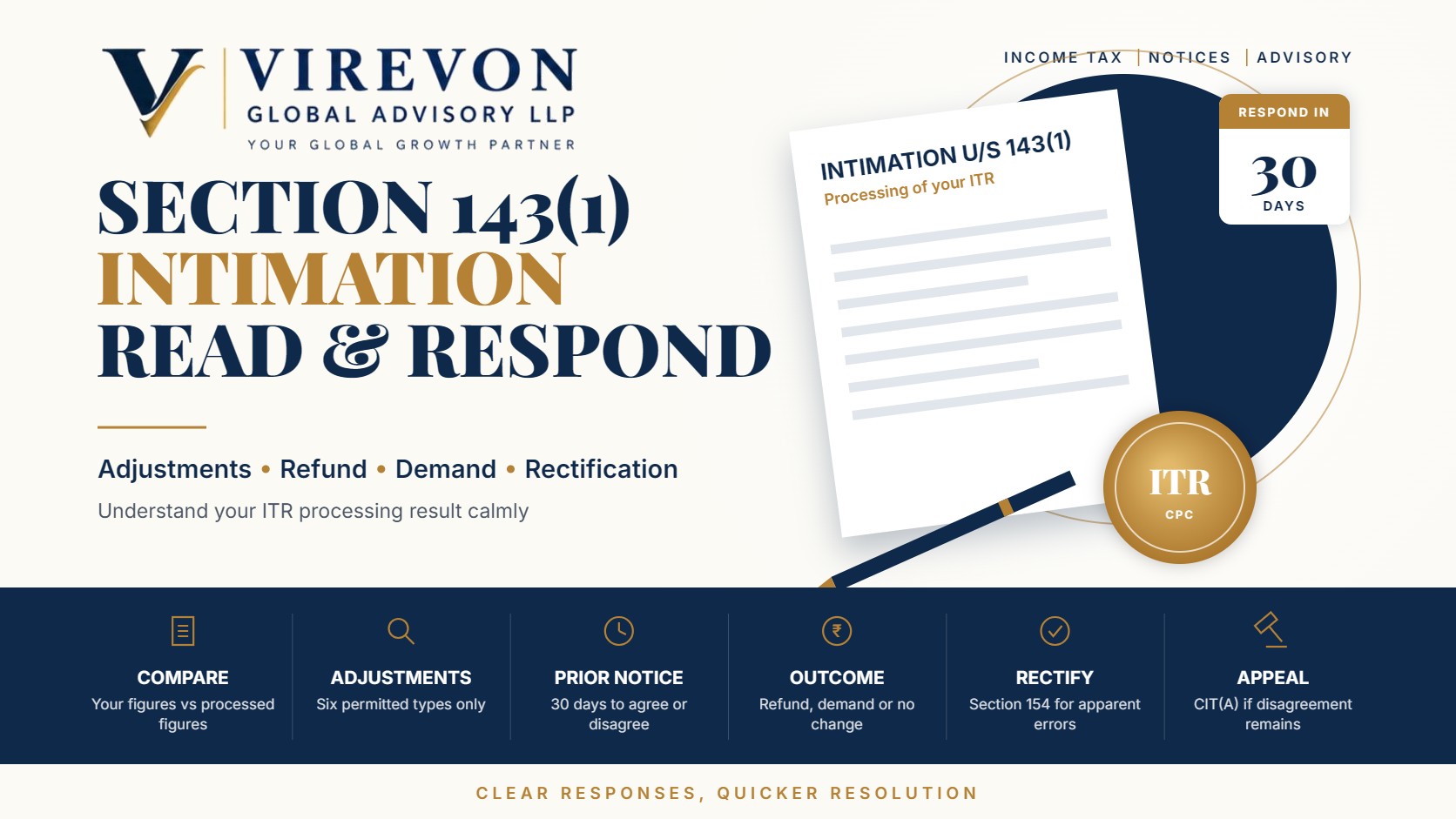
    A section 143(1) intimation is the most common communication taxpayers receive from the Income Tax Department, and in most cases it is simply confirmation that your return has been processed. It is not a scrutiny notice. The Centralised Processing Centre (CPC) compares your return with its own computation and tells you whether you get a refund, owe tax or neither.

    Where the department has made an adjustment, however, the intimation deserves careful reading. This article explains what the intimation contains, which adjustments are allowed, how to respond to a proposed adjustment and what to do if you think the processing is wrong. Returns for FY 2025-26 (AY 2026-27) are processed under section 143(1) of the Income-tax Act, 1961, so this remains fully relevant this season.

    Key takeaways

    • An intimation under section 143(1) is issued after processing your return and may show no demand, a refund or a demand.
    • Only six kinds of adjustment are allowed, such as arithmetical errors and income in Form 26AS not included in the return.
    • Before making an adjustment, CPC must give you a prior communication and 30 days to respond.
    • For a return filed in July 2026, the intimation can be issued up to 31 December 2027.
    • Errors can usually be fixed through rectification under section 154; appeals are available where the disagreement is on merits.

    What the intimation contains

    The intimation is sent by email and is available on the e-filing portal. The PDF is usually protected with your PAN in lowercase followed by your date of birth in DDMMYYYY format.

    It shows two columns: as provided by the taxpayer and as computed under section 143(1). Rows cover income under each head, deductions, tax, interest, TDS and advance tax credits, and the final result.

    ResultWhat it meansWhat to do
    No demand, no refundYour computation was acceptedKeep it on file; nothing further is needed
    RefundTax paid exceeds tax dueCheck bank account validation and track the refund
    DemandTax is payable after processingCompare line by line, then pay, respond or seek rectification

    The six permitted adjustments

    Section 143(1)(a) allows CPC to adjust returned income only for:

    1. Arithmetical errors in the return.
    2. Incorrect claims apparent from information in the return, such as a deduction claimed beyond the statutory limit.
    3. Disallowance of a loss claimed where the return for the year of loss was filed after the due date.
    4. Disallowance of expenditure or increase in income indicated in the tax audit report but not reflected in the return.
    5. Disallowance of specified deductions that require the return to be filed by the due date, where it was filed late.
    6. Addition of income appearing in Form 26AS, Form 16A or Form 16 that has not been included in the return.

    Anything outside these categories, such as a disagreement on how income should be classified, generally cannot be decided in summary processing. It is examined in a scrutiny assessment instead.

    Responding to a proposed adjustment

    Before making any adjustment, CPC sends a communication describing the proposed change. You have 30 days to respond on the e-filing portal, in the pending actions section.

    The response options are simple:

    • Agree with the adjustment, if you accept that the department’s figure is correct.
    • Disagree and give reasons, with supporting explanation where helpful.

    If you do not respond in time, CPC proceeds with the adjustment. A response is always worth making where you have a genuine explanation, because it is easier to prevent an incorrect demand than to reverse one.

    A worked example

    Meera, a salaried employee, files her return for FY 2025-26 in July 2026. Form 26AS shows fixed deposit interest of ₹48,000 from a bank, which she did not report. CPC proposes to add the interest to her income.

    On checking, Meera finds the deposit is held jointly with her mother, who is the first holder and has already offered the interest in her own return. The TDS was reported against Meera’s PAN because of a bank error.

    Meera selects disagree and explains the joint holding, with the bank certificate and her mother’s return details. She also asks the bank to correct its TDS statement. Had she not responded, the addition would have created a demand of about ₹15,000 at her 30% slab including cess.

    When you receive a demand you do not accept

    Work through these steps in order:

    1. Compare the two columns row by row and identify exactly where the difference arises.
    2. Check common causes: TDS not matching Form 26AS, a deduction not claimed in the correct schedule, advance tax paid against the wrong year, or relief under section 89 not claimed with Form 10E.
    3. Respond to the outstanding demand on the portal, stating whether you agree, partly agree or disagree.
    4. File a rectification request under section 154 where the error is apparent from the record, such as a TDS credit not given despite appearing in Form 26AS. Our guide on outstanding tax demand and rectification explains the process.
    5. File an appeal before the Commissioner (Appeals) if the disagreement is on a matter of law or fact that rectification cannot cover. Appeal time limits are short, so decide quickly.
    6. Consider a revised return if you discover a genuine omission of your own and the time to revise is still open.

    Good practices to avoid adjustments

    • Reconcile your income with Form 26AS and the Annual Information Statement before filing.
    • Report every TDS entry under the right head, even if the income is exempt.
    • Where TDS appears under your PAN in error, ask the deductor to correct it rather than ignore it.
    • For business returns, make sure disallowances reported by the tax auditor are reflected in the return.
    • File on time, as late filing affects loss carry-forward and some deductions.

    If your return is later picked for detailed examination, see our guide to the income tax scrutiny notice under section 143(2).

    Frequently asked questions

    Is a section 143(1) intimation a notice of scrutiny?

    No. It is the result of summary processing of your return. Scrutiny is a separate, detailed assessment that begins with a notice under section 143(2).

    How long does the department have to send a section 143(1) intimation?

    Nine months from the end of the financial year in which the return was filed. For a return filed in July 2026, that is 31 December 2027.

    What happens if I ignore a proposed adjustment?

    If you do not respond within 30 days, CPC proceeds with the adjustment, which may create a demand or reduce your refund.

    Can I file rectification against a section 143(1) intimation?

    Yes, for mistakes apparent from the record, such as a TDS credit not allowed or an arithmetical error. Disputes on merits may need an appeal instead.

    If you have received a section 143(1) intimation with an adjustment or demand you do not understand, our team would be glad to review it with you.

    This article is general information based on the law as of September 2026, and is not legal or tax advice. Please check the facts of your own case with a professional before acting.