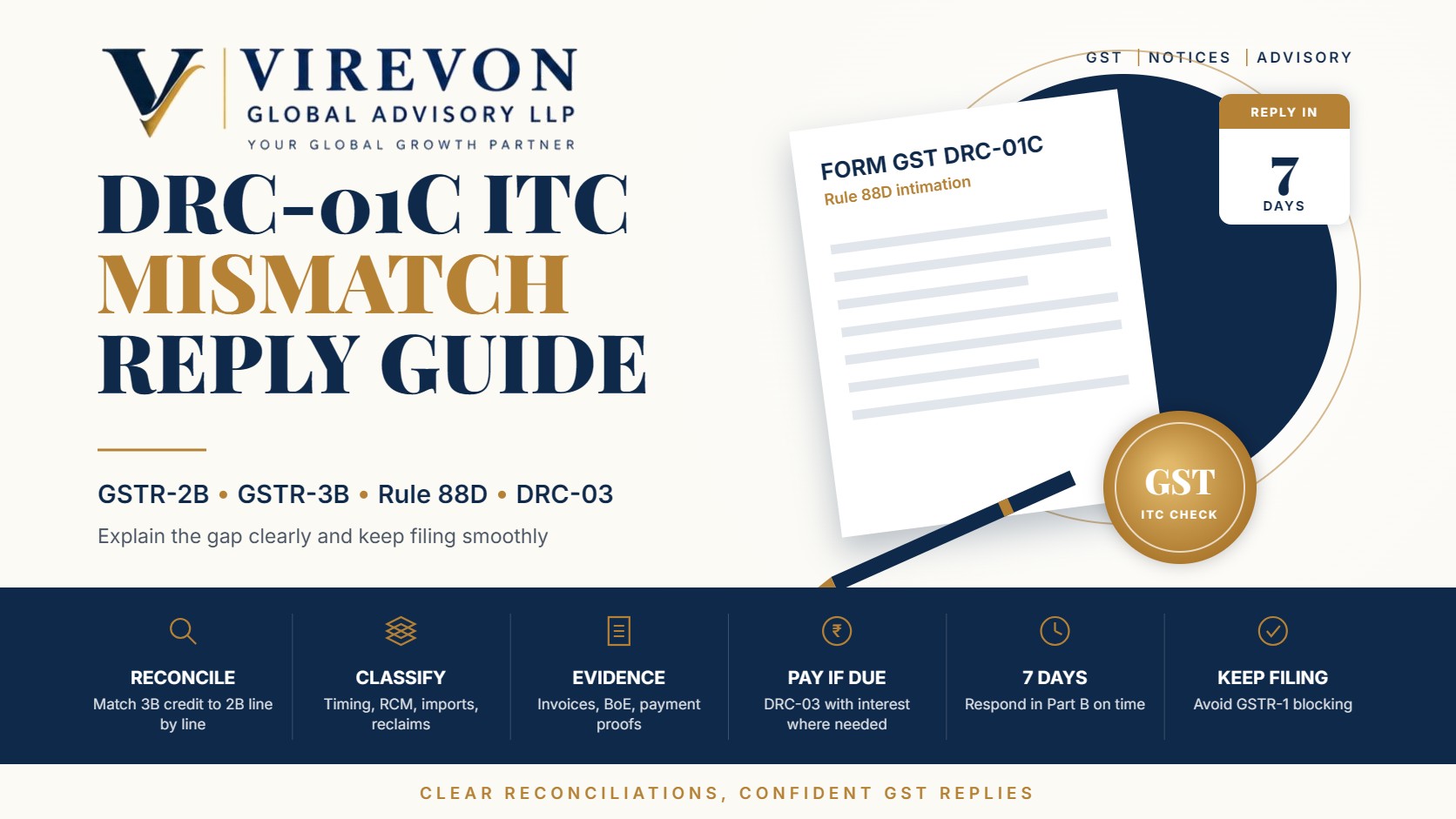
A DRC-01C intimation is the GST portal’s way of saying that the input tax credit you claimed in GSTR-3B is noticeably higher than what your GSTR-2B shows for the same period. It is an automated, early-stage alert, not a demand order, and in most cases it can be closed with a clean reconciliation and a short explanation.
The key is to respond on time. A DRC-01C that is left unanswered can stop you from filing your next GSTR-1, which affects your customers’ credit as well. This guide explains why the intimation is generated, how to work out the difference, and how to reply confidently.
Key takeaways
- DRC-01C is issued under Rule 88D of the CGST Rules, inserted by Notification No. 38/2023-Central Tax dated 4 August 2023.
- As recorded in the 50th GST Council minutes, it is generated when the excess ITC in GSTR-3B over GSTR-2B crosses both ₹25 lakh and 20%; the system parameters can be revised.
- You get seven days to respond in Part B: either pay the excess through DRC-03 or explain the difference.
- If you do neither, the portal can block filing of your next GSTR-1 or IFF.
- Most differences are genuine timing or classification gaps, so a well-documented reconciliation usually resolves the matter.
What a DRC-01C intimation actually says
The intimation is system-generated and reaches you by email and on the GST portal under the notices section. Part A shows the tax period, the ITC available as per GSTR-2B, the ITC claimed in GSTR-3B, and the difference head-wise (IGST, CGST, SGST and cess).
Part B is your response. Rule 88D gives you two routes, and you may use a combination of both:
- Pay the excess credit, with applicable interest, through Form DRC-03 and quote the ARN in Part B.
- Explain the difference, with reasons and supporting details, for the portion you believe is correctly claimed.
The intimation itself does not fix any tax liability. It is designed as a nudge so that genuine errors are corrected early, and genuine claims are placed on record before any formal proceeding.
Why the ITC in GSTR-3B can exceed GSTR-2B
GSTR-2B is a static statement built from what your suppliers report, cut off on a fixed date each month. Your GSTR-3B claim is based on your books. The two will rarely match exactly, and many differences are perfectly legitimate.
| Reason for the difference | Is the ITC valid? | What to show in Part B |
|---|---|---|
| Supplier filed GSTR-1 after the 2B cut-off; invoice appears in next month’s 2B | Usually yes (timing) | Invoice list and the later GSTR-2B period in which it appears |
| ITC on reverse charge supplies paid in cash through GSTR-3B | Yes, if RCM tax is paid | RCM liability paid, challan/3B reference, self-invoices |
| IGST on imports where Bill of Entry data reached 2B in a later period | Usually yes (timing) | Bill of Entry numbers, dates and ICEGATE status |
| ITC reversed earlier and reclaimed now (for example, after paying a supplier within 180 days) | Yes, if reversal was reported | Electronic Credit Reversal and Re-claimed Statement entries |
| Credit from an Input Service Distributor received late | Usually yes | ISD invoices and GSTR-6 details |
| Invoice rejected or kept pending in IMS, or never uploaded by the supplier | Needs review | Supplier follow-up; consider reversal or payment |
| Excess or duplicate claim, or ineligible credit | No | Pay through DRC-03 with interest |
The first five rows are the most common and are generally explainable. The last two need honest review, because they may be a real excess claim.
How to reconcile before replying to DRC-01C
A structured reconciliation makes the reply simple and credible. Work through it in this order:
- Download GSTR-2B for the period in the intimation and the two or three months after it.
- Export your purchase register for the same period, including RCM entries, imports and ISD credit.
- Match invoice by invoice, using GSTIN, invoice number and taxable value. Most accounting tools and the portal’s own comparison reports can help here.
- Bucket every unmatched item into timing, RCM, imports, reclaim, ISD or excess.
- Check later GSTR-2B periods to confirm that timing items have since appeared.
- Quantify the excess that has no explanation and decide whether to pay it.
It helps to link this exercise with your routine monthly checks. Our guide to GSTR-2B vs GSTR-3B ITC reconciliation sets out a monthly process that keeps these gaps small in the first place.
Drafting the Part B reply
The Part B text box is short, so the explanation should be crisp and factual. A practical structure looks like this:
- Summary line: total difference as per the intimation, amount explained, and amount paid (if any).
- Breakdown by reason: for example, “₹X relates to 14 invoices reflected in the GSTR-2B of the following month; ₹Y is ITC on RCM paid in cash in the same GSTR-3B.”
- Payment details: DRC-03 ARN and date for any portion you have chosen to pay.
- Documents offered: mention that invoice-wise workings and supporting documents are available and can be produced on request.
A short worked example
Suppose GSTR-2B shows ITC of ₹40 lakh and GSTR-3B shows ₹72 lakh, a gap of ₹32 lakh (80%). On reconciliation:
- ₹18 lakh appears in the next month’s GSTR-2B (late supplier filing).
- ₹9 lakh is IGST on imports where the Bill of Entry reflected in the following period.
- ₹3 lakh is RCM on legal and freight services, paid in cash.
- ₹2 lakh relates to a supplier who never uploaded the invoices.
The reply would explain ₹30 lakh with references, and the business would either obtain proper reporting from the supplier or pay the ₹2 lakh through DRC-03 with interest, quoting the ARN.
What happens if you do not respond
Rule 59(6) restricts filing of GSTR-1 or IFF where a DRC-01C intimation has not been addressed through Part B. That block affects your customers, whose GSTR-2B will not show your invoices until you file. It is also important to remember that unexplained excess credit can later be taken up through a formal show cause notice, under section 73 or 74 for earlier years, or section 74A from FY 2024-25 onwards.
If you are already at that stage, our guides on replying to a GST show cause notice and voluntary payment through DRC-03 explain the next steps.
Good habits that keep DRC-01C away
- Reconcile GSTR-2B with your books before filing every GSTR-3B, not at year-end.
- Use the Invoice Management System to accept, reject or keep pending supplier invoices deliberately.
- Keep a simple timing register of invoices claimed before they appear in GSTR-2B.
- Report reversals and reclaims correctly so the credit ledger statements support you.
- Follow up with suppliers who file late or report under the wrong GSTIN.
Frequently asked questions
Is DRC-01C a show cause notice?
No. It is an automated intimation under Rule 88D asking you to pay or explain an ITC difference. It becomes a demand only if the matter later moves to formal proceedings.
How many days do I get to reply to DRC-01C?
Rule 88D provides seven days from the date of the intimation. Replying early is always better, especially if your next GSTR-1 is due soon.
Can I partly pay and partly explain the difference?
Yes. You can pay the portion you accept through DRC-03 and explain the rest in the same Part B response, quoting the DRC-03 ARN.
What if the invoices appeared in GSTR-2B later?
Mention the later tax period and the invoice details in your reply. Timing differences of this kind are among the most common and accepted explanations.
If you have received a DRC-01C or want your monthly ITC reconciliation set up properly, our GST team will be glad to help you prepare a clear, well-documented reply.
This article is general information based on the law as of September 2026, and is not legal or tax advice. Please check the facts of your own case with a professional before acting.
Leave a Reply