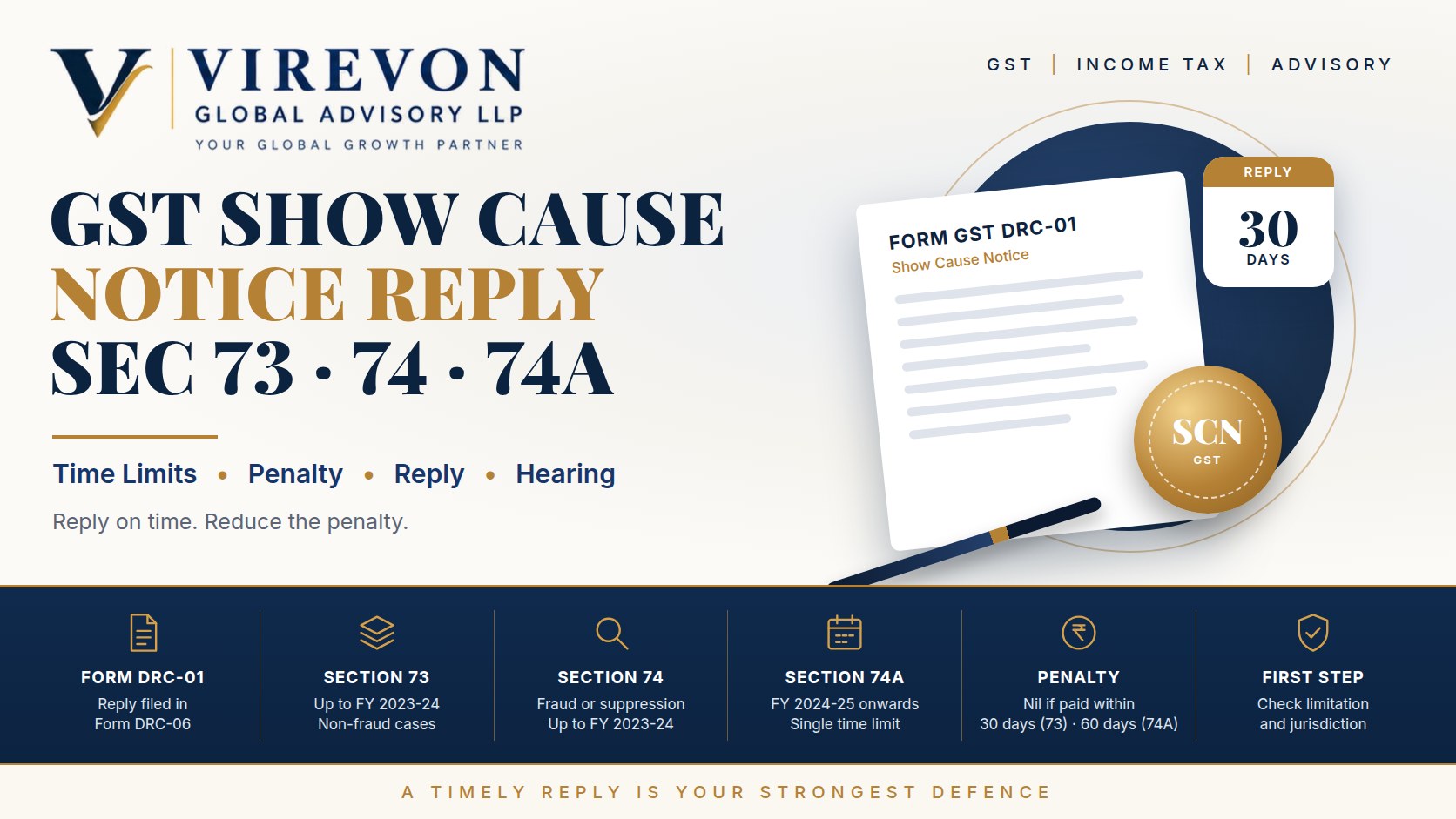
A show cause notice (SCN) in Form GST DRC-01 is the department formally saying that it believes tax has been short-paid, not paid, wrongly refunded, or that input tax credit (ITC) was wrongly availed. Which section the notice is issued under decides the time limit, the penalty, and how much you can save by acting early. This guide explains Sections 73, 74 and 74A of the CGST Act in plain terms and sets out what to do in the first week after the notice arrives.
Section 73, 74 or 74A: which one applies?
- Section 73 covers demands where there is no fraud, wilful misstatement or suppression of facts. It applies to tax periods up to FY 2023-24.
- Section 74 covers demands involving fraud, wilful misstatement or suppression of facts to evade tax. It also applies up to FY 2023-24.
- Section 74A applies from FY 2024-25 onwards and replaces both. It uses a single time limit, with different penalties depending on whether fraud or suppression is alleged.
Look at the top of the DRC-01 and the tax period it covers. A notice for FY 2024-25 citing Section 73 or 74 has cited the wrong provision, and that is worth raising in your reply.
Time limits the department must meet
- Section 73: the order must be passed within 3 years of the due date of the annual return for that year, and the SCN must be issued at least 3 months before that date.
- Section 74: the order must be passed within 5 years of the annual return due date, and the SCN at least 6 months before that date.
- Section 74A: the SCN must be issued within 42 months of the annual return due date, and the order within 12 months of the SCN (extendable by up to 6 months).
A notice or order issued after its time limit is invalid. Checking limitation is always the first step. It is also why an unusually large number of notices and orders appears near the end of each year’s window.
Penalty, and how to reduce it
The biggest saving in most SCNs comes from timing.
- Section 73 (non-fraud): no penalty if tax and interest are paid before the SCN, or within 30 days of it. Otherwise the penalty is 10% of the tax or ₹10,000, whichever is higher.
- Section 74 (fraud/suppression): penalty of 15% if paid before the SCN, 25% if paid within 30 days of the SCN, 50% if paid within 30 days of the order, and 100% otherwise.
- Section 74A: for non-fraud cases, no penalty if tax and interest are paid within 60 days of the SCN. For fraud or suppression cases, the penalty is 15% if paid before the SCN, 25% if paid within 60 days of the SCN, 50% if paid within 60 days of the order, and 100% otherwise.
Paying is not an admission that you agree. Where part of the demand is clearly correct, it often makes sense to pay that part within the window and contest the rest.
What to do in the first 7 days
- Note the reply date and the hearing date. Both are in the notice. If there is no hearing date, ask for one in writing.
- Check limitation and jurisdiction. Is the notice within time? Is the right officer issuing it? Is the correct section cited for the tax period?
- Download the attachments. The DRC-01 summary is short. The detailed grounds are usually in an attached PDF, and that is what you are replying to.
- Reconcile the numbers. Rebuild the officer’s figures from GSTR-1, GSTR-3B, GSTR-2A/2B, GSTR-9 and your books. Most demands contain at least some arithmetic or duplication errors.
- Decide pay vs contest for each item, using the penalty windows above.
- Draft and file the reply in DRC-06 with annexures, and attend the hearing.
Common grounds that succeed
- The SCN or order is time-barred or cites the wrong section for the period
- ITC was denied only because of a GSTR-2A/2B mismatch, while the invoices, payments and supplier returns support the claim
- Turnover differences caused by credit notes, advances or amendments in later months
- Non-application of mind: an order that ignores the reply, or a summary in DRC-07 that goes beyond the SCN
- No opportunity of a personal hearing before an adverse order
Received a DRC-01 or DRC-01A? Send it to us on WhatsApp. We review GST notices for businesses across Delhi NCR.
Read more: GST notice reply and representation in Delhi NCR · Appealing a GST demand order
This article is general information based on the CGST Act as amended, and is not legal advice. Check the facts of your own notice with a professional before acting.
Leave a Reply