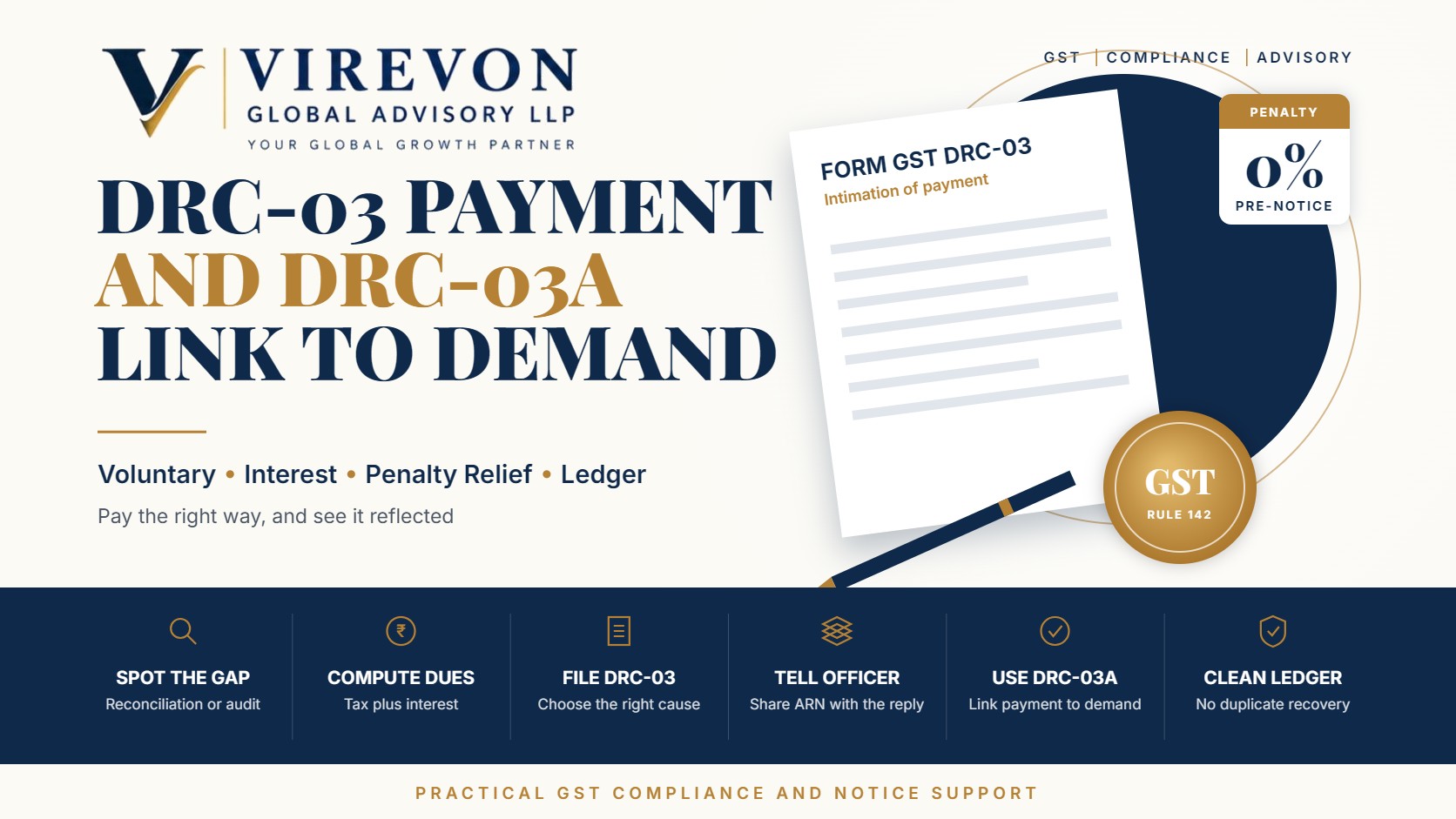
Sooner or later most GST-registered businesses find a gap: output tax missed in an earlier month, credit claimed that should have been reversed, or a difference picked up in an annual reconciliation. A DRC-03 voluntary payment is the standard way to pay such amounts outside the regular GSTR-3B, and doing it early can significantly reduce or eliminate penalty.
For years, one practical problem remained: payments made through DRC-03 often did not get adjusted against a later demand order, so the portal continued to show the demand as outstanding. Form DRC-03A, introduced in 2024, fixes that. This article explains both forms and when to use them.
Key takeaways
- DRC-03 is used to pay tax, interest and penalty voluntarily or in response to a notice, outside the regular return.
- In non-fraud cases, paying tax and interest before a show cause notice generally means no penalty for that amount.
- The cause of payment chosen in DRC-03 matters; select it carefully.
- DRC-03A, under rule 142(2B), lets you link a DRC-03 filed as ‘voluntary’ or ‘others’ to a demand order, so the liability register reflects the payment.
- Before filing an appeal, make sure pre-deposits and earlier payments are correctly linked to the demand.
When a DRC-03 voluntary payment makes sense
Typical situations include:
- Short payment found in reconciliation, for example GSTR-1 liability higher than GSTR-3B for a past month.
- Reversal of ITC that became ineligible, such as credit on blocked items under section 17(5) or unpaid supplier invoices beyond 180 days.
- Annual return differences noticed while preparing GSTR-9 or GSTR-9C.
- Response to a DRC-01A intimation, where part or all of the amount is accepted.
- Audit observations under section 65 that you agree with.
For current-period errors, it is often simpler to correct through the next GSTR-3B. DRC-03 is better where the period is closed, where interest must be shown clearly, or where the officer expects a specific payment reference.
Penalty relief for early payment
The law rewards payment before or soon after a notice. The broad position is:
| Stage of payment | Non-fraud cases | Fraud or suppression cases |
|---|---|---|
| Before show cause notice | Tax + interest; no penalty | Tax + interest + 15% penalty |
| After notice, within the window (30 days under sections 73/74; 60 days under section 74A) | Tax + interest; no penalty | Tax + interest + 25% penalty |
| After order (within the specified window) | Penalty as per order | Reduced penalty of 50% of tax where paid within the window |
Sections 73 and 74 apply up to FY 2023-24, and section 74A applies from FY 2024-25. For the notice stage, see our guide on DRC-01A pre-show cause intimations.
How to file DRC-03
- Log in and go to Services > User Services > My Applications, and choose Intimation of Voluntary Payment – DRC-03.
- Select the cause of payment: voluntary, SCN, annual return, reconciliation statement, audit, investigation, others and so on.
- Choose the section under which the payment is made and the tax period.
- Enter tax, interest, penalty and fee head-wise (IGST, CGST, SGST/UTGST, cess).
- Pay from the electronic cash ledger or, for tax, the credit ledger where allowed.
- Submit with DSC or EVC and download the acknowledgement with ARN.
Interest under section 50 should be calculated and paid along with the tax; paying only the tax leaves a gap that may be demanded later. Keep the working, showing each period, amount and days of delay.
Worked example
In May 2026, a manufacturer found that a ₹4,20,000 IGST liability on a September 2025 invoice had been reported in GSTR-1 but left out of GSTR-3B. It paid ₹4,20,000 tax through DRC-03 under the cause ‘voluntary’, together with interest at 18% a year for the period of delay, and wrote to the jurisdictional officer enclosing the ARN and interest working. Because the payment came before any notice, no penalty applied.
The problem DRC-03A solves
Suppose a payment was made through DRC-03 during an audit, and later a demand order (DRC-07) was issued for the same amount. On the portal, the demand remained ‘outstanding’ because the earlier payment was not linked to it, which sometimes led to recovery action or difficulty in filing an appeal.
With rule 142(2B) (Notification No. 12/2024-Central Tax dated 10 July 2024), taxpayers can file DRC-03A to adjust that payment against the demand. GSTN enabled the form on the portal in November 2024.
Key features of DRC-03A
- Only DRC-03 payments with cause ‘voluntary’ or ‘others’ can be linked.
- One DRC-03 can be adjusted against more than one demand, and several DRC-03s can be linked to one demand, with a separate DRC-03A for each payment.
- On submission, the electronic liability register is updated automatically.
Steps to file DRC-03A
- Go to Services > User Services > My Applications and select DRC-03A.
- Enter the ARN of the DRC-03 payment.
- Choose the demand order from the drop-down list.
- Check the auto-populated amounts, allocate the payment head-wise and submit.
Appeals and pre-deposit: link before you file
An appeal under section 107 requires payment of the admitted amount and a pre-deposit of 10% of the disputed tax, subject to the caps in the law. If part of the demand was already paid through DRC-03, link it through DRC-03A before filing APL-01, so the appeal form reflects the correct pre-deposit. Our guide on GST appeals under section 107 covers the appeal itself.
Frequently asked questions
Can I use input tax credit to pay through DRC-03?
Tax can generally be paid from the electronic credit ledger, subject to the usual utilisation rules. Interest, penalty and fees are paid in cash.
What if I chose the wrong cause of payment in DRC-03?
If the cause was ‘voluntary’ or ‘others’, you can link it to the relevant demand through DRC-03A. For other mismatches, write to the officer with the ARN and details.
Does a DRC-03 voluntary payment close the matter?
It settles the amount paid. Where a notice or proceeding is pending, inform the officer with the ARN and working so the proceedings for that amount can be concluded.
Is DRC-03A mandatory?
It is needed only where a DRC-03 payment has to be adjusted against a demand order. Without it, the demand may continue to show as outstanding.
If you need help working out a DRC-03 payment or linking earlier payments to a GST demand, our team would be happy to assist.
This article is general information based on the law as of September 2026, and is not legal or tax advice. Please check the facts of your own case with a professional before acting.
Leave a Reply