Tag: GST

  • GST on Employee Perquisites, Gifts and Recoveries: What Employers Should Know

    GST on Employee Perquisites, Gifts and Recoveries: What Employers Should Know

    Employers spend meaningful amounts on their people beyond salary: festival gifts, meals, transport, health insurance, mobile phones and club memberships. Many also recover part of these costs from employees. Each of these raises GST questions: is the benefit a taxable supply to the employee, is a recovery taxable, and can the employer claim input tax credit (ITC)? Understanding GST on employee gifts perquisites and recoveries helps you design benefits confidently and avoid avoidable disputes.

    This article explains the basic principles, the ₹50,000 gift threshold, the CBIC’s clarification on contractual perquisites, the treatment of common recoveries such as canteen charges and notice pay, and how the blocked credit rules apply. A quick reference table brings the common items together.

    Key takeaways

    • Services by an employee to the employer in the course of employment are neither goods nor services under Schedule III, so salary itself is outside GST.
    • Gifts to an employee up to ₹50,000 per year are not treated as a supply, even without consideration.
    • Perquisites provided under the employment contract are part of the employment relationship and are not treated as a separate taxable supply, as clarified in Circular No. 172/04/2022-GST.
    • ITC on items such as food, club membership, health services and leave travel is generally blocked under section 17(5), unless the facility is obligatory for the employer under a law.
    • Recoveries from employees need case-by-case review; the answer depends on the underlying arrangement, not on the label in the payroll.

    The starting point: employer and employee are related persons

    Under GST, an employer and employee are treated as related persons. Schedule I of the CGST Act deems certain supplies between related persons to be taxable even without consideration. This is why free benefits to employees are examined at all.

    Two important carve-outs reduce the practical impact:

    1. Gifts up to ₹50,000: Schedule I specifically states that gifts not exceeding ₹50,000 in value in a financial year by an employer to an employee are not treated as a supply of goods or services.
    2. Contractual perquisites: the CBIC has clarified that perquisites provided by the employer to the employee in terms of the contractual agreement are in lieu of the services provided by the employee in the course of employment, and are not subject to GST.

    Together, these mean that most routine benefits written into appointment letters or HR policies are not taxed as separate supplies to employees.

    Gifts to employees in practice

    A gift is something given without consideration and not as an entitlement under the employment contract. Festival hampers, anniversary presents and one-off rewards typically fall in this category.

    • If the total value of gifts to an employee in a financial year stays within ₹50,000, no GST is payable on the gift as an outward supply.
    • If it exceeds ₹50,000, the gift may be treated as a supply and GST may apply on its value.
    • Separately, ITC on goods given as gifts is blocked under section 17(5), regardless of value. So the employer usually pays GST on the purchase and cannot claim credit.

    Maintaining an employee-wise gift register helps show that the threshold has not been crossed.

    Perquisites and blocked credits

    Many perquisites fall within section 17(5), which blocks ITC on specified items. The proviso allows credit where the employer is obligated under any law to provide the facility. The blocked list is explained in detail in our guide on blocked credits under section 17(5).

    BenefitGST on the benefit to employeeITC for the employer
    Food and canteenGenerally not taxed if a contractual perkBlocked, unless obligatory under a law (for example, a statutory canteen)
    Health insurance and medical servicesNot taxed if contractualBlocked, unless obligatory under a law
    Club and fitness membershipsNot taxed if contractualBlocked
    Leave or home travel concessionsNot taxed if contractualBlocked
    Employee transport (cabs, buses)Not taxed if contractualDepends on the nature of service and vehicle rules; review carefully
    Laptops, mobiles used for workBusiness use, not a perkGenerally available if used for business
    Festival giftsNot a supply up to ₹50,000 a yearBlocked

    The distinction between a business tool and a personal benefit matters. A laptop issued for work is a business input; a smartphone given as a personal reward is closer to a gift.

    Recoveries from employees

    Employers often recover part of the cost of a benefit from employees. Common examples include:

    • Canteen charges: where the employer recovers part of the food cost and does not retain any margin, various rulings have taken the view that GST is not payable on the recovered amount, particularly where the employer has not claimed ITC on the canteen service. The facts, including who the caterer bills and whether the employer is making its own supply, need careful review.
    • Transport recoveries: similar reasoning applies; if the employer merely passes on part of the cost of a facility forming part of the employment arrangement, a separate supply is often not intended. Documentation is key.
    • Notice pay: amounts recovered when an employee leaves without serving notice have been widely viewed as compensation for breach rather than consideration for a service, in line with the CBIC’s clarification on liquidated damages and similar payments in Circular No. 178/10/2022-GST. Confirm the position with reference to your contract terms.
    • Asset buy-back and damage recovery: selling an old laptop to an employee is a sale of goods and may attract GST at the applicable rate; recovery for damage should be examined on its facts.

    Record the basis of each recovery in the HR policy and payroll so that the GST treatment is consistent across the year.

    Designing benefits with GST in mind

    1. Put benefits in writing: list perquisites in appointment letters or a benefits policy so they are clearly contractual.
    2. Separate gifts from entitlements: track gifts per employee against the ₹50,000 limit.
    3. Map ITC eligibility: review each benefit against section 17(5) and reverse credit where blocked.
    4. Check statutory obligations: where a law requires you to provide a canteen, crèche or medical facility, the ITC proviso may apply.
    5. Review with payroll changes: salary restructuring under the labour codes is a good moment to revisit benefits; see our note on new labour codes and payroll.
    6. Keep supporting documents: policies, caterer contracts and recovery workings are what an officer will ask for during an audit.

    Frequently asked questions

    Is GST payable on Diwali gifts to employees?

    Not if the total gifts to an employee in the financial year do not exceed ₹50,000. However, the employer generally cannot claim ITC on the gifts purchased.

    Are perquisites under the employment contract taxable under GST?

    The CBIC has clarified that perquisites provided under the contractual agreement are not subject to GST as a separate supply to the employee.

    Can an employer claim ITC on canteen services?

    Generally not, because food and beverages are blocked credits, unless providing the canteen is obligatory under a law applicable to the employer.

    Is notice pay recovered from an employee taxable?

    It is widely treated as not taxable, being compensation for breach rather than consideration for a service, but review the contract and current clarifications for your case.

    If you would like a quick GST review of your employee benefits and recovery policies, our GST team would be happy to help.

    This article is general information based on the law as of September 2026, and is not legal or tax advice. Please check the facts of your own case with a professional before acting.

  • Export of Services under GST: Conditions, Place of Supply and Zero-Rating

    Export of Services under GST: Conditions, Place of Supply and Zero-Rating

    India’s service exporters, from software developers and design studios to consultants and back-office providers, benefit from a simple principle under GST: exports are zero-rated. Export of services GST treatment means no tax is effectively borne on the export, and credits on inputs can be refunded. But a supply counts as an export only when specific conditions are met, and the place of supply rules decide much of the outcome.

    This guide explains the conditions, the place of supply framework, the important change for intermediaries from 30 March 2026, and the two routes to zero-rating.

    Key takeaways

    • A supply is an export of services only if all five conditions in section 2(6) of the IGST Act are met.
    • The place of supply must be outside India; for most services this is the location of the recipient.
    • From 30 March 2026, intermediary services follow the default rule, so Indian intermediaries serving foreign clients can now qualify as exporters.
    • Exporters can supply under a letter of undertaking (LUT) without paying IGST and claim refund of unused credit, or pay IGST and claim a refund of that tax.
    • Receiving payment in convertible foreign exchange (or in rupees where RBI permits) is essential, and documentation should link each receipt to the invoice.

    The five conditions for export of services

    A supply of services qualifies as an export only when:

    1. the supplier is located in India;
    2. the recipient is located outside India;
    3. the place of supply is outside India;
    4. payment is received by the supplier in convertible foreign exchange, or in Indian rupees wherever permitted by the RBI; and
    5. the supplier and recipient are not merely establishments of a distinct person, such as an Indian branch and its foreign head office.

    If any one condition fails, the supply is treated as a domestic taxable supply, usually attracting IGST at the applicable rate. Services to a foreign subsidiary or parent that is a separate legal entity can qualify, while services by an Indian branch to its own foreign head office generally cannot.

    Place of supply: where most questions arise

    For cross-border services, place of supply is decided by section 13 of the IGST Act. The default rule is the location of the recipient, which makes most B2B services to foreign clients exports. The exceptions are the ones to watch:

    Type of servicePlace of supplyTypical outcome for a foreign client
    Most professional, IT and consulting servicesLocation of recipientExport, if other conditions are met
    Services on goods physically made available in India, such as repairs or testingWhere the service is performedGenerally not an export, subject to specific carve-outs
    Services to individuals requiring physical presence in IndiaWhere performedNot an export
    Services related to immovable property in IndiaLocation of the propertyNot an export
    Event-related services held in IndiaWhere the event is heldNot an export
    Intermediary services (from 30 March 2026)Location of recipientExport, if other conditions are met
    Hiring of means of transport up to one monthLocation of supplierNot an export

    When a service mixes elements, look at the main nature of the supply and document the reasoning in the contract and invoice description.

    The intermediary change in 2026

    For years, section 13(8)(b) deemed the place of supply of intermediary services to be the supplier’s location. Indian agents who arranged supplies between foreign parties, such as sourcing agents and sales support providers, therefore could not treat their commission as an export, which led to extensive litigation.

    The Finance Act 2026 omitted this clause with effect from 30 March 2026. Intermediary services now follow the default recipient-location rule. Two practical effects follow:

    • Indian intermediaries serving foreign principals can treat those services as exports from that date, subject to the other conditions, and file an LUT to supply without IGST.
    • Indian businesses receiving intermediary services from abroad now generally pay IGST under reverse charge on the import of those services.

    The change operates prospectively, so disputes for earlier periods are decided under the earlier law.

    Zero-rating: LUT or IGST with refund

    Exports are zero-rated supplies under section 16 of the IGST Act, and exporters can choose between two routes:

    • Under LUT: file a letter of undertaking in Form GST RFD-11 for the financial year, export without paying IGST, and claim refund of accumulated input tax credit.
    • On payment of IGST: charge and pay IGST on the export, then claim a refund of the IGST paid.

    Most service exporters prefer the LUT route because it avoids blocking cash in tax. Remember to renew the LUT before the start of each financial year and quote it on export invoices.

    Refund of unutilised credit is claimed in Form GST RFD-01 with a statement of export invoices and foreign exchange receipts. Our guide to GST refunds for exporters walks through the refund process and documents.

    Worked example

    A Noida software firm bills a US client USD 20,000 for development work in August, under a valid LUT. The client is located in the US, the service is not performance-based in India, and payment arrives in US dollars through a bank channel.

    1. All five conditions are met, so the supply is an export of services.
    2. The invoice shows zero IGST with the LUT reference and the note supply meant for export under LUT without payment of IGST.
    3. The firm reports the export in GSTR-1 and GSTR-3B.
    4. Input credit on its cloud hosting, rent and professional fees accumulates and can be claimed as refund in RFD-01, supported by the bank realisation record.

    Documentation checklist

    • Contract or engagement letter showing the foreign recipient and nature of service.
    • Export invoice with LUT reference, currency and exchange rate.
    • Foreign inward remittance certificates or bank advices linking receipts to invoices.
    • Evidence of the recipient’s location, such as registration documents or addresses.
    • LUT acknowledgement for the relevant financial year.
    • A reconciliation of export turnover in GSTR-1, GSTR-3B and the books.

    Frequently asked questions

    Is GST charged on export of services?

    Export of services is zero-rated. Under an LUT, no IGST is charged; alternatively IGST can be paid and refunded.

    Can payment in Indian rupees count for export of services?

    Only where the RBI permits rupee receipts for the transaction. Otherwise, payment must be received in convertible foreign exchange.

    Are intermediary services now treated as exports?

    From 30 March 2026, the place of supply for intermediary services is the recipient’s location, so services to foreign recipients can qualify as exports if the other conditions are met.

    Are services to my foreign group company an export?

    It can be, if the foreign entity is a separate legal person and not merely an establishment of the same person, and the other conditions are satisfied.

    If you export services and want certainty on place of supply, LUT filing or refunds, our GST team would be glad to help.

    This article is general information based on the law as of September 2026, and is not legal or tax advice. Please check the facts of your own case with a professional before acting.

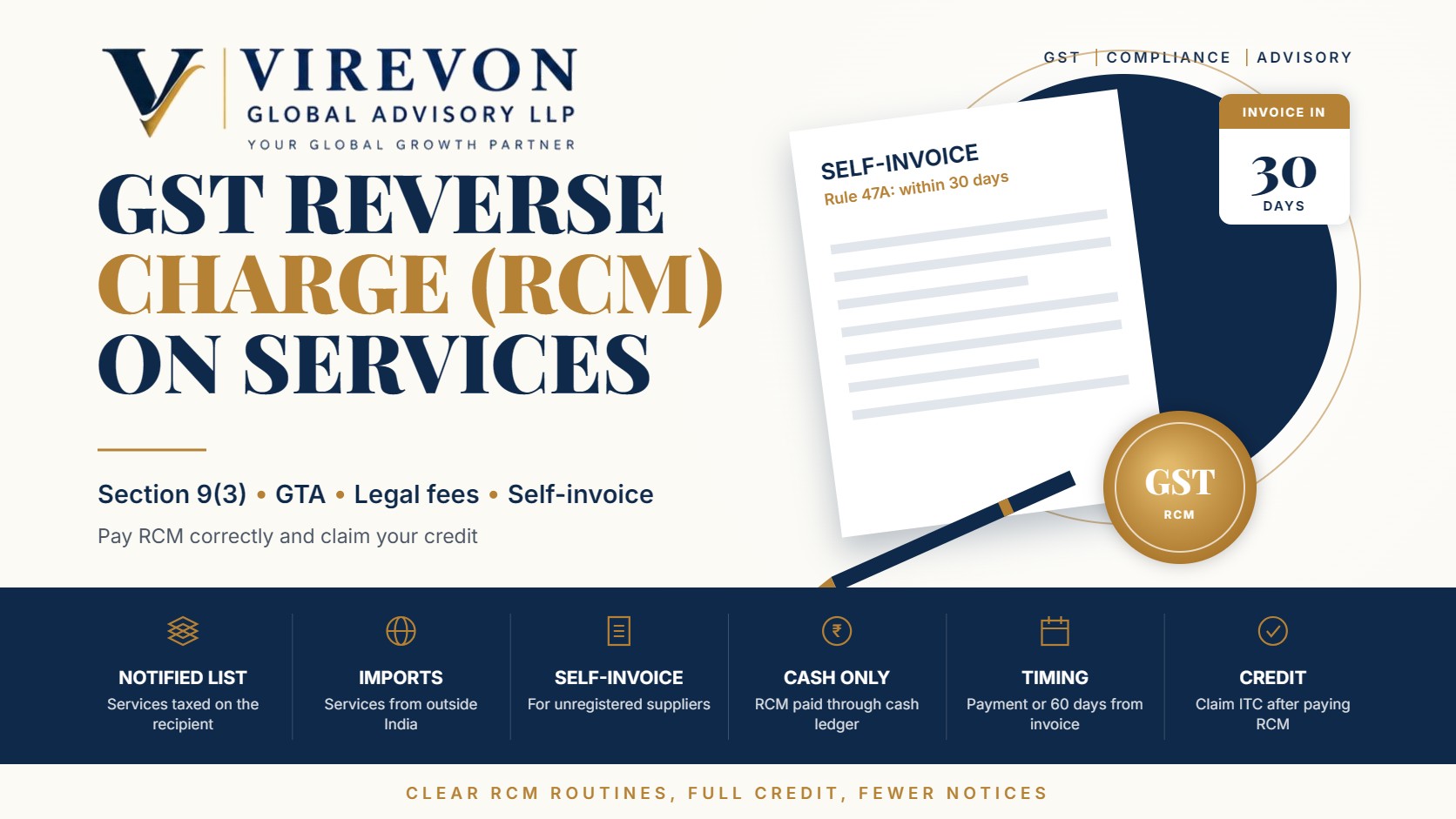
  • Reverse Charge Mechanism (RCM) under GST: Services Covered and Compliance Steps

    Reverse Charge Mechanism (RCM) under GST: Services Covered and Compliance Steps

    Under GST, the supplier normally charges and pays tax. The GST reverse charge mechanism (RCM) flips this for certain supplies: the recipient pays the tax directly to the government. For businesses, RCM is easy to miss because the supplier’s invoice may show no GST at all, yet the liability still exists and often surfaces later in audits and notices.

    The good news is that, for most regular taxpayers, RCM is cash-flow neutral: the tax paid under reverse charge is usually available as input tax credit. This guide explains which services attract RCM, how the timing and self-invoicing rules work, and a simple monthly routine.

    Key takeaways

    • RCM on services arises from the notified list under section 9(3), from section 9(4) for specified supplies by unregistered persons, and on import of services.
    • Common RCM services include goods transport agency services, legal services by advocates, director services, security services from non-corporate suppliers, sponsorship and renting of commercial property by unregistered landlords.
    • Tax under RCM must be paid in cash through the electronic cash ledger, not from input tax credit.
    • When the supplier is unregistered, the recipient issues a self-invoice within 30 days of receiving the supply.
    • Credit of RCM tax is available in the same return period once paid, subject to the usual conditions.

    Services commonly covered by GST reverse charge

    The list of services notified under section 9(3) is long, but these entries affect most businesses:

    ServiceSupplierRecipient liable (broadly)
    Goods transport agency (GTA), where GTA has not opted for forward chargeGTAFactories, companies, firms, registered persons and other specified recipients
    Legal servicesIndividual advocate or firm of advocatesBusiness entity with turnover above the exemption limit
    Services as directorDirector of a company or body corporateThe company or body corporate
    Security services (supply of security personnel)Person other than a body corporateRegistered persons, excluding composition taxpayers and some others
    Sponsorship servicesAny personBody corporate or partnership firm
    Insurance agent and recovery agent servicesAgentInsurance company, bank or NBFC
    Renting of commercial propertyUnregistered personRegistered person, excluding composition taxpayers
    Import of servicesPerson outside IndiaRecipient in India (non-business recipients are dealt with separately)

    The exact conditions for each entry, including exclusions, are in the notification, so check the precise wording before concluding for an unusual case.

    A note on GTA and commercial rent

    For GTA services, the transporter may opt to pay GST under forward charge by filing the prescribed declaration; otherwise the recipient pays at 5% under RCM. After GST 2.0, a GTA choosing forward charge can opt for 5% without credit or 18% with credit. Always ask transporters which option they have taken, and keep their declaration on file.

    RCM on commercial property rented from an unregistered landlord applies from 10 October 2024. Composition taxpayers were excluded from this entry from 16 January 2025.

    When the tax is payable: time of supply

    For services under reverse charge, the time of supply is broadly the earlier of:

    1. the date of payment to the supplier; or
    2. the date immediately after 60 days from the date of the supplier’s invoice.

    If neither can be determined, the date of entry in the recipient’s books applies. For imports of services from associated enterprises, special timing rules apply. In practice, this means an unpaid legal fee invoice still creates RCM liability once 60 days pass.

    Self-invoice, payment voucher and returns

    The documentation depends on whether the supplier is registered.

    • Registered supplier: the supplier issues its invoice mentioning that tax is payable on reverse charge. The recipient pays the tax and reports it.
    • Unregistered supplier: the recipient issues a self-invoice. Rule 47A requires this within 30 days from the date of receipt of the supply. The recipient also issues a payment voucher when paying the supplier.
    • Import of services: the recipient pays IGST under reverse charge; a self-invoice is generally prepared for the record.

    In the returns, RCM liability is reported in GSTR-3B under inward supplies liable to reverse charge, paid in cash, and the credit is claimed in the input tax credit section of the same return where eligible. Registered suppliers’ RCM invoices also appear in GSTR-2B, which helps with reconciliation.

    Worked example

    A Delhi-based private limited company receives the following in August:

    1. Freight of ₹40,000 from a GTA that has not opted for forward charge: RCM at 5% is ₹2,000.
    2. Legal fees of ₹1,00,000 from an individual advocate: RCM at 18% is ₹18,000.
    3. Sitting fees of ₹50,000 paid to an independent director: RCM at 18% is ₹9,000.

    The company pays ₹29,000 in cash through GSTR-3B for August and, subject to conditions, claims the same ₹29,000 as input tax credit in that return. The net cash cost is only the time value of money, but missing the payment would create interest and possible penalty exposure, along with a lost credit if time limits pass.

    Common mistakes and how to avoid them

    • Not flagging RCM vendors in the vendor master: tag advocates, directors, GTAs and unregistered landlords so the accounting system reminds you every time.
    • Using credit to pay RCM: RCM must be paid in cash; ITC can be used only for forward charge liability.
    • Missing self-invoices: without a self-invoice within 30 days, the credit claim can be questioned.
    • Assuming small amounts are exempt: there is no general small-value exemption for notified RCM services, though specific exemptions exist for some cases.
    • Blocked credits: RCM paid on items blocked under section 17(5) is still payable, but no credit is available. Our guide to blocked credits under section 17(5) explains which ones.

    A simple monthly RCM routine

    1. Run a report of payments and invoices from RCM-tagged vendors.
    2. Identify imports of services from foreign vendor invoices and card statements, including software subscriptions.
    3. Raise self-invoices for unregistered suppliers within 30 days.
    4. Compute RCM liability using the time of supply rules and deposit in cash with GSTR-3B.
    5. Claim credit in the same return where eligible, and reconcile with GSTR-2B for registered suppliers.
    6. Keep a yearly RCM register for the annual return and any departmental audit.

    For a wider view of credit matching, see our note on GSTR-2B vs GSTR-3B ITC reconciliation.

    Frequently asked questions

    Can I pay GST under reverse charge using input tax credit?

    No. Tax payable under reverse charge must be paid in cash through the electronic cash ledger. The tax so paid can then be claimed as credit, subject to conditions.

    Is RCM applicable on legal fees paid to an advocate?

    Yes, for legal services by an individual advocate or a firm of advocates to a business entity, subject to the exemption for smaller entities in the notification.

    Do I need to issue a self-invoice for RCM?

    Yes, when the supplier is unregistered. Rule 47A requires the self-invoice within 30 days from receipt of the supply.

    Is GST payable under RCM on foreign software subscriptions?

    For a registered business importing services, IGST is generally payable under reverse charge on the value of the imported service.

    If you would like a quick review of your RCM vendors and credits, our GST team would be happy to help you set up a clean monthly routine.

    This article is general information based on the law as of September 2026, and is not legal or tax advice. Please check the facts of your own case with a professional before acting.

  • GST Composition Scheme: Who Should Opt In, Limits and Conditions

    GST Composition Scheme: Who Should Opt In, Limits and Conditions

    For many small traders, manufacturers and restaurants, the GST composition scheme offers a simpler way to comply: tax is paid at a low flat rate on turnover, returns are fewer, and record-keeping is lighter. But it is not the right choice for everyone, because composition dealers cannot claim input tax credit, cannot charge GST to customers and cannot make inter-State sales.

    This guide explains the eligibility limits, rates and conditions for FY 2026-27, the compliance calendar, and a simple way to decide whether opting in makes sense for your business.

    Key takeaways

    • Businesses supplying goods (and restaurants) with aggregate turnover up to ₹1.5 crore in the preceding year can opt in; the limit is ₹75 lakh in specified special category States.
    • Service providers and mixed suppliers can use a separate scheme under section 10(2A) with a ₹50 lakh limit and a 6% rate.
    • Rates are 1% for manufacturers and traders and 5% for restaurant services (split equally between CGST and SGST).
    • Composition dealers file CMP-08 quarterly (by the 18th after each quarter) and GSTR-4 annually (by 30 June).
    • No input tax credit, no GST on invoices and no inter-State outward supplies; opting in is best when customers are mainly consumers and margins are stable.

    Who is eligible for the GST composition scheme

    A registered person whose aggregate turnover in the preceding financial year did not exceed ₹1.5 crore can opt for composition under section 10(1) of the CGST Act. In Arunachal Pradesh, Manipur, Meghalaya, Mizoram, Nagaland, Sikkim, Tripura and Uttarakhand, the limit is ₹75 lakh.

    Aggregate turnover is computed on an all-India PAN basis, so all registrations under the same PAN must opt in together.

    Who cannot opt in

    • Suppliers making inter-State outward supplies.
    • Casual and non-resident taxable persons.
    • Manufacturers of certain notified goods, such as ice cream, pan masala, tobacco products and aerated waters.
    • Persons supplying services through e-commerce operators that collect tax at source.
    • Businesses supplying goods not taxable under GST, such as alcoholic liquor for human consumption.

    Composition dealers can make intra-State supplies of goods through e-commerce operators, subject to the platform’s enrolment conditions.

    Rates under the composition scheme

    CategoryRate (CGST + SGST)Turnover base
    Manufacturers1% (0.5% + 0.5%)Turnover in the State
    Traders1% (0.5% + 0.5%)Turnover of taxable supplies
    Restaurants (not serving alcohol)5% (2.5% + 2.5%)Turnover in the State
    Service providers under section 10(2A)6% (3% + 3%)Turnover in the State

    The composition rates were not changed by the GST 2.0 rate rationalisation that took effect on 22 September 2025. However, the normal scheme became cheaper for many goods moving to 5%, which changes the comparison for some businesses. Our GST 2.0 rate structure checklist explains the new slabs.

    Conditions to keep in mind

    • Bill of supply, not tax invoice, with the words “composition taxable person, not eligible to collect tax on supplies”.
    • Display “composition taxable person” on the signboard at the principal place of business and on each additional place.
    • No input tax credit on purchases, including capital goods.
    • Reverse charge: tax on inward supplies liable to reverse charge must be paid at normal rates.
    • Purchases from unregistered persons: where reverse charge applies, it is payable in addition to composition tax.
    • Crossing the limit: once turnover in the year crosses the threshold, the option lapses and the business must move to the regular scheme and file the prescribed intimation.

    Compliance calendar

    FormPurposeDue date
    CMP-02Opt in (existing registered persons)Before the start of the financial year
    CMP-08Quarterly statement and tax payment18th of the month after the quarter
    GSTR-4Annual return30 June after the financial year
    CMP-04Withdraw from the scheme voluntarilyWhen opting out

    New applicants can opt for composition directly in the registration application. Existing registrants who wish to opt in for FY 2027-28 should file CMP-02 before 1 April 2027 and also deal with input tax credit on stock held on the day before opting in.

    Should you opt in? A simple test

    Composition works well when:

    • Your customers are mainly consumers or unregistered businesses who cannot use your GST anyway.
    • Your value addition is high relative to purchases, so losing input tax credit costs little.
    • You sell only within your State.
    • You want lighter compliance and have limited accounting support.

    It is usually unsuitable when:

    • Your customers are GST-registered businesses that want input tax credit on your invoices.
    • You buy large amounts of taxed inputs or capital goods.
    • You plan to sell to other States or grow beyond the limit soon.

    A worked comparison

    A trader in Uttar Pradesh sells ₹1 crore of goods a year, all at 5% GST, mostly to walk-in customers, and buys goods worth ₹80 lakh on which ₹4 lakh GST is paid.

    • Regular scheme: output tax ₹5 lakh less input tax credit ₹4 lakh = ₹1 lakh net GST (recovered from customers through prices).
    • Composition: 1% of ₹1 crore = ₹1 lakh, paid from the trader’s own margin, and the ₹4 lakh input GST becomes a cost.

    Here the regular scheme is clearly better because input credit is high. For a trader with higher margins, lower-rate inputs or goods at 18%, the answer can reverse. Run the numbers for your own mix before deciding.

    Frequently asked questions

    What is the turnover limit for the GST composition scheme in FY 2026-27?

    ₹1.5 crore of aggregate turnover in the preceding year for goods suppliers and restaurants (₹75 lakh in specified States), and ₹50 lakh for service providers under section 10(2A).

    Can a composition dealer sell to other States?

    No. Inter-State outward supplies are not allowed, although inter-State purchases are permitted.

    Can a composition dealer claim input tax credit?

    No. Input tax credit is not available on purchases while in the composition scheme.

    When is GSTR-4 due?

    GSTR-4, the annual return for composition dealers, is due by 30 June following the end of the financial year.

    If you are weighing the composition scheme against regular GST for your business, we would be happy to run the numbers with you and handle the switch smoothly.

    This article is general information based on the law as of September 2026, and is not legal or tax advice. Please check the facts of your own case with a professional before acting.
  • GST for E-commerce Sellers: Registration, TCS under Section 52 and Reconciliation

    GST for E-commerce Sellers: Registration, TCS under Section 52 and Reconciliation

    Selling on marketplaces opens up a national market almost overnight, but it also brings a distinct set of GST rules. GST for e-commerce sellers covers when you must register, how the marketplace collects tax at source (TCS) under section 52 of the CGST Act, and how to reconcile your returns with the data that the platform reports about you.

    This guide explains each of these in plain terms and offers a monthly routine that keeps your GSTR-1, GSTR-3B and TCS credits in agreement.

    Key takeaways

    • Sellers supplying through an e-commerce operator that collects TCS are generally required to register compulsorily, but there are notified exemptions for small service providers and, since 1 October 2023, for small intra-State goods sellers meeting conditions.
    • The operator collects TCS at 0.5% of the net value of taxable supplies (0.25% CGST + 0.25% SGST, or 0.5% IGST), a rate in force since 10 July 2024.
    • The operator files GSTR-8 by the 10th of the following month; the seller’s TCS then appears on the portal and, once accepted, credits the electronic cash ledger.
    • For notified services such as restaurant delivery and cab rides, the operator itself pays GST under section 9(5), and no TCS applies on those supplies.
    • Monthly reconciliation of orders, returns, settlements and GSTR-8 data is the single best protection against mismatch notices.

    Registration: who needs it

    Under section 24 of the CGST Act, a person supplying goods or services through an e-commerce operator required to collect tax at source must register, regardless of turnover. Over time, the government has relaxed this for smaller sellers:

    • Service providers selling through an operator are exempt from registration if their aggregate turnover stays within the normal threshold (₹20 lakh, or ₹10 lakh in special category States).
    • Goods sellers with turnover within the threshold can sell through operators without registration since 1 October 2023, but only for intra-State supplies and subject to conditions such as having a PAN and declaring the State of supply on the platform.
    • Composition taxpayers can supply goods through operators within their State, subject to the platform’s enrolment process, but services through TCS-collecting platforms remain restricted.

    If you plan to sell across States, you will generally need GST registration from the outset.

    How TCS under section 52 works

    Every operator that collects consideration on behalf of sellers must collect TCS on the net value of taxable supplies made through it in a month.

    ElementDetail
    Who collectsThe e-commerce operator
    Rate0.5% (0.25% CGST + 0.25% SGST for intra-State; 0.5% IGST for inter-State)
    BaseTaxable supplies made through the operator, less supplies returned in the month, excluding GST and section 9(5) supplies
    Deposit and returnBy the 10th of the following month, in Form GSTR-8
    Seller’s creditShown on the portal; accepted credit goes to the electronic cash ledger

    A simple example

    In a month, a seller makes taxable sales of ₹10,00,000 (excluding GST) through a marketplace, and customers return goods worth ₹1,00,000. Net value is ₹9,00,000. TCS at 0.5% is ₹4,500. The operator deducts this from the seller’s settlement and reports it in GSTR-8. The seller accepts the TCS entry on the portal and uses it from the cash ledger to pay GST in GSTR-3B, or claims a refund of any excess.

    Section 9(5) services

    For restaurant services delivered through apps, passenger transport through ride-hailing apps, certain accommodation services and some other notified services, the operator is treated as the supplier and pays GST itself. After GST 2.0 (effective 22 September 2025), check the current rates and notified list, including for local delivery services, since the rate structure moved to 5%, 18% and 40%.

    Reconciliation: where most problems start

    The operator’s GSTR-8 tells the tax department, month by month, how much you sold through that platform. If your GSTR-1 shows a different figure, you may receive a notice. A clean monthly reconciliation should compare:

    1. Order report from the seller panel (gross sales, cancellations, returns).
    2. Invoices issued by you or on your behalf through the platform’s tax invoice feature.
    3. GSTR-1: B2C supplies reported with the operator’s GSTIN in the relevant table, and B2B invoices where the buyer gave a GSTIN.
    4. GSTR-8 data shown in your TCS credit section.
    5. Settlement reports: payouts after commission, shipping fees, TCS and TDS.

    Differences usually come from returns in a later month, cancelled orders, timing of invoices near month-end, or wrong State or GSTIN mapping in multi-warehouse setups. Fix them in the next return and keep a reconciliation working file for every month.

    Remember also that the platform’s commission and fees are services to you, with GST charged by the operator. That GST is eligible input tax credit if it appears in your GSTR-2B, so include it in your GSTR-2B vs GSTR-3B reconciliation.

    Multi-State warehouses and income-tax TDS

    Marketplaces that store your stock in fulfilment centres in other States create a place-of-business issue: each State where your goods are stored generally requires registration or an additional place of business. Plan your registrations before enabling multi-State fulfilment.

    Separately from GST TCS, the operator also deducts income-tax TDS on the gross amount of sales (the provision earlier known as section 194-O, now in section 393 of the Income-tax Act 2025). Track both, as they appear in different places: GST TCS on the GST portal, and income-tax TDS in your annual tax credit statement.

    Monthly checklist for online sellers

    • Download order, return and settlement reports from every platform by the 3rd.
    • Reconcile sales with invoices and prepare GSTR-1 data platform-wise.
    • Accept or query TCS entries on the portal after GSTR-8 is filed.
    • Review input tax credit on platform fees in GSTR-2B.
    • File GSTR-3B using TCS credit in the cash ledger where helpful.
    • Keep month-wise reconciliation working papers for audits and notices; our guide on GSTR-1 vs GSTR-3B mismatch notices explains why this matters.

    Frequently asked questions

    Do I need GST registration to sell on a marketplace?

    Generally yes, unless you fall within a notified exemption, such as a small service provider within the threshold, or a small goods seller making only intra-State supplies and meeting the prescribed conditions.

    What is the current TCS rate under section 52?

    0.5% of the net value of taxable supplies, split as 0.25% CGST and 0.25% SGST, or 0.5% IGST for inter-State supplies, effective from 10 July 2024.

    How do I use the TCS collected by the marketplace?

    Once the operator files GSTR-8, accept the TCS entries on the GST portal. The amount is credited to your electronic cash ledger and can be used to pay GST or claimed as a refund.

    Is TCS charged on returned goods?

    TCS is charged on the net value, so goods returned during the month reduce the base on which TCS is collected.

    If you sell through one or more marketplaces and want your GST returns, TCS credits and settlements reconciled every month, we would be glad to help.

    This article is general information based on the law as of September 2026, and is not legal or tax advice. Please check the facts of your own case with a professional before acting.
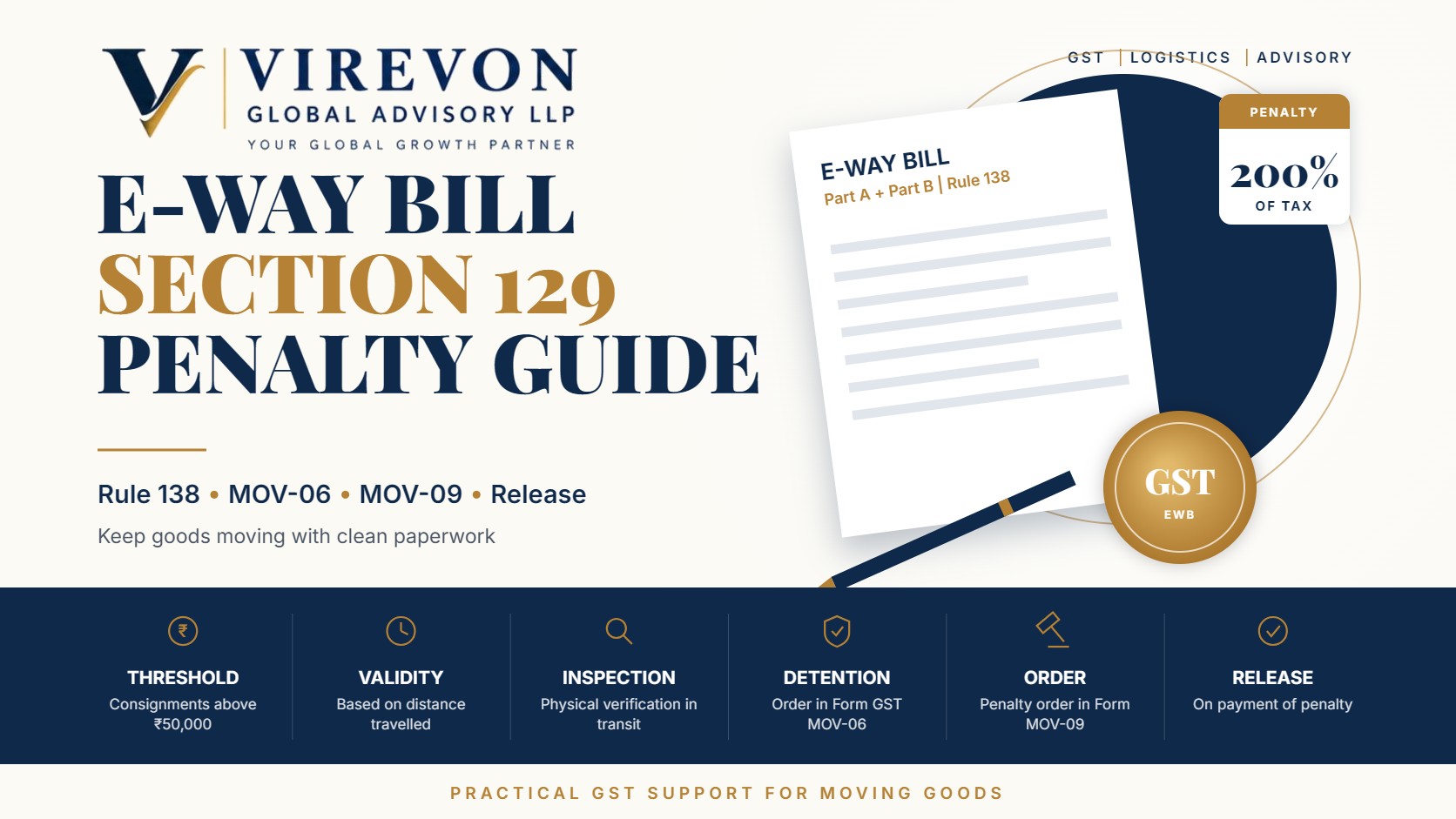
  • E-Way Bill Rules and Section 129 Penalty: A Business Guide

    E-Way Bill Rules and Section 129 Penalty: A Business Guide

    For businesses that move goods, the e-way bill is as important as the invoice. A missing, expired or incorrect e-way bill can lead to goods being stopped on the road, and the e-way bill penalty under section 129 of the CGST Act is steep: in most taxable cases it equals 200% of the tax payable on the goods. The good news is that almost every detention is preventable with simple controls.

    This guide covers when an e-way bill is required, how validity works, what happens when goods are detained, how the penalty is calculated, and how to respond calmly if a vehicle is intercepted.

    Key takeaways

    • An e-way bill is generally required for movement of goods where the consignment value exceeds ₹50,000, subject to exemptions and State-specific rules for intra-State movement.
    • Validity depends on distance: for normal cargo, one day for every 200 km or part of it.
    • Under section 129, goods and the vehicle can be detained for contravention of the Act or rules during transit; release requires payment of penalty.
    • Where the owner comes forward, penalty for taxable goods is 200% of the tax payable; otherwise it is the higher of 50% of the value of goods or 200% of the tax.
    • If the penalty is not paid within 15 days of the order, the goods or conveyance can be sold or disposed of under the amended provisions.

    When an e-way bill is required

    Rule 138 of the CGST Rules requires an e-way bill before movement of goods of consignment value above ₹50,000, whether the movement is for a supply, for reasons other than supply (such as job work or branch transfer), or because of an inward supply from an unregistered person. Consignment value is the invoice value including GST but excluding the value of exempt supplies billed together.

    The e-way bill has two parts:

    • Part A: invoice details, GSTINs of supplier and recipient, place of delivery, HSN and value.
    • Part B: transporter and vehicle details.

    Part B can be left blank where goods move up to 50 km within the same State from the supplier’s place of business to a transporter’s premises, but it must be updated before onward movement. Certain goods are exempt from the e-way bill requirement, and some States prescribe their own thresholds for intra-State movement, so check the rules that apply to your routes.

    Validity and extension

    Type of cargoValidity
    Normal cargo1 day for every 200 km or part thereof
    Over-dimensional cargo1 day for every 20 km or part thereof

    Validity can be extended by the generator before expiry (within the window allowed by the portal) where goods could not reach on time for genuine reasons, such as a breakdown. The portal also limits how old the underlying document can be and how long an e-way bill can be extended overall, so generate e-way bills promptly after invoicing.

    Recent system changes

    GSTN announced changes during 2026, including making ship-to GSTIN details mandatory in bill-to/ship-to cases and a facility to close an e-way bill on delivery. These were subsequently placed on hold. Keep an eye on the advisories on the e-way bill portal and make sure your ERP or API integration is ready when a revised date is announced.

    When goods can be detained under section 129

    Proper officers can intercept vehicles and verify documents and goods in transit. Common reasons for detention include:

    • No e-way bill, or an e-way bill that has expired.
    • Goods in the vehicle not matching the invoice or e-way bill (quantity, description or HSN).
    • Vehicle number in Part B different from the vehicle carrying the goods, without an update.
    • Movement without a valid invoice or delivery challan.

    Minor, clerical errors such as a small spelling mistake in a name, an error in the pin code where the address is otherwise correct, or a one-digit mistake in the document number have been clarified by CBIC as not warranting proceedings under section 129; a small general penalty may be levied instead. Keep that distinction in mind when discussing a mismatch with the officer.

    How the section 129 penalty is calculated

    Section 129 was substantially amended with effect from 1 January 2022. Tax and penalty are no longer separate; the penalty is the release amount.

    SituationTaxable goodsExempt goods
    Owner of goods comes forward200% of tax payable2% of value of goods or ₹25,000, whichever is lower
    Owner does not come forwardHigher of 50% of value of goods or 200% of tax payable5% of value of goods or ₹25,000, whichever is lower

    Worked example: goods worth ₹4,00,000 at 18% GST are detained because the e-way bill expired. Tax payable is ₹72,000. If the owner comes forward, the penalty is ₹1,44,000. If the owner does not, it is the higher of ₹2,00,000 (50% of value) and ₹1,44,000, so ₹2,00,000.

    Goods can also be released against a bond and security equal to the penalty, where permitted.

    The procedure and timelines

    1. Verification: the officer records a statement of the person in charge of the vehicle and conducts physical verification, recorded in the MOV series of forms.
    2. Detention order: if a contravention is found, a detention order is issued in Form GST MOV-06.
    3. Notice: a notice in Form GST MOV-07 is issued within 7 days of detention, specifying the penalty proposed.
    4. Order: the officer must pass an order in Form GST MOV-09 within 7 days of service of the notice, after giving an opportunity of being heard.
    5. Payment and release: once the penalty is paid, goods are released and proceedings are concluded.
    6. Non-payment: if the penalty is not paid within 15 days of the order, the goods or conveyance may be sold or disposed of.

    If you pay under protest and believe the detention was wrong, an appeal under section 107 remains available. Our guide on GST demand orders and appeals explains the process.

    What to do if your vehicle is stopped

    • Stay calm and cooperative: ask the driver to share the invoice, e-way bill and transport documents promptly.
    • Send documents immediately: many detentions end at verification when correct documents are produced quickly.
    • Check the reason in writing: request copies of the physical verification report and MOV-06.
    • Reply to MOV-07 on time with evidence, such as proof that the e-way bill expired due to a breakdown or that the mismatch is clerical.
    • Decide on release: weigh the cost of detention against paying under protest and appealing.

    Checklist to prevent detention

    1. Generate the e-way bill after the invoice and before goods leave.
    2. Match HSN, quantity and value on invoice, e-way bill and packing list.
    3. Update Part B whenever the vehicle changes, including at transhipment.
    4. Track expiry dates for long routes and extend before expiry.
    5. Train drivers to carry the invoice or its reference and the e-way bill number.
    6. Where e-invoicing applies, generate e-way bills from the e-invoice data; our e-invoicing applicability guide explains the linkage.

    Frequently asked questions

    Is an e-way bill needed for goods below ₹50,000?

    Generally not for inter-State movement, but some movements, such as certain job work consignments and handicraft goods, need one regardless of value, and States may set their own intra-State rules.

    Can the penalty under section 129 be reduced?

    The rates are fixed by the section. However, clerical errors should not lead to section 129 proceedings at all, and a well-supported reply to MOV-07 can result in the proceedings being dropped.

    How long can the officer take to pass the order?

    The order in MOV-09 must be passed within seven days of service of the MOV-07 notice.

    Can I appeal after paying the penalty?

    Yes. Paying to secure release does not take away your right to appeal against the order under section 107.

    If your goods have been detained or you want a quick review of your e-way bill controls, our GST team is ready to help you respond with confidence.

    This article is general information based on the law as of September 2026, and is not legal or tax advice. Please check the facts of your own case with a professional before acting.

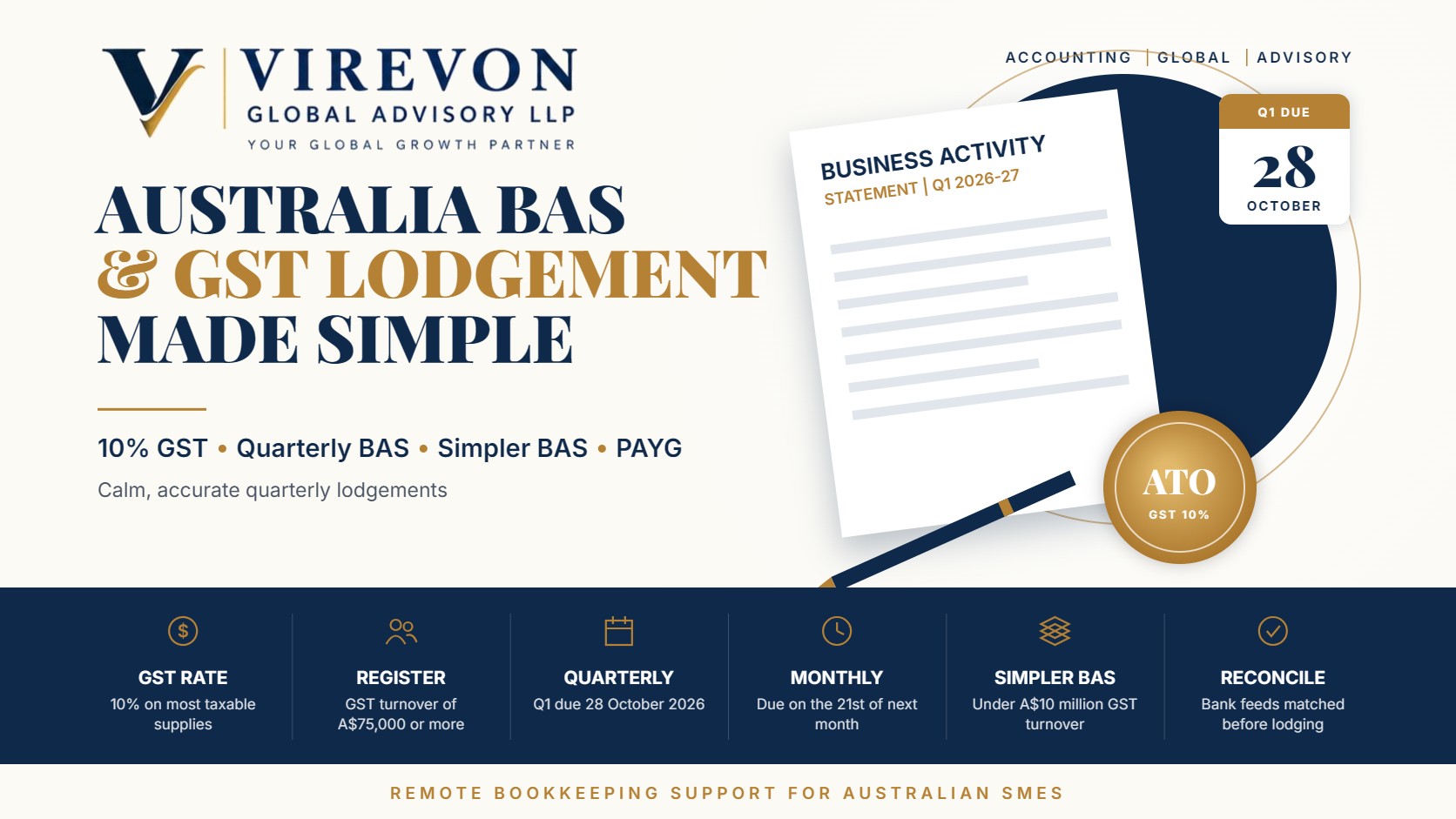
  • Australia BAS Lodgement and GST: A Bookkeeping Guide for Small Businesses

    Australia BAS Lodgement and GST: A Bookkeeping Guide for Small Businesses

    For most Australian small businesses, Australia BAS lodgement is the most regular conversation they have with the Australian Taxation Office (ATO). The business activity statement (BAS) brings together GST, PAYG withholding, PAYG instalments and a few other taxes in one form, usually every quarter. Done well, it becomes a routine that takes a few hours; done in a rush, it becomes a source of penalties and stress.

    This guide explains how GST works for small businesses, the 2026-27 lodgement calendar, the labels you will actually use, and a simple bookkeeping routine that keeps each BAS accurate and on time.

    Key takeaways

    • A business must register for GST once its GST turnover reaches A$75,000 (A$150,000 for non-profits); taxi and ride-sourcing drivers must register regardless of turnover.
    • GST is charged at 10% on most taxable sales, and GST credits can be claimed on business purchases supported by valid tax invoices.
    • Most small businesses lodge quarterly; Q1 of 2026-27 (July to September) is due on 28 October 2026, with a later date for online lodgement through a registered agent or eligible channel.
    • Businesses with GST turnover under A$10 million can use Simpler BAS, which reports only total sales, GST on sales and GST on purchases.
    • General interest charge incurred from 1 July 2025 is no longer tax-deductible, which makes on-time lodgement and payment even more valuable.

    GST basics for small businesses

    Goods and services tax is a broad-based tax of 10% on most goods, services and other items sold or consumed in Australia. Once registered, a business charges GST on its taxable sales, claims credits for the GST included in its business purchases, and pays (or is refunded) the difference through the BAS.

    Some supplies are GST-free, such as most basic food, some health and education services and exports. Others are input-taxed, such as residential rent and most financial supplies, where no GST is charged and related credits generally cannot be claimed. Correct tax codes in your accounting software are the foundation of an accurate BAS.

    To claim a GST credit on a purchase of more than A$82.50 (including GST), you need a valid tax invoice. For smaller purchases, other records such as a receipt are usually enough.

    Australia BAS lodgement due dates for 2026-27

    Quarterly lodgers follow a fixed calendar. The standard dates below apply to self-lodgers; businesses that lodge online or through a registered tax or BAS agent may receive additional time under the ATO’s lodgement arrangements, so confirm your own dates in Online services for business or with your agent.

    QuarterPeriodStandard due date
    Q1July to September 202628 October 2026
    Q2October to December 202628 February 2027 (moves to the next business day if it falls on a weekend)
    Q3January to March 202728 April 2027
    Q4April to June 202728 July 2027

    Monthly lodgement is compulsory for businesses with GST turnover of A$20 million or more, and some smaller businesses choose it to improve cash flow from refunds. Monthly BAS is due on the 21st of the following month. Very small voluntarily registered businesses may be eligible to report GST annually.

    The BAS labels you will actually use

    A full BAS can look intimidating, but most small businesses use only a handful of fields.

    GST section

    • G1 Total sales: all sales including GST.
    • 1A GST on sales: GST you owe.
    • 1B GST on purchases: GST credits you are claiming.

    Under Simpler BAS, available where GST turnover is under A$10 million, these three are all you report for GST. Your software still needs correct tax codes behind the scenes, but the form itself is shorter.

    PAYG sections

    • W1 and W2: total salary and wages paid, and the amount withheld from them. Businesses using Single Touch Payroll will find these figures in their payroll reports.
    • T7 or 5A: PAYG instalments towards the business’s own income tax, if the ATO has placed the business in the instalment system.

    Other labels, such as fuel tax credits, fringe benefits tax instalments and wine equalisation tax, apply only to specific businesses.

    A quarterly bookkeeping routine that works

    A calm BAS starts well before the due date. We suggest a simple rhythm:

    1. Weekly: code bank feed transactions in your software and attach receipts or tax invoices.
    2. Month-end: reconcile every bank account, credit card and payment gateway, and review unusual tax codes.
    3. Quarter-end, week one: run the GST reconciliation report, check that GST on sales matches your invoicing system and that capital purchases are coded correctly.
    4. Quarter-end, week two: reconcile payroll figures to Single Touch Payroll, review PAYG instalments and prepare the draft BAS.
    5. Before lodgement: compare the draft with the prior quarter; investigate large movements rather than lodging and hoping.
    6. After lodgement: pay by the due date and file the lodged BAS and working papers together.

    Our comparison of QuickBooks Online vs Xero covers how both platforms prepare BAS drafts directly from coded transactions.

    Cash or accruals: choosing a GST accounting method

    Businesses with GST turnover below A$10 million can generally account for GST on a cash basis, reporting GST only when payment is received or made. Larger businesses use the accruals basis, reporting GST when an invoice is issued or received.

    The cash basis often suits service businesses with slow-paying customers, because GST is not paid to the ATO before the customer pays. The accruals basis gives an earlier claim for credits on purchases. Whichever method you choose, make sure your software settings match what you have told the ATO.

    Common BAS errors and how to avoid them

    • Claiming GST on non-registered suppliers’ invoices: check the supplier’s ABN and GST status for larger purchases.
    • Coding private or input-taxed expenses as taxable: bank fees, residential rent and personal expenses carry no GST credit.
    • Missing capital purchases: vehicles and equipment should be reported correctly; a coding slip here can distort a quarter significantly.
    • Payroll mismatches: W1 and W2 should agree with Single Touch Payroll records.
    • Late lodgement: failure-to-lodge penalties and general interest charge add up, and GIC is no longer deductible.

    Errors in a lodged BAS can usually be corrected in a later BAS within set limits, or by revising the original statement. The ATO is generally supportive of businesses that correct mistakes promptly.

    Frequently asked questions

    When is the BAS for July to September 2026 due?

    The standard due date for Q1 of 2026-27 is 28 October 2026. Businesses lodging online or through a registered agent may have a later date, so confirm yours in ATO online services.

    Do I have to register for GST if my turnover is under A$75,000?

    Generally no, unless you provide taxi or ride-sourcing services. You can still register voluntarily, which lets you claim GST credits but means you must charge GST and lodge a BAS.

    What is Simpler BAS?

    It is the default GST reporting method for businesses with GST turnover under A$10 million. You report only total sales, GST on sales and GST on purchases.

    Can an offshore bookkeeper prepare my BAS?

    An offshore team can do the bookkeeping, reconciliations and draft BAS working papers. Lodgement on behalf of clients for a fee must be done by a registered tax or BAS agent, or by the business itself.

    If you would like reliable remote bookkeeping and BAS-ready working papers for your Australian business, we would be glad to help you set up a smooth quarterly routine.

    This article is general information based on the law as of September 2026, and is not legal or tax advice. Please check the facts of your own case with a professional before acting.
  • Singapore Company Compliance: GST at 9%, ACRA Annual Return and Form C-S

    Singapore Company Compliance: GST at 9%, ACRA Annual Return and Form C-S

    A Singapore private company has three main regulators to keep happy each year: IRAS for GST and income tax, and ACRA for corporate filings. None of the obligations is difficult on its own, but they run on different clocks. A single calendar for Singapore GST and ACRA filing is the easiest way to stay on time and avoid late penalties.

    This guide is written for founders and finance teams, including Indian groups with a Singapore holding or trading company. It covers GST at 9%, the AGM and annual return, estimated chargeable income (ECI), Form C-S and the YA 2026 corporate income tax rebate.

    Key takeaways

    • The GST rate has been 9% since 1 January 2024; registration is compulsory once taxable turnover exceeds S$1 million (on a retrospective or prospective basis).
    • GST returns are generally quarterly, due one month after the end of each accounting period.
    • A private company holds its AGM within six months and files its annual return with ACRA within seven months of the financial year end.
    • ECI is due within three months of the year end, unless waived; Form C-S or C-S (Lite) is due by 30 November.
    • For YA 2026, companies receive a corporate income tax rebate of 50%, capped at S$40,000, with a minimum cash grant of S$2,000 for eligible employers.

    GST at 9%: registration and returns

    Registration is required when taxable supplies exceed S$1 million in the past 12 months, or are expected to exceed S$1 million in the next 12 months. Businesses below the threshold can register voluntarily, which can help recover GST on costs, but must stay registered for at least two years.

    Key points for registered businesses:

    • Charge 9% on standard-rated supplies; exports of goods and international services are generally zero-rated
    • File GST F5 returns, usually quarterly, within one month of the period end
    • Keep records for at least five years
    • Imported services and low-value goods may require reverse charge or overseas vendor registration rules, depending on the business

    IRAS is also phasing in InvoiceNow, a Peppol-based e-invoicing network, for GST-registered businesses, starting with new voluntary registrants. If you are registering now, check whether the requirement applies to you.

    ACRA: AGM and annual return

    For a non-listed private company, the Companies Act sets two linked deadlines:

    ObligationDeadline
    Hold AGM (or pass resolutions in writing instead)Within 6 months after financial year end
    File annual return with ACRAWithin 7 months after financial year end

    Private companies can dispense with holding an AGM if they send financial statements to members within five months of the year end, and a qualifying private company can also be exempted in other circumstances. The annual return is filed on BizFile+ and generally includes financial statements, in XBRL format for many companies.

    Audit exemption for small companies

    A private company qualifies as a small company, and is exempt from statutory audit, if it meets at least two of three criteria for the past two financial years:

    • Total annual revenue of S$10 million or less
    • Total assets of S$10 million or less
    • 50 or fewer employees

    For groups, the test applies at group level. Unaudited financial statements must still comply with Singapore Financial Reporting Standards.

    Income tax: ECI and Form C-S

    Estimated chargeable income

    ECI is an early estimate of taxable income, due within three months of the financial year end. A company need not file ECI if its revenue is S$5 million or less and its ECI is nil for the year.

    Choosing the right return

    FormWho can use it
    Form C-S (Lite)Revenue of S$200,000 or below, meeting conditions
    Form C-SRevenue of S$5 million or below, meeting conditions
    Form CAll other companies

    Conditions include being Singapore-incorporated, taxed at the 17% rate, and not claiming certain specified items such as group relief or foreign tax credit. All returns are e-filed on myTax Portal by 30 November of the year of assessment.

    Worked example: YA 2026 tax for a small company

    A company with a 31 December 2025 year end has chargeable income of S$300,000 for YA 2026. It is not in its first three years, so partial tax exemption applies.

    StepAmount (S$)
    Chargeable income300,000
    Exempt: 75% of first 10,0007,500
    Exempt: 50% of next 190,00095,000
    Taxable income197,500
    Tax at 17%33,575
    Less 50% rebate (within cap)16,787.50
    Tax payable16,787.50

    If the company received the S$2,000 cash grant earlier in the year, that amount is deducted from the rebate it receives, so the total benefit remains within the rules.

    A simple annual calendar (31 December year end)

    • By 31 March: file ECI (or confirm waiver applies)
    • By 30 April, 31 July, 31 October, 31 January: file quarterly GST returns (subject to your assigned periods)
    • By 30 June: hold AGM or circulate financial statements
    • By 31 July: file annual return with ACRA
    • By 30 November: file Form C-S, C-S (Lite) or Form C

    If your Singapore company is owned from India, remember the Indian side too, including overseas investment reporting; our guide to overseas direct investment rules explains those obligations. The IRAS website is the best official reference for current rates and forms.

    Frequently asked questions

    What is the GST rate in Singapore?

    9%, in effect since 1 January 2024. Registration is compulsory once taxable turnover exceeds S$1 million.

    When is the ACRA annual return due?

    For a non-listed private company, within seven months after the financial year end, with the AGM due within six months.

    Who can file Form C-S?

    Singapore-incorporated companies with revenue of S$5 million or below that meet the conditions. Form C-S (Lite) is for revenue of S$200,000 or below.

    What is the corporate income tax rebate for YA 2026?

    50% of tax payable, capped at S$40,000, including a minimum S$2,000 cash grant for companies that employed at least one local employee in 2025.

    If you run a Singapore company and want one team to handle bookkeeping, GST returns and annual filings, we would be glad to help you set up a smooth calendar.

    This article is general information based on the law as of September 2026, and is not legal or tax advice. Please check the facts of your own case with a professional before acting.
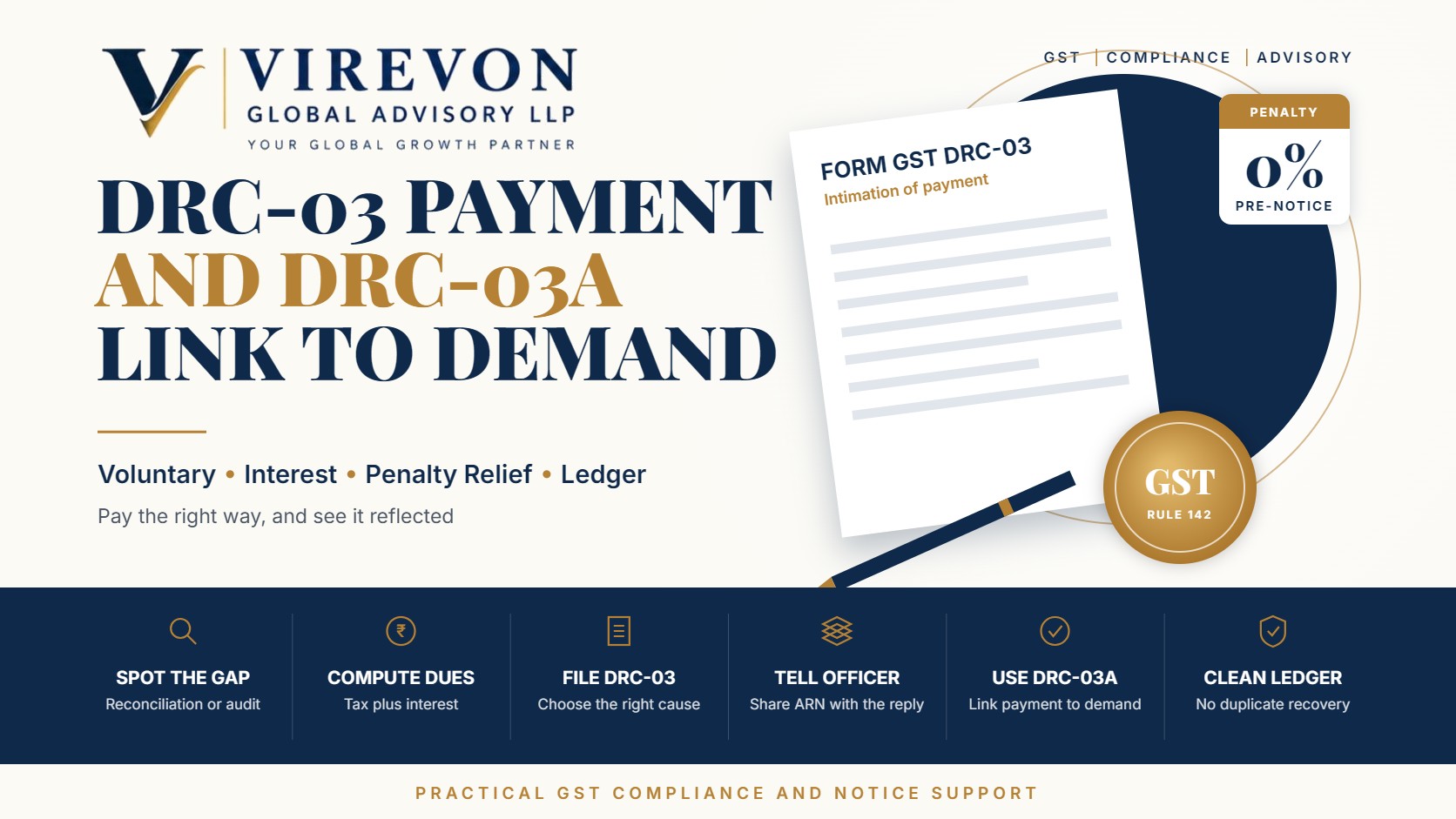
  • DRC-03 Voluntary Payment in GST: When to Use It and How DRC-03A Links Payments to Demands

    DRC-03 Voluntary Payment in GST: When to Use It and How DRC-03A Links Payments to Demands

    Sooner or later most GST-registered businesses find a gap: output tax missed in an earlier month, credit claimed that should have been reversed, or a difference picked up in an annual reconciliation. A DRC-03 voluntary payment is the standard way to pay such amounts outside the regular GSTR-3B, and doing it early can significantly reduce or eliminate penalty.

    For years, one practical problem remained: payments made through DRC-03 often did not get adjusted against a later demand order, so the portal continued to show the demand as outstanding. Form DRC-03A, introduced in 2024, fixes that. This article explains both forms and when to use them.

    Key takeaways

    • DRC-03 is used to pay tax, interest and penalty voluntarily or in response to a notice, outside the regular return.
    • In non-fraud cases, paying tax and interest before a show cause notice generally means no penalty for that amount.
    • The cause of payment chosen in DRC-03 matters; select it carefully.
    • DRC-03A, under rule 142(2B), lets you link a DRC-03 filed as ‘voluntary’ or ‘others’ to a demand order, so the liability register reflects the payment.
    • Before filing an appeal, make sure pre-deposits and earlier payments are correctly linked to the demand.

    When a DRC-03 voluntary payment makes sense

    Typical situations include:

    • Short payment found in reconciliation, for example GSTR-1 liability higher than GSTR-3B for a past month.
    • Reversal of ITC that became ineligible, such as credit on blocked items under section 17(5) or unpaid supplier invoices beyond 180 days.
    • Annual return differences noticed while preparing GSTR-9 or GSTR-9C.
    • Response to a DRC-01A intimation, where part or all of the amount is accepted.
    • Audit observations under section 65 that you agree with.

    For current-period errors, it is often simpler to correct through the next GSTR-3B. DRC-03 is better where the period is closed, where interest must be shown clearly, or where the officer expects a specific payment reference.

    Penalty relief for early payment

    The law rewards payment before or soon after a notice. The broad position is:

    Stage of paymentNon-fraud casesFraud or suppression cases
    Before show cause noticeTax + interest; no penaltyTax + interest + 15% penalty
    After notice, within the window (30 days under sections 73/74; 60 days under section 74A)Tax + interest; no penaltyTax + interest + 25% penalty
    After order (within the specified window)Penalty as per orderReduced penalty of 50% of tax where paid within the window

    Sections 73 and 74 apply up to FY 2023-24, and section 74A applies from FY 2024-25. For the notice stage, see our guide on DRC-01A pre-show cause intimations.

    How to file DRC-03

    1. Log in and go to Services > User Services > My Applications, and choose Intimation of Voluntary Payment – DRC-03.
    2. Select the cause of payment: voluntary, SCN, annual return, reconciliation statement, audit, investigation, others and so on.
    3. Choose the section under which the payment is made and the tax period.
    4. Enter tax, interest, penalty and fee head-wise (IGST, CGST, SGST/UTGST, cess).
    5. Pay from the electronic cash ledger or, for tax, the credit ledger where allowed.
    6. Submit with DSC or EVC and download the acknowledgement with ARN.

    Interest under section 50 should be calculated and paid along with the tax; paying only the tax leaves a gap that may be demanded later. Keep the working, showing each period, amount and days of delay.

    Worked example

    In May 2026, a manufacturer found that a ₹4,20,000 IGST liability on a September 2025 invoice had been reported in GSTR-1 but left out of GSTR-3B. It paid ₹4,20,000 tax through DRC-03 under the cause ‘voluntary’, together with interest at 18% a year for the period of delay, and wrote to the jurisdictional officer enclosing the ARN and interest working. Because the payment came before any notice, no penalty applied.

    The problem DRC-03A solves

    Suppose a payment was made through DRC-03 during an audit, and later a demand order (DRC-07) was issued for the same amount. On the portal, the demand remained ‘outstanding’ because the earlier payment was not linked to it, which sometimes led to recovery action or difficulty in filing an appeal.

    With rule 142(2B) (Notification No. 12/2024-Central Tax dated 10 July 2024), taxpayers can file DRC-03A to adjust that payment against the demand. GSTN enabled the form on the portal in November 2024.

    Key features of DRC-03A

    • Only DRC-03 payments with cause ‘voluntary’ or ‘others’ can be linked.
    • One DRC-03 can be adjusted against more than one demand, and several DRC-03s can be linked to one demand, with a separate DRC-03A for each payment.
    • On submission, the electronic liability register is updated automatically.

    Steps to file DRC-03A

    1. Go to Services > User Services > My Applications and select DRC-03A.
    2. Enter the ARN of the DRC-03 payment.
    3. Choose the demand order from the drop-down list.
    4. Check the auto-populated amounts, allocate the payment head-wise and submit.

    Appeals and pre-deposit: link before you file

    An appeal under section 107 requires payment of the admitted amount and a pre-deposit of 10% of the disputed tax, subject to the caps in the law. If part of the demand was already paid through DRC-03, link it through DRC-03A before filing APL-01, so the appeal form reflects the correct pre-deposit. Our guide on GST appeals under section 107 covers the appeal itself.

    Frequently asked questions

    Can I use input tax credit to pay through DRC-03?

    Tax can generally be paid from the electronic credit ledger, subject to the usual utilisation rules. Interest, penalty and fees are paid in cash.

    What if I chose the wrong cause of payment in DRC-03?

    If the cause was ‘voluntary’ or ‘others’, you can link it to the relevant demand through DRC-03A. For other mismatches, write to the officer with the ARN and details.

    Does a DRC-03 voluntary payment close the matter?

    It settles the amount paid. Where a notice or proceeding is pending, inform the officer with the ARN and working so the proceedings for that amount can be concluded.

    Is DRC-03A mandatory?

    It is needed only where a DRC-03 payment has to be adjusted against a demand order. Without it, the demand may continue to show as outstanding.

    If you need help working out a DRC-03 payment or linking earlier payments to a GST demand, our team would be happy to assist.

    This article is general information based on the law as of September 2026, and is not legal or tax advice. Please check the facts of your own case with a professional before acting.

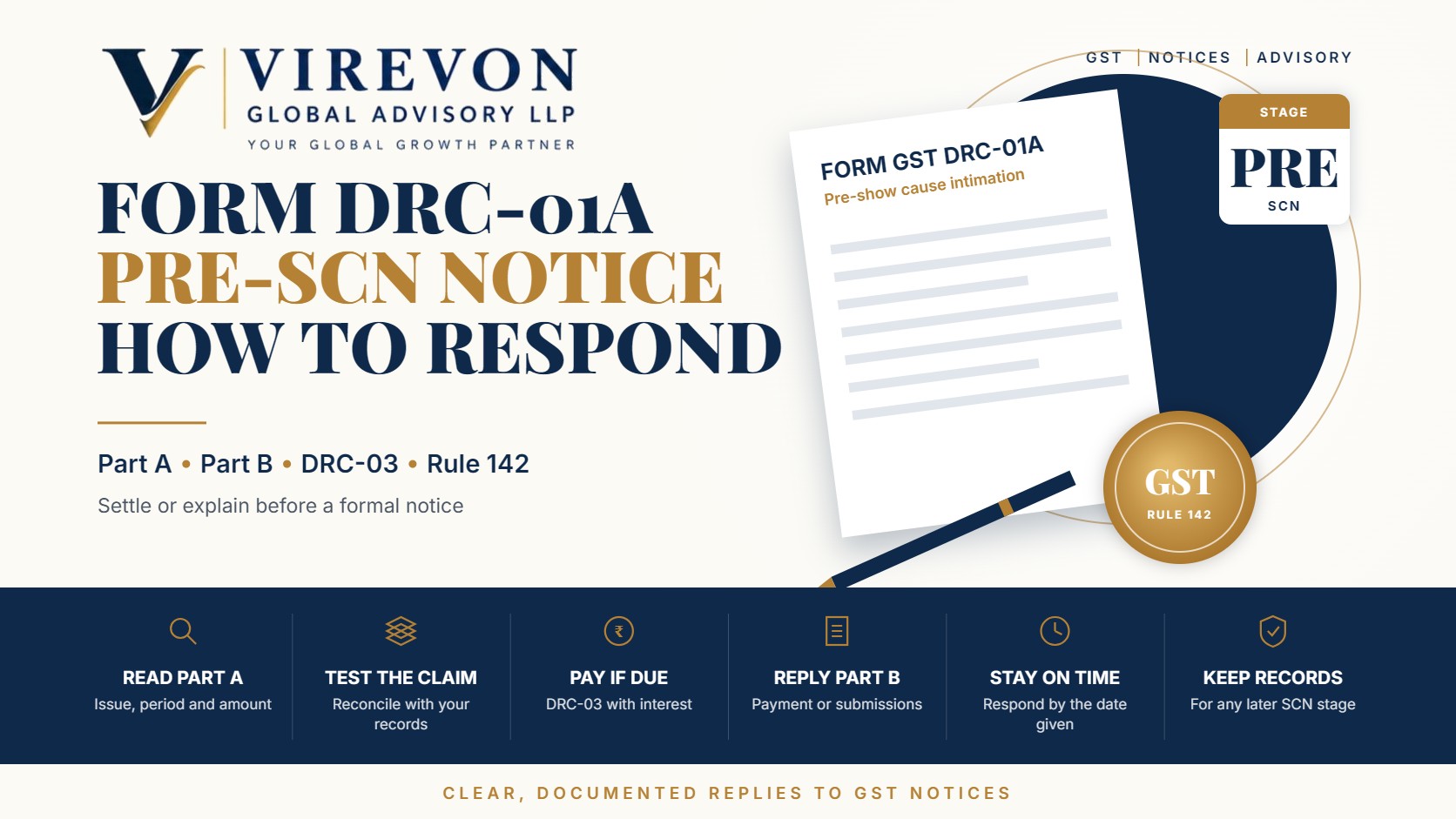
  • DRC-01A Pre-Show Cause Intimation: What It Means and How to Respond

    DRC-01A Pre-Show Cause Intimation: What It Means and How to Respond

    A DRC-01A is the GST department’s way of telling you, before a formal show cause notice, that it has worked out an amount of tax it believes is payable. It is issued under rule 142(1A) of the CGST Rules and gives you a chance either to pay and close the issue or to explain why the amount is not due.

    Used well, this early stage can save interest, penalty and months of proceedings. This article explains what the form contains, the benefits of acting at this point and how to write a reply that the officer can accept.

    Key takeaways

    • DRC-01A is a pre-show cause intimation in which the officer shares the tax, interest and penalty ascertained under section 73, 74 or 74A.
    • Part A sets out the liability; Part B is where you respond, by paying fully or partly or by filing submissions.
    • Paying tax and interest before a show cause notice in non-fraud cases generally means no penalty; in fraud cases a reduced penalty of 15% applies.
    • The use of the word ‘may’ in rule 142(1A) since October 2020 makes issuance discretionary, but many officers still issue it and courts value the opportunity it gives.
    • A reasoned, documented Part B reply often narrows or closes the issue before a show cause notice is issued.

    Where DRC-01A fits in GST proceedings

    Most demands follow a sequence:

    1. Scrutiny, audit or data analysis identifies a possible short payment.
    2. The officer may issue a DRC-01A with the ascertained amount.
    3. If the matter is not settled, a show cause notice is issued in DRC-01 under section 73, 74 or 74A.
    4. After hearing, an order is passed in DRC-07, which can be appealed.

    For tax periods up to FY 2023-24, sections 73 (non-fraud) and 74 (fraud or suppression) apply. For FY 2024-25 onwards, both situations are covered by the single section 74A. Our guide on show cause notices under sections 73, 74 and 74A explains the next stage in detail.

    Understanding the DRC-01A form

    PartFilled byWhat it contains
    Part AOfficerThe ground, tax period, section, tax, interest and penalty ascertained, and a date by which to pay
    Part BTaxpayerPayment details (full or part) through DRC-03, or submissions disputing the amount
    Part COfficerAcknowledgement of payment or acceptance of submissions

    The intimation usually comes as a PDF on the portal under additional notices or by email, and the Part B reply is filed online against it.

    Why the pre-notice stage matters

    The law rewards early settlement of undisputed amounts:

    • Non-fraud cases (section 73 / 74A): paying the tax and interest before the show cause notice means the officer does not issue a notice for that amount and no penalty is levied.
    • Fraud or suppression cases (section 74 / 74A): paying tax, interest and a penalty equal to 15% of the tax before the notice closes the matter for that amount.

    Once a notice is issued, these concessional outcomes narrow, so the DRC-01A stage is often the cheapest point to resolve genuine errors.

    Three ways to respond

    1. Agree and pay

    If the officer’s computation is correct, pay through DRC-03, selecting the appropriate cause of payment, and link the payment in Part B. Keep a copy of the ARN and challan.

    2. Agree in part

    Often only part of the amount is valid. Pay the admitted portion with interest and, in the same Part B reply, explain why the balance is not payable. A clear split between admitted and disputed amounts shows good faith and focuses any later notice.

    3. Disagree

    If the amount is not payable, file detailed submissions with evidence. Common grounds include:

    • The difference arises from timing, such as invoices reported in a later month but already taxed.
    • Credit notes, amendments or exports were not considered.
    • ITC flagged as excess was reflected in GSTR-2B of a later period within the time limit.
    • The rate or classification applied by the officer is incorrect.
    • The period is outside the time limit for issuing a notice.

    Worked example: an ITC difference

    A Delhi-based trading company received a DRC-01A for FY 2022-23 stating that ITC claimed in GSTR-3B exceeded GSTR-2A by ₹9.8 lakh, with interest and penalty added. Its reconciliation found:

    • ₹6.1 lakh of invoices appeared in suppliers’ returns filed in FY 2023-24 but related to FY 2022-23, and were within the time allowed under section 16(4).
    • ₹2.4 lakh related to import IGST supported by bills of entry, which do not appear in GSTR-2A.
    • ₹1.3 lakh was genuinely ineligible credit on a staff event.

    The company paid ₹1.3 lakh with interest via DRC-03 and filed Part B with invoice copies, supplier filing proof and bills of entry for the rest. The officer accepted the reply and no show cause notice followed. For related credit rules, see our guide to blocked credits under section 17(5).

    Drafting a strong Part B reply

    • Start with a summary table: amount per DRC-01A, amount admitted, amount disputed.
    • Deal with each issue separately, using the same headings as Part A.
    • Attach evidence in indexed annexures: reconciliations, invoices, e-way bills, bank proofs, supplier confirmations.
    • Cite the provision that supports your position, without long legal arguments at this stage.
    • Request a personal hearing if the issue needs explanation.
    • Reply by the date given in Part A, or seek more time in writing.

    If the intimation follows a scrutiny notice, keep your earlier ASMT-11 reply consistent with the DRC-01A response.

    Frequently asked questions

    Is DRC-01A a show cause notice?

    No. It is an intimation before a show cause notice. It gives you an opportunity to pay or explain, after which the officer decides whether to issue a formal notice in DRC-01.

    Is it mandatory for the officer to issue DRC-01A?

    Since October 2020, rule 142(1A) uses the word ‘may’, so issuance is discretionary. In practice many officers still issue it, and courts have noted its value as an opportunity for early settlement.

    How do I pay against a DRC-01A?

    Payment is made through FORM DRC-03 on the GST portal, and the payment is then referred to in Part B of the reply.

    What happens if I do not reply to DRC-01A?

    The officer is likely to issue a show cause notice for the full amount. You lose the chance to settle early and may face penalty in addition to tax and interest.

    If you have received a DRC-01A, our team would be glad to review the computation and help you prepare a clear Part B reply.

    This article is general information based on the law as of September 2026, and is not legal or tax advice. Please check the facts of your own case with a professional before acting.