Author: virevonadmin

  • Annual Information Statement (AIS) and TIS: How to Reconcile Before Filing

    Annual Information Statement (AIS) and TIS: How to Reconcile Before Filing

    The income-tax department now receives a large volume of information about each taxpayer: salary and TDS from employers, interest from banks, dividends from companies, mutual fund and share transactions from registrars and brokers, property purchases from registrars, and much more. All of this appears in the Annual Information Statement. Careful AIS reconciliation before filing is the single most effective way to avoid mismatch intimations and scrutiny questions later.

    This guide explains what the AIS and the Taxpayer Information Summary (TIS) contain, how they relate to the tax credit statement, how to reconcile them with your own records, and how to use the feedback facility when something is wrong. A sample reconciliation shows how differences are typically explained.

    Key takeaways

    • The AIS lists information reported by third parties; the TIS summarises it by category and feeds the pre-filled return.
    • TDS and TCS credits are claimed based on the tax credit statement (Form 26AS, which is Form 168 under the new law for later years), and AIS mirrors this data.
    • Five feedback options let you confirm, correct, deny or flag information as duplicate or belonging to another PAN or year.
    • Differences are normal; what matters is that you can explain each one and your return reflects the correct figure.
    • Reconciling a few weeks before the due date leaves time for deductors or reporting entities to correct errors.

    What AIS and TIS contain

    The AIS is organised into broad parts:

    • TDS and TCS information: salary, interest, rent, professional fees, sale of property, and other payments on which tax was deducted or collected.
    • Statement of financial transactions (SFT): savings and deposit interest, dividends, purchase and sale of shares and mutual funds, cash deposits, credit card payments, and property transactions above reporting thresholds.
    • Payment of taxes: advance tax and self-assessment tax paid.
    • Demand and refund: outstanding demands and refunds issued.
    • Other information: data such as GST turnover, interest on income-tax refunds and information from other government sources.

    The TIS aggregates these entries by category (for example, total interest from savings accounts) and shows a processed value and a derived value after any feedback. The pre-filled return uses these figures, which is why reconciling them matters.

    You can download both from the income-tax e-filing portal under the AIS section, in PDF, JSON or CSV format.

    A step-by-step AIS reconciliation

    1. Download everything: AIS, TIS and the tax credit statement for the financial year.
    2. Gather your records: salary slips and the salary certificate, bank statements and interest certificates, broker capital gains reports, mutual fund statements, rent receipts, property documents and tax payment challans.
    3. Match TDS line by line: compare each deductor, amount paid and tax deducted with your records. Differences here directly affect your credit.
    4. Review SFT entries: check interest, dividends and securities transactions against statements; look for duplicates, joint accounts and transactions of family members reported under your PAN.
    5. Check the year: interest reported on accrual versus receipt, or year-end transactions reported in the wrong year, are common causes of mismatch.
    6. Record your reconciliation in a simple working sheet: AIS value, your value, difference and explanation.
    7. Submit feedback for genuine errors, then file the return with the correct figures.

    A sample reconciliation

    ItemAIS/TIS value (₹)Your records (₹)Difference and explanation
    Savings bank interest42,30042,300Matches
    Fixed deposit interest1,86,0001,24,000Joint deposit with spouse reported fully under your PAN; your share is 2/3
    Dividend18,5009,250Same dividend reported twice (duplicate)
    Sale of mutual fund units6,40,0006,40,000Sale value matches; compute gain using cost from statement
    TDS on rent (from tenant)24,00036,000Tenant deducted but has not filed one quarter’s TDS statement; follow up for credit

    In this example, the return would show the correct fixed deposit interest and dividends, with feedback submitted for the joint deposit and duplicate dividend. For the missing rent TDS, the taxpayer asks the tenant to file or correct the TDS statement, because credit is generally allowed only when it appears in the tax credit statement.

    For capital gains, remember that AIS shows sale value, not profit. You still need the purchase cost and dates to compute gains correctly; our guide to capital gains tax rates explains the rates and holding periods.

    Using the feedback options

    For each AIS entry, you can choose one of the following:

    • Information is correct
    • Information is not fully correct – enter the correct amount
    • Information relates to other PAN or year
    • Information is duplicate – identify the matching entry
    • Information is denied – for transactions that do not relate to you at all

    After feedback, the modified value appears alongside the reported value, and the derived value in TIS is updated. In some cases, the information is sent to the reporting entity for confirmation. If the source confirms its original figure, you may need to follow up with it directly.

    Feedback does not replace filing the correct return. Its value is in creating a record of your explanation, which helps if the department later questions a difference.

    What happens if you do not reconcile

    If the return shows lower income than the AIS without explanation, the processing system may make adjustments or issue an intimation. Our article on section 143(1) intimations explains how to respond when that happens. Larger unexplained differences can also lead to compliance e-campaigns or scrutiny selection. Reconciling upfront is far easier than explaining later.

    Practical tips

    • Start early: download AIS in June or July; many deductors file corrections around the first quarter due dates.
    • Watch joint holdings: banks often report joint account interest under the first holder’s PAN.
    • Check high-value entries: property purchases, large cash deposits and credit card payments are frequently reviewed.
    • Keep evidence: save the working sheet and supporting statements with the return acknowledgement.
    • Revisit after filing: AIS is updated during the year; if new information appears, consider whether a revised or updated return is needed.

    Frequently asked questions

    Is AIS reconciliation mandatory before filing?

    It is not a separate legal requirement, but it is strongly advisable, because returns are processed against this data and mismatches can lead to adjustments or notices.

    What is the difference between AIS and TIS?

    AIS lists individual transactions reported by third parties, while TIS summarises them by category and shows the values used in the pre-filled return.

    Will my TDS credit be allowed if it appears in AIS but not in Form 26AS?

    Credit is generally given based on the tax credit statement. Both draw from the same TDS data, so check whether the deductor’s statement has been filed and processed correctly.

    Can I change AIS feedback later?

    Yes, feedback can generally be modified, and the latest submission is considered.

    If you would like help reconciling your AIS before filing or responding to a mismatch, our tax team would be glad to assist.

    This article is general information based on the law as of September 2026, and is not legal or tax advice. Please check the facts of your own case with a professional before acting.


  • GST on Employee Perquisites, Gifts and Recoveries: What Employers Should Know

    GST on Employee Perquisites, Gifts and Recoveries: What Employers Should Know

    Employers spend meaningful amounts on their people beyond salary: festival gifts, meals, transport, health insurance, mobile phones and club memberships. Many also recover part of these costs from employees. Each of these raises GST questions: is the benefit a taxable supply to the employee, is a recovery taxable, and can the employer claim input tax credit (ITC)? Understanding GST on employee gifts perquisites and recoveries helps you design benefits confidently and avoid avoidable disputes.

    This article explains the basic principles, the ₹50,000 gift threshold, the CBIC’s clarification on contractual perquisites, the treatment of common recoveries such as canteen charges and notice pay, and how the blocked credit rules apply. A quick reference table brings the common items together.

    Key takeaways

    • Services by an employee to the employer in the course of employment are neither goods nor services under Schedule III, so salary itself is outside GST.
    • Gifts to an employee up to ₹50,000 per year are not treated as a supply, even without consideration.
    • Perquisites provided under the employment contract are part of the employment relationship and are not treated as a separate taxable supply, as clarified in Circular No. 172/04/2022-GST.
    • ITC on items such as food, club membership, health services and leave travel is generally blocked under section 17(5), unless the facility is obligatory for the employer under a law.
    • Recoveries from employees need case-by-case review; the answer depends on the underlying arrangement, not on the label in the payroll.

    The starting point: employer and employee are related persons

    Under GST, an employer and employee are treated as related persons. Schedule I of the CGST Act deems certain supplies between related persons to be taxable even without consideration. This is why free benefits to employees are examined at all.

    Two important carve-outs reduce the practical impact:

    1. Gifts up to ₹50,000: Schedule I specifically states that gifts not exceeding ₹50,000 in value in a financial year by an employer to an employee are not treated as a supply of goods or services.
    2. Contractual perquisites: the CBIC has clarified that perquisites provided by the employer to the employee in terms of the contractual agreement are in lieu of the services provided by the employee in the course of employment, and are not subject to GST.

    Together, these mean that most routine benefits written into appointment letters or HR policies are not taxed as separate supplies to employees.

    Gifts to employees in practice

    A gift is something given without consideration and not as an entitlement under the employment contract. Festival hampers, anniversary presents and one-off rewards typically fall in this category.

    • If the total value of gifts to an employee in a financial year stays within ₹50,000, no GST is payable on the gift as an outward supply.
    • If it exceeds ₹50,000, the gift may be treated as a supply and GST may apply on its value.
    • Separately, ITC on goods given as gifts is blocked under section 17(5), regardless of value. So the employer usually pays GST on the purchase and cannot claim credit.

    Maintaining an employee-wise gift register helps show that the threshold has not been crossed.

    Perquisites and blocked credits

    Many perquisites fall within section 17(5), which blocks ITC on specified items. The proviso allows credit where the employer is obligated under any law to provide the facility. The blocked list is explained in detail in our guide on blocked credits under section 17(5).

    BenefitGST on the benefit to employeeITC for the employer
    Food and canteenGenerally not taxed if a contractual perkBlocked, unless obligatory under a law (for example, a statutory canteen)
    Health insurance and medical servicesNot taxed if contractualBlocked, unless obligatory under a law
    Club and fitness membershipsNot taxed if contractualBlocked
    Leave or home travel concessionsNot taxed if contractualBlocked
    Employee transport (cabs, buses)Not taxed if contractualDepends on the nature of service and vehicle rules; review carefully
    Laptops, mobiles used for workBusiness use, not a perkGenerally available if used for business
    Festival giftsNot a supply up to ₹50,000 a yearBlocked

    The distinction between a business tool and a personal benefit matters. A laptop issued for work is a business input; a smartphone given as a personal reward is closer to a gift.

    Recoveries from employees

    Employers often recover part of the cost of a benefit from employees. Common examples include:

    • Canteen charges: where the employer recovers part of the food cost and does not retain any margin, various rulings have taken the view that GST is not payable on the recovered amount, particularly where the employer has not claimed ITC on the canteen service. The facts, including who the caterer bills and whether the employer is making its own supply, need careful review.
    • Transport recoveries: similar reasoning applies; if the employer merely passes on part of the cost of a facility forming part of the employment arrangement, a separate supply is often not intended. Documentation is key.
    • Notice pay: amounts recovered when an employee leaves without serving notice have been widely viewed as compensation for breach rather than consideration for a service, in line with the CBIC’s clarification on liquidated damages and similar payments in Circular No. 178/10/2022-GST. Confirm the position with reference to your contract terms.
    • Asset buy-back and damage recovery: selling an old laptop to an employee is a sale of goods and may attract GST at the applicable rate; recovery for damage should be examined on its facts.

    Record the basis of each recovery in the HR policy and payroll so that the GST treatment is consistent across the year.

    Designing benefits with GST in mind

    1. Put benefits in writing: list perquisites in appointment letters or a benefits policy so they are clearly contractual.
    2. Separate gifts from entitlements: track gifts per employee against the ₹50,000 limit.
    3. Map ITC eligibility: review each benefit against section 17(5) and reverse credit where blocked.
    4. Check statutory obligations: where a law requires you to provide a canteen, crèche or medical facility, the ITC proviso may apply.
    5. Review with payroll changes: salary restructuring under the labour codes is a good moment to revisit benefits; see our note on new labour codes and payroll.
    6. Keep supporting documents: policies, caterer contracts and recovery workings are what an officer will ask for during an audit.

    Frequently asked questions

    Is GST payable on Diwali gifts to employees?

    Not if the total gifts to an employee in the financial year do not exceed ₹50,000. However, the employer generally cannot claim ITC on the gifts purchased.

    Are perquisites under the employment contract taxable under GST?

    The CBIC has clarified that perquisites provided under the contractual agreement are not subject to GST as a separate supply to the employee.

    Can an employer claim ITC on canteen services?

    Generally not, because food and beverages are blocked credits, unless providing the canteen is obligatory under a law applicable to the employer.

    Is notice pay recovered from an employee taxable?

    It is widely treated as not taxable, being compensation for breach rather than consideration for a service, but review the contract and current clarifications for your case.

    If you would like a quick GST review of your employee benefits and recovery policies, our GST team would be happy to help.

    This article is general information based on the law as of September 2026, and is not legal or tax advice. Please check the facts of your own case with a professional before acting.
  • Significant Beneficial Ownership (SBO) and Form BEN-2: Who Must Report

    Significant Beneficial Ownership (SBO) and Form BEN-2: Who Must Report

    Company law in India wants to know not just who is on the share register, but who ultimately owns or controls a company. That person is the significant beneficial owner (SBO). Where an individual holds a stake through another company, a trust, a partnership or a nominee, the company must identify them, record them and report them to the Registrar of Companies in Form BEN-2.

    Most private companies with simple shareholdings have straightforward SBO positions, but group structures, foreign holding companies and nominee arrangements need a closer look. This guide explains who counts as an SBO, the forms and timelines, and how to keep the records current.

    Key takeaways

    • An SBO is an individual who, alone or with others, holds at least 10% of shares, voting rights or dividend rights, or exercises significant influence or control, through indirect holdings.
    • The SBO must declare in Form BEN-1 within 30 days of becoming an SBO or of any change.
    • The company must file Form BEN-2 with the ROC within 30 days of receiving the declaration, and keep a register in Form BEN-3.
    • The company must actively identify SBOs, including by sending Form BEN-4 notices to non-individual members holding 10% or more.
    • Section 90 prescribes penalties for the SBO, the company and its officers in default.

    Who is a significant beneficial owner?

    Section 90 of the Companies Act 2013 and the Companies (Significant Beneficial Owners) Rules 2018 define an SBO as an individual who, acting alone or together with others (including through a trust), holds indirectly, or together with direct holdings, any of the following:

    • at least 10% of the share capital;
    • at least 10% of the voting rights;
    • the right to receive or participate in at least 10% of distributable dividends or other distributions; or
    • the right to exercise significant influence or control in any manner other than through direct holdings alone.

    An individual who holds shares only directly, in their own name, is recorded as a member rather than reported as an SBO. The rules focus on the indirect element.

    Tracing indirect holdings

    The rules explain how to look through intermediate entities:

    If the member is aThe individual is treated as holding through it if they
    CompanyHold a majority stake in that company, or in its ultimate holding company
    Hindu undivided familyAre the karta of the HUF
    Partnership firm or LLPAre a partner, or hold a majority stake in a body corporate that is a partner
    TrustAre a trustee (discretionary or charitable trust), a beneficiary (specific trust), or the author or settlor (revocable trust)
    Pooled investment vehicleAre a general partner, investment manager or CEO of the manager, where the vehicle is based outside India

    A simple example

    ABC Private Limited has two members: Ms Rao holds 40% directly, and XYZ Holdings Limited holds 60%. Mr Mehta holds 70% of XYZ Holdings. Mr Mehta is an SBO of ABC because he holds a majority stake in a body corporate that holds 10% or more of ABC. Ms Rao holds her shares directly and is shown as a member, not as an SBO, unless she also has an indirect route.

    The forms and the timeline

    1. BEN-1: the SBO gives a declaration to the company within 30 days of acquiring SBO status or any change in it.
    2. BEN-2: the company files a return with the ROC within 30 days of receiving the BEN-1 declaration.
    3. BEN-3: the company records SBO details in a register of significant beneficial owners, open for inspection by members.
    4. BEN-4: the company sends a notice to any non-individual member holding 10% or more (and to any person it believes may be an SBO), seeking information to identify SBOs.

    If a person does not respond or the company is not satisfied, the company may apply to the Tribunal for directions, including restrictions on the shares.

    Exemptions

    The rules do not apply to the extent shares are held by:

    • the Investor Education and Protection Fund Authority;
    • the holding company of the reporting company (provided the holding company itself reports its SBOs);
    • the Central or a State Government, or a local authority;
    • a body corporate or entity controlled by the Central or State Governments;
    • investment vehicles registered with and regulated by SEBI, RBI, IRDAI or PFRDA, such as mutual funds, alternative investment funds, REITs and InvITs.

    Limited liability partnerships have a separate but similar framework under the LLP (Significant Beneficial Owners) Rules 2023, with their own forms.

    Penalties under section 90

    DefaultPenalty
    SBO fails to declare₹50,000, plus ₹1,000 per day of continuing failure, up to ₹2 lakh
    Company fails to maintain the register, file BEN-2 or allow inspection₹1 lakh, plus ₹500 per day of continuing failure, subject to the statutory cap
    Every officer in default₹25,000, plus ₹200 per day of continuing failure, subject to the statutory cap

    The MCA has issued many adjudication orders for late BEN-2 filings, so it is worth treating these timelines as firm.

    A practical significant beneficial owner checklist

    • Map the shareholding chart, including all intermediate companies, trusts, firms and foreign parents, up to individuals.
    • Send BEN-4 notices each year and whenever a corporate or non-individual shareholder holds 10% or more.
    • Collect BEN-1 declarations at every change: share transfers, fresh allotments, group restructurings, changes in trusteeship.
    • File BEN-2 promptly and update the BEN-3 register.
    • Align with other filings: the annual return (MGT-7 or MGT-7A), FDI reporting such as FC-GPR, and bank KYC should show consistent ownership. Our guides on ROC annual filing and FDI reporting cover these.
    • Review nominee and beneficial interest declarations under section 89 at the same time.

    Frequently asked questions

    Who is a significant beneficial owner under the Companies Act?

    An individual who, through indirect holdings alone or together with direct holdings, has at least 10% of shares, voting rights or dividend rights, or significant influence or control over the company.

    What is the due date for Form BEN-2?

    Within 30 days of the company receiving the BEN-1 declaration from the SBO.

    Does a company with only individual shareholders need to file BEN-2?

    Usually not, if all members hold shares directly in their own names and no one exercises control through an indirect route. The company should still document its assessment.

    What is Form BEN-4?

    It is a notice the company sends to a non-individual member holding 10% or more, or to anyone it believes may be an SBO, seeking the information needed to identify SBOs.

    If you would like help mapping your ownership structure and completing SBO filings, our corporate compliance team is happy to assist.

    This article is general information based on the law as of September 2026, and is not legal or tax advice. Please check the facts of your own case with a professional before acting.

  • MIS Reports for Small and Mid-Sized Businesses: What to Track Every Month

    MIS Reports for Small and Mid-Sized Businesses: What to Track Every Month

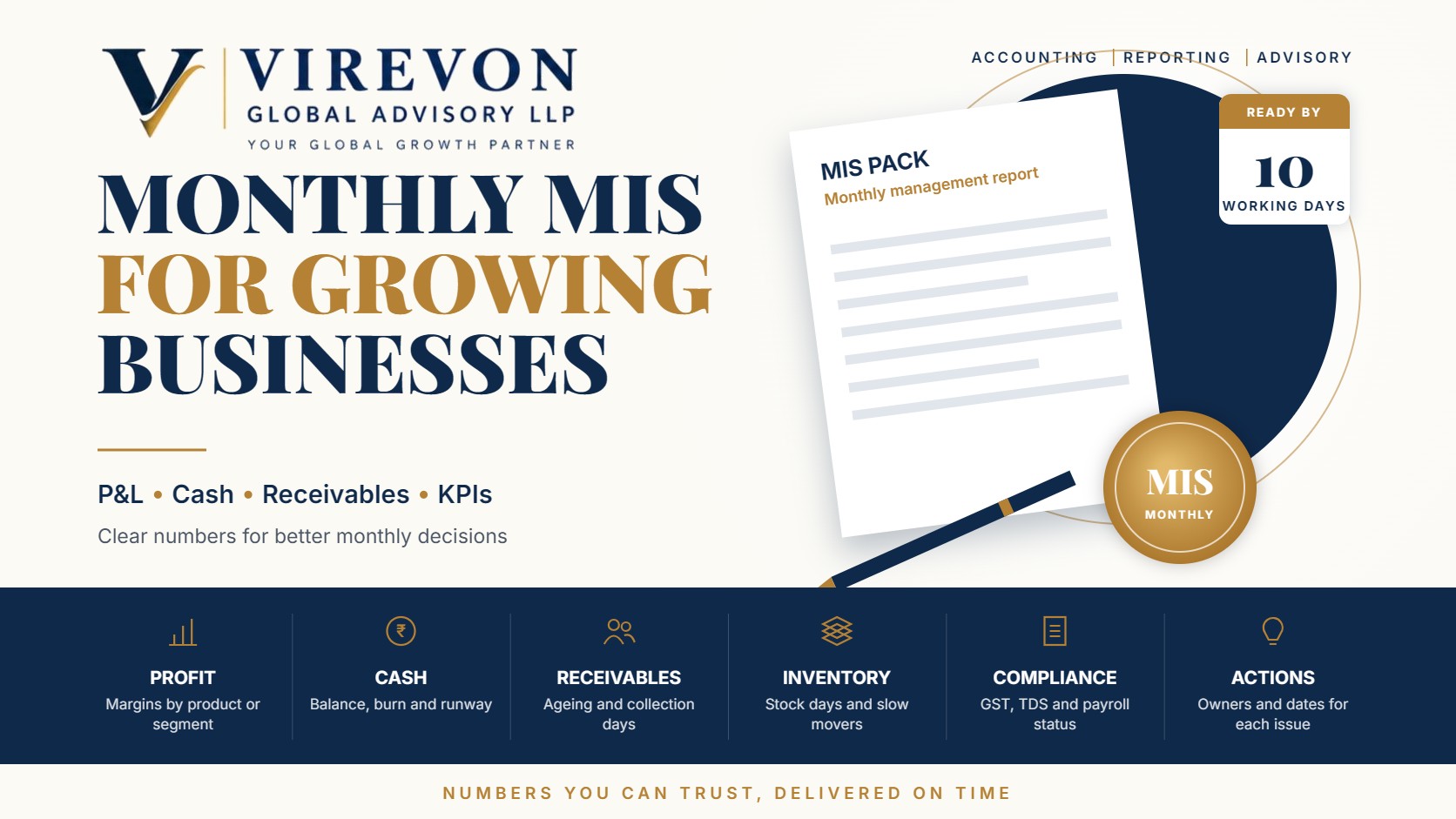
    Most owners of small and mid-sized businesses know their sales figure every month. Far fewer know, with the same confidence, their gross margin by product, how many days of cash they have left or which customers are drifting past their credit terms. Good MIS reporting for SMEs closes that gap. A management information system (MIS) report is a short, regular pack of numbers that tells leadership how the business is really doing and where to act.

    The aim is not a thick document. A clear five to eight page pack, delivered within the first two weeks of the month and discussed in a regular review meeting, is usually far more useful than a detailed report that arrives late. This guide sets out what to include, which metrics matter and how to build the habit.

    Key takeaways

    • A monthly MIS pack should cover profit, cash, working capital, sales pipeline, people costs and compliance status.
    • Compare every number with budget, last month and the same month last year; trends matter more than single figures.
    • Receivable days, inventory days and cash runway are often the most valuable metrics for a growing business.
    • Reliable MIS depends on a disciplined month-end close and reconciled accounts.
    • Every MIS review should end with a short list of actions, owners and dates.

    What goes into a monthly MIS pack

    A practical structure that works for most trading, manufacturing and services businesses:

    1. One-page dashboard with 8–12 key indicators and a short commentary.
    2. Profit and loss for the month and year to date, against budget and last year.
    3. Segment or product profitability, showing contribution margin.
    4. Cash flow and bank position, with a short forward view of the next 4–13 weeks.
    5. Working capital: receivables ageing, payables ageing and inventory.
    6. Sales and order book: new orders, pipeline and major customers.
    7. People and overheads: headcount, payroll cost and key overhead lines.
    8. Compliance tracker: GST, TDS, PF, ESI and ROC filings for the month.

    The key metrics to track every month

    AreaMetricWhy it matters
    GrowthRevenue vs budget and last yearShows momentum and seasonality
    ProfitabilityGross margin % and contribution margin by productIdentifies which lines truly earn money
    ProfitabilityEBITDA and EBITDA %Measures operating performance before financing
    CashClosing cash, monthly net cash flow, runway in monthsEarly warning on funding needs
    ReceivablesDebtor days and amounts overdue above 60 or 90 daysSlow collections are the most common cash drain
    PayablesCreditor days, and MSME dues outstanding over 45 daysProtects supplier relationships and tax deductions
    InventoryInventory days and slow-moving stockReleases cash locked in stock
    EfficiencyPayroll cost as % of revenueKeeps growth in hiring aligned with growth in sales
    PipelineOrders booked and conversion rateIndicates next quarter’s revenue

    For many businesses, the cash conversion cycle (debtor days plus inventory days minus creditor days) is the single most useful number. Reducing it by even ten days can release a meaningful amount of working capital.

    MIS reporting for SMEs: a simple monthly timeline

    • Working days 1–3: close sales and purchase entries, record payroll and accruals, complete bank reconciliations.
    • Working days 4–6: review GST and TDS reconciliations, stock valuation and receivable balances; post adjusting entries.
    • Working days 7–8: prepare the P&L, balance sheet, cash flow and the KPI dashboard.
    • Working days 9–10: write short commentary on variances and hold the review meeting.

    This timeline only works if the month-end close is disciplined. Our month-end close checklist and guide to bank reconciliation best practices cover the groundwork.

    Making the numbers useful

    Explain variances in plain language

    A variance table with no explanation is rarely acted upon. For each major difference, note the reason in one line: “Freight cost up 18% because of urgent air shipments for two export orders.” This turns data into decisions.

    Use a rolling forecast

    Update a rolling 12-month forecast each quarter, and a 13-week cash forecast each month. It helps you plan borrowing, capital expenditure and hiring with fewer surprises.

    Keep definitions consistent

    Decide once how you define gross margin, EBITDA or overdue receivables, write it down and apply it every month. Changing definitions makes trends meaningless.

    Build from your accounting system

    Tally, Zoho Books, QuickBooks and other systems can export most of the data. A simple spreadsheet or a dashboard tool linked to these exports reduces manual effort and errors. Consistent ledger mapping and cost centres are more important than the choice of tool.

    Common pitfalls

    1. Too many metrics. Focus on the few that drive decisions in your business.
    2. Late reports. An MIS delivered after the 20th is mostly history; aim for the 10th working day.
    3. Unreconciled data. If bank, GST and stock balances are not reconciled, the MIS will mislead.
    4. No follow-up. Record actions from each review and check them the next month.
    5. Ignoring compliance. A late GST return or unpaid TDS carries a cost; include a simple compliance status line in every pack.

    Frequently asked questions

    What is MIS reporting for SMEs?

    It is a regular, usually monthly, set of management reports covering profit, cash, working capital, sales and compliance, designed to help owners and managers make decisions.

    How often should an SME prepare MIS reports?

    Monthly is the norm, with a short weekly cash report for businesses that are growing fast or have tight liquidity.

    Which metric matters most for a small business?

    Cash-related metrics usually matter most: closing cash, debtor days and the cash conversion cycle, because they show how long the business can operate comfortably.

    Can MIS be outsourced?

    Yes. Many growing businesses have their bookkeeping, month-end close and MIS preparation handled by an external accounting team, with management focusing on the review and decisions.

    If you would like a clear monthly MIS pack for your business, built on reliable books and delivered on time, our accounting team would be glad to help.

    This article is general information based on the law as of September 2026, and is not legal or tax advice. Please check the facts of your own case with a professional before acting.
  • Presumptive Taxation under Sections 44AD and 44ADA: Limits and Conditions

    Presumptive Taxation under Sections 44AD and 44ADA: Limits and Conditions

    Small traders, manufacturers, shop owners and independent professionals often find full bookkeeping and a tax audit disproportionate to the size of their business. Presumptive taxation under 44AD and its professional counterpart, section 44ADA, offer a simpler route: declare income at a fixed percentage of turnover or receipts, pay tax on it and file a short return.

    The scheme is generous, but it comes with limits, eligibility rules and a five-year consistency condition. This guide explains them with examples, for returns of FY 2025-26 under the Income-tax Act 1961. The Income-tax Act 2025 carries the schemes forward for the tax year 2026-27 under new section numbers.

    Key takeaways

    • Section 44AD: eligible businesses with turnover up to ₹2 crore (₹3 crore if cash receipts are 5% or less) declare 8% of turnover, or 6% for digital receipts.
    • Section 44ADA: specified professionals with receipts up to ₹50 lakh (₹75 lakh if cash receipts are 5% or less) declare 50% of receipts.
    • Only resident individuals, HUFs and partnership firms qualify; LLPs and companies do not.
    • Advance tax is paid in one instalment by 15 March.
    • If you opt out of 44AD within five years, you cannot return for the next five years, and a tax audit may apply.

    Section 44AD at a glance

    PointSection 44ADSection 44ADA
    WhoResident individual, HUF, partnership firm (not LLP)Resident individual or partnership firm (not LLP)
    ActivityEligible business (most trading, manufacturing, services)Specified professions such as legal, medical, engineering, architecture, accountancy, technical consultancy, interior decoration
    Basic limitTurnover up to ₹2 croreReceipts up to ₹50 lakh
    Enhanced limit₹3 crore if cash receipts do not exceed 5%₹75 lakh if cash receipts do not exceed 5%
    Deemed income8% of turnover; 6% for receipts by banking or digital modes50% of gross receipts
    Higher incomeCan declare more than the deemed rateCan declare more than 50%

    A few businesses are excluded from section 44AD, including commission or brokerage agents, persons carrying on agency business, and goods carriage operators (who have a separate scheme under section 44AE).

    How the 6% and 8% rates work

    The 6% rate applies to turnover received by account payee cheque, account payee draft, bank transfer or other prescribed electronic modes, where received within the year or by the due date of filing the return. Everything else, including cash, is at 8%.

    Worked example: a trader

    A retailer has FY 2025-26 turnover of ₹2.4 crore: ₹2.3 crore through UPI and bank transfers, and ₹10 lakh in cash.

    1. Cash receipts are about 4.2% of turnover, within the 5% condition, so the enhanced ₹3 crore limit applies.
    2. Deemed income: 6% of ₹2.3 crore = ₹13.8 lakh, plus 8% of ₹10 lakh = ₹0.8 lakh.
    3. Total presumptive business income: ₹14.6 lakh.

    No separate deduction for expenses like rent, salary or depreciation is allowed, as they are treated as already covered in the deemed rate. The retailer still needs to keep basic records of turnover and bank transactions.

    Worked example: a consultant

    An IT consultant (technical consultancy) receives ₹70 lakh, entirely by bank transfer. The enhanced ₹75 lakh limit applies, and deemed income under 44ADA is 50%, or ₹35 lakh.

    The five-year rule for presumptive taxation 44AD

    Section 44AD(4) is often overlooked. If a person opts for 44AD in one year and then, within the next five years, declares profit below the deemed rate (that is, opts out), they cannot use 44AD for the following five years. In those years, if total income exceeds the basic exemption limit, they must maintain books and get a tax audit under section 44AB.

    Practical tip: before opting in, think about the next five years, not just the current one. If profit margins are likely to fall below 6–8%, regular books may suit you better.

    Section 44ADA does not have the same five-year lock-in, but declaring income below 50% when receipts exceed the basic exemption limit generally requires books of account and a tax audit.

    Advance tax, ITR form and other compliance

    • Advance tax: the full advance tax for presumptive income can be paid in one instalment by 15 March of the financial year. Paying later attracts interest.
    • ITR form: ITR-4 (Sugam) for individuals, HUFs and firms whose total income does not exceed ₹50 lakh and who meet the other conditions; otherwise ITR-3 (or ITR-5 for firms).
    • GST: presumptive income tax has nothing to do with GST. If your turnover crosses the GST threshold, registration and returns still apply.
    • Tax audit: generally not needed while you remain within the scheme and its limits. Our tax audit checklist explains when an audit becomes necessary.
    • Records: keep sales registers, bank statements and invoices; they support your turnover figure if your AIS shows different numbers.

    Common mistakes to avoid

    1. An LLP claiming 44AD. LLPs are not eligible.
    2. Using 44ADA for a non-specified profession, such as a commission-based agent or a general services business.
    3. Ignoring the 5% cash test and claiming the enhanced limit when cash receipts were higher.
    4. Missing the five-year consequence after declaring a lower profit in one year.
    5. Not reconciling turnover with AIS and GST returns, which can prompt queries. Our guide on section 143(1) intimations explains how mismatches are handled.

    Frequently asked questions

    What is the turnover limit for presumptive taxation under 44AD?

    ₹2 crore, increased to ₹3 crore if cash receipts do not exceed 5% of total turnover or gross receipts.

    Can freelancers use section 44ADA?

    Yes, if they are resident individuals in a specified profession (such as technical consultancy, legal, medical, engineering or architecture) and receipts are within ₹50 lakh, or ₹75 lakh where cash receipts are 5% or less.

    Can an LLP opt for presumptive taxation?

    No. Sections 44AD and 44ADA are not available to limited liability partnerships.

    Is advance tax required under the presumptive scheme?

    Yes. The advance tax can be paid in a single instalment by 15 March of the financial year.

    If you would like help deciding whether presumptive taxation suits your business and filing your return correctly, our team would be happy to guide you.

    This article is general information based on the law as of September 2026, and is not legal or tax advice. Please check the facts of your own case with a professional before acting.

  • Pre-Deposit for GST Appeals: First Appellate Authority and GSTAT Explained

    Pre-Deposit for GST Appeals: First Appellate Authority and GSTAT Explained

    When a GST demand order goes against you, the law gives a clear route to challenge it: first before the Appellate Authority, and then before the Goods and Services Tax Appellate Tribunal (GSTAT). Each stage requires a pre-deposit, a fixed percentage of the disputed tax paid before the appeal is admitted. Understanding the GSTAT pre-deposit and the first-appeal pre-deposit helps you plan cash flow and file on time.

    Now that the GSTAT is functioning across its benches, more businesses are taking appeals to the second level. This guide explains how much you need to deposit, how it can be paid, and what protection it gives you.

    Key takeaways

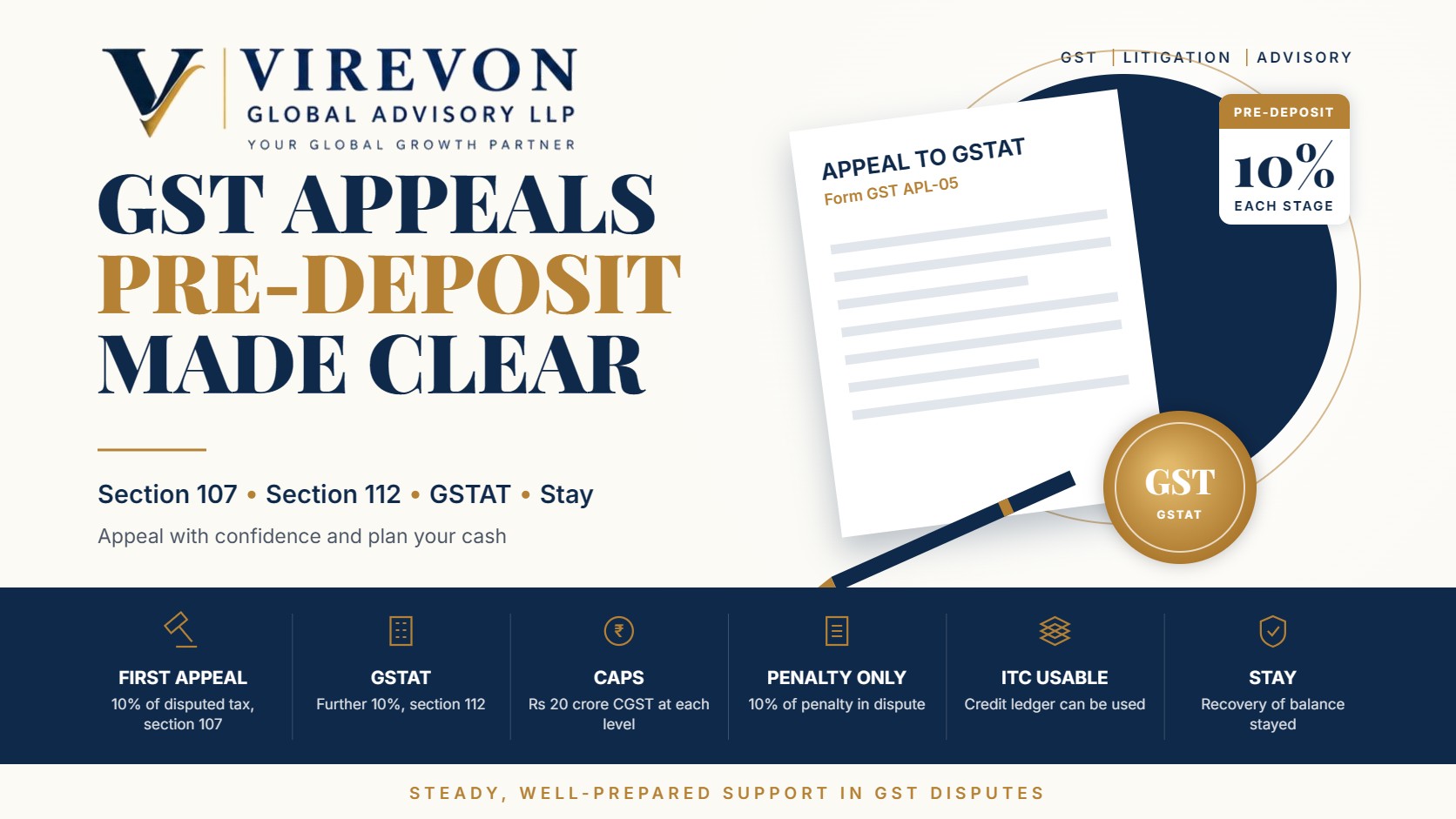
    • First appeal (section 107): pay the admitted amount in full plus 10% of the disputed tax, capped at ₹20 crore each under CGST and SGST.
    • GSTAT appeal (section 112): pay a further 10% of the tax remaining in dispute, again capped at ₹20 crore each under CGST and SGST.
    • For orders that demand only a penalty, the pre-deposit is 10% of the penalty.
    • Pre-deposit can be paid using the electronic credit ledger as well as cash.
    • Once the pre-deposit is paid, recovery of the balance is deemed stayed until the appeal is decided.

    Why pre-deposit matters

    Pre-deposit is a condition for the appeal to be admitted. It is not a penalty and not a final payment; it is adjusted against the final outcome and refunded with interest if you succeed. Paying the correct amount at the right time also stops recovery action, which protects your bank accounts and receivables while the appeal is pending.

    Pre-deposit at the first appellate stage

    Under section 107(6) of the CGST Act, an appeal to the Appellate Authority is admitted only if you pay:

    1. In full, the tax, interest, fine, fee and penalty that you admit, and
    2. A sum equal to 10% of the remaining tax in dispute, subject to a maximum of ₹20 crore under the CGST Act (with a corresponding amount under the SGST Act, and ₹40 crore under the IGST Act).

    The 10% is calculated on tax only, not on interest or penalty, except in penalty-only cases. Appeals must be filed within three months of the order being communicated, with up to one further month if there is sufficient cause for delay. Our guide on appealing a GST demand order covers the grounds and drafting.

    GSTAT pre-deposit under section 112

    If the Appellate Authority does not fully accept your case, the next step is the GSTAT. Under section 112(8), in addition to the admitted amount, you must pay a further 10% of the tax remaining in dispute after the first appeal, capped at ₹20 crore under CGST and a matching amount under SGST (₹40 crore under IGST). This rate and cap were reduced from 20% and ₹50 crore by the Finance (No. 2) Act 2024.

    The appeal to the GSTAT is generally filed within three months of the appellate order being communicated, online through the GSTAT portal. A special window for older orders, which accumulated before the tribunal became operational, has now closed; appeals on those orders now depend on condonation of delay where the law allows.

    Worked example

    A business receives an order confirming CGST ₹30 lakh and SGST ₹30 lakh, with interest and a penalty of ₹60 lakh. It accepts nothing and appeals.

    StageDisputed taxPre-depositCumulative paid
    First appeal₹60 lakh₹6 lakh (₹3 lakh CGST + ₹3 lakh SGST)₹6 lakh
    Appellate order reduces demand to ₹40 lakh tax₹40 lakh—₹6 lakh
    GSTAT appeal₹40 lakh₹4 lakh (further 10%)₹10 lakh

    No pre-deposit is needed on the interest and the penalty that accompany the tax demand. If the business wins at the GSTAT, the amounts paid are refundable with interest as provided in the Act.

    Penalty-only orders

    Where an order demands only a penalty, without any tax, the Finance Act 2025 provides that the pre-deposit is 10% of the penalty in dispute, both at the first appeal and at the GSTAT. This is a welcome change for businesses facing procedural penalties.

    How the pre-deposit is paid

    • Pre-deposit is discharged through the electronic liability ledger while filing the appeal, or through a linked payment, and is shown in the appeal form.
    • CBIC has clarified (Circular 172/04/2022-GST) that the pre-deposit can be paid using the electronic credit ledger, since it is a payment of output tax. This can ease the cash burden where ITC balances are available.
    • Keep the payment reference and debit entry numbers; they are needed in the appeal form and later for refund.
    • If you made any payment during investigation (for example through DRC-03), it may be adjustable towards the pre-deposit. Check that it is correctly linked to the demand.

    Stay of recovery and practical tips

    Section 107(7) and section 112(9) provide that once the pre-deposit is paid, recovery of the balance is deemed to be stayed until the appeal is disposed of. To make that protection work in practice:

    1. File the appeal and pay the pre-deposit within time, then inform the jurisdictional officer with a copy of the acknowledgement.
    2. Check that the demand in the electronic liability register shows the appeal status.
    3. Keep a single dispute file with the order, appeal, payment proofs and correspondence.
    4. Review whether rectification under section 161 is a faster route for obvious errors before appealing.
    5. Plan the cash impact of both stages early, especially for large demands.

    Frequently asked questions

    What is the GSTAT pre-deposit?

    A further 10% of the tax remaining in dispute after the first appellate order, in addition to any admitted amount, capped at ₹20 crore each under CGST and SGST.

    Is pre-deposit calculated on interest and penalty?

    No, it is calculated on the disputed tax. Only where the order demands a penalty without tax is the pre-deposit 10% of the penalty.

    Can input tax credit be used for pre-deposit?

    Yes. CBIC has clarified that the electronic credit ledger can be used to pay the pre-deposit.

    Will the department recover the balance while my appeal is pending?

    Once the prescribed pre-deposit is paid and the appeal filed, recovery of the balance is deemed stayed until the appeal is decided.

    If you have received a GST demand order and would like help assessing an appeal and planning the pre-deposit, our litigation support team is here to help.

    This article is general information based on the law as of September 2026, and is not legal or tax advice. Please check the facts of your own case with a professional before acting.

  • Section 8 Company Registration: Process, Benefits and Compliance

    Section 8 Company Registration: Process, Benefits and Compliance

    Founders who want to run an education initiative, a skilling programme, a health project or a research foundation often ask which legal form suits them best. For many, Section 8 company registration is the right answer. A Section 8 company is a company formed under the Companies Act 2013 to promote charitable or social objects, with the credibility of a registered company and the discipline of annual filings.

    This guide covers who can form one, the registration process, the documents you will need, the benefits and restrictions, and the compliance that follows each year.

    Key takeaways

    • A Section 8 company promotes objects such as education, art, science, sports, research, social welfare, religion, charity or protection of the environment.
    • Profits must be applied to its objects; no dividend can be paid to members.
    • Incorporation, the Section 8 licence, PAN and TAN are handled together through the SPICe+ web form.
    • There is no minimum capital, and the name need not end with “Limited” or “Private Limited”.
    • After incorporation, apply for income-tax registration and donor-deduction approval, and CSR-1 if you plan to receive CSR funds.

    What is a Section 8 company?

    Section 8 of the Companies Act 2013 allows the Central Government to grant a licence to a company that intends to promote specified charitable objects, applies its income to those objects and prohibits payment of dividends. It can be formed as a private or public company.

    Compared with trusts and societies, a Section 8 company offers a uniform national framework, limited liability for members, a clear board structure and greater comfort for corporate donors, CSR partners and foreign institutions.

    FeatureSection 8 companyTrustSociety
    Governing lawCompanies Act 2013State trust law or Indian Trusts ActSocieties Registration Act (and State laws)
    RegulatorRegistrar of CompaniesCharity commissioner / sub-registrarRegistrar of Societies
    Limited liabilityYesNoGenerally no
    GovernanceBoard of directors, membersTrusteesGoverning body
    Perceived credibility with CSR donorsHighModerateModerate

    Section 8 company registration process

    1. Arrange DSCs for proposed directors and subscribers. A private Section 8 company needs at least two directors and two members.
    2. Reserve the name through SPICe+ Part A. Names often use words such as Foundation, Forum, Association, Federation, Council or Chambers.
    3. Draft the MOA and AOA. The memorandum is in Form INC-13, with objects clearly limited to the charitable purposes.
    4. Prepare declarations: Form INC-14 by a practising professional and Form INC-15 by each subscriber, confirming compliance with Section 8.
    5. Prepare projections: an estimate of income and expenditure for the next three years, showing sources of funds.
    6. File SPICe+ Part B with the attachments, together with linked forms for PAN, TAN and other registrations.
    7. Receive the licence and certificate. On approval, the Section 8 licence is issued along with the certificate of incorporation, PAN and TAN.

    Processing time depends on the Central Registration Centre’s queries; well-drafted objects and consistent projections help avoid resubmissions.

    Documents checklist

    • PAN and address proof of each director and subscriber
    • Aadhaar or passport for identity (passport and apostilled documents for foreign nationals)
    • Proof of registered office address with the owner’s no-objection letter and a recent utility bill
    • MOA (INC-13) and AOA
    • Declarations in INC-14 and INC-15
    • Estimated income and expenditure for three years
    • Consent of directors (DIR-2)

    Benefits of a Section 8 company

    • No minimum capital, so the company can be started with modest contributions.
    • Name flexibility without the Limited suffix.
    • Tax exemption and donor deductions, once registered under the income-tax law.
    • Access to CSR funds after registering on the MCA portal in Form CSR-1.
    • Some procedural relaxations under the Companies Act, such as fewer board meeting requirements for certain Section 8 companies. Check the current exemption notification for the conditions.
    • Perpetual succession and clear ownership of property in the company’s name.

    Restrictions to keep in mind

    • Income and assets must be used only to promote the stated objects.
    • No dividend or distribution of surplus to members, directly or indirectly.
    • Changes to the MOA or AOA generally need prior approval.
    • On winding up, surplus assets are transferred to another Section 8 company or similar body with like objects, not to members.
    • The licence can be revoked if conditions are breached.

    Tax registrations after incorporation

    A Section 8 company is not automatically exempt from income tax. It must apply for registration as a charitable institution, and separately for approval that allows donors to claim a deduction. Under the Income-tax Act 1961 these were sections 12AB and 80G; from 1 April 2026 equivalent provisions apply under the Income-tax Act 2025 with new section and form numbers. A provisional registration is typically granted first, followed by regular registration after activities begin.

    If the company will receive foreign contributions, registration or prior permission under the Foreign Contribution (Regulation) Act is needed before accepting any foreign funds. GST registration applies only if taxable supplies cross the threshold or other conditions apply.

    Annual compliance

    ComplianceTypical timeline
    Board meetings and AGMAs per Act and applicable relaxations
    Statutory audit of accountsEvery year
    AOC-4 (financial statements)Within 30 days of the AGM
    MGT-7 or MGT-7A (annual return)Within 60 days of the AGM
    DIR-3 KYC of directorsAnnually
    Income-tax return and audit report for charitable entitiesBy the applicable due dates
    Donation statement and certificates to donorsAnnually
    CSR utilisation recordsAs agreed with CSR donors

    Our guide on ROC annual filing: AOC-4 and MGT-7 explains the forms in detail. If you are still comparing structures, our article on private limited company registration covers the for-profit route.

    Frequently asked questions

    How many people are needed to form a Section 8 company?

    A private Section 8 company needs at least two directors and two members; a public one needs at least three directors and seven members.

    Can a Section 8 company pay salaries to its directors?

    It can pay reasonable remuneration for services actually rendered, subject to its articles and the conditions of its licence, but it cannot distribute profits.

    Is a Section 8 company exempt from income tax automatically?

    No. It must obtain registration as a charitable institution under the income-tax law and meet the conditions on application of income.

    Can a Section 8 company receive CSR funds?

    Yes, once it is registered on the MCA portal in Form CSR-1 and meets the eligibility conditions in the CSR rules.

    If you are planning to set up a non-profit and would like help with Section 8 company registration and the tax registrations that follow, we would be glad to guide you.

    This article is general information based on the law as of September 2026, and is not legal or tax advice. Please check the facts of your own case with a professional before acting.

  • Payroll Compliance in India: PF, ESI, Professional Tax and TDS in One Calendar

    Payroll Compliance in India: PF, ESI, Professional Tax and TDS in One Calendar

    Running payroll in India means more than paying salaries on time. Every month the employer must deduct and deposit provident fund, employees’ state insurance, professional tax and income tax, and then file returns on a separate cycle. Missing any one of these can bring interest, damages or a notice, even when the amounts are small. A single calendar for payroll compliance in India is the simplest way to keep everything in order.

    This guide sets out the key statutory dates, explains what each one involves and shares a few habits that make month-end payroll smoother. It reflects the new income-tax form numbers from 1 April 2026 and the EPF wage ceiling of ₹25,000 from 17 September 2026.

    Key takeaways

    • Salary TDS is deposited by the 7th of the following month (30 April for March).
    • PF and ESI contributions are paid, and the PF ECR filed, by the 15th of the following month.
    • Quarterly salary TDS statements are now filed in Form 138 (earlier Form 24Q), and salary TDS certificates are issued in Form 130 (earlier Form 16).
    • Professional tax and labour welfare fund rules differ by State; confirm the rules where each employee works.
    • Under the labour codes, monthly wages should be paid by the 7th of the following month.

    The monthly payroll compliance calendar

    Date (following month)ComplianceNotes
    7thPay salaries (monthly wage period)Required under the Code on Wages
    7thDeposit TDS on salary30 April for deductions made in March
    15thPay PF and file the ECREmployee 12% and employer 12% of PF wages
    15thPay ESI contributionsFor employees earning up to ₹21,000 a month
    As per StatePay professional taxMonthly, quarterly or annual depending on the State and employer size
    As per StateLabour welfare fundMonthly, half-yearly or annual in States that levy it

    A practical rule: finalise payroll and statutory computations by the 1st or 2nd working day, so salaries go out well before the 7th and statutory payments before the 15th.

    Provident fund (PF)

    • Applies to establishments with 20 or more employees, and voluntarily to others.
    • Contributions are 12% from the employee and 12% from the employer on PF wages; part of the employer’s share goes to the Employees’ Pension Scheme (EPS).
    • From 17 September 2026 the wage ceiling for mandatory coverage is ₹25,000 a month, up from ₹15,000. September 2026 contributions needed a split computation in one ECR.
    • The ECR (electronic challan cum return) is filed on the EPFO portal and payment made against it by the 15th.
    • New joiners must be linked to a UAN with Aadhaar-seeded KYC.

    Late payment can attract interest and damages, so the 15th is worth treating as a hard deadline.

    Employees’ State Insurance (ESI)

    • Applies to employees earning up to ₹21,000 a month in covered establishments.
    • Contribution rates are 0.75% from the employee and 3.25% from the employer.
    • Contributions are paid monthly by the 15th through the ESIC portal.
    • Register new employees on the portal before or on the day of joining so that medical benefits are available from day one.

    Professional tax and labour welfare fund

    Professional tax is a State levy with a constitutional ceiling of ₹2,500 a year per person. Rates, slabs and payment frequency vary: some States such as Maharashtra and Karnataka levy it, while others such as Uttar Pradesh and Delhi do not. Employers with staff in several States need a separate registration and return for each State that levies it.

    Labour welfare fund contributions are similar: small amounts, but State-specific and easy to overlook.

    TDS on salary under the new Income-tax Act

    From 1 April 2026 the Income-tax Act 2025 applies to salary paid in the tax year 2026-27. The substance of salary TDS is familiar, but several form numbers have changed:

    PurposeEarlier formNew form
    Quarterly TDS statement on salaryForm 24QForm 138
    Salary TDS certificateForm 16Form 130
    Employee’s declaration of claimsForm 12BBForm 124

    Quarterly statement due dates remain 31 July, 31 October, 31 January and 31 May. The annual salary certificate is issued after the year ends, typically by mid-June. Our guide to new income-tax form numbers lists the full mapping.

    Each month, compute TDS on projected annual salary under the regime the employee has chosen, and adjust for declarations and proofs. Late deposit or late statements can bring interest and fees; our article on TDS default notices explains how these are computed.

    Annual and event-based tasks

    1. Start of the year: collect regime choice and investment declarations; update salary structures and the 50% wages test under the labour codes.
    2. January to March: collect investment proofs and finalise TDS for the year.
    3. After year-end: file the Q4 statement by 31 May and issue Form 130 certificates.
    4. Bonus: pay statutory bonus within the prescribed time after the close of the accounting year, where applicable.
    5. Exits: complete full and final settlement within two working days of the last working day, including gratuity where due.
    6. Registers and returns: maintain wage, attendance and leave records in the formats applicable in your State.

    For how the labour codes affect salary structure, PF and gratuity, see our guide on new labour codes and payroll.

    Habits that keep payroll compliance on track

    • One master calendar for every State and entity, with owners and reminder dates.
    • Monthly reconciliation of payroll register, PF ECR, ESI challan, TDS challan and the bank statement.
    • Employee master hygiene: PAN, Aadhaar, UAN, ESIC number and bank details verified at joining.
    • Maker-checker review before payments are released.
    • A compliance folder each month with challans, acknowledgements and reconciliations, ready for any inspection or query.

    Frequently asked questions

    What is the due date for PF and ESI payment?

    Both are due by the 15th of the month following the wage month.

    When should TDS on salary be deposited?

    By the 7th of the following month, and by 30 April for deductions made in March.

    Is Form 24Q still used for salary TDS?

    For the tax year 2026-27 onwards, the quarterly salary TDS statement is Form 138. Statements for earlier periods continue under the old forms.

    Is professional tax payable in every State?

    No. It is levied only by some States, and rates and due dates vary, so check the rules in each State where you have employees.

    If you would like help setting up a payroll compliance calendar or taking payroll off your plate altogether, our team is happy to support you.

    This article is general information based on the law as of September 2026, and is not legal or tax advice. Please check the facts of your own case with a professional before acting.
  • Capital Gains Tax in India: Current Rates, Holding Periods and Exemptions

    Capital Gains Tax in India: Current Rates, Holding Periods and Exemptions

    Selling shares, mutual fund units, gold or property brings a capital gains question with it. The rules were simplified significantly from 23 July 2024, and Budget 2026 made a further change to how share buybacks are taxed. Knowing the current capital gains tax rates, holding periods and exemptions lets you plan the timing of a sale and set aside the right amount of tax.

    From 1 April 2026 the Income-tax Act 2025 applies and section numbers have changed. For familiarity, this guide uses the older section references that most people still recognise; the substance of the rates described below carries forward.

    Key takeaways

    • Listed shares and equity mutual funds become long-term after 12 months; most other assets after 24 months.
    • Long-term gains are taxed at 12.5% without indexation for most assets; listed equity gains get an annual exemption of ₹1.25 lakh.
    • Short-term gains on listed equity (where STT is paid) are taxed at 20%; other short-term gains are taxed at slab rates.
    • Resident individuals and HUFs selling land or buildings bought before 23 July 2024 can compare 12.5% without indexation with 20% with indexation.
    • Reinvestment exemptions under sections 54, 54F and 54EC remain valuable for property sellers.

    Holding periods: short term or long term?

    AssetLong-term if held for more than
    Listed equity shares, equity-oriented mutual funds, units of business trusts12 months
    Other listed securities (such as listed bonds)12 months
    Land, buildings, unlisted shares, gold, jewellery, other assets24 months
    Specified mutual funds (mostly debt), unlisted bonds and debentures, market-linked debenturesAlways treated as short term

    The last row matters: gains on debt-oriented mutual fund units bought on or after 1 April 2023 are taxed at slab rates, whatever the holding period.

    Current capital gains tax rates

    Type of gainRate
    Long-term gain on listed equity and equity funds12.5% on gains above ₹1.25 lakh a year
    Short-term gain on listed equity and equity funds (STT paid)20%
    Long-term gain on property, unlisted shares, gold and other assets12.5% without indexation
    Short-term gain on other assetsSlab rates
    Specified mutual funds, unlisted bonds, market-linked debenturesSlab rates

    Surcharge and 4% health and education cess apply on top. Surcharge on long-term and short-term equity gains is capped at 15%.

    Grandfathering for older equity holdings

    For listed shares and equity funds bought before 1 February 2018, the cost can be taken as the higher of actual cost and the fair market value on 31 January 2018 (limited to the sale price). This protects gains that accrued before long-term gains on equity became taxable.

    Property sales: the pre-July 2024 choice

    Indexation was withdrawn from 23 July 2024. For land or buildings acquired before that date, resident individuals and HUFs can compute tax both ways and pay the lower:

    • 12.5% on the gain without indexation, or
    • 20% on the gain with indexation.

    A simple example: a flat bought in 2012 for ₹40 lakh is sold in 2026 for ₹1.2 crore. Without indexation the gain is ₹80 lakh, and tax at 12.5% is ₹10 lakh. With indexation the gain would be much lower, and tax at 20% on that lower gain may work out cheaper. Always run both computations with the actual cost inflation index figures before filing.

    Non-residents do not get this choice and pay 12.5% without indexation. Buyers must deduct TDS on property purchased from NRIs; see our guide on NRI property sales and TDS.

    Share buybacks after Budget 2026

    From 1 October 2024 to 31 March 2026, the entire buyback proceeds were taxed as dividend in the shareholder’s hands. From 1 April 2026, buybacks are again taxed as capital gains, so only the difference between the buyback price and the cost of acquisition is taxable. Promoters face an additional levy that raises their effective rate. If you tendered shares in a buyback in either period, check which regime applies to the date of the buyback.

    Exemptions that reduce capital gains tax

    The main reinvestment reliefs for long-term gains are:

    1. Section 54 — gain on sale of a residential house, reinvested in another residential house in India within the prescribed time. The exemption is capped at ₹10 crore.
    2. Section 54F — gain on sale of any other long-term asset (such as shares or land), where the net sale consideration is invested in a residential house. Conditions apply on the number of houses already owned.
    3. Section 54EC — gain on land or buildings invested in specified bonds within six months, up to ₹50 lakh, with a five-year lock-in.
    4. Capital Gains Account Scheme — if the new house is not bought before the return due date, the unused amount can be deposited in this scheme with a bank to keep the exemption alive.

    Keep purchase deeds, improvement bills, brokerage statements and bank records for every claim.

    Practical points before you file

    • Match your AIS. Sale transactions reported by brokers, registrars and sub-registrars appear in the Annual Information Statement. Differences should be explained or corrected.
    • Set off losses correctly. Short-term losses can be set off against both short-term and long-term gains; long-term losses only against long-term gains. Unused losses carry forward for eight years if the return is filed on time.
    • Rebate limits. The section 87A rebate under the new regime cannot be used against tax on special-rate gains such as listed equity gains.
    • Advance tax. Large gains during the year may need advance tax in the quarter of sale to avoid interest.
    • Choose the right form. Capital gains generally require ITR-2 (or ITR-3 if you also have business income).

    For the wider changes under the new law, read our overview of the tax year concept under the Income-tax Act 2025.

    Frequently asked questions

    What is the long-term capital gains tax rate on shares in India?

    12.5% on gains above ₹1.25 lakh a year for listed equity shares and equity mutual funds held for more than 12 months, plus applicable surcharge and cess.

    Is indexation still available on property?

    Only as an option for resident individuals and HUFs selling land or buildings acquired before 23 July 2024, where they may pay 20% with indexation instead of 12.5% without it.

    How are debt mutual funds taxed now?

    Units of specified (mostly debt) mutual funds bought on or after 1 April 2023 are taxed at slab rates regardless of holding period.

    How much can be invested in 54EC bonds?

    Up to ₹50 lakh, within six months of the sale of land or buildings, with a five-year lock-in.

    If you are planning a sale of property or investments and would like a clear tax computation in advance, we would be glad to help.

    This article is general information based on the law as of September 2026, and is not legal or tax advice. Please check the facts of your own case with a professional before acting.

  • GST on Corporate Guarantees Between Related Parties: Valuation Rules Explained

    GST on Corporate Guarantees Between Related Parties: Valuation Rules Explained

    Group companies often help each other borrow. A holding company gives a guarantee to a bank so that its subsidiary can raise a term loan or working capital limit, usually without charging anything. Since 26 October 2023, GST on corporate guarantee arrangements between related parties has a specific valuation rule, which means even an unpaid guarantee can carry a tax cost.

    The good news is that, for most domestic groups where the borrower is entitled to full input tax credit (ITC), the practical cost is limited. This guide explains the rule, the clarifications issued by CBIC and a simple way to stay compliant.

    Key takeaways

    • A corporate guarantee given to a related person is treated as a supply of service, even without consideration, under Schedule I of the CGST Act.
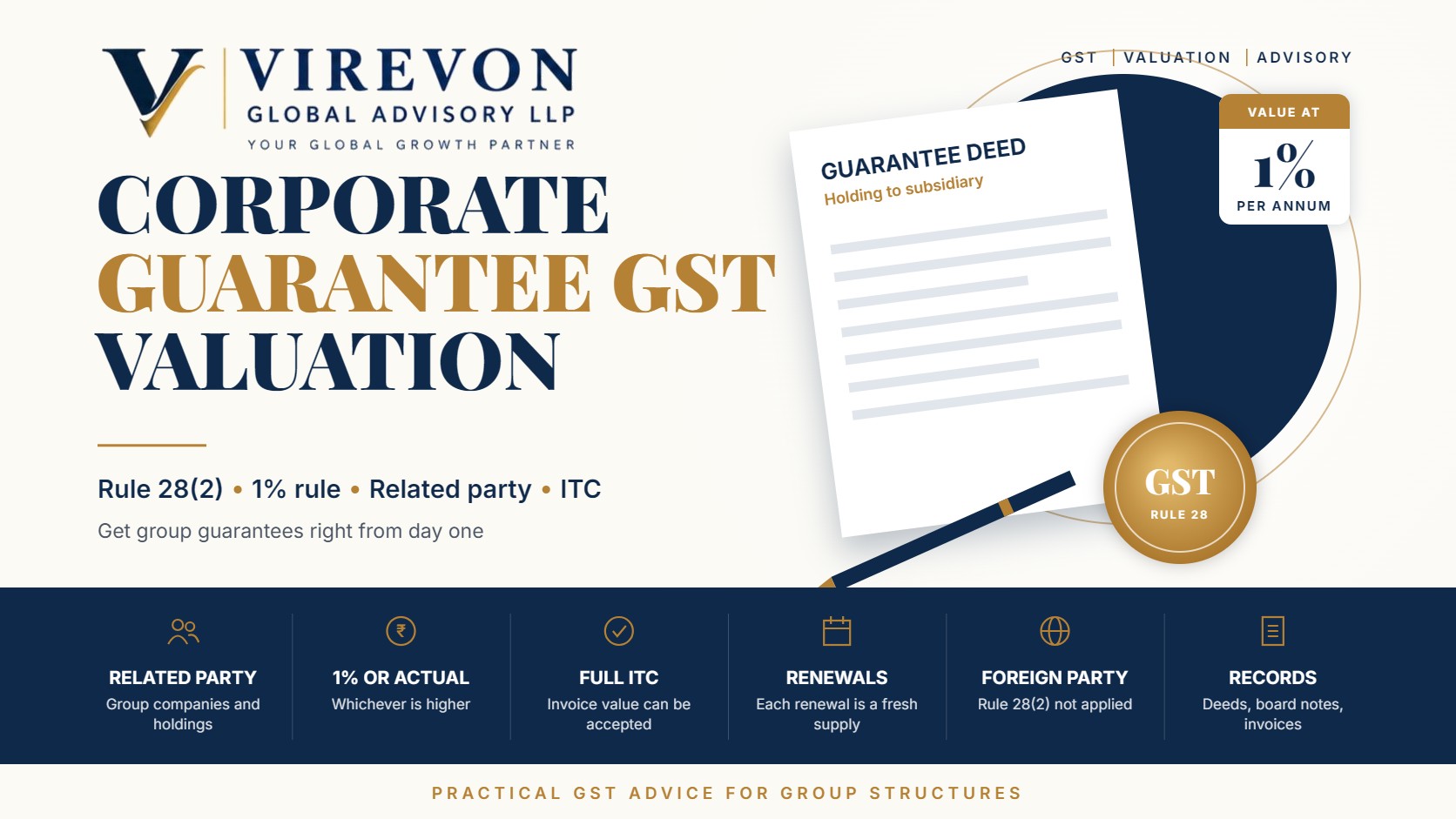
    • Rule 28(2) of the CGST Rules values it at 1% of the amount guaranteed per annum, or the actual consideration if higher.
    • Where the recipient is eligible for full ITC, the value declared in the invoice is deemed to be the value, which can reduce the practical burden.
    • The rule does not apply where the recipient of the guarantee is located outside India.
    • Personal guarantees given by directors without consideration are generally treated as having nil value, as clarified by CBIC.

    Why a free guarantee is taxable

    Under Schedule I, a supply between related persons made in the course of business is treated as a supply even without consideration. A guarantee issued by one group company for the benefit of another is such a service. The recipient of the service is the company whose borrowing is supported, not the bank.

    The applicable GST rate on this financial service is 18%. For a domestic transaction, the guarantor raises a tax invoice on the related company; where the guarantor is abroad and the recipient is in India, the Indian company may need to consider reverse charge. Our guide on reverse charge on services explains how RCM works in practice.

    Rule 28(2): the 1% valuation for GST on corporate guarantee

    Rule 28(2), inserted by notification with effect from 26 October 2023, provides that the value of a guarantee between related persons (or by a company to a banking or financial institution on behalf of a related person) is:

    • 1% of the amount guaranteed, per annum, or
    • the actual consideration, whichever is higher.

    A later amendment in 2024 added that where the recipient is eligible for full ITC, the value declared in the invoice is deemed to be the value of supply. In practice, this means that if the subsidiary can claim full credit, the tax charged by the guarantor is neutral for the group, and the department generally does not seek to substitute a higher value.

    How CBIC has clarified the rule

    CBIC issued clarifications in Circular 204/16/2023-GST and Circular 225/19/2024-GST. The main points, in plain terms:

    SituationPosition
    Guarantee issued before 26 October 2023Rule 28(2) valuation does not apply; earlier valuation principles apply
    Guarantee for several yearsValue based on 1% of the guaranteed amount for each year of the guarantee
    Renewal of an existing guaranteeTreated as a fresh supply, valued again under the rule
    Loan not fully disbursedValue is based on the amount guaranteed, not the amount drawn
    Recipient located outside IndiaRule 28(2) does not apply
    Several co-guarantorsValue apportioned among them
    Director’s personal guarantee, no considerationOpen market value treated as nil, so no tax

    On multi-year guarantees, review the timing of the tax liability carefully with the circular and your agreement, because the time of supply depends on when the invoice is issued or payment made.

    Worked example

    A holding company guarantees a ₹20 crore term loan taken by its Indian subsidiary for three years. No fee is charged, and the subsidiary is a fully taxable business eligible for full ITC.

    1. The value under the 1% rule would be ₹20 lakh for each year, or ₹60 lakh for the full term.
    2. GST at 18% on ₹60 lakh is ₹10.8 lakh.
    3. The holding company pays this and raises an invoice; the subsidiary claims the same amount as ITC.
    4. Net cost to the group is close to nil, apart from the timing of cash flow.

    Where the subsidiary makes exempt supplies (for example, some financial services or residential rentals), full ITC is not available. In that case the 1% value applies and the tax becomes a real cost, so it should be factored into financing decisions.

    Compliance checklist for group guarantees

    • Keep a register of all guarantees: guarantor, beneficiary, lender, amount, period, renewal dates and any fee.
    • Confirm whether the beneficiary is a related person under the GST definition.
    • Assess whether the recipient is eligible for full ITC and document the conclusion.
    • Issue tax invoices on time and report them in GSTR-1; ensure the recipient reports and accepts them correctly.
    • Diary renewals and enhancements, as each is a fresh valuation event.
    • For foreign group entities, examine place of supply, export of services conditions and reverse charge separately.
    • Align the transfer pricing and GST positions so that guarantee fees are consistent across tax laws.

    Our GST 2.0 business checklist is a useful companion for reviewing related-party transactions more widely.

    If you receive a notice

    Notices on corporate guarantees often arise from audit observations or balance sheet disclosures of contingent liabilities. A calm, document-based response usually works best: show the guarantee period, the related-party status, the invoice raised (or the reason none was required) and the recipient’s ITC eligibility. If a formal show cause notice is issued, see our guide on replying to GST show cause notices.

    Frequently asked questions

    Is GST payable on a corporate guarantee given free of cost to a subsidiary?

    Yes, where the parties are related. The service is treated as a supply even without consideration and is valued under Rule 28(2).

    What is the value of a corporate guarantee under GST?

    1% of the amount guaranteed per annum, or the actual consideration, whichever is higher. Where the recipient is eligible for full ITC, the invoice value is deemed to be the value of supply.

    Does Rule 28(2) apply to guarantees given for a foreign subsidiary?

    No. CBIC has clarified that the rule does not apply where the recipient is located outside India, though other GST provisions still need to be examined.

    Is a director’s personal guarantee for a company loan taxable?

    Where the director receives no consideration, CBIC has clarified that the open market value is treated as nil, so no GST is payable.

    If your group has guarantees in place and you would like them reviewed for GST, our team would be glad to help you set up a simple, compliant process.

    This article is general information based on the law as of September 2026, and is not legal or tax advice. Please check the facts of your own case with a professional before acting.