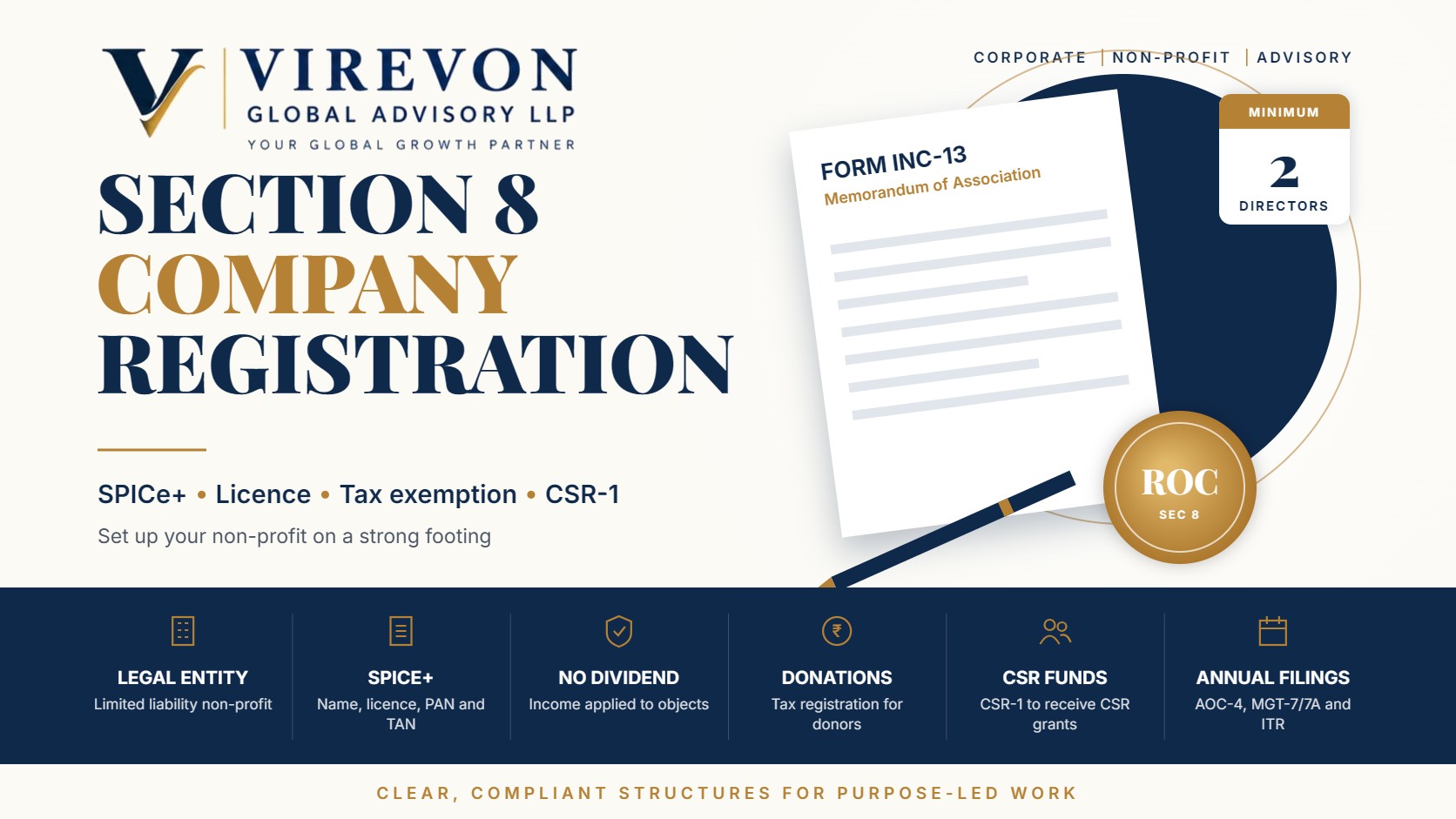
Founders who want to run an education initiative, a skilling programme, a health project or a research foundation often ask which legal form suits them best. For many, Section 8 company registration is the right answer. A Section 8 company is a company formed under the Companies Act 2013 to promote charitable or social objects, with the credibility of a registered company and the discipline of annual filings.
This guide covers who can form one, the registration process, the documents you will need, the benefits and restrictions, and the compliance that follows each year.
Key takeaways
- A Section 8 company promotes objects such as education, art, science, sports, research, social welfare, religion, charity or protection of the environment.
- Profits must be applied to its objects; no dividend can be paid to members.
- Incorporation, the Section 8 licence, PAN and TAN are handled together through the SPICe+ web form.
- There is no minimum capital, and the name need not end with “Limited” or “Private Limited”.
- After incorporation, apply for income-tax registration and donor-deduction approval, and CSR-1 if you plan to receive CSR funds.
What is a Section 8 company?
Section 8 of the Companies Act 2013 allows the Central Government to grant a licence to a company that intends to promote specified charitable objects, applies its income to those objects and prohibits payment of dividends. It can be formed as a private or public company.
Compared with trusts and societies, a Section 8 company offers a uniform national framework, limited liability for members, a clear board structure and greater comfort for corporate donors, CSR partners and foreign institutions.
| Feature | Section 8 company | Trust | Society |
|---|---|---|---|
| Governing law | Companies Act 2013 | State trust law or Indian Trusts Act | Societies Registration Act (and State laws) |
| Regulator | Registrar of Companies | Charity commissioner / sub-registrar | Registrar of Societies |
| Limited liability | Yes | No | Generally no |
| Governance | Board of directors, members | Trustees | Governing body |
| Perceived credibility with CSR donors | High | Moderate | Moderate |
Section 8 company registration process
- Arrange DSCs for proposed directors and subscribers. A private Section 8 company needs at least two directors and two members.
- Reserve the name through SPICe+ Part A. Names often use words such as Foundation, Forum, Association, Federation, Council or Chambers.
- Draft the MOA and AOA. The memorandum is in Form INC-13, with objects clearly limited to the charitable purposes.
- Prepare declarations: Form INC-14 by a practising professional and Form INC-15 by each subscriber, confirming compliance with Section 8.
- Prepare projections: an estimate of income and expenditure for the next three years, showing sources of funds.
- File SPICe+ Part B with the attachments, together with linked forms for PAN, TAN and other registrations.
- Receive the licence and certificate. On approval, the Section 8 licence is issued along with the certificate of incorporation, PAN and TAN.
Processing time depends on the Central Registration Centre’s queries; well-drafted objects and consistent projections help avoid resubmissions.
Documents checklist
- PAN and address proof of each director and subscriber
- Aadhaar or passport for identity (passport and apostilled documents for foreign nationals)
- Proof of registered office address with the owner’s no-objection letter and a recent utility bill
- MOA (INC-13) and AOA
- Declarations in INC-14 and INC-15
- Estimated income and expenditure for three years
- Consent of directors (DIR-2)
Benefits of a Section 8 company
- No minimum capital, so the company can be started with modest contributions.
- Name flexibility without the Limited suffix.
- Tax exemption and donor deductions, once registered under the income-tax law.
- Access to CSR funds after registering on the MCA portal in Form CSR-1.
- Some procedural relaxations under the Companies Act, such as fewer board meeting requirements for certain Section 8 companies. Check the current exemption notification for the conditions.
- Perpetual succession and clear ownership of property in the company’s name.
Restrictions to keep in mind
- Income and assets must be used only to promote the stated objects.
- No dividend or distribution of surplus to members, directly or indirectly.
- Changes to the MOA or AOA generally need prior approval.
- On winding up, surplus assets are transferred to another Section 8 company or similar body with like objects, not to members.
- The licence can be revoked if conditions are breached.
Tax registrations after incorporation
A Section 8 company is not automatically exempt from income tax. It must apply for registration as a charitable institution, and separately for approval that allows donors to claim a deduction. Under the Income-tax Act 1961 these were sections 12AB and 80G; from 1 April 2026 equivalent provisions apply under the Income-tax Act 2025 with new section and form numbers. A provisional registration is typically granted first, followed by regular registration after activities begin.
If the company will receive foreign contributions, registration or prior permission under the Foreign Contribution (Regulation) Act is needed before accepting any foreign funds. GST registration applies only if taxable supplies cross the threshold or other conditions apply.
Annual compliance
| Compliance | Typical timeline |
|---|---|
| Board meetings and AGM | As per Act and applicable relaxations |
| Statutory audit of accounts | Every year |
| AOC-4 (financial statements) | Within 30 days of the AGM |
| MGT-7 or MGT-7A (annual return) | Within 60 days of the AGM |
| DIR-3 KYC of directors | Annually |
| Income-tax return and audit report for charitable entities | By the applicable due dates |
| Donation statement and certificates to donors | Annually |
| CSR utilisation records | As agreed with CSR donors |
Our guide on ROC annual filing: AOC-4 and MGT-7 explains the forms in detail. If you are still comparing structures, our article on private limited company registration covers the for-profit route.
Frequently asked questions
How many people are needed to form a Section 8 company?
A private Section 8 company needs at least two directors and two members; a public one needs at least three directors and seven members.
Can a Section 8 company pay salaries to its directors?
It can pay reasonable remuneration for services actually rendered, subject to its articles and the conditions of its licence, but it cannot distribute profits.
Is a Section 8 company exempt from income tax automatically?
No. It must obtain registration as a charitable institution under the income-tax law and meet the conditions on application of income.
Can a Section 8 company receive CSR funds?
Yes, once it is registered on the MCA portal in Form CSR-1 and meets the eligibility conditions in the CSR rules.
If you are planning to set up a non-profit and would like help with Section 8 company registration and the tax registrations that follow, we would be glad to guide you.
This article is general information based on the law as of September 2026, and is not legal or tax advice. Please check the facts of your own case with a professional before acting.
Leave a Reply