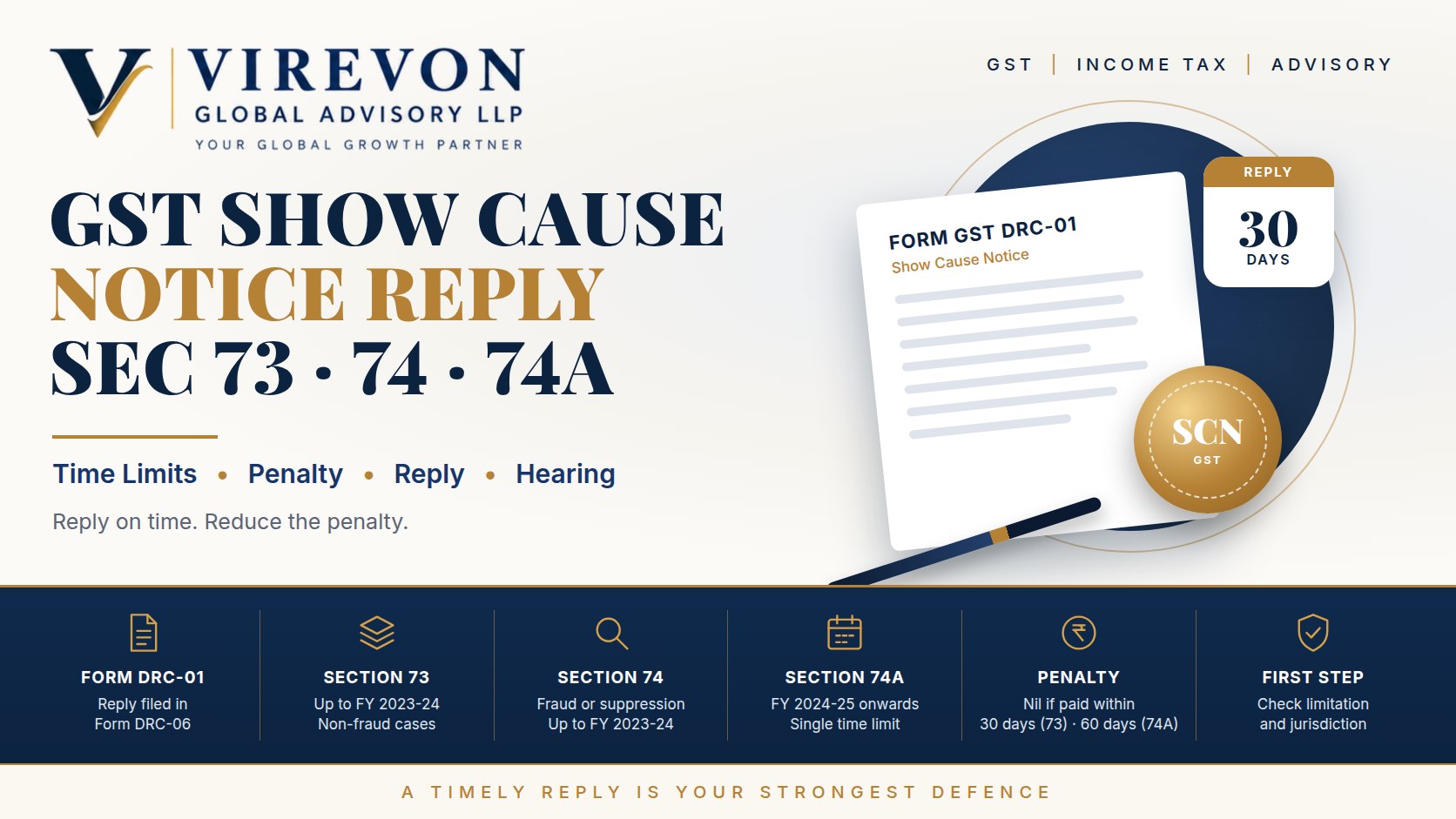
A show cause notice (SCN) in Form GST DRC-01 is the department formally saying that it believes tax has been short-paid, not paid, wrongly refunded, or that input tax credit (ITC) was wrongly availed. Which section the notice is issued under decides the time limit, the penalty, and how much you can save by acting early. This guide explains Sections 73, 74 and 74A of the CGST Act in plain terms and sets out what to do in the first week after the notice arrives.
Section 73, 74 or 74A: which one applies?
Section 73 covers demands where there is no fraud, wilful misstatement or suppression of facts. It applies to tax periods up to FY 2023-24.
Section 74 covers demands involving fraud, wilful misstatement or suppression of facts to evade tax. It also applies up to FY 2023-24.
Section 74A applies from FY 2024-25 onwards and replaces both. It uses a single time limit, with different penalties depending on whether fraud or suppression is alleged.
Look at the top of the DRC-01 and the tax period it covers. A notice for FY 2024-25 citing Section 73 or 74 has cited the wrong provision, and that is worth raising in your reply.
Time limits the department must meet
Section 73: the order must be passed within 3 years of the due date of the annual return for that year, and the SCN must be issued at least 3 months before that date.
Section 74: the order must be passed within 5 years of the annual return due date, and the SCN at least 6 months before that date.
Section 74A: the SCN must be issued within 42 months of the annual return due date, and the order within 12 months of the SCN (extendable by up to 6 months).
A notice or order issued after its time limit is invalid. Checking limitation is always the first step. It is also why an unusually large number of notices and orders appears near the end of each year’s window.
Penalty, and how to reduce it
The biggest saving in most SCNs comes from timing.
Section 73 (non-fraud): no penalty if tax and interest are paid before the SCN, or within 30 days of it. Otherwise the penalty is 10% of the tax or ₹10,000, whichever is higher.
Section 74 (fraud/suppression): penalty of 15% if paid before the SCN, 25% if paid within 30 days of the SCN, 50% if paid within 30 days of the order, and 100% otherwise.
Section 74A: for non-fraud cases, no penalty if tax and interest are paid within 60 days of the SCN. For fraud or suppression cases, the penalty is 15% if paid before the SCN, 25% if paid within 60 days of the SCN, 50% if paid within 60 days of the order, and 100% otherwise.
Paying is not an admission that you agree. Where part of the demand is clearly correct, it often makes sense to pay that part within the window and contest the rest.
What to do in the first 7 days
Note the reply date and the hearing date. Both are in the notice. If there is no hearing date, ask for one in writing.
Check limitation and jurisdiction. Is the notice within time? Is the right officer issuing it? Is the correct section cited for the tax period?
Download the attachments. The DRC-01 summary is short. The detailed grounds are usually in an attached PDF, and that is what you are replying to.
Reconcile the numbers. Rebuild the officer’s figures from GSTR-1, GSTR-3B, GSTR-2A/2B, GSTR-9 and your books. Most demands contain at least some arithmetic or duplication errors.
Decide pay vs contest for each item, using the penalty windows above.
Draft and file the reply in DRC-06 with annexures, and attend the hearing.
Common grounds that succeed
The SCN or order is time-barred or cites the wrong section for the period
ITC was denied only because of a GSTR-2A/2B mismatch, while the invoices, payments and supplier returns support the claim
Turnover differences caused by credit notes, advances or amendments in later months
Non-application of mind: an order that ignores the reply, or a summary in DRC-07 that goes beyond the SCN
No opportunity of a personal hearing before an adverse order
Received a DRC-01 or DRC-01A? Send it to us on WhatsApp. We review GST notices for businesses across Delhi NCR.
This article is general information based on the CGST Act as amended, and is not legal advice. Check the facts of your own notice with a professional before acting.
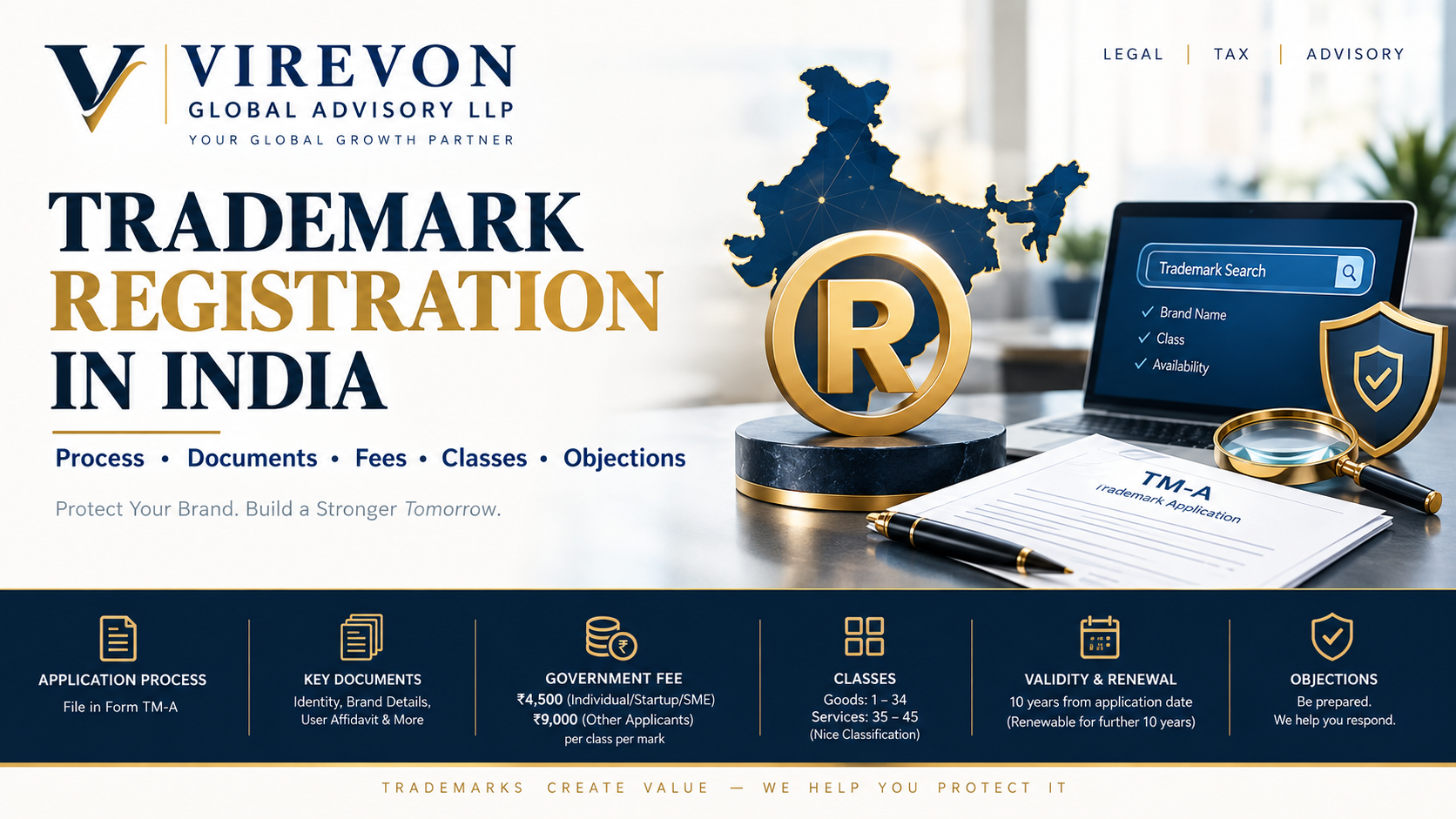
Trademark registration in India is an important step for protecting a brand name, logo, slogan, product identity or business name. However, simply filing a trademark application does not mean that the trademark is immediately registered.
After filing, a trademark application passes through several stages such as Formalities Check, Examination, Examination Report, Objected, Hearing, Accepted, Advertised, Opposed and Registered.
Understanding these trademark application status meanings can help applicants know what is happening with their application and what action may be required.
This guide explains the trademark registration process in India, the approximate timeline for each stage, the meaning of common trademark statuses and what an applicant should do at each stage.
Quick Overview: Trademark Registration Timeline in India
A typical trademark application may move through the following process:
Trademark Search
      ↓
Select Trademark Class
      ↓
Prepare Documents
      ↓
File TM-A Application
      ↓
Application Number Generated
      ↓
Formalities Check
      ↓
Examination
      ↓
Examination Report
      ↓
 ┌───────────────┐
 │ No Objection  │
 └───────┬───────┘
         ↓
      Accepted
         ↓
Trade Marks Journal
         ↓
4-Month Opposition Period
         ↓
 ┌────────────────────┐
 │ No Opposition       │
 └─────────┬──────────┘
           ↓
      REGISTERED ®

OR

Examination Objection
        ↓
Reply to Examination Report
        ↓
Hearing, if required
        ↓
Acceptance / Refusal
The official IP India workflow follows this general structure, including formalities examination, substantive examination, examination objections, hearing, acceptance, journal publication and opposition proceedings. (IP India)
1. What Is a Trademark Application?
A trademark application is an application filed with the Indian Trade Marks Registry to obtain legal protection for a mark used or intended to be used in connection with particular goods or services.
A trademark may include:
Brand name
Business name
Logo
Symbol
Tagline
Slogan
Word mark
Device mark
Combination of words and logo
Certain non-traditional marks where legally registrable
The application is generally filed using Form TM-A.
The applicant must identify the relevant Nice Classification class or classes covering the goods or services for which protection is sought. IP India’s filing guidance specifically identifies trademark search, class selection, applicant details, representation of the mark and Form TM-A filing as key parts of the process. (IP India)
The following table provides a simplified understanding of the major stages.
Stage / Status
Approx. Indicative Time
What It Means
Applicant’s Action
Application Filed
Day 0
Application has been submitted
Keep application number safely
Formalities Check
Few weeks to several months
Registry checks basic filing requirements
Monitor status
Vienna Codification
Variable
Applies mainly where the application contains a device/logo element
Usually no immediate action
Marked for Examination
Variable
Application is awaiting substantive examination
Monitor
Examination Report Issued
Variable
Registrar has examined the application
Read objections carefully
Objected
Usually after examination
Registry has raised one or more objections
File reply within prescribed period
Hearing
Variable
Objection could not be resolved solely on written reply or hearing is required
Attend/represent at hearing
Accepted
Variable
Application has been accepted for registration
Monitor Journal publication
Advertised / Published
Variable
Mark has been published for public opposition
Monitor opposition period
Opposed
Depends on third-party action
Someone has formally opposed registration
Defend opposition
Registered
After successful completion
Trademark has been entered on the Register
Maintain and renew trademark
Refused
Variable
Application has been refused
Consider available review/appeal remedies
Abandoned
Variable
Application stopped progressing because required action was not taken
Examine restoration/remedy options
Important: These are practical indicative periods, not statutory guarantees. The actual time may vary significantly depending on Registry workload, examination, objections, hearings, opposition and other procedural issues.
3. Status: “Application Filed”
Meaning
This is the starting point of the trademark registration process.
The application has been submitted to the Trade Marks Registry and an application number has generally been generated.
What should you do?
Keep copies of:
Trademark application
Application number
Filing date
Applicant details
Trademark representation
Goods/services description
Class details
User claim, if applicable
Power of Attorney, where applicable
The filing date is particularly important because it establishes the application’s position in the registration process.
Typical Timeline
Day 0 onward
The application then proceeds for processing and examination.
4. Status: “Formalities Check”
Meaning
The Registry first checks whether the application satisfies basic procedural and filing requirements.
This may include checking:
Applicant details
Application form
Prescribed fee
Trademark representation
Class information
Documents
Other filing requirements
IP India’s official workflow identifies Formality Check as an early stage of the trademark application process. (IP India)
If a deficiency is raised, the applicant may need to correct or respond to it within the applicable time.
5. Status: “Vienna Codification”
What Does Vienna Codification Mean?
If the trademark contains a logo, symbol, graphical element or other figurative component, the mark may undergo Vienna Codification.
The Vienna Classification is an international classification system used for figurative elements of trademarks.
For example:
Brand + Logo
may be processed differently from a simple:
WORD MARK
This stage does not mean that the trademark has been registered.
It is essentially part of the Registry’s processing and classification workflow.
6. Status: “Marked for Examination”
This means the application is moving toward substantive examination by the Trade Marks Registry.
The Registry examines the application against relevant legal requirements and searches earlier trademarks to identify potentially conflicting marks.
Under the Trade Marks Rules, examination includes searching earlier trademarks to determine whether identical or deceptively similar marks exist for the relevant goods or services. (IP India)
7. Status: “Examination Report”
This is one of the most important stages in the trademark registration process.
The Registrar may raise objections under provisions including:
Section 9 – absolute grounds for refusal
Section 11 – relative grounds for refusal
Other applicable provisions depending on the facts of the application
Common Trademark Objections
Examples include:
Trademark is descriptive
Trademark lacks distinctiveness
Trademark is generic
Trademark is deceptively similar to an earlier mark
Conflict with an existing trademark
Incorrect or overly broad specification
Classification-related issues
Formal or procedural deficiencies
The official Trade Marks Rules provide for an examination report where the Registrar objects to acceptance or proposes conditions, amendments or limitations. (IP India)
8. Status: “Objected”
What Does “Objected” Mean?
Objected does NOT mean that the trademark has been finally rejected.
It means the Trademark Registry has raised an objection that must be addressed.
This is a critical distinction.
What Should the Applicant Do?
The applicant should:
Download the Examination Report.
Identify every objection.
Analyse the cited trademarks, if any.
Prepare a legally supported reply.
Provide evidence of use where relevant.
Submit supporting documents where necessary.
Request/attend a hearing if the matter proceeds to hearing.
Under Rule 33, the applicant must respond to an examination report within the prescribed period; failure to respond can result in the application being treated as abandoned. (IP India)
Simplified Flow
Examination Report
       ↓
    Objection
       ↓
Prepare Reply
       ↓
Registry Review
       ↓
 ┌───────────────┐
 │ Objection     │
 │ Resolved      │
 └───────┬───────┘
         ↓
      Accepted

OR

Reply Not Accepted
       ↓
Show Cause Hearing
       ↓
Decision
9. Trademark Examination Report Reply
A strong trademark objection reply should not simply state:
“Our trademark is different.”
A professional response generally analyses:
Applicant’s mark
Earlier cited mark
Visual similarity
Phonetic similarity
Structural similarity
Conceptual similarity
Goods/services
Trade channels
Consumer profile
Nature of business
Actual use, if applicable
Distinctiveness
Relevant legal provisions
Supporting evidence
For businesses that have already used a trademark, proof of use can become particularly important depending on the objection and factual circumstances.
10. Status: “Hearing”
What Does Hearing Mean?
If the objection is not resolved on the written response alone, the Registry may provide an opportunity for a hearing.
The applicant or authorised representative may present arguments and clarify the issues raised by the Registry.
The applicant should carefully monitor hearing notices and comply with the prescribed procedural requirements.
11. Status: “Accepted”
What Does “Accepted” Mean?
This is an important positive procedural stage.
It generally means the application has been accepted for advertisement/registration process, either unconditionally or subject to applicable conditions.
However:
Accepted ≠ Registered
The trademark still has to pass through the publication and opposition stage.
IP India’s workflow shows acceptance followed by publication in the Trade Marks Journal and then the opposition period. (IP India)
12. Status: “Advertised” or “Published”
Once accepted, the trademark application is published in the Trade Marks Journal.
The purpose is to provide an opportunity for third parties to oppose the registration.
This is an important distinction:
Application Filed
Means:
“I have applied.”
Accepted
Means:
“The Registry has accepted the application for the next stage.”
Advertised
Means:
“The application has been published for public opposition.”
Registered
Means:
“The trademark has been entered on the Register.”
13. Opposition Period – Usually 4 Months
After publication in the Trade Marks Journal, a third party may oppose the trademark within the prescribed opposition period.
The current Trade Marks Rules provide a four-month period for filing a notice of opposition from publication/re-advertisement in the Trade Marks Journal. (IP India)
Opposition Flow
Trademark Journal Publication
             ↓
       Opposition Window
             ↓
      ┌──────┴──────┐
      ↓             ↓
 No Opposition    Opposition
      ↓             ↓
 Registration     Opposition
                    ↓
             Counterstatement
                    ↓
                 Evidence
                    ↓
                 Hearing
                    ↓
                 Decision
14. Status: “Opposed”
Meaning
An Opposed status means a third party has filed an opposition against the trademark application.
This does not automatically mean that the applicant has lost.
The applicant gets an opportunity to defend the application through the prescribed opposition procedure.
Opposition proceedings can involve:
Notice of Opposition
Counterstatement
Evidence
Replies/evidence
Hearing
Registrar’s decision
Further legal remedies where available
IP India’s materials describe opposition proceedings under Section 21 and the applicable Trade Marks Rules. (IP India)
Why Do Trademarks Get Opposed?
Common reasons may include:
Similarity with an existing trademark
Prior use
Prior registration
Likelihood of confusion
Bad-faith allegations
Descriptiveness
Lack of distinctiveness
Similar goods/services
Proprietary or commercial interest
The actual grounds depend upon the opposition notice and facts of the case.
15. Status: “Registered”
What Does “Registered” Mean?
This is the stage at which the trademark has successfully completed the registration process and has been entered on the Register of Trade Marks.
The proprietor can then use the registered trademark rights available under applicable Indian trademark law, subject to the scope of registration and other legal limitations.
The trademark can generally be represented with:
®
after registration.
Important
Do not use ® merely because a trademark application has been filed.
An application may use terms such as:
TM
while a registered trademark may use:
®
subject to applicable law.
16. Status: “Refused”
Meaning
A Refused status means the Registrar has refused the application after considering the applicable objections, responses and/or hearing.
This does not necessarily mean that every possible legal remedy has ended.
Depending on the order and circumstances, the applicant may have options such as review, appeal or other appropriate legal proceedings.
The appropriate remedy depends upon:
Date of order
Nature of order
Grounds of refusal
Procedural history
Applicable law
Available limitation period
Professional legal advice should be taken promptly after a refusal order.
17. Status: “Abandoned”
What Does Abandoned Mean?
An application may be treated as abandoned when the applicant fails to take a required procedural step within the applicable period.
Examples may include failure to:
Respond to an examination report
Attend a required hearing
Comply with a Registry direction
Remedy certain deficiencies
The Trade Marks Rules specifically provide circumstances in which failure to respond to an examination report or attend a hearing can lead to abandonment. (IP India)
Important
Abandoned does not mean “rejected after full merits examination.”
The procedural history should be examined before deciding what remedy or fresh filing strategy may be appropriate.
18. Complete Trademark Status Flowchart
Here is a simplified flowchart for understanding the entire process:
19. How Long Does Trademark Registration Take in India?
There is no single guaranteed trademark registration timeline applicable to every application.
A straightforward application without objections or opposition can progress considerably faster than a contested application.
A practical way of looking at the process is:
Situation
Possible Overall Time
Straightforward application with smooth processing
Several months
Application with examination objection
Longer than a straightforward application
Application requiring hearing
Further time may be required
Application facing opposition
Potentially substantially longer
Complex contested matter
Can extend for years
Therefore, applicants should not rely on statements such as:
“Every trademark is registered in exactly X months.”
The Registry’s own workflow contains multiple decision points, and the time required at each stage can vary. (IP India)
20. Can Trademark Registration Be Expedited?
Yes.
The Trade Marks Rules provide for expedited processing through Form TM-M, subject to the applicable prescribed fee and conditions.
The Rules state that an application for expedited processing is to be examined expeditiously and ordinarily within three months from submission of the expedited-processing request, with subsequent proceedings also intended to be dealt with expeditiously subject to the applicable guidelines. (IP India)
However:
Expedited processing does not guarantee registration.
An objection, hearing, opposition or other legal issue can still affect the ultimate outcome.
21. Trademark Application Status vs. Trademark Registration Status
One of the biggest misunderstandings among business owners is treating every status as registration.
Status
Registered?
Basic Meaning
Application Filed
❌ No
Application submitted
Formalities Check
❌ No
Initial procedural processing
Vienna Codification
❌ No
Figurative/logo classification stage
Marked for Examination
❌ No
Awaiting/under examination
Objected
❌ No
Examination objection exists
Hearing
❌ No
Matter requires/has hearing
Accepted
❌ No
Accepted for next stage
Advertised
❌ No
Published for opposition
Opposed
❌ No
Third-party opposition filed
Registered
✅ Yes
Trademark registered
Refused
❌ No
Registration refused
Abandoned
❌ No
Application treated as abandoned
22. Most Important Trademark Statuses in One Line
For quick reference:
New Application / Filed → Application has been submitted.
Formalities Check → Registry is checking procedural requirements.
Vienna Codification → Figurative/logo elements are being classified where applicable.
Marked for Examination → Application is awaiting substantive examination.
Exam Report → Registrar has examined the application.
Objected → Registry has raised an objection.
Reply Filed → Applicant has responded to the examination objection.
Hearing → Applicant is required to present arguments before the Registry.
Accepted → Application has been accepted for the next stage.
Advertised → Application has been published in the Trade Marks Journal.
Opposed → A third party has challenged the application.
Registered → Trademark has been registered.
Refused → Registration has been refused.
Abandoned → Application has stopped due to failure to comply with a required procedural step or other applicable reason.
23. Trademark Registration: Common Mistakes to Avoid
Mistake 1: Filing Without a Trademark Search
A business may invest heavily in a brand only to discover that a similar trademark already exists.
A proper trademark search in India should consider:
Identical marks
Phonetically similar marks
Similar spelling
Similar business categories
Related goods/services
Existing applications
Existing registrations
Mistake 2: Choosing the Wrong Trademark Class
Trademark protection is connected to the goods/services covered by the registration.
For example:
A technology company, restaurant, clothing brand and financial service provider may require different classes depending on their activities.
Therefore, Nice Classification and the correct description of goods/services are important parts of trademark filing strategy.
Mistake 3: Treating “Objected” as “Rejected”
This is one of the most common misunderstandings.
Objected ≠ Rejected
An objection creates an opportunity to respond.
The quality and legal basis of the response can be important to the subsequent outcome.
Mistake 4: Ignoring the Examination Report
An examination report should not be ignored.
The Trade Marks Rules prescribe a response period, and failure to respond can result in the application being treated as abandoned. (IP India)
Mistake 5: Ignoring Trade Marks Journal Publication
Even after acceptance, applicants should monitor the Trade Marks Journal because the application becomes open to opposition.
Mistake 6: Using ® Before Registration
A pending trademark application is not the same as a registered trademark.
Use the appropriate designation based on the actual legal status of the mark.
24. Trademark Registration Checklist for Businesses
Before filing:
☐ Conduct trademark availability search ☐ Check similar marks ☐ Identify correct Nice class ☐ Decide Word Mark vs Logo Mark ☐ Verify applicant’s legal name ☐ Prepare trademark representation ☐ Prepare goods/services description ☐ Determine whether use claim applies ☐ Collect supporting documents ☐ File Form TM-A ☐ Preserve application number and filing date
After filing:
☐ Monitor application status ☐ Download examination report if issued ☐ Respond to objections within time ☐ Monitor hearing notices ☐ Check Trade Marks Journal publication ☐ Monitor opposition period ☐ Download registration certificate after registration ☐ Maintain trademark records ☐ Monitor renewal deadline
25. Word Mark vs Logo Mark – Which Application Should You Consider?
A business may have:
Brand Name: VIREVON
and
Logo: Stylised VIREVON design
These may involve different trademark protection considerations.
Word Mark
Protects the word/name as a trademark, subject to the scope and legal protection available.
Device/Logo Mark
Protects the particular graphical representation of the mark.
Businesses should consider their branding strategy before deciding whether to file one or multiple applications.
26. Trademark Registration for Startups and MSMEs
Trademark registration is particularly relevant for:
Startups
D2C brands
E-commerce businesses
Amazon sellers
Flipkart sellers
Manufacturers
Service businesses
SaaS companies
Restaurants
Clothing brands
Cosmetic brands
FMCG businesses
Professional service firms
Digital businesses
Export businesses
For an expanding business, trademark protection should ideally be considered before significant investment is made in:
Packaging
Advertising
Social media
Website
Marketplaces
Distribution
Franchise expansion
International expansion
27. Trademark Registration for E-Commerce Businesses
For online sellers, trademark protection can be particularly relevant because a brand may be used across:
Amazon
Flipkart
Meesho
Shopify
Own website
Social media
Digital advertising
Product packaging
Marketplace listings
A properly planned trademark strategy can form part of a broader brand protection and intellectual property strategy.
28. Trademark Protection in India and Global Expansion
Indian businesses expanding internationally should distinguish between:
Indian trademark registration
and
international trademark protection.
Trademark rights are generally territorial. Registration in India does not automatically provide equivalent trademark rights in every foreign country.
Businesses looking for international trademark protection may consider national/regional filings or the Madrid System, depending on the countries involved and eligibility.
Under WIPO’s Madrid System, an applicant generally starts with a national or regional “basic mark” and can seek protection in designated member jurisdictions. Each designated country’s IP office applies its own domestic law and can grant or refuse protection. (WIPO)
29. India Trademark Registration vs International Trademark Registration
Factor
India Trademark
International / Madrid Route
Main purpose
Protection in India
Seeking protection across designated jurisdictions
Authority
Indian Trade Marks Registry
WIPO + designated national offices
Basic filing
TM-A
Madrid international application
Examination
Indian law
Domestic law of each designated country
Geographic protection
India
Designated countries/regions
Automatic worldwide protection?
No
No
Local objections possible?
Yes
Yes
International expansion
Separate foreign strategy may be needed
Madrid may simplify multi-country filing
WIPO specifically notes that each designated Madrid System member conducts substantive examination under its own domestic law and may issue a provisional refusal. (WIPO)
30. Frequently Asked Questions About Trademark Status
How long does trademark registration take in India?
There is no fixed universal timeline. A straightforward application may progress within several months, while objections, hearings or opposition can significantly extend the process.
What does “Objected” mean in trademark status?
It means that the Registry has raised an objection against the application. It does not automatically mean that the application has been finally rejected.
What happens after a trademark is accepted?
The application generally proceeds toward publication in the Trade Marks Journal, where third parties have an opportunity to oppose it. (IP India)
How long is the trademark opposition period in India?
Under the Trade Marks Rules, a notice of opposition is generally filed within four months from publication/re-advertisement in the Trade Marks Journal. (IP India)
Does “Accepted” mean my trademark is registered?
No.
Accepted and Registered are different stages.
Can an accepted trademark still be opposed?
Yes.
Publication creates the opportunity for third-party opposition.
What happens if my trademark is opposed?
The applicant may need to defend the application through opposition proceedings, which can involve counterstatement, evidence and hearing.
What does “Abandoned” mean?
It generally indicates that the application has been treated as abandoned because a required procedural action was not taken or another applicable abandonment provision has operated.
Can a refused trademark application be challenged?
Depending on the order and circumstances, legal remedies such as review or appeal may be available. The applicable remedy and limitation period should be examined immediately.
Can I register my trademark internationally?
International protection can be pursued through national/regional filing routes or, where eligible, the WIPO Madrid System. A single international filing does not mean automatic protection in every country. (WIPO)
31. The Most Important Takeaway
The trademark application journey should not be understood simply as:
Filed → Registered
Instead, it is better understood as:
FILED
  ↓
FORMALITIES
  ↓
EXAMINATION
  ↓
OBJECTION? ── YES → REPLY → HEARING
  │                         ↓
  NO                    ACCEPTANCE
  │                         ↓
  └─────────────────────────┘
             ↓
       JOURNAL PUBLICATION
             ↓
     4-MONTH OPPOSITION
             ↓
       NO OPPOSITION
             ↓
          REGISTERED
The most important point is to monitor the application continuously and respond to every Registry communication within the applicable deadline.
A trademark application is not simply a filing exercise. Trademark search, class selection, drafting of goods/services, examination reply, evidence of use, opposition management and post-registration monitoring can all influence the protection strategy.
32. Professional Trademark Assistance
Businesses planning trademark registration in India should consider obtaining professional assistance for:
Trademark availability search
Trademark classification
Word mark registration
Logo/device mark registration
TM-A filing
Examination report analysis
Trademark objection reply
Hearing representation
Trademark opposition
Counterstatement
Trademark renewal
Trademark assignment
Trademark licensing
Trademark watch services
International trademark registration
Madrid Protocol applications
Trademark infringement and enforcement strategy
For startups, e-commerce businesses and established brands, trademark protection should be considered as part of the broader intellectual property and brand protection strategy.
Conclusion
Understanding trademark application status in India helps applicants avoid unnecessary delays and missed deadlines.
The key stages are:
Application Filed → Formalities Check → Examination → Examination Report → Objection/Reply → Hearing, if required → Acceptance → Trade Marks Journal → Opposition Period → Registration
Not every application follows exactly the same timeline. Applications without objections may move more smoothly, while applications involving examination objections, hearings or opposition can take substantially longer.
The safest approach is therefore to track the application regularly, understand each status and take the required action within the applicable statutory or procedural deadline.
For businesses building a long-term brand, trademark registration should be treated not merely as a certificate but as part of a broader intellectual property, brand protection and commercial expansion strategy.
Official Sources
IP India – Trademark Application Workflow
Trade Marks Rules, 2017
Trade Marks Act, 1999
IP India – Trademark Filing Process
WIPO – Madrid System
This article is provided for general informational purposes and does not constitute legal advice. Trademark outcomes and timelines depend on the facts of each application, the applicable law and the proceedings before the Trade Marks Registry.
SEO keyword set
Primary keywords: trademark registration in India, trademark application status, trademark registration process, trademark registration timeline, trademark application timeline, trademark status India, trademark application status India
High-intent keywords: trademark registration online, trademark application India, trademark search India, trademark objection, trademark objection reply, trademark examination report, trademark hearing, trademark opposition, trademark journal, trademark registration fees, trademark renewal India, trademark lawyer India
Long-tail keywords: trademark registration process in India step by step, how to check trademark application status, trademark status meaning in India, how long does trademark registration take in India, what does objected mean in trademark, what does accepted mean in trademark, what happens after trademark acceptance, trademark opposition period India, trademark examination report reply, trademark application abandoned meaning, trademark application refused meaning, trademark registration timeline India 2026, trademark registration for startups India, trademark registration for ecommerce business, international trademark registration from India
Global keywords: international trademark registration, global trademark registration, Madrid Protocol trademark, WIPO trademark registration, international trademark protection, global brand protection, trademark registration worldwide, Madrid System India
Protect your brand. Build your identity. Secure your business.
A brand is more than just a name or logo. For many businesses, the brand represents years of investment in marketing, customer relationships, goodwill and reputation. As a business grows, protecting that brand becomes an important part of its long-term strategy.
Trademark Registration in India provides a statutory framework for protecting eligible trademarks in relation to specified goods or services. Individuals, startups, companies, LLPs, partnership firms and other eligible applicants can apply for trademark registration through the Indian Trade Marks Registry.
Whether you are launching a startup, building an e-commerce brand, expanding an established business or protecting an existing brand, understanding the trademark registration process can help you make better decisions before filing.
Quick Take: A successful trademark strategy starts before the application is filed. Trademark search, ownership, classification, specification of goods/services and the basis of use should be carefully evaluated before submitting Form TM-A.
The government fee figures above are the prescribed e-filing fees shown by IP India and are payable per class and per mark. Professional fees, where applicable, are separate.
What Is a Trademark?
A trademark is a sign capable of distinguishing the goods or services of one person from those of another.
A trademark may include:
Brand names
Words
Letters
Numerals
Logos
Symbols
Device marks
Slogans
Colour combinations
Shapes of goods or packaging
Sound marks
Other eligible distinctive marks
The purpose of a trademark is to help consumers identify the source of goods or services and distinguish them from those of other businesses.
Example
Suppose a company launches a clothing brand called “ABCORA” with a distinctive logo.
The business may need to evaluate:
ABCORA → Word Mark
and
ABCORA Logo → Device/Logo Mark
depending on its intended protection strategy.
Why Is Trademark Registration Important for a Business?
Trademark registration can provide important legal and commercial advantages.
1. Protect Your Brand Identity
Registration provides statutory protection for the registered mark in relation to the goods or services covered by the registration.
2. Build a Valuable Business Asset
A trademark can become an important intangible asset of a business.
It may also be relevant to:
Licensing
Assignment
Franchising
Business restructuring
Investment
Commercial transactions
3. Strengthen Enforcement Rights
Registration can provide a stronger statutory basis for taking action against certain unauthorized uses of the registered trademark.
4. Support Business Expansion
A protected brand can be particularly relevant when a business expands into:
E-commerce
New cities
New states
Franchising
Distributors
New product lines
International markets
5. Build Consumer Recognition
A consistent and protected brand can help a business develop long-term recognition and goodwill.
6. Protect Long-Term Brand Value
The longer a business invests in a brand, the more commercially important that brand may become.
For this reason, trademark protection should ideally be considered before substantial investment is made in marketing and brand development.
Who Can Apply for Trademark Registration in India?
A trademark application can be filed by eligible individuals and entities, including:
Applicant
Can Apply?
Individual
✓
Proprietorship
✓
Startup
✓
Small Enterprise
✓
Partnership Firm
✓
LLP
✓
Private/Public Company
✓
Trust/Society
✓
Foreign Applicant
✓
IP India’s guidance states that individuals, startups, SMEs, companies, partnership firms, trusts/societies and foreign applicants can apply for trademark registration. Applications may be filed directly or through a registered trademark agent or attorney.
Trademark Classes in India
One of the most important decisions before filing a trademark application is selecting the correct trademark class.
India follows the Nice Classification system.
Classes
Category
1–34
Goods
35–45
Services
Why Is Class Selection Important?
Trademark registration is connected with the goods or services covered by the application.
For example, businesses may need to consider classes relating to:
Clothing and apparel
Cosmetics
Food products
Pharmaceuticals
Software
Technology services
Advertising
Business management
Retail services
Education
Financial services
Legal services
Restaurant services
Manufacturing
Consultancy
The correct class should be determined from the actual and intended goods or services of the business.
Important: Choosing a trademark class simply because another business has used it can be risky. The classification should correspond with the applicant’s actual business activities and intended protection.
Trademark Search in India: The Most Important Step Before Filing
Before applying for trademark registration, a trademark availability search should be conducted.
However, a proper search is not simply an exact-name search.
A preliminary assessment may consider:
Exact Match + Phonetic Similarity + Visual Similarity + Related Goods/Services + Relevant Class
Example
Suppose a business wants to register:
VIREZA
Searching only for “VIREZA” may not be sufficient.
Potentially relevant marks may include names that are:
Phonetically similar
Visually similar
Conceptually similar
Used for related goods or services
A Proper Trademark Search Can Help Identify:
Existing registered trademarks
Pending applications
Similar trademarks
Relevant classes
Potential examination issues
Possible conflicts
IP India’s own filing process places checking availability, assessing similarity/conflicts and selecting the appropriate class among the initial steps.
Trademark Registration Process in India
The overall process can be understood through the following stages:
01 — Brand & Trademark Selection
↓
02 — Trademark Search
↓
03 — Class Selection
↓
04 — Ownership & Documents
↓
05 — Form TM-A Filing
↓
06 — Examination
↓
07 — Objection Reply / Hearing, If Required
↓
08 — Trade Marks Journal Publication
↓
09 — Opposition Period
↓
10 — Registration
↓
11 — Renewal
IP India’s official step-by-step process follows this general sequence.
Step 1: Select the Trademark
First, determine exactly what you want to protect.
This may be:
Brand name
Word mark
Logo
Device mark
Tagline
Slogan
Other eligible distinctive mark
For an important brand, businesses should evaluate whether protection should be sought for the word element, logo element or both.
Step 2: Conduct a Trademark Search
Search the relevant trademark records before filing.
The search should consider both identical and potentially conflicting marks.
A trademark search can help answer:
“Is this brand reasonably suitable for filing, or are there existing marks that may create a conflict?”
It is important to remember that a search does not guarantee registration.
Step 3: Select the Correct Class
Determine which Nice Classification class or classes apply.
A business offering multiple products or services may need to evaluate more than one class.
For example:
Business Activity
Class Assessment
Clothing
Relevant goods class
Cosmetics
Relevant goods class
Advertising services
Class 35 may be relevant
Software/technology services
Relevant class based on actual service
Education
Relevant education/services class
Restaurant services
Relevant hospitality/services class
The exact class should be determined from the actual nature of the goods or services.
Step 4: Identify the Correct Trademark Owner
This step is frequently overlooked.
Before filing, determine who should own the trademark:
Individual
Proprietorship
Partnership
LLP
Company
Other eligible entity
The owner should ideally correspond with the intended commercial ownership of the brand.
Practical Point: If a founder owns the trademark personally but the company builds the entire business around that brand, future licensing, assignment or ownership arrangements may require additional consideration.
Step 5: Prepare Documents and Information
Depending on the application, the required information may include:
Applicant name
Applicant address
Entity details
PAN/identification details
Trademark representation
Goods/services description
User status
Prior-use details, where applicable
User affidavit and supporting documents, where required
Startup/small-enterprise documents, where applicable
Power of Attorney, where applicable
IP India’s filing guidance specifically identifies applicant details, trademark representation, goods/services description and applicable user affidavit/Power of Attorney requirements.
Step 6: File Form TM-A
A new trademark registration application is filed through Form TM-A.
The application may be filed online through the Trade Marks Registry’s e-filing system.
Before submission, review:
✓ Applicant details ✓ Trademark representation ✓ Class ✓ Goods/services description ✓ User status ✓ Supporting documents ✓ Applicant category ✓ Government fee
IP India’s official filing process identifies TM-A as the application form for new trademark registration.
Trademark Registration Fees in India
The government filing fee depends on the applicant category.
Current E-Filing Government Fee
Applicant Category
Fee per Class per Mark
Individual
₹4,500
Startup
₹4,500
Small Enterprise
₹4,500
Other Applicants
₹9,000
The official IP India fee schedule specifies these amounts for TM-A applications and states that the fee applies for each class and each mark.
Example
If an eligible startup files:
1 trademark × 2 classes
Government e-filing fee:
₹4,500 × 2 = ₹9,000
If an applicant in the “other applicants” category files the same application:
₹9,000 × 2 = ₹18,000
Note: Professional fees, if any, are separate from government filing fees.
Step 7: Trademark Examination
After filing, the Trade Marks Registry examines the application.
The examination process may consider:
Distinctiveness
Earlier trademarks
Similarity
Classification
Goods/services specification
Statutory requirements
Other applicable grounds
The official workflow identifies substantive examination under relevant provisions including Sections 9 and 11.
Step 8: Trademark Objection
If the Registry raises an objection, the applicant may need to respond.
A trademark objection may arise due to issues such as:
Absolute Grounds
For example:
Lack of distinctiveness
Descriptive character
Generic nature
Other statutory restrictions
Relative Grounds
For example:
Similarity with an earlier trademark
Likelihood of confusion
Other conflicts under applicable law
The response should be based on the actual examination report and facts of the application.
How to Respond to a Trademark Objection
A professional trademark objection response may involve:
Reviewing the examination report
Identifying each objection
Reviewing the cited trademarks
Analysing similarity
Reviewing the goods/services
Preparing legal submissions
Providing evidence where relevant
Filing the response within the prescribed time
Preparing for a hearing if scheduled
If the objection is not resolved through the written response, the application may proceed to a show-cause hearing.
Step 9: Trademark Journal Publication
If the application proceeds to publication, it is advertised in the Trade Marks Journal.
This allows third parties an opportunity to oppose the application.
Under the current Trade Marks Rules, a notice of opposition is generally required to be filed within four months from the date of publication/re-advertisement.
Trademark Opposition vs. Trademark Objection
These two terms are often confused.
Trademark Objection
Trademark Opposition
Raised during examination
Raised after publication
Raised by the Trade Marks Registry
Filed by a third party
Usually addressed through examination response
Can become a contested proceeding
May involve a hearing
May involve pleadings, evidence and hearing
Based on examination of the application
Based on opposition grounds raised by opponent
Understanding this distinction is important when monitoring a trademark application.
Step 10: Trademark Registration
If the application successfully completes the applicable stages and there is no successful opposition or other legal barrier, the trademark proceeds toward registration.
The Trade Marks Act provides for registration where the application has been accepted and the opposition period has expired without opposition, or where opposition proceedings have been decided in favour of the applicant.
How Long Is a Trademark Valid in India?
A registered trademark is generally valid for:
10 Years
The registration can be renewed for further periods of 10 years.
IP India’s current guidance confirms that trademark registration is valid for 10 years from the date of application and may be renewed for additional 10-year periods.
Trademark Lifecycle
Application
→ Examination
→ Publication
→ Registration
→ 10-Year Protection
→ Renewal
→ Further 10-Year Period
Renewal can continue for successive periods, subject to the applicable law and prescribed requirements.
Proposed-to-Be-Used vs. Prior Use Trademark
A trademark application may be filed on different factual bases.
Basis
Meaning
Proposed to be used
Applicant intends to use the trademark
Prior use
Applicant claims the trademark has already been used
Where prior use is claimed, appropriate evidence and a user affidavit may be required.
Evidence of Prior Use May Include
Depending on the circumstances:
Sales invoices
Product packaging
Advertisements
Website records
Product catalogues
Marketing material
Sales records
Other commercial documents
A prior-use claim should be made carefully and should be capable of being supported with appropriate evidence.
Common Trademark Registration Mistakes
❌ 1. Filing Without a Trademark Search
An application may face avoidable issues if potentially conflicting marks are not identified before filing.
❌ 2. Choosing the Wrong Class
Trademark protection is connected with the goods/services covered by the registration.
❌ 3. Filing Only the Logo
If the brand name itself is commercially important, businesses should evaluate whether word-mark protection is also appropriate.
❌ 4. Making an Unsupported Prior-Use Claim
Prior use should not be claimed without appropriate supporting evidence.
❌ 5. Ignoring an Examination Report
An objection requires timely attention.
❌ 6. Ignoring Journal Publication
Businesses should monitor the application even after examination because third-party opposition may arise after publication.
❌ 7. Forgetting Renewal
A trademark portfolio should have a proper renewal calendar.
Trademark Registration for Startups
For startups, trademark registration should ideally be considered during the early stages of brand development.
This becomes particularly important when a startup is investing in:
Website development
Social media
Digital advertising
Packaging
E-commerce
Influencer marketing
Product development
Distribution
Franchise development
Startup Trademark Checklist
Brand Name → Search → Class → Owner → Application → Monitor → Protect → Renew
Early planning can help reduce the risk of building substantial commercial goodwill around a brand without first considering its trademark position.
Trademark Registration for E-Commerce Businesses
E-commerce businesses often build significant value around a product or brand name.
This is particularly relevant for:
Amazon sellers
Flipkart sellers
D2C brands
Private-label businesses
Online retailers
Marketplace businesses
Social-commerce businesses
A growing e-commerce business should consider trademark protection alongside:
Product listings
Packaging
Brand stores
Digital advertising
Social media
Influencer campaigns
Distributor relationships
Trademark registration can form one part of a broader brand-protection strategy.
Trademark Registration vs. Company Registration
These are two different legal processes.
Company/LLP Registration
Trademark Registration
Establishes a legal business entity
Protects an eligible trademark
Relates to business structure
Relates to specified goods/services
Governed by applicable entity laws
Governed by trademark law
Does not automatically create trademark rights
Provides statutory trademark protection subject to law
Example: Company/LLP incorporation
Example: Brand name registration
Important
Registering a company name does not automatically mean that the company’s brand is registered as a trademark.
A business should evaluate its company-name and trademark strategy separately.
Trademark Registration for International Expansion
Indian trademark registration does not automatically provide worldwide trademark protection.
If a business plans to expand internationally, it should consider trademark protection in relevant countries or territories based on its actual and planned markets.
An international trademark strategy may consider:
Current countries of operation
Planned expansion markets
Brand ownership
Relevant goods/services
Existing trademarks
Licensing
Franchising
International filing strategy
For businesses planning cross-border expansion, trademark protection should be considered alongside the overall international business structure.
Trademark Renewal in India
Trademark registration should not be treated as a one-time activity.
A business should maintain a trademark portfolio containing:
Information
Purpose
Trademark name
Identify the brand
Application number
Track the application
Registration number
Track registered rights
Filing date
Determine relevant dates
Class
Identify protected goods/services
Owner
Confirm ownership
Renewal date
Prevent missed deadlines
Status
Monitor current position
Regular monitoring is particularly important for businesses holding multiple trademarks.
Frequently Asked Questions
How much does trademark registration cost in India?
The current government e-filing fee for a new TM-A application is ₹4,500 per class per mark for individuals, startups and small enterprises, and ₹9,000 per class per mark for other applicants. Professional fees are separate.
How long is trademark registration valid?
A registered trademark is generally valid for 10 years from the date of application and can be renewed for further 10-year periods.
Can an individual register a trademark?
Yes. Individuals are eligible to apply for trademark registration.
Can a startup register a trademark?
Yes. Startups can apply for trademark registration and eligible startups can avail the applicable government fee category.
Can I register a trademark before starting my business?
Yes, an application can generally be filed on a proposed-to-be-used basis, subject to the applicable legal requirements.
Can one trademark be registered in multiple classes?
A trademark application can cover multiple classes, with the prescribed fee applicable for each class and mark.
What happens if my trademark receives an objection?
The applicant may need to file an appropriate response to the examination report and may be required to attend a hearing if the matter proceeds to that stage.
What happens if someone opposes my trademark?
The matter may proceed as a trademark opposition proceeding involving the prescribed pleadings, evidence and hearing process. The applicable procedure depends on the circumstances of the opposition.
Is trademark registration mandatory for every business?
Trademark registration is not generally mandatory merely to operate a business. However, businesses building valuable brands should consider trademark protection as part of their intellectual-property strategy.
Does company registration protect my brand?
No. Company/entity registration and trademark registration are separate processes.
Trademark Registration Checklist
Before filing your application, review the following:
Check
Status
Brand name finalized
☐
Logo finalized, if applicable
☐
Trademark search completed
☐
Similar marks reviewed
☐
Correct class identified
☐
Goods/services specification prepared
☐
Correct owner identified
☐
Use status determined
☐
Prior-use evidence collected, if applicable
☐
Startup/Small Enterprise status verified
☐
Applicant documents prepared
☐
TM-A reviewed
☐
Government fee calculated
☐
Application filed
☐
Application status monitored
☐
Examination report reviewed
☐
Objection response filed, if required
☐
Hearing monitored, if required
☐
Journal publication monitored
☐
Opposition period monitored
☐
Registration status confirmed
☐
Renewal date recorded
☐
How Virevon Global Advisory LLP Can Help
At Virevon Global Advisory LLP, we assist businesses, startups, companies, LLPs and entrepreneurs with structured business, legal, tax and compliance advisory.
Our Trademark Support Includes:
Trademark Search Preliminary assessment of the proposed brand and potentially conflicting marks.
Class Selection Assistance in identifying the relevant goods/services classification.
Application Preparation Support in preparing information and documentation for trademark filing.
TM-A Filing Support Assistance with the trademark application process.
Examination & Objection Support Review and assistance in responding to examination objections.
Hearing Support Assistance in preparing for applicable trademark hearings.
Opposition Support Documentation and coordination relating to trademark opposition matters.
Renewal Support Monitoring and assistance with trademark renewal requirements.
IP & Business Advisory Trademark considerations integrated with the wider business and brand strategy.
Why Choose a Structured Trademark Strategy?
A trademark application should not be viewed as merely completing an online form.
A better approach is:
SEARCH
Identify potentially conflicting marks.
ANALYSE
Evaluate similarity, classes and business use.
PLAN
Determine ownership and protection strategy.
FILE
Prepare and submit the appropriate application.
MONITOR
Track examination, publication and opposition.
PROTECT
Maintain registration and respond to issues when they arise.
RENEW
Maintain the trademark through timely renewal.
Build Your Brand. Protect Your Identity.
Your brand may represent years of investment, customer trust and business reputation.
Whether you are:
Launching a Startup | Building an E-Commerce Brand | Expanding an Existing Business | Protecting a Product Name | Developing a Franchise | Entering New Markets
trademark protection should be considered as part of your long-term business strategy.
Need assistance with Trademark Registration in India?
Virevon Global Advisory LLP can assist with trademark search, classification, application support, examination objections, opposition-related matters, renewal and related intellectual-property advisory.
VIREVON GLOBAL ADVISORY LLP Legal | Tax | Advisory
Final Takeaway
Trademark registration in India is not merely about obtaining a registration certificate. It is about building a structured strategy for protecting one of your business’s most valuable intangible assets — its brand.
A careful approach to trademark search, classification, ownership, application drafting, examination, objection management, publication, opposition monitoring and renewal can help businesses manage their trademark portfolio more effectively.
If you are planning to launch or expand a brand, consider evaluating its trademark position before investing heavily in marketing and commercial expansion.
Disclaimer
This article is intended for general informational and educational purposes only and does not constitute legal advice or create an advocate-client relationship. Trademark registration depends on the specific facts, mark, applicant, goods/services, prior marks, evidence and proceedings involved. Government fees, forms, procedures and applicable requirements may change. Readers should verify the latest requirements with the Indian Trade Marks Registry/IP India before filing or taking action.
Official sources: IP India, Trade Marks Act, 1999 and Trade Marks Rules, 2017.