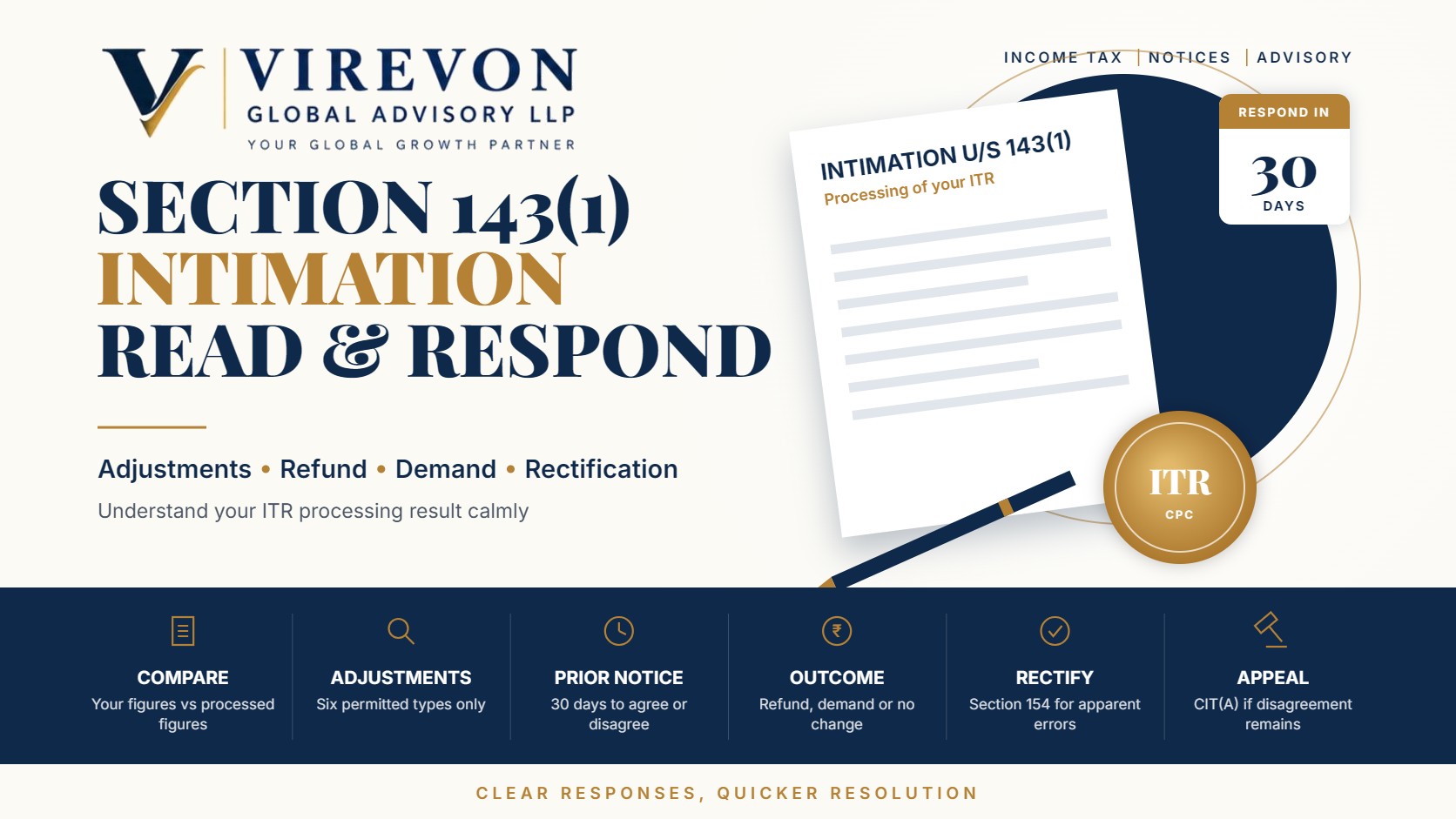
A section 143(1) intimation is the most common communication taxpayers receive from the Income Tax Department, and in most cases it is simply confirmation that your return has been processed. It is not a scrutiny notice. The Centralised Processing Centre (CPC) compares your return with its own computation and tells you whether you get a refund, owe tax or neither.
Where the department has made an adjustment, however, the intimation deserves careful reading. This article explains what the intimation contains, which adjustments are allowed, how to respond to a proposed adjustment and what to do if you think the processing is wrong. Returns for FY 2025-26 (AY 2026-27) are processed under section 143(1) of the Income-tax Act, 1961, so this remains fully relevant this season.
Key takeaways
- An intimation under section 143(1) is issued after processing your return and may show no demand, a refund or a demand.
- Only six kinds of adjustment are allowed, such as arithmetical errors and income in Form 26AS not included in the return.
- Before making an adjustment, CPC must give you a prior communication and 30 days to respond.
- For a return filed in July 2026, the intimation can be issued up to 31 December 2027.
- Errors can usually be fixed through rectification under section 154; appeals are available where the disagreement is on merits.
What the intimation contains
The intimation is sent by email and is available on the e-filing portal. The PDF is usually protected with your PAN in lowercase followed by your date of birth in DDMMYYYY format.
It shows two columns: as provided by the taxpayer and as computed under section 143(1). Rows cover income under each head, deductions, tax, interest, TDS and advance tax credits, and the final result.
| Result | What it means | What to do |
|---|---|---|
| No demand, no refund | Your computation was accepted | Keep it on file; nothing further is needed |
| Refund | Tax paid exceeds tax due | Check bank account validation and track the refund |
| Demand | Tax is payable after processing | Compare line by line, then pay, respond or seek rectification |
The six permitted adjustments
Section 143(1)(a) allows CPC to adjust returned income only for:
- Arithmetical errors in the return.
- Incorrect claims apparent from information in the return, such as a deduction claimed beyond the statutory limit.
- Disallowance of a loss claimed where the return for the year of loss was filed after the due date.
- Disallowance of expenditure or increase in income indicated in the tax audit report but not reflected in the return.
- Disallowance of specified deductions that require the return to be filed by the due date, where it was filed late.
- Addition of income appearing in Form 26AS, Form 16A or Form 16 that has not been included in the return.
Anything outside these categories, such as a disagreement on how income should be classified, generally cannot be decided in summary processing. It is examined in a scrutiny assessment instead.
Responding to a proposed adjustment
Before making any adjustment, CPC sends a communication describing the proposed change. You have 30 days to respond on the e-filing portal, in the pending actions section.
The response options are simple:
- Agree with the adjustment, if you accept that the department’s figure is correct.
- Disagree and give reasons, with supporting explanation where helpful.
If you do not respond in time, CPC proceeds with the adjustment. A response is always worth making where you have a genuine explanation, because it is easier to prevent an incorrect demand than to reverse one.
A worked example
Meera, a salaried employee, files her return for FY 2025-26 in July 2026. Form 26AS shows fixed deposit interest of ₹48,000 from a bank, which she did not report. CPC proposes to add the interest to her income.
On checking, Meera finds the deposit is held jointly with her mother, who is the first holder and has already offered the interest in her own return. The TDS was reported against Meera’s PAN because of a bank error.
Meera selects disagree and explains the joint holding, with the bank certificate and her mother’s return details. She also asks the bank to correct its TDS statement. Had she not responded, the addition would have created a demand of about ₹15,000 at her 30% slab including cess.
When you receive a demand you do not accept
Work through these steps in order:
- Compare the two columns row by row and identify exactly where the difference arises.
- Check common causes: TDS not matching Form 26AS, a deduction not claimed in the correct schedule, advance tax paid against the wrong year, or relief under section 89 not claimed with Form 10E.
- Respond to the outstanding demand on the portal, stating whether you agree, partly agree or disagree.
- File a rectification request under section 154 where the error is apparent from the record, such as a TDS credit not given despite appearing in Form 26AS. Our guide on outstanding tax demand and rectification explains the process.
- File an appeal before the Commissioner (Appeals) if the disagreement is on a matter of law or fact that rectification cannot cover. Appeal time limits are short, so decide quickly.
- Consider a revised return if you discover a genuine omission of your own and the time to revise is still open.
Good practices to avoid adjustments
- Reconcile your income with Form 26AS and the Annual Information Statement before filing.
- Report every TDS entry under the right head, even if the income is exempt.
- Where TDS appears under your PAN in error, ask the deductor to correct it rather than ignore it.
- For business returns, make sure disallowances reported by the tax auditor are reflected in the return.
- File on time, as late filing affects loss carry-forward and some deductions.
If your return is later picked for detailed examination, see our guide to the income tax scrutiny notice under section 143(2).
Frequently asked questions
Is a section 143(1) intimation a notice of scrutiny?
No. It is the result of summary processing of your return. Scrutiny is a separate, detailed assessment that begins with a notice under section 143(2).
How long does the department have to send a section 143(1) intimation?
Nine months from the end of the financial year in which the return was filed. For a return filed in July 2026, that is 31 December 2027.
What happens if I ignore a proposed adjustment?
If you do not respond within 30 days, CPC proceeds with the adjustment, which may create a demand or reduce your refund.
Can I file rectification against a section 143(1) intimation?
Yes, for mistakes apparent from the record, such as a TDS credit not allowed or an arithmetical error. Disputes on merits may need an appeal instead.
If you have received a section 143(1) intimation with an adjustment or demand you do not understand, our team would be glad to review it with you.
This article is general information based on the law as of September 2026, and is not legal or tax advice. Please check the facts of your own case with a professional before acting.
Leave a Reply