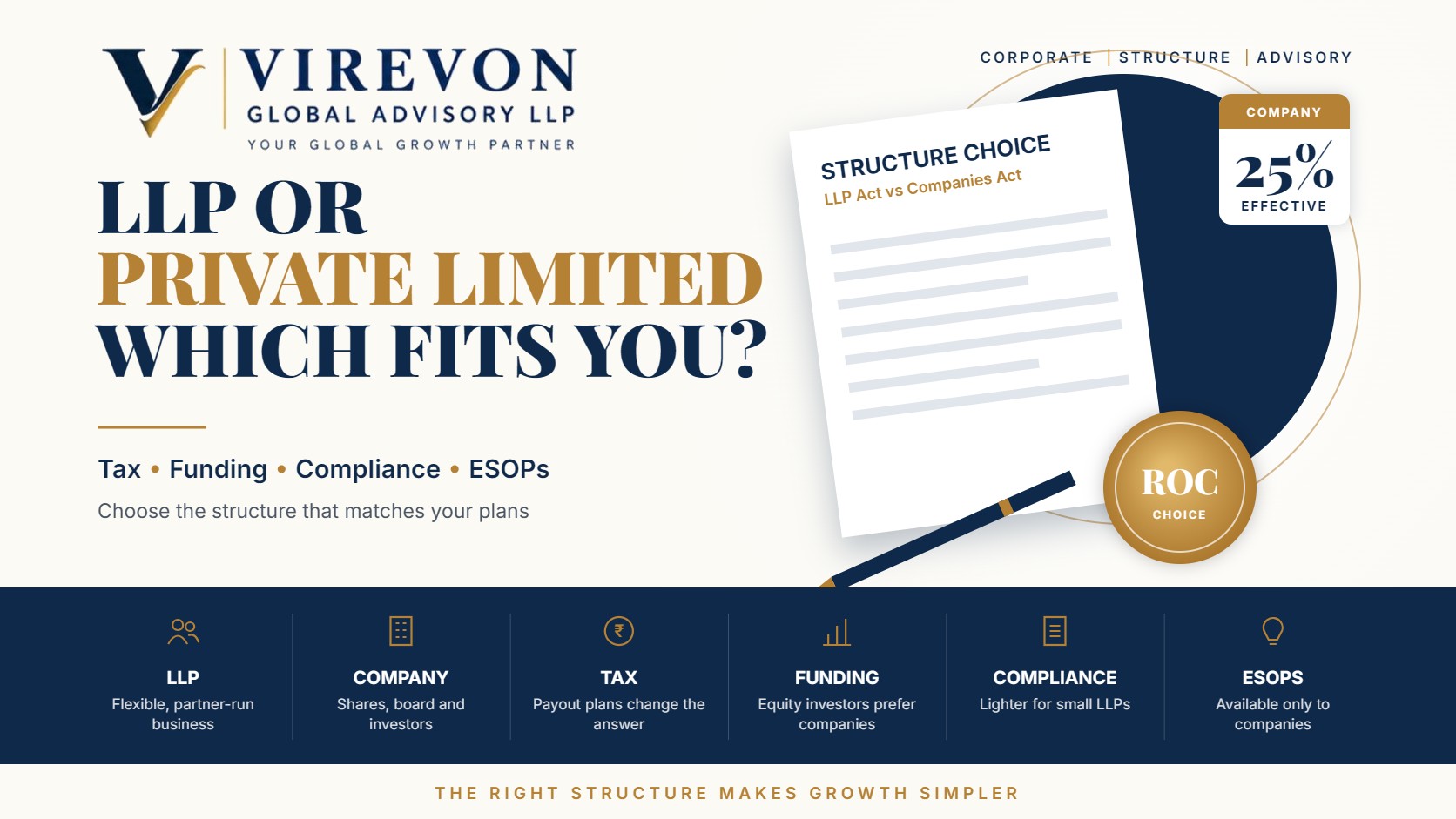
The LLP vs private limited question comes up at the start of almost every new venture, and again when an existing business grows. Both structures give limited liability, separate legal existence and perpetual succession. The differences lie in how profits are taxed, how much compliance each demands, and how easily each can raise money or reward employees with equity.
There is no universally better choice. A professional services firm run by three partners may be perfectly served by an LLP, while a product startup that expects to raise venture funding almost always needs a private limited company. This guide compares the two on the points that matter and works through an example.
Key takeaways
- An LLP suits owner-managed businesses that plan to distribute most profits and do not expect equity investors.
- A private limited company suits businesses that plan to raise equity, issue ESOPs or retain profits for growth.
- LLPs pay tax at 30% plus applicable surcharge and cess; profit share is not taxed again in partners’ hands.
- Companies opting for the concessional regime pay an effective rate of about 25.17%, but dividends are taxed in shareholders’ hands.
- A small LLP has noticeably lighter compliance than a company, which always needs an audit.
LLP vs private limited: side-by-side comparison
| Point | LLP | Private limited company |
|---|---|---|
| Governing law | LLP Act, 2008 | Companies Act, 2013 |
| Minimum owners | Two partners, two designated partners | Two shareholders, two directors |
| Ownership | Partners’ contribution under the LLP agreement | Shares, easy to transfer and value |
| Income tax | 30% plus surcharge above ₹1 crore and cess | About 25.17% under the concessional regime |
| Payout to owners | Profit share not taxed again; remuneration taxed as business income of partners | Salary taxed as salary; dividends taxed at shareholders’ slab rates |
| Statutory audit | Only if turnover exceeds ₹40 lakh or contribution exceeds ₹25 lakh | Always required |
| Annual ROC filings | Form 11 and Form 8 | AOC-4, MGT-7 or MGT-7A, plus event-based forms |
| Equity funding | Difficult; most investors do not invest in LLPs | Standard route for angel and venture funding |
| ESOPs | Not available | Available |
| Foreign investment | Automatic route only in sectors with 100% automatic FDI and no performance conditions | Automatic route in most sectors |
How tax works in each structure
LLP
An LLP is taxed as a firm. It pays tax on its profits at 30%, with a 12% surcharge where income exceeds ₹1 crore, plus 4% cess. Partners’ share of profit is not taxed again in their hands. The LLP can pay partners remuneration and interest on capital within limits set by the income-tax law; these are deductible for the LLP and taxable for the partners.
Private limited company
A domestic company can opt for the concessional regime, paying 22% plus a 10% surcharge and 4% cess, an effective rate of about 25.17%, without most deductions and incentives. Directors’ salaries are deductible for the company and taxable as salary. Dividends are taxed in the shareholders’ hands at their slab rates.
For tax year 2026-27 these rules continue under the Income-tax Act 2025, with rates set by the Finance Act. See our overview of the Income-tax Act 2025 key changes.
A worked example
Two founders expect a profit of ₹50 lakh before any payout to themselves. For simplicity, ignore remuneration, surcharge on individuals and other income.
If all profit is distributed:
- LLP: tax at 31.2% is ₹15.6 lakh. The remaining ₹34.4 lakh reaches the partners without further tax.
- Company: tax at 25.168% is about ₹12.58 lakh. If the remaining ₹37.42 lakh is paid as dividend to shareholders in the 30% slab, their tax at 31.2% is about ₹11.67 lakh. Total tax is about ₹24.26 lakh, and ₹25.74 lakh reaches the founders.
If most profit is retained for growth:
- The company pays about ₹12.58 lakh and keeps ₹37.42 lakh to reinvest.
- The LLP pays ₹15.6 lakh and keeps ₹34.4 lakh.
The lesson: an LLP tends to be more efficient when profits are regularly distributed; a company can be more efficient when profits are reinvested, and its advantages in funding and ESOPs often outweigh the tax difference. Actual results depend on salaries, remuneration, surcharge and the founders’ other income, so model your own numbers.
Compliance and running costs
LLP
- Form 11 by 30 May and Form 8 by 30 October each year. See our guide to LLP Form 8 and Form 11.
- Audit only above the turnover or contribution thresholds.
- Fewer mandatory meetings and registers.
Private limited company
- Board meetings each quarter (with relaxations for small companies), an AGM each year and statutory registers.
- Mandatory audit, AOC-4 and MGT-7 or MGT-7A. See our guide to ROC annual filing.
- Director KYC, auditor appointment filings and event-based forms.
A company will usually spend more each year on professional fees and internal administration than a small LLP.
Funding, ESOPs and exit
- Equity funding: angel investors, venture funds and most institutional investors invest through shares. A company structure is almost essential for this.
- ESOPs: only companies can grant stock options to employees, a key tool for startups hiring talent.
- Debt: banks lend to both, though companies may find it easier to create charges and raise larger facilities.
- Exit and succession: shares are easy to transfer or sell; transferring an LLP interest needs changes to the LLP agreement.
- Conversion: an LLP can later convert into a company, but it is simpler to start with the structure you expect to need.
A quick decision guide
Choose an LLP if most of these apply:
- You are a professional or service firm run by the owners.
- You plan to distribute most profits each year.
- You do not expect to raise equity from outside investors.
- You want lighter compliance while the business is small.
Choose a private limited company if most of these apply:
- You plan to raise angel or venture funding.
- You want to offer ESOPs.
- You plan to reinvest profits for growth.
- You want a structure that customers, lenders and foreign partners recognise easily.
Ready to proceed with a company? Our guide to private limited company registration explains the SPICe+ process.
Frequently asked questions
Is an LLP cheaper to run than a private limited company?
Usually yes, especially when turnover and contribution are below the audit thresholds, because a small LLP does not need a statutory audit and has fewer filings.
Which pays less tax, an LLP or a company?
It depends on how profits are used. An LLP often suits full distribution, while a company can be efficient when profits are retained. Model your own figures before deciding.
Can an LLP raise venture capital?
It is rare. Most investors require shares and a board structure, so startups planning to raise equity generally choose a private limited company.
Can I convert my LLP into a company later?
Yes, conversion is possible under the Companies Act, but it involves time and cost, so choose the right structure at the start where you can.
If you are weighing an LLP against a private limited company, our team would be happy to walk through the numbers and compliance with you.
This article is general information based on the law as of September 2026, and is not legal or tax advice. Please check the facts of your own case with a professional before acting.
Leave a Reply