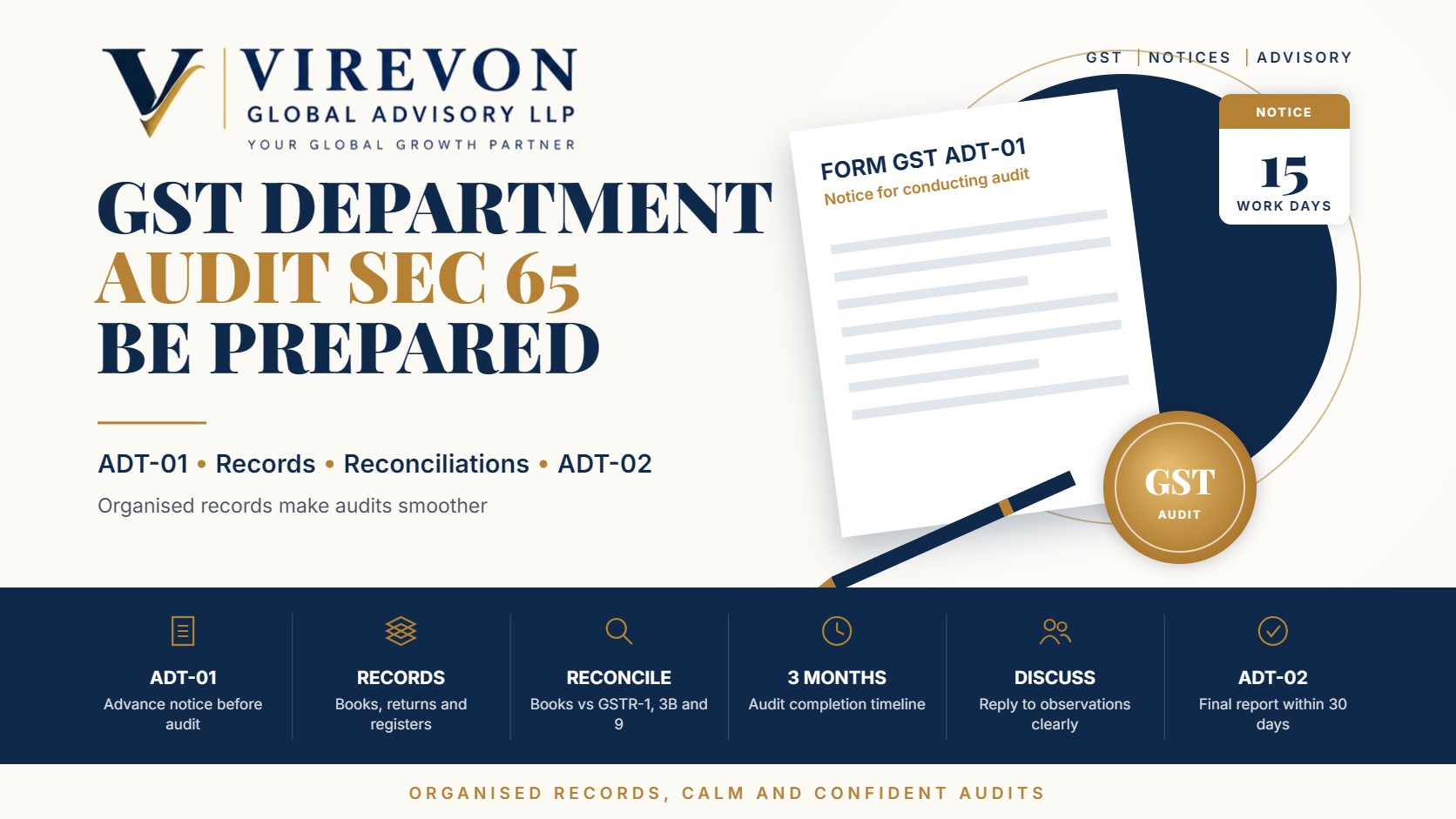
A GST audit under section 65 is a scheduled examination of your records by the tax department. It is different from a notice triggered by a specific mismatch: the officer reviews your returns, books and documents for a chosen period to check whether tax, credit and refunds have been dealt with correctly.
For a well-organised business, a departmental audit is largely an exercise in presenting records clearly. This guide explains the notice, the timelines, what officers typically ask for, and how to prepare so that the process stays smooth and professional.
Key takeaways
- Section 65 of the CGST Act empowers the Commissioner or authorised officers to audit any registered person; Rule 101 sets out the procedure.
- You receive an advance notice in Form GST ADT-01, at least 15 working days before the audit.
- The audit is to be completed within three months of commencement, extendable by up to six months with recorded reasons.
- Findings are communicated in Form GST ADT-02 within 30 days of completion of the audit.
- Where tax is found short paid, it can be paid voluntarily; otherwise proceedings may follow under the demand provisions.
How the GST audit under section 65 works
The ADT-01 notice
The audit begins with Form ADT-01, which names the period to be audited and asks you to either make records available at your place of business or produce them at the tax office. The notice period of at least 15 working days gives you time to gather documents and plan internally.
When the audit is treated as commenced
The three-month clock starts from the date on which the records called for are made available to the officer, or the date the audit actually begins at your premises, whichever is later. Keeping a note of submission dates is helpful for tracking timelines.
Observations and your reply
During the audit, the officer verifies documents, examines returns and financial statements, and may seek clarifications. Discrepancies noticed are communicated to you, and you get an opportunity to respond with explanations and supporting working. This is the most important stage: a well-reasoned reply often resolves an observation before it appears in the final report.
The ADT-02 report
On conclusion, the officer informs you of the findings, your rights and obligations, and the reasons, in Form ADT-02 within 30 days.
Timeline at a glance
| Stage | Form or event | Timeline |
|---|---|---|
| Intimation of audit | ADT-01 | At least 15 working days before the audit |
| Commencement | Records made available or audit starts | Later of the two dates |
| Completion | Audit concluded | Within 3 months, extendable by up to 6 months |
| Findings | ADT-02 | Within 30 days of conclusion |
| Follow-up | Voluntary payment or demand proceedings | As per the findings |
Documents officers commonly ask for
The exact list depends on the business, but most audits cover the following:
- Financial statements, trial balance and ledgers for the audit period.
- Sales and purchase registers with GSTIN, HSN/SAC, rate and tax details.
- GSTR-1, GSTR-3B, GSTR-9 and GSTR-9C for each registration.
- GSTR-2A/2B downloads and your ITC reconciliation.
- E-invoice and e-way bill data, and delivery documents.
- Bills of entry and shipping bills for imports and exports; LUT copies.
- Contracts and agreements for significant supplies, including related-party arrangements.
- Credit and debit notes, with the linkage to original invoices.
- Records of ITC reversals under Rule 42/43 and for non-payment to suppliers.
Areas that usually get attention
Knowing where officers commonly focus helps you pre-check your position:
- Turnover reconciliation: books versus GSTR-1, GSTR-3B and GSTR-9, including other income, scrap sales and asset disposals.
- ITC eligibility: blocked credits under section 17(5), time limit under section 16(4), and credit claimed without matching supplier reporting.
- Reverse charge: legal services, goods transport, import of services and other notified services.
- Classification and rates: especially after the GST 2.0 rate changes effective 22 September 2025, where items moved between rate slabs.
- Common credit: apportionment between taxable and exempt supplies.
- Related-party supplies and cross-charges: valuation and invoicing between distinct persons.
Our guides on GSTR-2B vs GSTR-3B reconciliation and blocked credit under section 17(5) are useful for the pre-audit check.
How to prepare: a practical checklist
- Nominate one coordinator who handles all communication and keeps a log of documents submitted.
- Build a reconciliation pack for each year: turnover, tax liability, ITC and RCM, with clear explanations for differences.
- Index your documents so that any invoice or contract can be retrieved quickly.
- Review the period yourself first, identify genuine errors and decide how to deal with them.
- Respond in writing to every observation, attaching working and legal basis where relevant.
- Keep copies and acknowledgements of everything submitted.
Handling the findings
If the audit identifies a short payment that you agree with, you can pay it along with interest through Form DRC-03, which often closes the point without further proceedings. Where you disagree, the officer may start proceedings under section 73 or 74 for earlier periods, or section 74A for FY 2024-25 onwards, beginning with a show cause notice. At that stage you get a full opportunity to reply and be heard.
If that happens, our guides to voluntary payment through DRC-03 and replying to a GST show cause notice explain the next steps.
Frequently asked questions
What is Form GST ADT-01?
It is the notice informing a registered person that a departmental audit will be conducted under section 65, stating the audit period and asking for records to be made available.
How long does a GST departmental audit take?
It should be completed within three months from its commencement. The Commissioner can extend this by up to six months for recorded reasons.
Can the audit be conducted at the tax office?
Yes. The audit may take place at your place of business or at the tax authority’s office, as stated in the notice.
Does an audit observation mean I must pay tax?
Not necessarily. You can explain or contest observations during the audit. Only agreed amounts are usually paid voluntarily; disputed points follow the formal show cause process.
If you have received an ADT-01 notice or want your GST records reviewed ahead of an audit, our GST team will be glad to help you prepare a well-organised audit file.
This article is general information based on the law as of September 2026, and is not legal or tax advice. Please check the facts of your own case with a professional before acting.