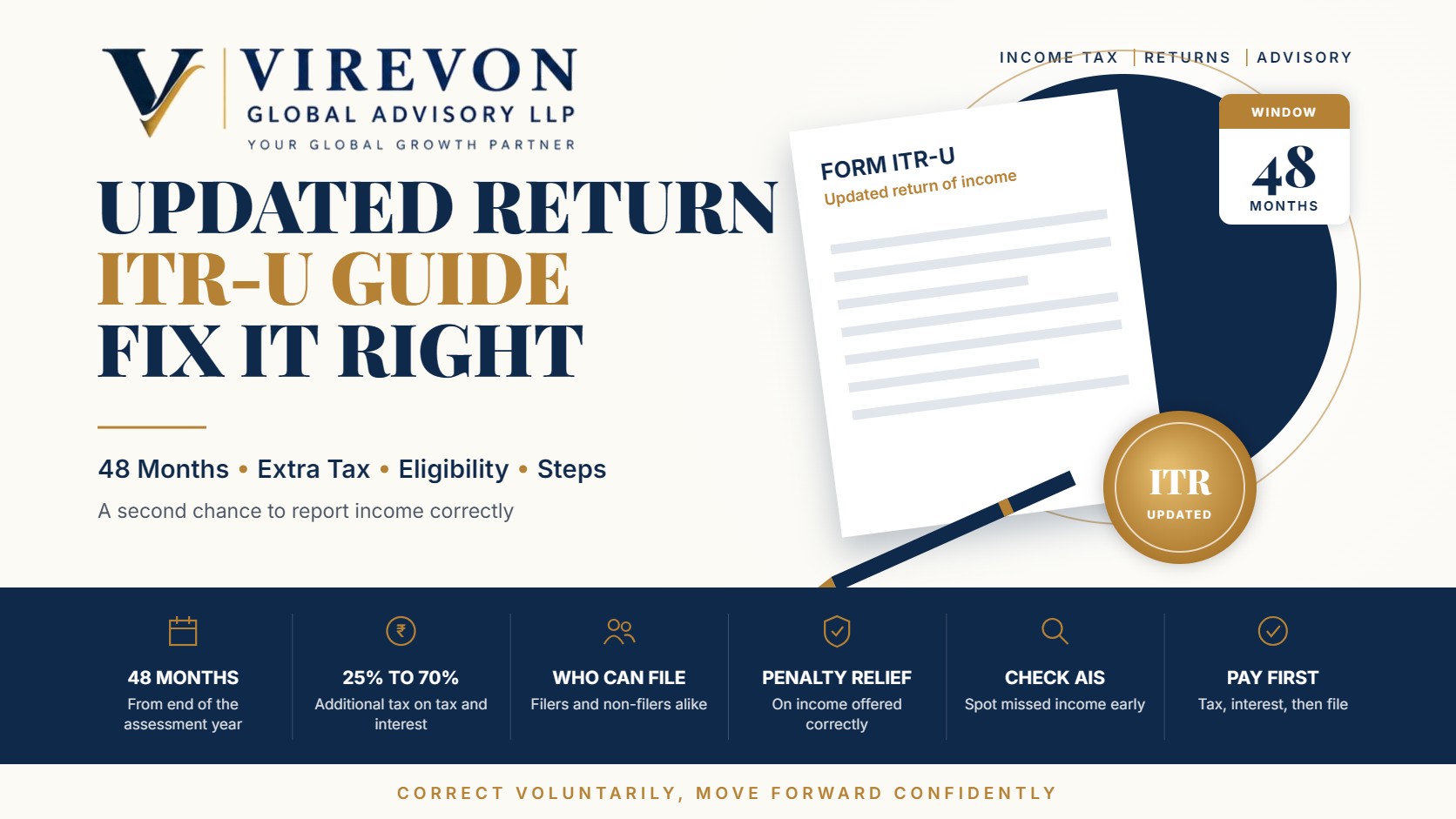
Everyone overlooks something occasionally — an interest credit, a small capital gain, a freelance receipt. The updated return ITR-U lets you correct such omissions voluntarily, years after the normal deadline, by paying the tax with an additional amount instead of facing a notice and penalty later.
Since 2025, the window to file has been 48 months, and the Finance Act, 2026 made the facility more flexible still. This guide explains who can use it, the time limits and additional tax, what it cannot be used for, and a simple step-by-step process.
Key takeaways
- An updated return can be filed within 48 months from the end of the relevant assessment year (under the new law, from the end of the financial year following the tax year).
- It is meant for reporting more income, not for claiming a refund or a bigger loss.
- The additional tax is 25%, 50%, 60% or 70% of the tax and interest due, depending on how late you file.
- Recent amendments allow an updated return even after a reassessment notice (with a further 10 percentage points of additional tax) and in cases where the loss is being reduced.
- All tax, interest and additional tax must be paid before filing ITR-U.
Who can file an updated return ITR-U
You can file an updated return whether or not you filed an original return, a belated return or a revised return for that year. Common situations include:
- Income omitted from the original return, such as bank interest, dividends or rent.
- Income taxed at the wrong rate or under the wrong head.
- A wrong deduction or exemption claimed that now needs to be withdrawn.
- No return filed at all even though income was taxable.
- A mismatch spotted later in the Annual Information Statement (AIS).
Our AIS and TIS reconciliation guide shows how to spot such gaps before they turn into notices.
Time limits and additional tax
The additional tax is calculated on the aggregate of the tax and interest payable on the updated return.
| Updated return filed | Additional tax | Illustrative last date for FY 2025-26 (AY 2026-27) |
|---|---|---|
| Within 12 months of end of AY | 25% | 31 March 2028 |
| After 12, within 24 months | 50% | 31 March 2029 |
| After 24, within 36 months | 60% | 31 March 2030 |
| After 36, within 48 months | 70% | 31 March 2031 |
The earlier you correct an omission, the lower the cost. Waiting simply adds interest and moves you into a higher slab of additional tax.
A simple illustration
Suppose you missed ₹2,00,000 of fixed deposit interest in your return for FY 2025-26 and you are in the 30% slab under the old regime. Tax plus cess on that income is about ₹62,400. Assume interest for late payment works out to ₹12,000 (the actual figure depends on dates).
- Tax and interest: ₹74,400
- Additional tax at 25% (filed within the first 12 months): ₹18,600
- Total payable: ₹93,000
The same omission detected by the department could lead to reassessment and a penalty of 50% or even 200% of the tax on under-reported income — so voluntary correction is usually the more economical route.
When an updated return cannot be filed
The facility is for honest corrections, not for reopening every year. Broadly, an updated return cannot be used to:
- Declare a loss or increase a loss already claimed (though reducing a loss is now permitted).
- Reduce total tax liability.
- Create or increase a refund.
- File a second updated return for the same year.
It is also generally unavailable where search or survey action has been initiated, or where information has been received under specified laws or treaties. Before filing, confirm that your year is not affected by such proceedings.
Recent changes: reassessment notices and loss cases
Two amendments through the Finance Act, 2026 are worth noting:
- After a reassessment notice: a taxpayer who receives a reassessment notice can file an updated return within the time allowed in that notice. The additional tax goes up by a further 10 percentage points (for example, 35% instead of 25%). Income offered this way is protected from penalty, though the reassessment proceedings themselves continue.
- Reducing a loss: where the original return claimed a larger loss than was correct, an updated return can now be filed to reduce it.
If you have already received a notice, read our guide on income tax reassessment notices before deciding on the approach, because the timing and wording of your response matter.
Step-by-step process to file ITR-U
- Identify the omission and compute the correct total income for the year.
- Compute tax and interest as if filing now, using the rules applicable to that year.
- Add the additional tax at the applicable rate.
- Pay the full amount through the e-Pay Tax facility and note the challan details.
- Prepare the updated return in the prescribed ITR-U form along with the regular ITR form for the year.
- State the reason for updating from the options provided (for example, income not reported correctly or wrong rate of tax).
- Submit and e-verify within the time allowed, and keep your working papers.
Practical tips
- Reconcile AIS, TIS and Form 26AS (Form 168 under the new law) for each open year once a year.
- Keep proofs of the income being added and the computation used.
- If TDS was deducted on the omitted income, claim the credit correctly — it reduces the tax, not the additional tax base beyond what the rules allow.
- Do not use ITR-U to change regimes or claim new deductions; it is a one-way correction.
- Consider the penalty angle: our note on penalty under section 270A and immunity explains why early correction helps.
Frequently asked questions
Can I file ITR-U if I never filed an original return?
Yes. An updated return can be filed even if no original return was filed, provided it results in tax payable and none of the exclusions apply.
Is there a late fee for an updated return?
No separate fee is prescribed for filing ITR-U itself. However, the regular late fee and interest applicable to that year must be included in the computation.
Can I claim a refund through an updated return?
No. An updated return cannot result in or increase a refund. If you are owed money, other remedies such as rectification or a revised return (within its time) are more suitable.
How many times can I file an updated return for a year?
Only once for each year. Make sure the updated return captures all corrections in one go.
If you have spotted an omission in an earlier return, our team can help you work out the numbers and file the updated return smoothly.
This article is general information based on the law as of September 2026, and is not legal or tax advice. Please check the facts of your own case with a professional before acting.
Leave a Reply