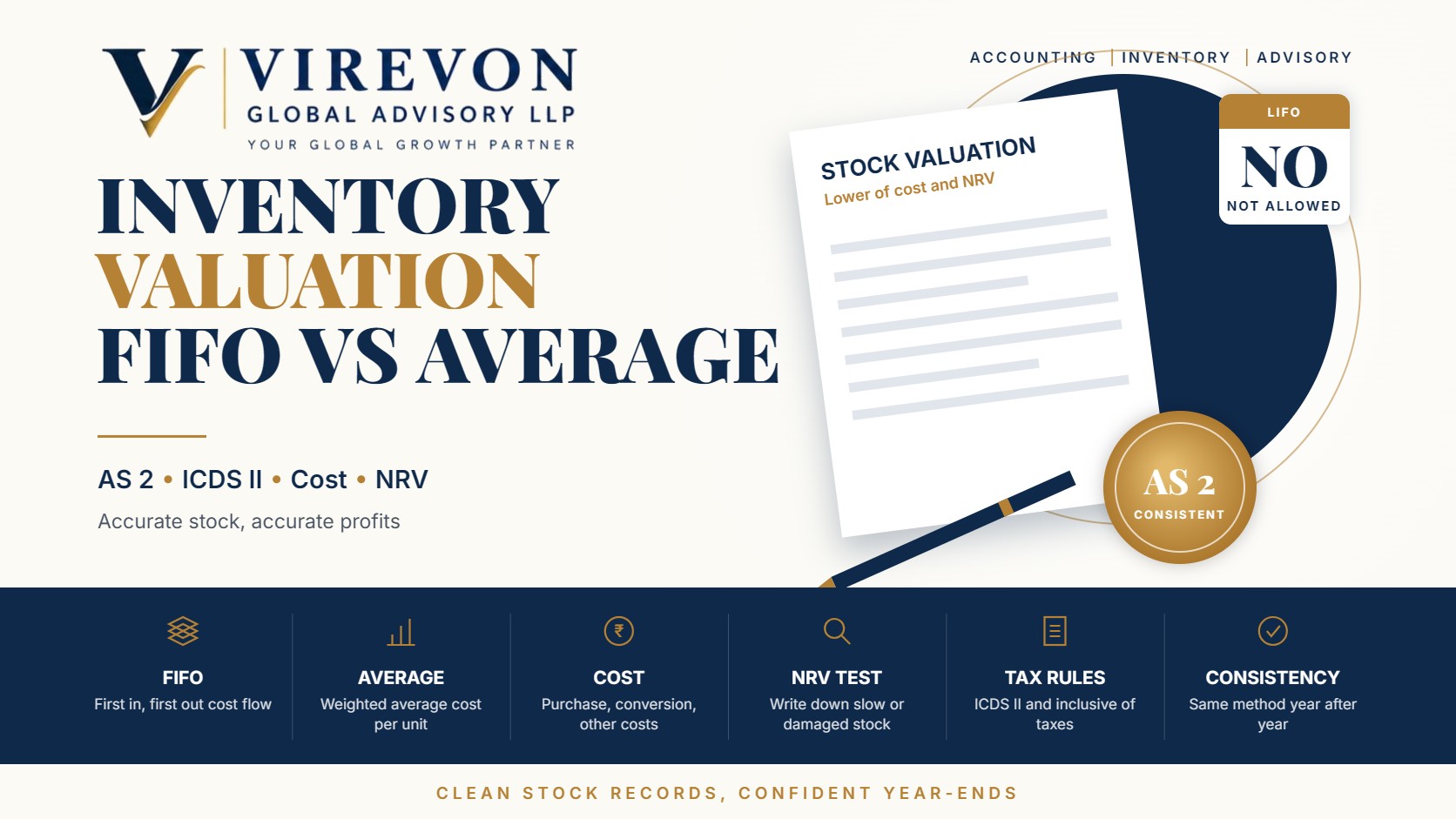
Closing stock is often the single largest number that decides a business’s profit for the year. Getting inventory valuation right therefore matters not just for the balance sheet, but for the tax you pay, the credit your bank extends and the confidence your investors place in your numbers.
Most Indian businesses choose between two cost formulas — First In, First Out (FIFO) and weighted average. This guide explains how each works, what the accounting standards and tax rules require, walks through a simple worked example, and ends with a year-end checklist you can use straight away.
Key takeaways
- Inventory is valued at the lower of cost and net realisable value (NRV) under AS 2 (and Ind AS 2 for larger companies).
- The permitted cost formulas are FIFO and weighted average; specific identification applies to items that are not interchangeable. LIFO is not allowed.
- For tax, ICDS II broadly follows the same principles, and the tax law requires inventory to be valued inclusive of taxes and duties actually paid or incurred.
- In a period of rising prices, FIFO generally shows a higher closing stock and higher profit than weighted average — a timing difference that reverses later.
- Whichever method you choose, apply it consistently and document the reason for any change.
What “cost” means in inventory valuation
Before choosing a formula, be clear about what goes into cost. Under AS 2, cost includes:
- Cost of purchase — price, import duties and non-recoverable taxes, freight inward and handling, less trade discounts and rebates.
- Cost of conversion — direct labour and a systematic allocation of fixed and variable production overheads, based on normal capacity.
- Other costs incurred to bring the inventory to its present location and condition.
The following are excluded and charged to profit and loss: abnormal wastage, storage costs (unless needed in the production process), administrative overheads not related to production, and selling costs.
GST for which input tax credit is available is not part of cost for accounting purposes, because it is recoverable.
FIFO vs weighted average: how the methods differ
| Feature | FIFO | Weighted average |
|---|---|---|
| Assumption | Oldest stock is sold first | Every unit carries the average cost |
| Closing stock | Reflects the most recent purchase prices | Reflects a blend of old and new prices |
| Rising prices | Higher closing stock, higher profit | Lower closing stock, lower profit |
| Falling prices | Lower closing stock, lower profit | Higher closing stock, higher profit |
| Best suited to | Perishables, FMCG, items with expiry dates | Commodities, bulk and interchangeable goods |
| System effort | Needs batch or lot tracking | Simpler; most ERPs support it by default |
Both are acceptable under AS 2 and ICDS II. The right choice is the one that best reflects how your goods physically move and that your systems can apply reliably.
A worked example
Assume a trader has no opening stock and makes three purchases during the year:
- April: 100 units at ₹100 = ₹10,000
- August: 100 units at ₹120 = ₹12,000
- December: 100 units at ₹140 = ₹14,000
Total: 300 units costing ₹36,000. During the year, 200 units are sold, leaving 100 units in closing stock.
Under FIFO, the 100 units left are assumed to be the latest ones bought at ₹140. Closing stock is ₹14,000 and cost of goods sold is ₹22,000.
Under weighted average (periodic), the average cost is ₹36,000 ÷ 300 = ₹120. Closing stock is ₹12,000 and cost of goods sold is ₹24,000.
FIFO shows ₹2,000 more profit this year, so more tax is payable this year. Next year, the higher opening stock under FIFO pushes cost of goods sold up, and the difference reverses. Over the life of the business, total profit is the same — the method changes the timing.
The NRV test and write-downs
Cost is only half the rule. If the net realisable value — estimated selling price less costs to complete and sell — falls below cost, inventory must be written down to NRV. Typical triggers include:
- Damaged, expired or obsolete items.
- Slow-moving stock that will need heavy discounts.
- A fall in market prices after the year end that confirms conditions at the balance sheet date.
Write-downs are usually assessed item by item or for groups of similar items, not for inventory as a whole. Raw materials held for production are generally not written down if the finished products will still sell at or above cost.
Tax impact and ICDS II
For income-tax purposes, businesses following the mercantile system must also comply with ICDS II — Valuation of Inventories. It mirrors AS 2 in most respects, including the ban on LIFO and the lower of cost and NRV rule. A few points need attention:
- Inclusive method: the tax law (section 145A of the 1961 Act, carried into the Income-tax Act, 2025) requires purchases, sales and inventory to be valued including taxes, duties and cess actually paid or incurred. Where GST credit is available, the adjustment is usually profit-neutral, but it should be reflected in the tax computation.
- Change of method: a change is permitted only with reasonable cause, and the effect should be disclosed.
- Dissolution of a firm or AOP: inventory is valued at NRV, whether or not the business continues.
- Opening stock: for tax purposes, it must equal the previous year’s closing stock.
The valuation method and any deviation from the tax rules are reported during a tax audit, which is why stock records deserve care well before the year end. Our month-end close checklist explains how to keep stock ledgers reconciled throughout the year.
Year-end inventory valuation checklist
- Conduct or observe a physical count and reconcile it to the stock register.
- Confirm the cost formula in the ERP matches your accounting policy.
- Review freight, duties and overhead allocation for consistency with last year.
- Identify slow-moving, expired or damaged items and estimate NRV.
- Reconcile stock with GST records — mismatches between purchases, sales and stock are a common query.
- Check that stock statements submitted to your bank reconcile with the books, with reasons for differences documented.
- Record the valuation basis clearly in the notes to accounts.
For regular management visibility on stock levels and margins, see our guide on MIS reporting for SMEs.
Frequently asked questions
Can I switch from weighted average to FIFO to reduce tax?
A change is allowed only if it results in a more appropriate presentation, or is required by law, and there is reasonable cause. Changing purely for tax savings is not a valid reason, and the effect must be disclosed.
Why is LIFO not allowed in India?
LIFO tends to leave very old costs in closing stock, which may not reflect current values. Both AS 2 and ICDS II therefore permit only FIFO, weighted average or specific identification.
Should GST be included in inventory cost?
For accounts, GST is excluded where input tax credit is available. For tax computation, the inclusive method applies, although the net effect on profit is usually nil.
How often should inventory be valued?
At least at every financial year end, but a monthly or quarterly valuation gives far better control over margins and helps with bank stock statements.
If you would like help reviewing your inventory valuation policy or setting up clean stock records, our team would be glad to assist.
This article is general information based on the law as of September 2026, and is not legal or tax advice. Please check the facts of your own case with a professional before acting.
Leave a Reply