Category: Income Tax & TDS Updates

  • Section 43B(h): Paying MSME Suppliers Within 45 Days to Protect Your Deduction

    Section 43B(h): Paying MSME Suppliers Within 45 Days to Protect Your Deduction

    Delayed payments have long been a problem for small suppliers. To encourage prompt settlement, the Finance Act 2023 introduced clause (h) in section 43B of the Income-tax Act, 1961. Under section 43B(h) MSME payment rules, amounts owed to micro and small enterprises that are not paid within the time allowed under the MSMED Act are deductible only in the year they are actually paid. For a buyer with large supplier balances at year end, this can shift a significant expense into the next year.

    This article explains who is covered, how the time limits work, how the disallowance is computed, and what finance teams can do to stay on the right side of the rule. The provision applies from FY 2023-24 and continues under the Income-tax Act, 2025 among the deductions allowed only on actual payment.

    Key takeaways

    • The rule applies to amounts payable to micro and small enterprises registered under the MSMED Act; medium enterprises are not covered.
    • The time limit is 15 days from acceptance where there is no written agreement, and the agreed period, capped at 45 days, where there is one.
    • If an amount remains unpaid beyond the time limit at the end of the year, the expense is allowed only in the year of actual payment.
    • The usual relief for payment before the return due date does not apply to this clause.
    • Interest payable to MSMEs for delayed payment under the MSMED Act is not deductible.

    Who is covered?

    The rule applies when the supplier is a micro or small enterprise under the MSMED Act, 2006, usually evidenced by Udyam registration. Key points:

    • Medium enterprises are outside the rule.
    • Traders: the delayed payment provisions of the MSMED Act are generally understood not to extend to wholesale and retail traders, even if they hold Udyam registration for other purposes. Buyers should confirm the classification shown on the supplier’s Udyam certificate.
    • Unregistered suppliers: the rule applies to enterprises registered under the MSMED Act; obtain and keep declarations from suppliers.
    • Nature of purchase: the rule covers goods and services supplied by the MSE to the buyer in the course of business; capital goods are generally treated differently because their cost is claimed through depreciation, so seek advice on specific cases.

    Our guide on Udyam registration and MSME benefits explains how enterprises are classified.

    How the time limits work

    Section 15 of the MSMED Act requires the buyer to pay:

    • On or before the date agreed in writing, which cannot exceed 45 days from the day of acceptance (or deemed acceptance) of the goods or services, or
    • Where there is no written agreement, within 15 days of acceptance.

    The day of acceptance is usually the date of delivery or performance, unless an objection is raised within the specified period. Section 43B(h) uses this MSMED Act deadline to decide whether the deduction is at risk.

    Worked cases at the year end

    Assume the financial year ends on 31 March and the buyer has a written agreement with each supplier for 45-day credit.

    CaseInvoice acceptedMSMED due datePayment dateDeduction for the year ending 31 March?
    A5 January19 February15 FebruaryYes – paid within time
    B5 January19 February10 MarchYes – paid late but within the same year
    C5 January19 February20 AprilNo – overdue at year end; allowed next year
    D1 March15 April10 AprilYes – paid within the MSMED time limit
    E1 March15 April30 AprilNo – paid after the time limit; allowed next year

    Cases B and C show why the year end matters. A late payment made within the same year still gets the deduction that year. An amount that is overdue and unpaid at year end, or paid after the MSMED deadline in the following year, moves to the year of payment.

    Illustration of the impact

    A manufacturer has ₹80 lakh payable to micro and small suppliers on 31 March, of which ₹30 lakh is beyond the 45-day limit and paid only in May. The ₹30 lakh is added back to income for the current year and claimed next year. At a 25% tax rate (plus surcharge and cess), this means roughly ₹7.5 lakh or more of tax paid a year earlier than expected, besides interest on any resulting shortfall in advance tax.

    Where interest comes in

    If payment is delayed, the MSMED Act entitles the supplier to compound interest at three times the bank rate notified by the RBI. That interest is not deductible for income-tax purposes, so late payment carries a double cost: the timing disallowance under section 43B(h) and a permanent disallowance of any interest paid. Suppliers may also approach the MSME Facilitation Council for recovery, which adds management time and strains relationships.

    Reporting and documentation

    • The disallowance is reported in the tax audit report where the business is subject to tax audit, and reflected in the computation of income. Our tax audit checklist covers the preparation steps.
    • Companies also disclose MSME dues and interest in their financial statements under Schedule III.
    • Maintain for each MSE supplier: Udyam certificate, classification, credit terms, invoice acceptance dates and payment dates.

    A practical payables process

    1. Tag suppliers in the vendor master as micro, small, medium or non-MSME, with Udyam numbers and certificate copies.
    2. Record credit terms in written purchase orders or agreements, not exceeding 45 days.
    3. Capture acceptance dates for goods receipts and service confirmations.
    4. Run a weekly ageing report for MSE suppliers highlighting invoices approaching the deadline.
    5. Prioritise MSE payments in the payment run, particularly in February and March.
    6. Reconcile at year end and compute the disallowance before closing the books and paying the last advance tax instalment.
    7. Review annually: suppliers’ classifications can change, so ask for updated declarations each year.

    Frequently asked questions

    Does section 43B(h) apply to payments to medium enterprises?

    No. The clause covers only micro and small enterprises as defined under the MSMED Act.

    If I pay before filing my return, will the deduction be allowed for the same year?

    Not under this clause. Unlike other items in section 43B, payment before the return due date does not save the deduction if the MSMED time limit has passed.

    What if my agreement allows 60 days’ credit?

    The MSMED Act caps the agreed period at 45 days, so payment after 45 days is treated as late for this purpose.

    Does the rule apply to businesses using presumptive taxation?

    Where income is computed on a presumptive basis, expenses are not claimed separately, so the disallowance generally has no practical effect.

    If you would like help setting up an MSME payables tracker or reviewing your year-end exposure under section 43B(h), our team would be glad to assist.

    This article is general information based on the law as of September 2026, and is not legal or tax advice. Please check the facts of your own case with a professional before acting.

  • Annual Information Statement (AIS) and TIS: How to Reconcile Before Filing

    Annual Information Statement (AIS) and TIS: How to Reconcile Before Filing

    The income-tax department now receives a large volume of information about each taxpayer: salary and TDS from employers, interest from banks, dividends from companies, mutual fund and share transactions from registrars and brokers, property purchases from registrars, and much more. All of this appears in the Annual Information Statement. Careful AIS reconciliation before filing is the single most effective way to avoid mismatch intimations and scrutiny questions later.

    This guide explains what the AIS and the Taxpayer Information Summary (TIS) contain, how they relate to the tax credit statement, how to reconcile them with your own records, and how to use the feedback facility when something is wrong. A sample reconciliation shows how differences are typically explained.

    Key takeaways

    • The AIS lists information reported by third parties; the TIS summarises it by category and feeds the pre-filled return.
    • TDS and TCS credits are claimed based on the tax credit statement (Form 26AS, which is Form 168 under the new law for later years), and AIS mirrors this data.
    • Five feedback options let you confirm, correct, deny or flag information as duplicate or belonging to another PAN or year.
    • Differences are normal; what matters is that you can explain each one and your return reflects the correct figure.
    • Reconciling a few weeks before the due date leaves time for deductors or reporting entities to correct errors.

    What AIS and TIS contain

    The AIS is organised into broad parts:

    • TDS and TCS information: salary, interest, rent, professional fees, sale of property, and other payments on which tax was deducted or collected.
    • Statement of financial transactions (SFT): savings and deposit interest, dividends, purchase and sale of shares and mutual funds, cash deposits, credit card payments, and property transactions above reporting thresholds.
    • Payment of taxes: advance tax and self-assessment tax paid.
    • Demand and refund: outstanding demands and refunds issued.
    • Other information: data such as GST turnover, interest on income-tax refunds and information from other government sources.

    The TIS aggregates these entries by category (for example, total interest from savings accounts) and shows a processed value and a derived value after any feedback. The pre-filled return uses these figures, which is why reconciling them matters.

    You can download both from the income-tax e-filing portal under the AIS section, in PDF, JSON or CSV format.

    A step-by-step AIS reconciliation

    1. Download everything: AIS, TIS and the tax credit statement for the financial year.
    2. Gather your records: salary slips and the salary certificate, bank statements and interest certificates, broker capital gains reports, mutual fund statements, rent receipts, property documents and tax payment challans.
    3. Match TDS line by line: compare each deductor, amount paid and tax deducted with your records. Differences here directly affect your credit.
    4. Review SFT entries: check interest, dividends and securities transactions against statements; look for duplicates, joint accounts and transactions of family members reported under your PAN.
    5. Check the year: interest reported on accrual versus receipt, or year-end transactions reported in the wrong year, are common causes of mismatch.
    6. Record your reconciliation in a simple working sheet: AIS value, your value, difference and explanation.
    7. Submit feedback for genuine errors, then file the return with the correct figures.

    A sample reconciliation

    ItemAIS/TIS value (₹)Your records (₹)Difference and explanation
    Savings bank interest42,30042,300Matches
    Fixed deposit interest1,86,0001,24,000Joint deposit with spouse reported fully under your PAN; your share is 2/3
    Dividend18,5009,250Same dividend reported twice (duplicate)
    Sale of mutual fund units6,40,0006,40,000Sale value matches; compute gain using cost from statement
    TDS on rent (from tenant)24,00036,000Tenant deducted but has not filed one quarter’s TDS statement; follow up for credit

    In this example, the return would show the correct fixed deposit interest and dividends, with feedback submitted for the joint deposit and duplicate dividend. For the missing rent TDS, the taxpayer asks the tenant to file or correct the TDS statement, because credit is generally allowed only when it appears in the tax credit statement.

    For capital gains, remember that AIS shows sale value, not profit. You still need the purchase cost and dates to compute gains correctly; our guide to capital gains tax rates explains the rates and holding periods.

    Using the feedback options

    For each AIS entry, you can choose one of the following:

    • Information is correct
    • Information is not fully correct – enter the correct amount
    • Information relates to other PAN or year
    • Information is duplicate – identify the matching entry
    • Information is denied – for transactions that do not relate to you at all

    After feedback, the modified value appears alongside the reported value, and the derived value in TIS is updated. In some cases, the information is sent to the reporting entity for confirmation. If the source confirms its original figure, you may need to follow up with it directly.

    Feedback does not replace filing the correct return. Its value is in creating a record of your explanation, which helps if the department later questions a difference.

    What happens if you do not reconcile

    If the return shows lower income than the AIS without explanation, the processing system may make adjustments or issue an intimation. Our article on section 143(1) intimations explains how to respond when that happens. Larger unexplained differences can also lead to compliance e-campaigns or scrutiny selection. Reconciling upfront is far easier than explaining later.

    Practical tips

    • Start early: download AIS in June or July; many deductors file corrections around the first quarter due dates.
    • Watch joint holdings: banks often report joint account interest under the first holder’s PAN.
    • Check high-value entries: property purchases, large cash deposits and credit card payments are frequently reviewed.
    • Keep evidence: save the working sheet and supporting statements with the return acknowledgement.
    • Revisit after filing: AIS is updated during the year; if new information appears, consider whether a revised or updated return is needed.

    Frequently asked questions

    Is AIS reconciliation mandatory before filing?

    It is not a separate legal requirement, but it is strongly advisable, because returns are processed against this data and mismatches can lead to adjustments or notices.

    What is the difference between AIS and TIS?

    AIS lists individual transactions reported by third parties, while TIS summarises them by category and shows the values used in the pre-filled return.

    Will my TDS credit be allowed if it appears in AIS but not in Form 26AS?

    Credit is generally given based on the tax credit statement. Both draw from the same TDS data, so check whether the deductor’s statement has been filed and processed correctly.

    Can I change AIS feedback later?

    Yes, feedback can generally be modified, and the latest submission is considered.

    If you would like help reconciling your AIS before filing or responding to a mismatch, our tax team would be glad to assist.

    This article is general information based on the law as of September 2026, and is not legal or tax advice. Please check the facts of your own case with a professional before acting.

  • Presumptive Taxation under Sections 44AD and 44ADA: Limits and Conditions

    Presumptive Taxation under Sections 44AD and 44ADA: Limits and Conditions

    Small traders, manufacturers, shop owners and independent professionals often find full bookkeeping and a tax audit disproportionate to the size of their business. Presumptive taxation under 44AD and its professional counterpart, section 44ADA, offer a simpler route: declare income at a fixed percentage of turnover or receipts, pay tax on it and file a short return.

    The scheme is generous, but it comes with limits, eligibility rules and a five-year consistency condition. This guide explains them with examples, for returns of FY 2025-26 under the Income-tax Act 1961. The Income-tax Act 2025 carries the schemes forward for the tax year 2026-27 under new section numbers.

    Key takeaways

    • Section 44AD: eligible businesses with turnover up to ₹2 crore (₹3 crore if cash receipts are 5% or less) declare 8% of turnover, or 6% for digital receipts.
    • Section 44ADA: specified professionals with receipts up to ₹50 lakh (₹75 lakh if cash receipts are 5% or less) declare 50% of receipts.
    • Only resident individuals, HUFs and partnership firms qualify; LLPs and companies do not.
    • Advance tax is paid in one instalment by 15 March.
    • If you opt out of 44AD within five years, you cannot return for the next five years, and a tax audit may apply.

    Section 44AD at a glance

    PointSection 44ADSection 44ADA
    WhoResident individual, HUF, partnership firm (not LLP)Resident individual or partnership firm (not LLP)
    ActivityEligible business (most trading, manufacturing, services)Specified professions such as legal, medical, engineering, architecture, accountancy, technical consultancy, interior decoration
    Basic limitTurnover up to ₹2 croreReceipts up to ₹50 lakh
    Enhanced limit₹3 crore if cash receipts do not exceed 5%₹75 lakh if cash receipts do not exceed 5%
    Deemed income8% of turnover; 6% for receipts by banking or digital modes50% of gross receipts
    Higher incomeCan declare more than the deemed rateCan declare more than 50%

    A few businesses are excluded from section 44AD, including commission or brokerage agents, persons carrying on agency business, and goods carriage operators (who have a separate scheme under section 44AE).

    How the 6% and 8% rates work

    The 6% rate applies to turnover received by account payee cheque, account payee draft, bank transfer or other prescribed electronic modes, where received within the year or by the due date of filing the return. Everything else, including cash, is at 8%.

    Worked example: a trader

    A retailer has FY 2025-26 turnover of ₹2.4 crore: ₹2.3 crore through UPI and bank transfers, and ₹10 lakh in cash.

    1. Cash receipts are about 4.2% of turnover, within the 5% condition, so the enhanced ₹3 crore limit applies.
    2. Deemed income: 6% of ₹2.3 crore = ₹13.8 lakh, plus 8% of ₹10 lakh = ₹0.8 lakh.
    3. Total presumptive business income: ₹14.6 lakh.

    No separate deduction for expenses like rent, salary or depreciation is allowed, as they are treated as already covered in the deemed rate. The retailer still needs to keep basic records of turnover and bank transactions.

    Worked example: a consultant

    An IT consultant (technical consultancy) receives ₹70 lakh, entirely by bank transfer. The enhanced ₹75 lakh limit applies, and deemed income under 44ADA is 50%, or ₹35 lakh.

    The five-year rule for presumptive taxation 44AD

    Section 44AD(4) is often overlooked. If a person opts for 44AD in one year and then, within the next five years, declares profit below the deemed rate (that is, opts out), they cannot use 44AD for the following five years. In those years, if total income exceeds the basic exemption limit, they must maintain books and get a tax audit under section 44AB.

    Practical tip: before opting in, think about the next five years, not just the current one. If profit margins are likely to fall below 6–8%, regular books may suit you better.

    Section 44ADA does not have the same five-year lock-in, but declaring income below 50% when receipts exceed the basic exemption limit generally requires books of account and a tax audit.

    Advance tax, ITR form and other compliance

    • Advance tax: the full advance tax for presumptive income can be paid in one instalment by 15 March of the financial year. Paying later attracts interest.
    • ITR form: ITR-4 (Sugam) for individuals, HUFs and firms whose total income does not exceed ₹50 lakh and who meet the other conditions; otherwise ITR-3 (or ITR-5 for firms).
    • GST: presumptive income tax has nothing to do with GST. If your turnover crosses the GST threshold, registration and returns still apply.
    • Tax audit: generally not needed while you remain within the scheme and its limits. Our tax audit checklist explains when an audit becomes necessary.
    • Records: keep sales registers, bank statements and invoices; they support your turnover figure if your AIS shows different numbers.

    Common mistakes to avoid

    1. An LLP claiming 44AD. LLPs are not eligible.
    2. Using 44ADA for a non-specified profession, such as a commission-based agent or a general services business.
    3. Ignoring the 5% cash test and claiming the enhanced limit when cash receipts were higher.
    4. Missing the five-year consequence after declaring a lower profit in one year.
    5. Not reconciling turnover with AIS and GST returns, which can prompt queries. Our guide on section 143(1) intimations explains how mismatches are handled.

    Frequently asked questions

    What is the turnover limit for presumptive taxation under 44AD?

    ₹2 crore, increased to ₹3 crore if cash receipts do not exceed 5% of total turnover or gross receipts.

    Can freelancers use section 44ADA?

    Yes, if they are resident individuals in a specified profession (such as technical consultancy, legal, medical, engineering or architecture) and receipts are within ₹50 lakh, or ₹75 lakh where cash receipts are 5% or less.

    Can an LLP opt for presumptive taxation?

    No. Sections 44AD and 44ADA are not available to limited liability partnerships.

    Is advance tax required under the presumptive scheme?

    Yes. The advance tax can be paid in a single instalment by 15 March of the financial year.

    If you would like help deciding whether presumptive taxation suits your business and filing your return correctly, our team would be happy to guide you.

    This article is general information based on the law as of September 2026, and is not legal or tax advice. Please check the facts of your own case with a professional before acting.
  • Capital Gains Tax in India: Current Rates, Holding Periods and Exemptions

    Capital Gains Tax in India: Current Rates, Holding Periods and Exemptions

    Selling shares, mutual fund units, gold or property brings a capital gains question with it. The rules were simplified significantly from 23 July 2024, and Budget 2026 made a further change to how share buybacks are taxed. Knowing the current capital gains tax rates, holding periods and exemptions lets you plan the timing of a sale and set aside the right amount of tax.

    From 1 April 2026 the Income-tax Act 2025 applies and section numbers have changed. For familiarity, this guide uses the older section references that most people still recognise; the substance of the rates described below carries forward.

    Key takeaways

    • Listed shares and equity mutual funds become long-term after 12 months; most other assets after 24 months.
    • Long-term gains are taxed at 12.5% without indexation for most assets; listed equity gains get an annual exemption of ₹1.25 lakh.
    • Short-term gains on listed equity (where STT is paid) are taxed at 20%; other short-term gains are taxed at slab rates.
    • Resident individuals and HUFs selling land or buildings bought before 23 July 2024 can compare 12.5% without indexation with 20% with indexation.
    • Reinvestment exemptions under sections 54, 54F and 54EC remain valuable for property sellers.

    Holding periods: short term or long term?

    AssetLong-term if held for more than
    Listed equity shares, equity-oriented mutual funds, units of business trusts12 months
    Other listed securities (such as listed bonds)12 months
    Land, buildings, unlisted shares, gold, jewellery, other assets24 months
    Specified mutual funds (mostly debt), unlisted bonds and debentures, market-linked debenturesAlways treated as short term

    The last row matters: gains on debt-oriented mutual fund units bought on or after 1 April 2023 are taxed at slab rates, whatever the holding period.

    Current capital gains tax rates

    Type of gainRate
    Long-term gain on listed equity and equity funds12.5% on gains above ₹1.25 lakh a year
    Short-term gain on listed equity and equity funds (STT paid)20%
    Long-term gain on property, unlisted shares, gold and other assets12.5% without indexation
    Short-term gain on other assetsSlab rates
    Specified mutual funds, unlisted bonds, market-linked debenturesSlab rates

    Surcharge and 4% health and education cess apply on top. Surcharge on long-term and short-term equity gains is capped at 15%.

    Grandfathering for older equity holdings

    For listed shares and equity funds bought before 1 February 2018, the cost can be taken as the higher of actual cost and the fair market value on 31 January 2018 (limited to the sale price). This protects gains that accrued before long-term gains on equity became taxable.

    Property sales: the pre-July 2024 choice

    Indexation was withdrawn from 23 July 2024. For land or buildings acquired before that date, resident individuals and HUFs can compute tax both ways and pay the lower:

    • 12.5% on the gain without indexation, or
    • 20% on the gain with indexation.

    A simple example: a flat bought in 2012 for ₹40 lakh is sold in 2026 for ₹1.2 crore. Without indexation the gain is ₹80 lakh, and tax at 12.5% is ₹10 lakh. With indexation the gain would be much lower, and tax at 20% on that lower gain may work out cheaper. Always run both computations with the actual cost inflation index figures before filing.

    Non-residents do not get this choice and pay 12.5% without indexation. Buyers must deduct TDS on property purchased from NRIs; see our guide on NRI property sales and TDS.

    Share buybacks after Budget 2026

    From 1 October 2024 to 31 March 2026, the entire buyback proceeds were taxed as dividend in the shareholder’s hands. From 1 April 2026, buybacks are again taxed as capital gains, so only the difference between the buyback price and the cost of acquisition is taxable. Promoters face an additional levy that raises their effective rate. If you tendered shares in a buyback in either period, check which regime applies to the date of the buyback.

    Exemptions that reduce capital gains tax

    The main reinvestment reliefs for long-term gains are:

    1. Section 54 — gain on sale of a residential house, reinvested in another residential house in India within the prescribed time. The exemption is capped at ₹10 crore.
    2. Section 54F — gain on sale of any other long-term asset (such as shares or land), where the net sale consideration is invested in a residential house. Conditions apply on the number of houses already owned.
    3. Section 54EC — gain on land or buildings invested in specified bonds within six months, up to ₹50 lakh, with a five-year lock-in.
    4. Capital Gains Account Scheme — if the new house is not bought before the return due date, the unused amount can be deposited in this scheme with a bank to keep the exemption alive.

    Keep purchase deeds, improvement bills, brokerage statements and bank records for every claim.

    Practical points before you file

    • Match your AIS. Sale transactions reported by brokers, registrars and sub-registrars appear in the Annual Information Statement. Differences should be explained or corrected.
    • Set off losses correctly. Short-term losses can be set off against both short-term and long-term gains; long-term losses only against long-term gains. Unused losses carry forward for eight years if the return is filed on time.
    • Rebate limits. The section 87A rebate under the new regime cannot be used against tax on special-rate gains such as listed equity gains.
    • Advance tax. Large gains during the year may need advance tax in the quarter of sale to avoid interest.
    • Choose the right form. Capital gains generally require ITR-2 (or ITR-3 if you also have business income).

    For the wider changes under the new law, read our overview of the tax year concept under the Income-tax Act 2025.

    Frequently asked questions

    What is the long-term capital gains tax rate on shares in India?

    12.5% on gains above ₹1.25 lakh a year for listed equity shares and equity mutual funds held for more than 12 months, plus applicable surcharge and cess.

    Is indexation still available on property?

    Only as an option for resident individuals and HUFs selling land or buildings acquired before 23 July 2024, where they may pay 20% with indexation instead of 12.5% without it.

    How are debt mutual funds taxed now?

    Units of specified (mostly debt) mutual funds bought on or after 1 April 2023 are taxed at slab rates regardless of holding period.

    How much can be invested in 54EC bonds?

    Up to ₹50 lakh, within six months of the sale of land or buildings, with a five-year lock-in.

    If you are planning a sale of property or investments and would like a clear tax computation in advance, we would be glad to help.

    This article is general information based on the law as of September 2026, and is not legal or tax advice. Please check the facts of your own case with a professional before acting.

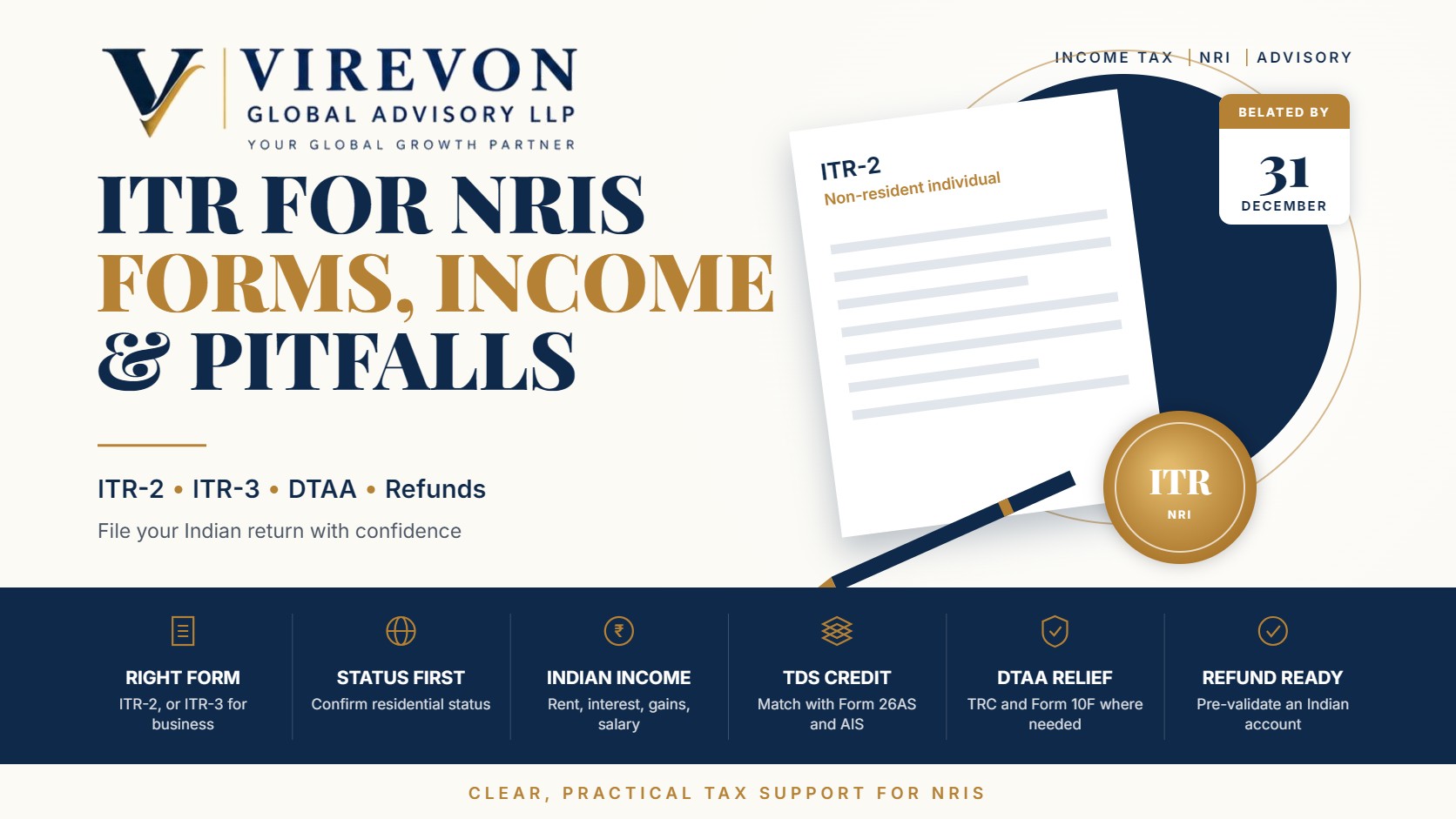
  • ITR for NRIs: Which ITR Form, What to Report and Common Mistakes

    ITR for NRIs: Which ITR Form, What to Report and Common Mistakes

    Many non-resident Indians still earn income in India: rent from a flat, interest on NRO deposits, dividends, or gains on shares and mutual funds. Filing an ITR for NRI status is often the only way to claim back excess TDS, carry forward losses and keep a clean record for future property sales or visa and loan applications.

    The process is not complicated once you know which form applies, what counts as taxable in India and where the usual errors happen. This guide covers the return for the financial year 2025-26, which is still filed under the Income-tax Act 1961.

    Key takeaways

    • Residential status decides everything; confirm it before choosing a form.
    • Most NRIs file ITR-2; ITR-3 applies only if there is business or professional income in India. ITR-1 and ITR-4 are not available to non-residents.
    • Only Indian-source income (income received, accruing or arising in India) is taxable for a non-resident; foreign income and foreign assets are not reported while non-resident.
    • The section 87A rebate is for residents only, so an NRI may owe tax even where a resident with the same income would not.
    • A belated return for FY 2025-26 can still be filed up to 31 December 2026, with a late fee.

    Step 1: Confirm your residential status

    Before anything else, work out whether you were a non-resident for FY 2025-26. The basic test looks at the number of days you were in India during the year (182 days) and, in some cases, a combination of 60 or 120 days in the year with 365 days over the previous four years. Indian citizens with Indian income above ₹15 lakh who are not taxable in any other country may be treated as deemed residents. Some returning Indians qualify as “resident but not ordinarily resident” (RNOR), which has its own reporting rules.

    Our guide on NRI residential status rules walks through each test with examples.

    Which ITR form should an NRI file?

    Your Indian incomeForm
    Salary for work in India, rent, interest, dividends, capital gainsITR-2
    Business or professional income in India (including partner remuneration)ITR-3
    Only interest income, with low total incomeUsually ITR-2 (ITR-1 is not allowed)
    Presumptive income under section 44AD or 44ADAITR-3 (ITR-4 is not allowed)

    Choosing the wrong form is one of the most common reasons for a defective return notice, so this step is worth a second look.

    What to report in an ITR for NRI

    Income from house property

    Report rent from Indian property, less municipal taxes paid, with the standard deduction of 30% and interest on a housing loan where eligible. Tenants paying rent to an NRI must deduct TDS, so check that the TDS appears in your tax credit statement.

    Interest and dividends

    Interest on NRO savings and fixed deposits is taxable. Interest on NRE accounts and FCNR deposits is generally exempt for non-residents, but should still be reviewed each year against the account type. Dividends from Indian companies are taxable and usually carry TDS.

    Capital gains

    Gains on Indian shares, mutual funds and property are taxable in India. For listed equity shares and equity-oriented funds, long-term gains above ₹1.25 lakh are taxed at 12.5% and short-term gains at 20% under the rates applying since 23 July 2024. Property sales by NRIs attract TDS at the buyer’s end; our article on TDS on NRI property sales explains how to seek a lower deduction certificate.

    Salary

    Salary for services rendered in India is taxable here even if paid abroad. Salary for work done outside India is generally not taxable in India for a non-resident.

    What you do not report

    While you are a non-resident, foreign income, foreign bank accounts and Schedule FA (foreign assets) do not need to be reported. This changes once you become resident and ordinarily resident, so plan for the year you return.

    TDS, tax credits and DTAA relief

    TDS on payments to NRIs is often deducted at higher rates under section 195, which is why many NRIs are due a refund. To claim it:

    1. Download Form 26AS and the Annual Information Statement (AIS) and match every TDS entry with your records.
    2. Report each credit in the correct schedule, including the relevant section code.
    3. If you rely on a lower treaty rate under a Double Taxation Avoidance Agreement (DTAA), keep a Tax Residency Certificate from your country of residence and file Form 10F where required. See our guide on DTAA benefit, TRC and Form 10F.
    4. Where your country taxes the same income, keep Indian tax payment evidence to claim credit there.

    Tax rates and the rebate point

    NRIs use the same slab rates as residents under the new or old regime, but they cannot claim the rebate under section 87A. Under the new regime, an NRI with ₹12 lakh of taxable Indian income would pay about ₹62,400 including cess, whereas a resident with the same income would pay nothing after the rebate. Some deductions, such as certain investment-linked ones under the old regime, are also restricted for non-residents. It is worth comparing both regimes before filing.

    Common mistakes in NRI returns

    • Filing ITR-1 out of habit from resident years.
    • Wrong residential status, particularly in the year of leaving or returning to India.
    • Missing TDS credits because the deductor used a different PAN or quarter; always reconcile with AIS.
    • Treating NRO interest as exempt in the same way as NRE interest.
    • No pre-validated Indian bank account, which delays refunds. The refund goes to an Indian account; validate it on the e-filing portal in advance.
    • Not e-verifying within the time allowed, which leaves the return incomplete.
    • Ignoring capital loss carry forward, which requires a return filed by the original due date.

    Frequently asked questions

    Is it compulsory for an NRI to file an income tax return?

    It is required if total Indian income exceeds the basic exemption limit, and it is advisable where TDS has been deducted and a refund is due or losses need to be carried forward.

    Can an NRI file ITR-1?

    No. ITR-1 is available only to resident individuals. Most NRIs use ITR-2, or ITR-3 if they have business or professional income in India.

    Is NRE account interest taxable in India?

    Interest on NRE accounts is generally exempt for a person who is non-resident, while NRO interest is taxable.

    What if I missed the original due date for FY 2025-26?

    You can still file a belated return up to 31 December 2026, with a late fee of up to ₹5,000 (₹1,000 if total income does not exceed ₹5 lakh). Some losses cannot be carried forward in a belated return.

    If you are an NRI and would like help choosing the right form, reconciling TDS or claiming a refund, we would be glad to assist.

    This article is general information based on the law as of September 2026, and is not legal or tax advice. Please check the facts of your own case with a professional before acting.

  • NRI Property Sale TDS: Lower Deduction Certificate and Repatriation

    NRI Property Sale TDS: Lower Deduction Certificate and Repatriation

    Selling a flat or plot in India while living abroad is common, but the tax mechanics surprise many families. The biggest one is NRI property sale TDS: when the seller is a non-resident, the buyer must deduct tax at source at much higher rates than the 1% that applies between residents, and often on the full sale price unless a lower deduction certificate is obtained.

    This guide explains the rates, what changed for buyers in 2026, how a lower deduction certificate helps, and the steps to repatriate the sale proceeds.

    Key takeaways

    • When a non-resident sells property in India, the buyer deducts TDS under the non-resident provisions (old section 195, now section 393(2) of the Income-tax Act 2025), not the 1% resident rule.
    • For long-term capital gains (property held for more than 24 months), the base rate is 12.5%, plus surcharge and 4% cess; short-term gains are taxed at slab rates, so TDS is usually at the highest rate.
    • From 1 October 2026, resident individual and HUF buyers can deposit and report this TDS using their PAN through Form 141, without obtaining a TAN.
    • A lower deduction certificate (Form 128, formerly Form 13) lets TDS be deducted on the actual estimated gain rather than the full price.
    • Proceeds can be repatriated from the NRO account within the USD 1 million per financial year facility, with Forms 145 and 146 (formerly 15CA and 15CB).

    How NRI property sale TDS works

    The buyer, whether resident or non-resident, must deduct tax when paying a non-resident seller. The obligation arises at the time of payment or credit, whichever is earlier, including on advances and instalments.

    Without a certificate, buyers commonly deduct on the full sale consideration, because they cannot verify the seller’s cost of acquisition. That can lock up a large amount in TDS far exceeding the actual tax, which is then recovered only through a refund after filing the return.

    Rates in brief

    Type of gainHolding period for propertyBase tax rateTDS in practice
    Long-term capital gainMore than 24 months12.5% (without indexation)12.5% plus surcharge and 4% cess
    Short-term capital gain24 months or lessSlab ratesUsually 30% plus surcharge and 4% cess

    Surcharge depends on the amount of consideration and is capped at 15% for capital gains. For a sale above ₹1 crore, the effective long-term TDS rate works out to about 14.95% of the amount on which TDS is deducted.

    What changed for buyers in 2026

    Until recently, every buyer purchasing from an NRI had to obtain a TAN, file a quarterly non-resident TDS return and issue a TDS certificate. For individual homebuyers, this was a real hurdle.

    For transactions from 1 October 2026, the CBDT has revised the forms so that resident individual and HUF buyers can pay and report TDS on purchases from non-residents using their PAN through Form 141, the challan-cum-statement that replaced Form 26QB. The deadline is 30 days from the end of the month in which tax is deducted, and the buyer then issues the certificate in Form 132 to the seller. Transactions before this date follow the earlier TAN-based process, so check which regime applies to your payment dates.

    Buyers who are companies, firms or other entities continue to deduct and report through their TAN.

    The lower deduction certificate

    A seller who expects the actual tax to be much lower than the TDS can apply online for a certificate for lower or nil deduction in Form 128. The Assessing Officer considers the cost of acquisition, improvement costs and any planned reinvestment in eligible assets, and issues a certificate specifying the rate and amount for that buyer.

    Worked example. Priya, an NRI in Canada, sells a flat in Noida for ₹1.5 crore. She bought it in 2012 for ₹70 lakh.

    • Without a certificate: the buyer deducts about 14.95% on ₹1.5 crore, roughly ₹22.4 lakh.
    • With a certificate based on a long-term gain of about ₹80 lakh: TDS reduces to roughly ₹12 lakh, and less still if she reinvests in a new residential house or eligible bonds.

    Apply early. Processing takes time, and the certificate must be in hand before the buyer pays. Share the certificate with the buyer so that it is quoted correctly in the TDS filing.

    Reducing the tax itself

    • Section 54: long-term gains reinvested in a residential house in India, within the prescribed time, can be exempt, subject to the conditions and overall cap.
    • Section 54EC: investment of long-term gains in specified bonds within six months, up to the annual limit.
    • Capital gains account scheme: if reinvestment is planned but not done by the return due date, deposit the amount in the scheme.
    • Treaty relief: under most tax treaties, gains from immovable property are taxable in the country where the property is situated, so India retains the right to tax. Credit for Indian tax may be available in your country of residence.

    Filing an Indian return is essential to claim any excess TDS as a refund. Your residential status for the year decides the return form and which income is reported.

    Repatriating the sale proceeds

    1. Receive proceeds in your NRO account (or NRE, where specifically permitted).
    2. Obtain the accountant’s certificate in Form 146 (formerly 15CB), confirming that tax has been paid or deducted.
    3. File Form 145 (formerly 15CA) on the income-tax portal.
    4. Submit these with the bank’s remittance form and sale documents.

    Under FEMA, NRIs can remit up to USD 1 million per financial year from NRO balances, including property sale proceeds, subject to documentation. Special rules apply where property was bought from foreign or NRE funds, and for inherited property, so keep the purchase and inheritance documents ready.

    Frequently asked questions

    Is TDS on property bought from an NRI 1% like a resident sale?

    No. The 1% rate applies only when the seller is resident. For a non-resident seller, TDS is deducted at the rates applicable to capital gains, plus surcharge and cess.

    Do I still need a TAN to buy property from an NRI?

    For transactions from 1 October 2026, resident individual and HUF buyers can use their PAN and file Form 141. Earlier transactions and entity buyers follow the TAN-based process.

    How long does a lower deduction certificate take?

    It varies with the case and workload. Apply as soon as the sale is agreed and before the first payment, including any advance.

    How much of the sale money can an NRI send abroad?

    Up to USD 1 million per financial year from the NRO account, including property sale proceeds, after completing the tax and bank documentation.

    If you are an NRI planning to sell property in India, or buying from one, we would be glad to help with the certificate, TDS filings and repatriation steps.

    This article is general information based on the law as of September 2026, and is not legal or tax advice. Please check the facts of your own case with a professional before acting.

  • NRI Residential Status: How the Day-Count Rules Work

    NRI Residential Status: How the Day-Count Rules Work

    Your tax liability in India depends far more on your residential status than on your citizenship or passport. NRI residential status is decided each year by counting the days you spend in India, with a few special rules for Indian citizens, persons of Indian origin and those with significant Indian income. Get the status right, and everything else, from which income is taxable to which return form applies, falls into place.

    This guide explains the day-count tests, the 120-day and deemed resident rules, the resident but not ordinarily resident (RNOR) category, and how to plan visits sensibly. The rules are the same in substance under the Income-tax Act 2025, which applies from the 2026-27 tax year.

    Key takeaways

    • You are resident in a tax year if you are in India for 182 days or more, or for 60 days or more in the year and 365 days or more in the four preceding years.
    • For Indian citizens leaving India for employment (or as crew), and for Indian citizens and persons of Indian origin visiting India, the 60-day limb is replaced with 182 days.
    • If such a visitor’s Indian income (excluding foreign-source income) exceeds ₹15 lakh, the 60-day limb becomes 120 days, and a resident under this rule is treated as RNOR.
    • An Indian citizen with Indian income above ₹15 lakh who is not liable to tax in any other country is deemed resident (as RNOR).
    • A non-resident is taxed in India only on income that arises, accrues or is received in India.

    Why residential status matters

    • Residents and ordinarily residents (ROR) are taxed in India on worldwide income and must report foreign assets.
    • Resident but not ordinarily resident (RNOR) individuals are taxed broadly on Indian income, plus foreign income from a business controlled or profession set up in India.
    • Non-residents (NR) are taxed only on Indian-source income or income received in India.

    The status is determined separately for each tax year (1 April to 31 March). Under the Income-tax Act 2025, the “tax year” replaces the old previous year and assessment year concepts; our explainer on the tax year concept covers this change.

    The basic NRI residential status tests

    An individual is resident in India for a tax year if either condition is met:

    1. Present in India for 182 days or more in the year; or
    2. Present in India for 60 days or more in the year and for 365 days or more in the four immediately preceding years.

    If neither is met, the individual is a non-resident. Days of arrival and departure are generally both counted as days in India, so keep a precise travel log.

    Exceptions to the 60-day limb

    PersonSecond test becomes
    Indian citizen leaving India for employment abroad, or as a crew member of an Indian ship182 days (so only the 182-day test effectively applies)
    Indian citizen or person of Indian origin visiting India, Indian income up to ₹15 lakh182 days
    Indian citizen or person of Indian origin visiting India, Indian income above ₹15 lakh120 days, with 365 days in the preceding four years

    “Indian income” here means total income other than income from foreign sources.

    Deemed residency for Indian citizens

    An Indian citizen whose Indian income exceeds ₹15 lakh and who is not liable to tax in any other country because of domicile, residence or a similar criterion is deemed to be resident in India, regardless of the number of days spent here. Such a person is treated as RNOR, so foreign income generally remains outside the Indian tax net.

    This rule mainly affects individuals living in countries that do not levy personal income tax. If this applies to you, keep evidence of your tax position abroad and review your Indian income each year.

    RNOR: the helpful middle category

    A resident individual is RNOR if either:

    • They were non-resident in 9 out of the 10 preceding years; or
    • They were in India for 729 days or less in the preceding 7 years.

    In addition, individuals who become resident only because of the 120-day rule, and those who are deemed resident, are treated as RNOR.

    RNOR status is particularly useful for returning NRIs. It often provides one to three years in which foreign income, such as interest on overseas deposits or rent from a property abroad, is not taxed in India, giving time to restructure overseas assets.

    Worked examples

    Example 1: frequent visitor with modest Indian income. Ravi, an Indian citizen working in Dubai, spends 150 days in India in the 2026-27 tax year. His Indian income is ₹6 lakh. Because he is a visiting citizen with Indian income below ₹15 lakh, the 60-day limb is replaced by 182 days. At 150 days, he is a non-resident.

    Example 2: visitor with significant Indian income. Meera, a person of Indian origin living in Singapore, spends 130 days in India. Her Indian income from rent and capital gains is ₹22 lakh, and she was in India for 400 days in the preceding four years. The 120-day limb applies, and she meets it, so she is resident but treated as RNOR.

    Example 3: returning NRI. Arjun moves back to India permanently in June 2026 after 12 years abroad. He is resident for 2026-27 (over 182 days), but having been non-resident in at least 9 of the previous 10 years, he is RNOR for the year.

    Practical tips for NRIs

    • Track days carefully: use passport stamps, boarding passes and a simple spreadsheet. Differences of a few days can change the status.
    • Estimate Indian income early in the year if you plan long visits, to see whether the ₹15 lakh threshold may be crossed.
    • Update your bank status: once you become resident, NRE and FCNR accounts need to be redesignated under FEMA rules, which are separate from tax residence.
    • Check the treaty: if you are resident in both India and another country, the tie-breaker rules in the relevant DTAA decide where you are treated as resident for treaty purposes.
    • Choose the right return: residential status determines the return form and schedules, including foreign asset reporting for ROR individuals. See our overview of key changes under the Income-tax Act 2025.

    Frequently asked questions

    Is residential status based on the calendar year?

    No. It is based on the Indian tax year, which runs from 1 April to 31 March.

    Do the arrival and departure days count?

    Generally yes. Both the day of arrival and the day of departure are usually treated as days of presence in India.

    Does the ₹15 lakh threshold include foreign income?

    No. It refers to total income other than income from foreign sources, such as Indian salary, rent, interest and capital gains.

    Did the Income-tax Act 2025 change the residence rules?

    The substance of the tests, including the 120-day and deemed resident rules, was carried forward. Terminology changed, with the tax year replacing the previous year.

    If you are an NRI planning your visits or returning to India and want clarity on your residential status, we would be glad to help you work it out.

    This article is general information based on the law as of September 2026, and is not legal or tax advice. Please check the facts of your own case with a professional before acting.

  • TDS on Rent: Sections 194-I and 194-IB, Thresholds and Compliance

    TDS on Rent: Sections 194-I and 194-IB, Thresholds and Compliance

    TDS on rent affects almost every business and many salaried families who pay high rent. The rules differ depending on who pays the rent, what is being rented and, from 1 April 2026, which Income-tax Act governs the payment. Getting the basics right avoids interest, late fees and awkward conversations with landlords about missing credits.

    This guide explains the two regimes carried over from sections 194-I and 194-IB, the thresholds and rates, how GST and advances are treated, and the new forms under the Income-tax Act 2025.

    Key takeaways

    • Businesses and other specified payers deduct TDS on rent at 2% for plant, machinery or equipment and 10% for land, building or furniture, where rent exceeds ₹50,000 for a month or part of a month.
    • Individuals and HUFs who are not covered by the old section 194-I deduct 2% where monthly rent exceeds ₹50,000, generally once a year; no TAN is needed.
    • From 1 April 2026 both are part of the TDS table in section 393(1) of the Income-tax Act 2025; rates and thresholds were retained.
    • Individual tenants now use Form 141 (replacing Form 26QC) and issue Form 132 to the landlord; business payers report in Form 140 and issue Form 131.
    • Where GST is charged separately on rent, TDS is deducted on the rent excluding GST.

    Two regimes for TDS on rent

    Rent for this purpose is broadly defined. It covers payments under any lease, sub-lease, tenancy or arrangement for the use of land, building (including factory buildings), land appurtenant to a building, machinery, plant, equipment, furniture or fittings, whether or not owned by the payee.

    PointBusiness payers (old section 194-I)Individual/HUF tenants (old section 194-IB)
    Who deductsCompanies, firms, LLPs, and individuals/HUFs whose accounts must be audited under the tax audit provisionsIndividuals and HUFs not covered in the first column
    ThresholdRent above ₹50,000 for a month or part of a monthRent above ₹50,000 for a month or part of a month
    Rate2% plant/machinery/equipment; 10% land/building/furniture2%
    WhenAt credit or payment, whichever is earlierGenerally once, on rent for the last month of the tax year or of the tenancy, if earlier
    TANRequiredNot required; PAN-based filing
    Return/statementQuarterly return (Form 140 from tax year 2026-27)Challan-cum-statement (Form 141 from 2026-27)

    The ₹50,000-per-month test for business payers applies from 1 April 2025. Before that, the threshold was an annual figure, so older rent agreements and ERP settings may need updating.

    What changed from 1 April 2026

    The Income-tax Act 2025 replaced the 1961 Act from 1 April 2026. Non-salary TDS provisions are now set out in a table under section 393(1), and rent appears as separate entries in that table. The substance of the rules was carried over, but forms and references changed.

    A practical point for March 2026: the Act that applies depends on the earlier of credit or payment. Rent for March 2026 credited on 31 March 2026 remains under the 1961 Act, even if paid in April, and is reported in the old forms. For a broader view, see our TDS rate chart for FY 2026-27.

    ItemUp to 31 March 2026From 1 April 2026
    Individual tenant’s challan-cum-statementForm 26QCForm 141
    Certificate by individual tenantForm 16CForm 132
    Business payer’s quarterly returnForm 26QForm 140
    Business payer’s certificateForm 16AForm 131
    Landlord’s credit statementForm 26ASForm 168

    Worked examples

    Example 1: a company renting an office

    A company pays office rent of ₹1,20,000 per month plus 18% GST shown separately. Rent exceeds ₹50,000 for the month, so it deducts 10% of ₹1,20,000, that is ₹12,000 each month, and deposits it by the 7th of the next month.

    Example 2: a salaried family renting a flat

    A salaried individual pays ₹60,000 per month for a flat. Rent exceeds ₹50,000 per month, so TDS at 2% applies. Deducted once on the March rent, the TDS for a full year is 2% of ₹7,20,000, that is ₹14,400, deducted from the last month’s rent and paid through Form 141.

    If the landlord does not furnish a PAN, a higher rate applies, but for individual tenants the deduction is capped at the rent for the last month of the year or tenancy.

    Practical issues and how to handle them

    • Security deposits: a refundable deposit is not rent and does not attract TDS. A non-refundable or adjustable deposit that is really advance rent generally does.
    • Advance rent: TDS applies at the time of payment, since the earlier of credit or payment triggers deduction.
    • Common area maintenance: if charged separately under a distinct arrangement, it may fall under the TDS provision for contracts rather than rent; review the agreement.
    • Multiple landlords: where a property is jointly owned and each co-owner receives a defined share, the threshold is generally tested on each owner’s share.
    • Non-resident landlords: rent paid to a non-resident is dealt with under the separate non-resident TDS provisions, often at higher rates and with a TAN requirement.
    • Lower deduction certificate: a landlord with lower tax liability can apply for a certificate for lower or nil deduction; the tenant then deducts at the certified rate.

    Due dates and consequences

    • Business payers deposit TDS by the 7th of the following month (30 April for March) and file quarterly returns.
    • Individual tenants file Form 141 within 30 days from the end of the month of deduction and issue the certificate after downloading it from the TRACES portal.
    • Late deduction or deposit attracts interest; late statements attract a fee; and for businesses, non-deduction can lead to a partial disallowance of rent expense until TDS is paid. Our note on TDS default notices explains how to correct defaults.

    Frequently asked questions

    Do I need a TAN to deduct TDS on house rent?

    No. An individual or HUF tenant not covered by the business-payer rules uses a PAN-based challan-cum-statement, now Form 141, without a TAN.

    Is TDS deducted on the GST portion of rent?

    No, where GST is shown separately in the invoice, TDS is deducted on the rent excluding GST.

    My rent is ₹45,000 a month. Do I deduct TDS?

    No. The obligation arises only where rent exceeds ₹50,000 for a month or part of a month.

    Which form should I use for rent paid in April 2026?

    Individual tenants use Form 141 and business payers report in Form 140, as the payment falls under the Income-tax Act 2025.

    If you would like help setting up rent TDS for your offices or reviewing your tenancy payments for the year, our team would be glad to assist.

    This article is general information based on the law as of September 2026, and is not legal or tax advice. Please check the facts of your own case with a professional before acting.

  • Section 194Q TDS on Purchase of Goods: Applicability and Practical Issues

    Section 194Q TDS on Purchase of Goods: Applicability and Practical Issues

    Section 194Q TDS on purchase of goods is one of those provisions that looks simple on paper but creates daily questions for accounts teams: which vendors are covered, when to start deducting, what to do with GST and purchase returns, and how the new Income-tax Act 2025 changes the paperwork. The good news is that once the rules are set up in your ERP, the provision runs almost on autopilot.

    This guide explains who must deduct, how the ₹50 lakh threshold works, the practical issues buyers face most often, and what changed from 1 April 2026 when section 194Q was carried into section 393(1) of the new Act.

    Key takeaways

    • A buyer whose turnover exceeded ₹10 crore in the preceding financial year must deduct TDS on purchases of goods from a resident seller once purchases from that seller cross ₹50 lakh in the year.
    • The rate is 0.1% on the amount above ₹50 lakh; it rises to 5% if the seller has not furnished a PAN.
    • From 1 April 2026 the same obligation sits in section 393(1) of the Income-tax Act 2025; rates and thresholds were carried over, but forms are renumbered (Form 26Q is now Form 140, Form 16A is now Form 131).
    • TCS on sale of goods under the old section 206C(1H) was withdrawn from 1 April 2025, so buyer-side TDS is now the only mechanism for most goods transactions.
    • Clean vendor masters, turnover checks at the start of each year and a ledger-level trigger at ₹50 lakh prevent most defaults.

    Who must deduct section 194Q TDS on purchase

    The provision applies to a buyer, meaning a person whose total sales, gross receipts or turnover from business exceeded ₹10 crore in the financial year immediately preceding the year of purchase. The legal form of the buyer does not matter; companies, firms, LLPs and individuals with large businesses are all covered once they cross this turnover line.

    The seller must be a resident. Purchases from non-residents are dealt with under the separate non-resident TDS provisions. The obligation arises only on the portion of purchases from a single seller that exceeds ₹50 lakh in the year, so small and occasional vendors are naturally outside its scope.

    A few situations where this TDS does not apply:

    • Where tax is deductible under any other TDS provision on the same transaction.
    • Where the transaction is covered by TDS on e-commerce operators (the old section 194O), which takes priority.
    • Where tax is collectible at source under the TCS provisions other than the withdrawn sale-of-goods TCS.
    • Certain notified persons and specified transactions, which the government can exclude by notification. Check the current list before relying on any exclusion.

    How the ₹50 lakh threshold works: a worked example

    The threshold is counted per seller, per financial year, and it resets every 1 April. TDS is charged only on the excess.

    MonthPurchase from Seller A (₹)Cumulative (₹)Amount liable to TDS (₹)TDS at 0.1% (₹)
    April–July42,00,00042,00,000NilNil
    August12,00,00054,00,0004,00,000400
    September10,00,00064,00,00010,00,0001,000

    In this example the buyer starts deducting in August, only on the ₹4 lakh that crosses the threshold, and on every rupee of purchases from that seller thereafter in the same year. Many businesses simply configure their ERP to deduct from the first invoice for vendors who routinely cross ₹50 lakh; that is acceptable as long as the total deducted is correct by year-end.

    Timing, GST and other practical issues

    When to deduct

    TDS is deducted at the time of credit to the seller’s account or payment, whichever is earlier. For most businesses this means at the time the purchase invoice is booked.

    GST component

    Where TDS is deducted at the time of credit and the GST amount is shown separately on the invoice, TDS is computed on the value excluding GST. Where TDS is deducted on an advance payment, the entire payment is treated as the base, because the GST split is not yet known.

    Purchase returns and discounts

    If goods are returned after TDS has been deducted, the usual practical approach is to adjust the excess against subsequent purchases from the same seller within the year, rather than seeking a refund of the TDS already deposited.

    Capital goods and freight

    The provision covers purchase of goods generally, so capital goods are included. Freight or other services invoiced separately may attract a different TDS provision, so map each expense head carefully.

    What changed from 1 April 2026 under the Income-tax Act 2025

    The Income-tax Act 2025 came into force on 1 April 2026 and uses the concept of a tax year in place of previous year and assessment year. All non-salary TDS provisions for residents have been consolidated into a table under section 393(1), and TDS on purchase of goods now sits in that table. The rate (0.1%), the ₹10 crore turnover test and the ₹50 lakh threshold were retained.

    What does change is the paperwork:

    ItemUp to 31 March 2026From 1 April 2026
    Charging provisionSection 194Q (1961 Act)Section 393(1) (2025 Act)
    Quarterly TDS returnForm 26QForm 140
    TDS certificate to sellerForm 16AForm 131
    Seller’s tax credit statementForm 26ASForm 168

    The practical rule is that the law applicable to a transaction depends on when the earlier of credit or payment happened. Invoices credited on or before 31 March 2026 remain under the 1961 Act, even if paid later. For a full map of renumbered forms, see our guide to new income-tax form numbers.

    Compliance checklist for buyers

    1. Confirm the turnover test each April based on the audited or final figures for the preceding year.
    2. Tag vendors in the master: resident or non-resident, PAN available, goods or services, and whether any other TDS or TCS provision applies.
    3. Set a cumulative trigger at ₹50 lakh per seller in your ERP or purchase register.
    4. Deposit TDS by the 7th of the following month (30 April for March deductions).
    5. File the quarterly return (Form 140 from tax year 2026-27) and issue Form 131 certificates to sellers on time.
    6. Reconcile quarterly with sellers so that their Form 168 matches your books.

    What happens if TDS is missed

    Missed deduction can lead to interest for the period of delay, late filing fees for returns, and a disallowance of 30% of the purchase amount while computing business income until the TDS is deposited. The buyer can also be treated as an assessee in default. If you receive a notice, our article on TDS default notices, late fee and interest explains how to respond calmly and correct the position.

    The reassuring part is that most defaults under this provision arise from set-up gaps rather than intent, and they are straightforward to fix with a correction statement and payment of interest.

    Frequently asked questions

    Does section 194Q apply if my turnover is below ₹10 crore?

    No. The obligation arises only for buyers whose business turnover exceeded ₹10 crore in the preceding financial year. The test is repeated every year.

    Is TDS deducted on the full ₹50 lakh or only on the excess?

    Only on the amount by which purchases from a seller exceed ₹50 lakh in the financial year. Purchases up to ₹50 lakh are not subjected to this TDS.

    Should TDS be calculated on the GST-inclusive amount?

    If TDS is deducted when the invoice is credited and GST is shown separately, deduct on the value excluding GST. For advance payments, deduct on the full amount paid.

    Which return do I file for purchases from April 2026 onwards?

    For deductions from 1 April 2026, the quarterly statement for non-salary TDS is Form 140, which replaces Form 26Q under the Income-tax Rules 2026.

    If you would like help setting up TDS on purchases in your ERP or reviewing vendor ledgers before your next quarterly return, our team is happy to assist.

    This article is general information based on the law as of September 2026, and is not legal or tax advice. Please check the facts of your own case with a professional before acting.

  • TDS Rate Chart FY 2026-27: Key Sections, Thresholds and Rates

    TDS Rate Chart FY 2026-27: Key Sections, Thresholds and Rates

    The start of tax year 2026-27 brought a big change in form, though not much in substance, for anyone deducting tax at source. Under the Income-tax Act, 2025, TDS on salary is in section 392, and most other TDS provisions for residents are consolidated in the tables of section 393, with payment codes used in statements instead of the familiar section numbers. This guide sets out the key TDS rates FY 2026-27 in one practical reference.

    The rates and thresholds largely continue from the Finance Act 2025, which raised several thresholds from 1 April 2025. Budget 2026 did not make broad changes to the TDS structure. The chart below uses the old 1961 Act section numbers as a familiar reference.

    Key takeaways

    • Salary TDS is under section 392; most other resident TDS items are in section 393, with payment codes replacing section references in TDS statements.
    • Rent on land or building attracts 10% TDS where rent exceeds ₹50,000 a month or part of a month.
    • Contractors attract 1% (individual or HUF) or 2% (others), above ₹30,000 per payment or ₹1 lakh in the year.
    • Professional fees attract 10%, and technical services 2%, above ₹50,000 a year.
    • Where the payee does not furnish PAN, a higher rate, generally 20%, applies, with lower special rates for some items.

    TDS rates FY 2026-27: chart for resident payees

    Nature of paymentEarlier section (1961 Act)ThresholdRate
    Salary192Basic exemption, as per regimeSlab rates
    Interest on securities193₹10,00010%
    Dividend194₹10,000 per year10%
    Interest by banks, co-op banks, post office194A₹50,000 (₹1 lakh for senior citizens)10%
    Other interest194A₹10,00010%
    Lottery, crossword, online games winnings194B, 194BA₹10,000 per transaction (lottery); net winnings (online games)30%
    Insurance commission194D₹20,0002% (non-company)
    Commission or brokerage194H₹20,0002%
    Rent: plant and machinery194-I₹50,000 per month2%
    Rent: land or building194-I₹50,000 per month10%
    Rent by certain individuals or HUF194-IB₹50,000 per month2%
    Purchase of immovable property194-IAConsideration ₹50 lakh or more1%
    Contractors194C₹30,000 single; ₹1 lakh aggregate1% (individual or HUF); 2% (others)
    Professional fees194J₹50,00010%
    Technical services, certain royalties, call centres194J₹50,0002%
    Remuneration to partners194T₹20,00010%
    Benefits or perquisites of business194R₹20,00010%
    Purchase of goods (buyer turnover above ₹10 crore)194QPurchases above ₹50 lakh from a seller0.1%
    E-commerce operators194-O₹5 lakh for individual or HUF sellers0.1%
    Virtual digital assets194S₹10,000 (₹50,000 for specified persons)1%
    Compensation on compulsory acquisition194LA₹5 lakh10%

    Thresholds are generally per payee per financial year unless shown otherwise. Always confirm the payment code and any conditions in the section 393 table before deducting.

    Worked examples

    Office rent

    A company pays ₹75,000 a month to an individual landlord for office premises. Since monthly rent exceeds ₹50,000, TDS at 10% applies: ₹7,500 a month, deposited by the 7th of the following month.

    Contractor with a mix of bills

    A firm pays a housekeeping contractor (a company) bills of ₹22,000, ₹18,000, ₹26,000 and ₹40,000 in the year. No single bill crosses ₹30,000 until the fourth, but the aggregate crosses ₹1 lakh with the fourth bill (₹1,06,000). TDS at 2% applies on the aggregate, ₹2,120, deducted from the fourth payment.

    Professional and technical fees

    A start-up pays an independent designer ₹80,000 for design services (professional) and a cloud consultant ₹60,000 for technical services. TDS is 10% (₹8,000) on the first and 2% (₹1,200) on the second, as each exceeds ₹50,000 for the year.

    Higher rates and lower deduction certificates

    • No PAN: a higher rate applies, generally 20%, with special rates for items such as purchase of goods and e-commerce. The earlier section 206AB (higher rate for non-filers) was removed by the Finance Act 2025, so payers no longer need to run that check.
    • Lower or nil deduction: a payee can apply for a certificate for lower or no deduction, and the payer must follow the certificate.
    • Declarations: eligible individuals can furnish declarations for non-deduction on interest and certain income if their total income is below the taxable limit, subject to the conditions in the law.

    Deposit, returns and certificates

    • Deposit TDS by the 7th of the following month; for March, by 30 April.
    • File quarterly TDS statements using the new payment codes; ensure PANs are verified.
    • Issue certificates: salary certificates (earlier Form 16, now Form 130) and non-salary certificates (earlier Form 16A, now Form 131).
    • Reconcile deductions with the annual tax statement (earlier Form 26AS, now Form 168) before year-end.

    For an overview of other renumbered forms, see our guide on new income tax form numbers in 2026.

    Common mistakes to avoid

    1. Treating technical services as professional fees, or the reverse, leading to short or excess deduction.
    2. Missing the aggregate threshold for contractors by looking only at individual bills.
    3. Deducting TDS on rent including GST where the agreement shows GST separately; TDS is generally on the amount excluding GST in such cases.
    4. Using the wrong payment code under the new Act, causing mismatches in the payee’s credit.
    5. Not applying the 20% rate where PAN is missing or invalid.

    The income tax department’s website publishes the section 393 tables and payment codes, and is the best place to confirm edge cases.

    Frequently asked questions

    Which section covers TDS in the Income-tax Act, 2025?

    Salary TDS is in section 392, and most other TDS on payments to residents is in section 393, arranged in tables with payment codes.

    What is the TDS rate on rent for FY 2026-27?

    10% for land or building and 2% for plant and machinery, where rent exceeds ₹50,000 for a month or part of a month.

    Did Budget 2026 change TDS rates?

    Budget 2026 largely retained the rates and thresholds set by the Finance Act 2025. The main change for deductors is the new section structure and payment codes.

    What happens if TDS is not deducted?

    Interest, disallowance of the expense to the extent specified, and possible penalties can follow. Our guide on TDS default notices explains the consequences in detail.

    If you would like help mapping your vendor payments to the correct TDS codes and rates for FY 2026-27, our team will be glad to assist.

    This article is general information based on the law as of September 2026, and is not legal or tax advice. Please check the facts of your own case with a professional before acting.