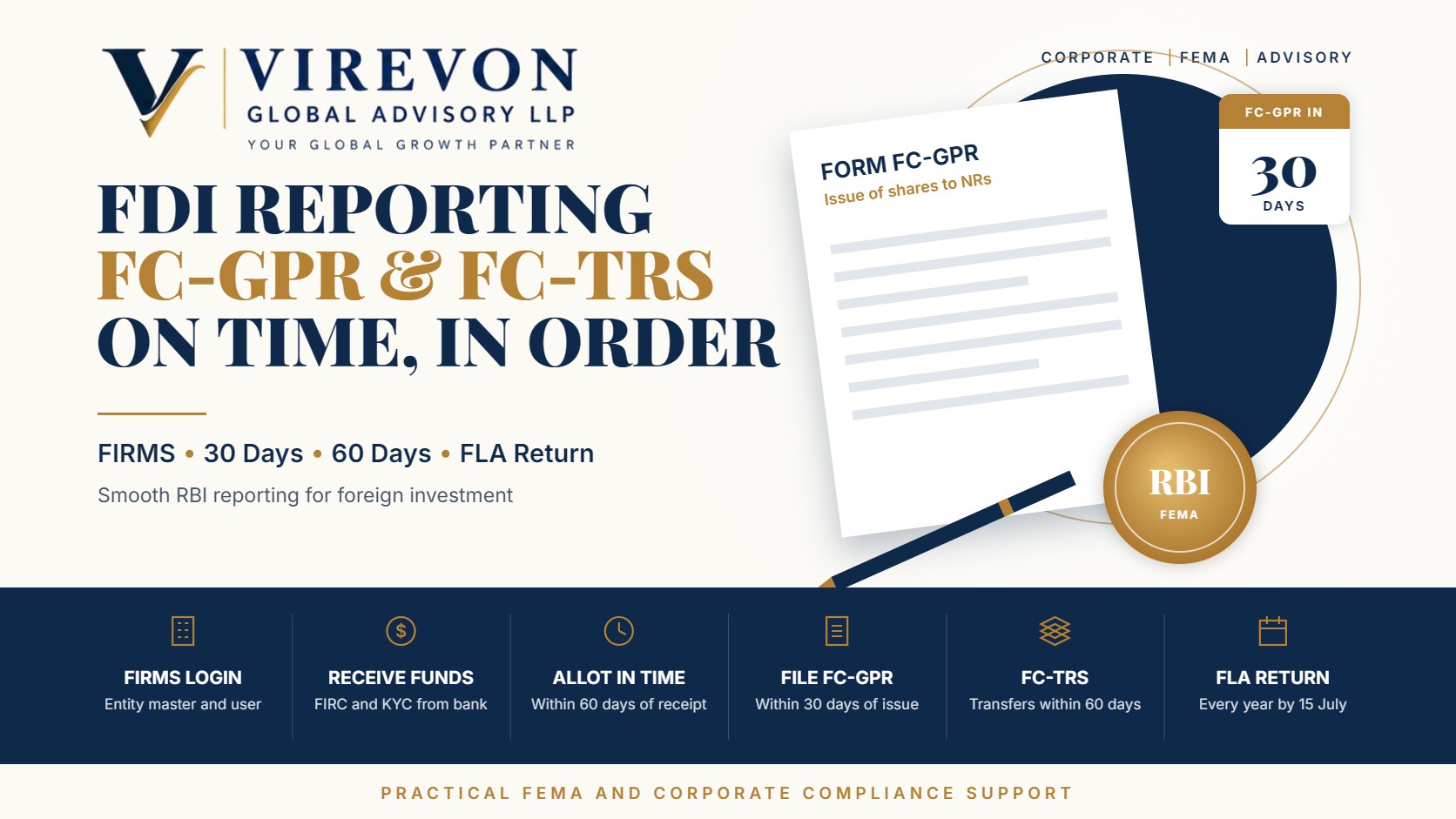
Foreign investment into an Indian company brings capital and confidence, along with a set of reporting duties to the Reserve Bank of India. FDI reporting FC-GPR covers fresh issues of shares to non-residents, while FC-TRS covers transfers between residents and non-residents. Both are filed on RBI’s FIRMS portal through the company’s authorised dealer bank.
The process is routine once you know the sequence, but missed timelines can lead to late submission fees or compounding. This guide sets out the timelines, documents and practical steps for each form, with the annual return that follows.
Key takeaways
- Reporting is governed by the FEMA (Non-debt Instruments) Rules, 2019 and the related reporting regulations, and filed on the FIRMS portal.
- Shares must be issued within 60 days of receiving the foreign inward remittance, otherwise the money must be refunded within 15 days thereafter.
- FC-GPR is due within 30 days from the date of issue of equity instruments.
- FC-TRS is due within 60 days of transfer or receipt/remittance of funds, whichever is earlier, and is filed by the resident party.
- Delays can usually be regularised by paying a late submission fee, and the FLA return is due every year by 15 July.
Before the first filing: FIRMS set-up
Companies need to register on FIRMS before any filing:
- Entity master: the company’s details, registered once and updated on changes.
- Business user registration: an authorised person (usually a director or company secretary) registered with supporting documents, approved through the AD bank.
Doing this early avoids a rush when the 30-day FC-GPR clock is running.
FDI reporting FC-GPR: fresh issue of shares
Sequence and timelines
| Step | Timeline |
|---|---|
| Receipt of funds from non-resident investor through banking channels | Day 0 |
| Obtain FIRC and KYC of the remitter from the AD bank | Soon after receipt |
| Allot equity shares, CCPS or CCDs | Within 60 days of receipt |
| If not allotted, refund the amount | Within 15 days after the 60 days |
| File FC-GPR on FIRMS | Within 30 days of allotment |
| File return of allotment (PAS-3) with the Registrar of Companies | Within 30 days of allotment |
Documents typically required
- FIRC and KYC report from the remitting bank.
- Board resolution for allotment and, where relevant, shareholders’ special resolution.
- Valuation certificate confirming the issue price is not below fair value as per pricing guidelines.
- Declaration on sectoral cap and entry route (automatic or government approval).
- Company secretary’s certificate on compliance with the Companies Act and FEMA.
- Memorandum of Association, and the pre- and post-issue shareholding pattern.
Worked example
A Noida SaaS company received USD 400,000 from a Singapore investor on 5 May. The board allotted CCPS on 20 June, which is within 60 days. FC-GPR was due by 20 July. The company obtained the FIRC and KYC in May, commissioned the valuation before allotment and filed on 10 July. The AD bank raised one query on the valuation date, which was answered within a week, and the form was approved.
FC-TRS: transfers between residents and non-residents
FC-TRS applies when equity instruments of an Indian company are transferred:
- From a resident to a non-resident (for example, a founder selling to a foreign fund).
- From a non-resident to a resident (for example, a buyback by a resident promoter).
Key points:
- The form is due within 60 days of transfer of the instruments or receipt/remittance of funds, whichever is earlier.
- The resident transferor or transferee is responsible for filing.
- Pricing must follow the guidelines: a resident selling to a non-resident cannot sell below fair value, and a non-resident selling to a resident cannot sell above it.
- Up to 25% of the consideration can be deferred, placed in escrow or paid with indemnity for up to 18 months, subject to pricing compliance.
- Transfers between two non-residents generally do not require FC-TRS.
Other reporting forms to keep in mind
- Form DI: downstream investment by an Indian company that counts as foreign-owned or controlled.
- FDI-LLP(I) and (II): for foreign investment into, and transfers in, LLPs.
- Form CN: for convertible notes issued by startups.
- ESOP reporting: for shares issued to non-resident employees.
- FLA return: the annual return on foreign liabilities and assets, due by 15 July each year from every company that has received FDI or made overseas investment.
If your group also invests abroad, our guide to overseas direct investment rules covers the outbound side.
If a filing is delayed: late submission fee
Delays can generally be regularised by paying a late submission fee (LSF), computed as:
LSF = ₹7,500 + (0.025% × A × n), where A is the amount involved and n is the delay in years, rounded up to the nearest month and expressed to two decimals. The LSF cannot exceed the amount involved.
For example, an FC-GPR for ₹3.2 crore filed 7 months late gives n = 0.58. LSF = ₹7,500 + (0.025% × ₹3,20,00,000 × 0.58) = ₹7,500 + ₹4,640 = ₹12,140.
For longer or more serious contraventions, compounding with RBI may be required. Keeping a compliance calendar is far cheaper than either route.
Good practices for smooth FDI reporting
- Plan valuation and board approvals before funds arrive, so allotment fits the 60-day window.
- Ask investors to mention the purpose and the company’s details clearly in the remittance.
- Keep one file per round: FIRC, KYC, valuation, resolutions, forms and approvals.
- Align FEMA filings with company law filings such as PAS-3 and updates to the register of members.
- Review sectoral caps and conditions before each round, especially where government approval may be needed.
For founders still setting up, our guide to private limited company registration covers incorporation basics.
Frequently asked questions
What is the time limit for FC-GPR?
FC-GPR must be filed within 30 days from the date of issue of equity instruments to the non-resident investor.
Who files FC-TRS?
The resident party to the transfer, whether transferor or transferee, is responsible for filing FC-TRS within 60 days.
What happens if shares are not allotted within 60 days of receiving funds?
The amount must be refunded to the investor within 15 days after the 60-day period. Continued retention is a contravention that may require compounding.
Is the FLA return required every year?
Yes. Companies that have received FDI or made overseas investment must file the FLA return by 15 July each year, including in years with no fresh investment.
If you are raising foreign investment or transferring shares with non-residents, we would be glad to help plan and file the RBI reporting.
This article is general information based on the law as of September 2026, and is not legal or tax advice. Please check the facts of your own case with a professional before acting.
Leave a Reply