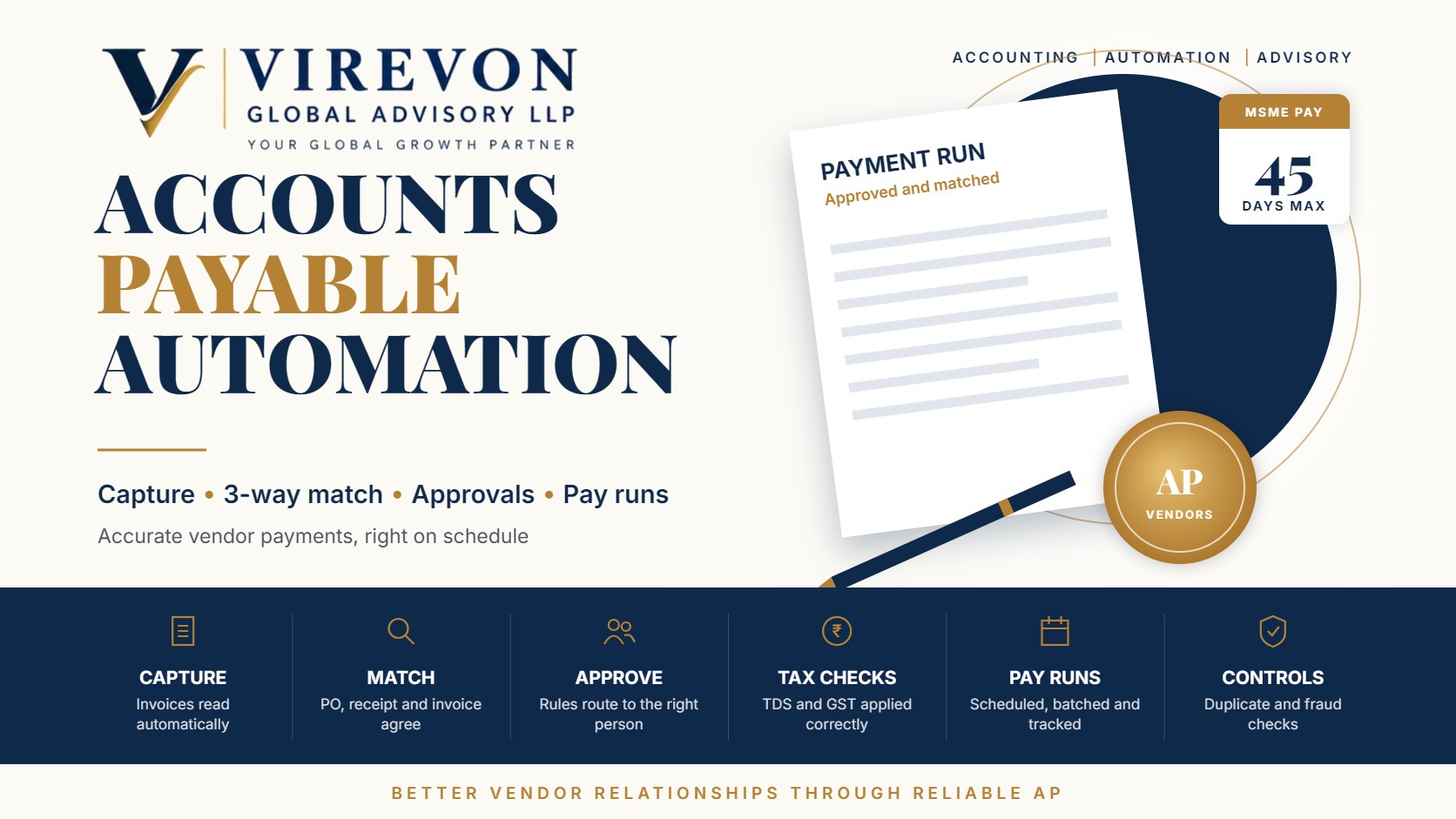
Paying suppliers sounds simple until volumes grow. Invoices arrive by email, courier and portal; approvals sit in inboxes; TDS and GST checks are done by hand; and vendors call to ask when they will be paid. Accounts payable automation brings order to this process by capturing invoices digitally, matching them to purchase orders and receipts, routing approvals automatically and scheduling payments.
For Indian businesses, automation also helps with compliance that directly affects tax: deducting TDS correctly, protecting input tax credit, and paying micro and small enterprise vendors within the legal time limits. This guide explains how to design an automated payables process that is accurate, well controlled and vendor friendly.
Key takeaways
- Automate the full cycle: invoice capture, matching, approval, tax checks, payment and reconciliation.
- Use three-way matching of purchase order, goods receipt and invoice for inventory and capital purchases.
- Build TDS and GST checks into the workflow, including GSTR-2B matching before credit is claimed.
- Track MSME vendors and pay them within 15 days, or the agreed period capped at 45 days, to avoid tax disallowance.
- Keep strong controls over vendor master changes and duplicate payments, which are the main fraud risks.
Why automate accounts payable
Manual payables processes tend to produce the same problems in every growing business:
- invoices lost or entered late, leading to missed discounts and unhappy vendors;
- duplicate payments when the same invoice arrives through two channels;
- TDS deducted at the wrong rate or not at all;
- input tax credit lost because supplier invoices were not matched with GSTR-2B;
- limited visibility of upcoming cash outflows.
Automation addresses these by creating a single digital path for every invoice, with rules applied consistently and a full audit trail.
Designing the automated payables workflow
| Step | Manual approach | Automated approach |
|---|---|---|
| Invoice receipt | Paper and scattered emails | Dedicated AP email inbox and vendor portal, with OCR capture |
| Data entry | Typed by accountant | Extracted automatically, validated against vendor master |
| Matching | Visual checks | Automatic two-way or three-way match with tolerance limits |
| Approval | Emails and signatures | Rule-based routing by amount, department and cost centre |
| Tax checks | Case-by-case | TDS section and rate mapped per vendor and expense type; GST validated |
| Payment | Individual bank transfers | Scheduled batch payment runs through bank integration |
| Reconciliation | Month-end matching | Daily bank feed matching and vendor statement reconciliation |
Three-way matching in practice
For goods and capital purchases, the system compares:
- the purchase order (what was ordered and at what price);
- the goods receipt note (what was actually received);
- the supplier invoice (what is being charged).
If quantity and price agree within set tolerances, the invoice is approved for payment automatically. Exceptions go to the buyer or requester to resolve. For services and recurring expenses without purchase orders, two-way matching against a contract or approved budget works well.
Building tax compliance into accounts payable automation
Payables is where many Indian tax obligations are triggered, so the workflow should handle them automatically:
- TDS: map each vendor and expense type to the correct TDS provision and rate, including thresholds such as those for purchases of goods and rent. Validate PAN status and apply lower deduction certificates only within their limits.
- GST input tax credit: match supplier invoices with GSTR-2B and act on them in the Invoice Management System before claiming credit. Hold payment or follow up where a supplier has not reported the invoice.
- 180-day rule: if a supplier is not paid within 180 days of the invoice date, the related credit must be reversed until payment is made. A related reversal applies when a supplier has not paid its own GST; our guide to ITC and Rule 37A explains it.
- Reverse charge: flag vendors whose services attract reverse charge so that self-invoices and tax payments are generated on time.
- E-invoices: where suppliers are covered by e-invoicing, check that invoices carry a valid IRN and QR code.
Paying MSME vendors on time
Under the MSMED Act, buyers must pay micro and small enterprises within the agreed period, which cannot exceed 45 days from acceptance, or within 15 days where there is no written agreement. Delayed payment attracts compound interest at three times the RBI bank rate. For income-tax purposes, the rule introduced as section 43B(h) of the 1961 Act, and carried into the Income-tax Act 2025, disallows such payables until actual payment if they remain unpaid beyond the permitted period.
An automated system helps by:
- tagging vendors with their Udyam classification and enterprise category;
- calculating due dates from the date of acceptance and payment terms;
- prioritising MSME invoices in each payment run;
- producing a year-end report of overdue MSME payables for tax and disclosure purposes.
Controls that protect cash
Automation reduces errors, but it also needs strong controls:
- Vendor master changes: require independent verification, such as a call-back on a known number, before changing bank details. This is the most common payment fraud route.
- Duplicate detection: flag invoices with the same vendor, number, date or amount.
- Segregation of duties: the person who adds vendors should not approve payments, and neither should reconcile the bank.
- Approval limits: set clear thresholds and require dual approval for high-value payments.
- Bank-side controls: use maker-checker on net banking and review authorised users regularly.
- Reconciliation: match payments to bank feeds daily; our note on bank reconciliation best practices covers this in detail.
Rolling out automation step by step
- Start with a process map: document how invoices arrive, who approves them and where delays occur.
- Clean the vendor master: remove duplicates, confirm PAN, GSTIN, bank details and MSME status.
- Pick tools that fit: many accounting platforms offer AP modules or integrations; larger businesses may use dedicated AP software connected to their ERP.
- Pilot with one entity or department, measure invoice cycle time and exceptions, then expand.
- Measure results: track cost per invoice, days to approve, on-time payment rate, and early payment discounts captured.
- Tie it to the close: accruals for goods received without invoices should flow automatically into the month-end close checklist.
Frequently asked questions
What is accounts payable automation?
It is the use of software to capture supplier invoices, match them to orders and receipts, route approvals, apply tax checks and schedule payments with minimal manual work.
Is accounts payable automation suitable for small businesses?
Yes. Many accounting platforms include affordable invoice capture and approval features, and even partial automation of capture and payment runs saves significant time.
How does automation help with MSME payment rules?
It tags MSME vendors, calculates due dates within the 15 or 45-day limits, and prioritises those invoices, reducing the risk of interest and tax disallowance.
Can automation help protect GST input tax credit?
Yes. Automated matching with GSTR-2B and payment tracking against the 180-day rule help ensure credit is claimed correctly and not lost.
If you would like to streamline vendor payments and build compliance checks into your payables process, our accounting team would be glad to help.
This article is general information based on the law as of September 2026, and is not legal or tax advice. Please check the facts of your own case with a professional before acting.