A registered trademark is one of the few business assets that can last indefinitely, but only if it is renewed on time. In India, a registration is valid for ten years and must then be renewed for further ten-year periods. Trademark renewal is a simple online filing, yet missed deadlines are common, especially for marks registered years ago by founders who have since moved on.
This guide explains the renewal timeline, fees, what happens if the deadline passes, and how a lapsed mark can be restored.
Key takeaways
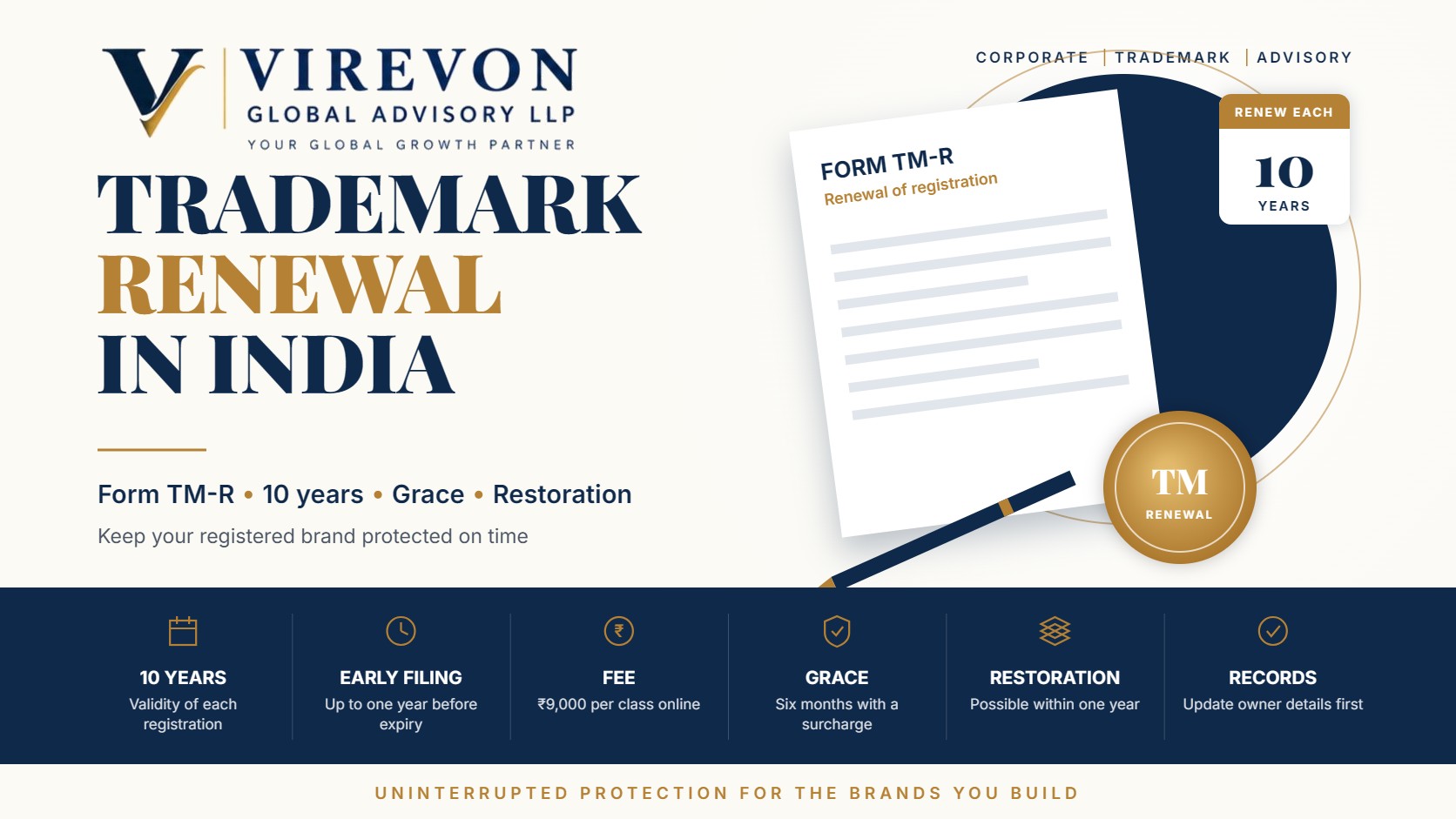
- A trademark registration is valid for ten years and can be renewed any number of times, each for a further ten years.
- The ten years run from the date of application, which is treated as the date of registration.
- Renewal is filed online in Form TM-R; the official fee is ₹9,000 per class for e-filing.
- You can renew up to one year before expiry, and within six months after expiry with a surcharge.
- If the mark is removed, it can usually be restored within one year of expiry, at the Registrar’s discretion.
How the ten-year cycle works
Under the Trade Marks Act, 1999, a registration is valid for ten years and renewable for successive ten-year periods. Because the date of registration is deemed to be the date of the application, a mark applied for on 15 March 2017 but registered in 2019 still expires on 15 March 2027.
This surprises many owners, who assume the clock starts from the registration certificate. Always check the expiry date on the IP India portal rather than relying on the certificate date.
Trademark renewal timeline and fees
| Stage | Timing | Form and official fee (e-filing) | Effect |
|---|---|---|---|
| Early renewal | Up to one year before expiry | Form TM-R, ₹9,000 per class | Registration continues without interruption |
| On expiry date | By the expiry date | Form TM-R, ₹9,000 per class | Registration continues without interruption |
| Grace period | Within six months after expiry | Form TM-R with renewal fee and surcharge | Mark is renewed; not removed from the register |
| Restoration | After removal, within one year of expiry | Form TM-R with renewal and restoration fees | Mark restored and renewed, at the Registrar’s discretion |
| Beyond one year | More than one year after expiry | Fresh application | Earlier registration is lost; new filing date applies |
The fee for physical filing is higher than for e-filing, so online filing is the sensible default. Fees are charged per class, so a mark registered in three classes needs three times the fee.
Step-by-step: renewing a trademark
- Check the register: confirm the expiry date, classes and the owner’s name and address on the portal.
- Update details first: if the owner’s name, address or constitution has changed (for example, a proprietorship converted into a company), record the change or assignment before, or together with, the renewal.
- File Form TM-R online with the application number, class and fee.
- Track the status: the portal will show the renewal once processed, and the renewal is recorded and published.
- Keep evidence: save the filing receipt and updated record for due diligence, licensing and enforcement.
The Registry is expected to send a reminder notice before the expiry date to the address on record, but owners should not rely on it. Outdated addresses and email IDs mean many reminders never reach the current owner.
What happens if you miss the expiry date
Missing the expiry date does not immediately end protection.
- Within six months after expiry: you can still renew by paying the renewal fee plus a surcharge. The mark will not be removed if renewal is completed in this window.
- After six months: the Registrar may remove the mark from the register and publish the removal.
- Restoration: a removed mark can be restored and renewed if the request is made within one year from the expiry date, on payment of the prescribed fees. Restoration is discretionary, and the Registrar can consider the interests of third parties who may have adopted similar marks in the meantime.
- After one year: the only route is a fresh application, which takes a new filing date and may face objections or oppositions, including from others who filed in the interim.
This is why renewing early is the most cost-effective option. It keeps the original priority date intact, which can be decisive in disputes with later users.
Special situations to watch
- Assignments and mergers: if the brand has been sold or the business restructured, the new owner should record the assignment and then renew. A renewal in the old owner’s name can create avoidable questions in due diligence.
- Multiple classes and series marks: each class needs its own fee; keep a single tracker for all classes and variants.
- Logo refresh: if you have changed your logo substantially, the old registration may not protect the new version. Consider filing for the new logo in addition to renewing the old one.
- Opposition or rectification pending: renewals can proceed, but coordinate with any ongoing proceedings. Our guide to trademark opposition in India explains those proceedings.
- Non-use: a registered mark not used for a continuous period of five years or more can be vulnerable to removal on the ground of non-use, even if renewed. Keep evidence of use up to date.
Building a simple renewal calendar
A small amount of organisation avoids expensive restoration:
- List every mark with application number, class, owner and expiry date.
- Set reminders at 12 months, 6 months and 1 month before expiry.
- Nominate one person or adviser responsible for renewals and portal access.
- Review the portfolio annually: drop marks no longer needed and plan new filings for new products. Our trademark registration guide covers filing for new marks and classes.
Frequently asked questions
How long is a trademark valid in India?
Ten years from the date of application, renewable indefinitely for successive ten-year periods.
When can I file for trademark renewal?
Up to one year before the expiry date. It can also be filed within six months after expiry with a surcharge.
What is the government fee for trademark renewal?
The official fee for e-filing Form TM-R is ₹9,000 per class. Late renewal and restoration involve additional fees.
Can I restore a trademark that was removed for non-renewal?
Yes, if you apply within one year from the expiry date. Restoration is discretionary and requires payment of the prescribed fees.
If your trademarks are due for renewal or have lapsed recently, our team would be glad to help you renew or restore them smoothly.
This article is general information based on the law as of September 2026, and is not legal or tax advice. Please check the facts of your own case with a professional before acting.