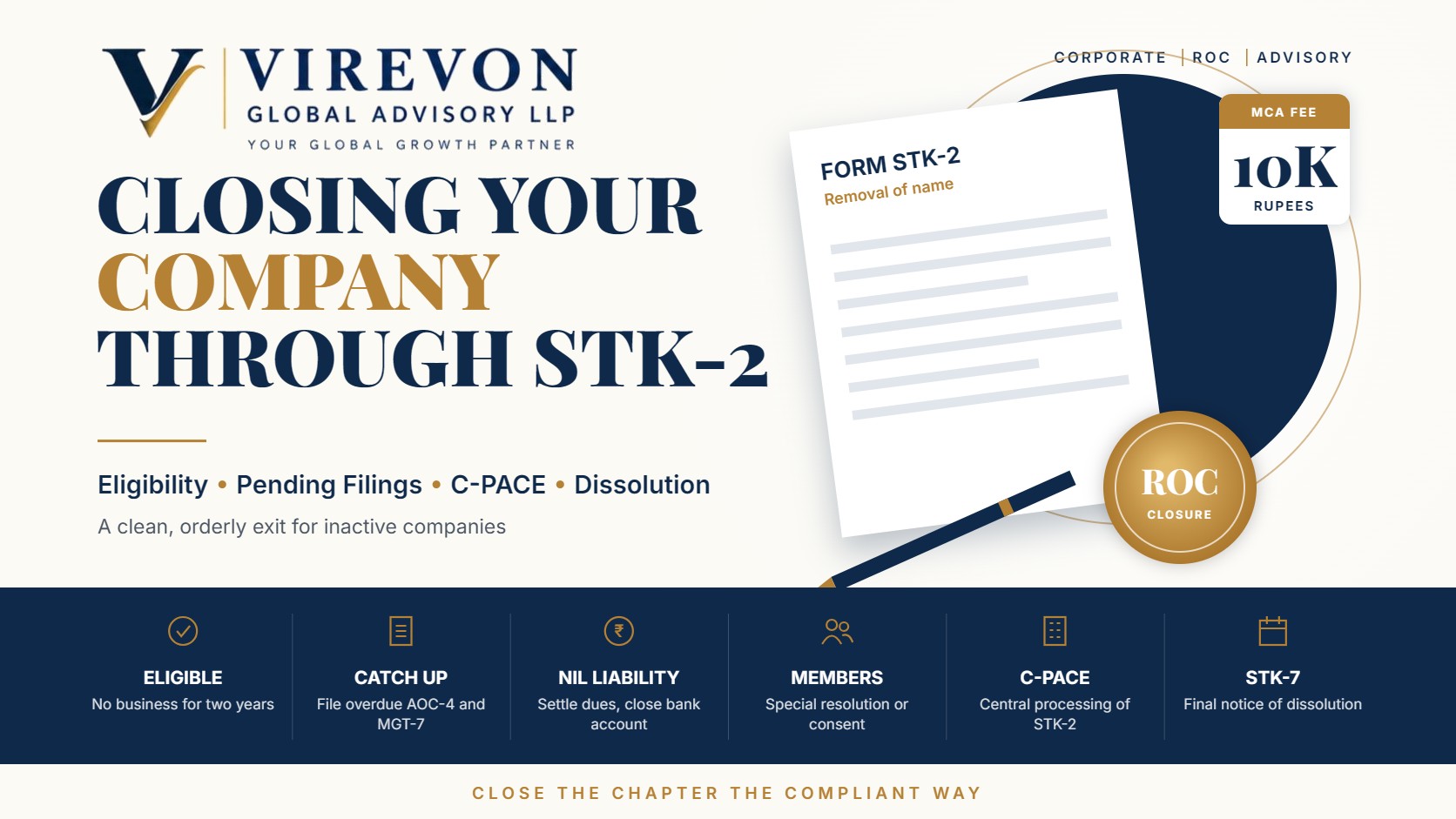
Not every company goes on to become a thriving business. Some are set up for a project that never took off, some complete their purpose, and others become inactive when promoters move on. Leaving such a company dormant on the register without filings only builds up late fees and can lead to director disqualification. A company strike off through Form STK-2 is the simplest way for an eligible private limited company to close cleanly.
This article explains which companies can apply, what must be completed before filing, the documents required, how the application is processed, and what happens after the name is removed. It also covers the points that most often cause applications to be returned.
Key takeaways
- A company can apply for strike off if it has not carried on business for the two immediately preceding financial years, or did not commence business within one year of incorporation, and has not obtained dormant status.
- The company must have no assets and no liabilities at the time of application, supported by a recent statement of accounts.
- Overdue annual filings up to the end of the financial year in which business ceased must be completed before filing STK-2.
- STK-2 applications are processed centrally by the MCA’s Centre for Processing Accelerated Corporate Exit (C-PACE).
- Liability of directors and members for past acts continues even after strike off, and restoration is possible in certain cases.
Who can apply for strike off?
Under section 248(2) of the Companies Act, 2013, a company may apply to the Registrar to remove its name if:
- It has failed to commence business within one year of incorporation, or
- It has not carried on any business or operation for the two immediately preceding financial years and has not applied for dormant company status.
Companies that cannot use this route
- Listed companies and certain delisted companies
- Companies registered under section 8
- Companies under inspection or investigation, or with prosecution pending
- Companies that have accepted public deposits that remain outstanding, or have charges pending satisfaction
- Companies with pending applications for compromise or arrangement
- Companies that, within the previous three months, changed their name or registered office state, disposed of property or rights for value other than in the normal course, or engaged in any activity other than that needed for closure
If the company is not eligible, voluntary winding up under the Insolvency and Bankruptcy Code or other routes may be needed.
Preparing the company for closure
Before filing, the company should reach a clean position:
- Settle all liabilities: pay creditors, statutory dues, director loans (or obtain waivers) and any tax demands.
- Realise or write off assets: sell or distribute assets and bring the balance sheet to nil.
- Close tax registrations: apply for cancellation of GST registration and file the final return; see our guide on GST registration cancellation. Close professional tax and other registrations where applicable.
- File overdue returns: file financial statements (AOC-4) and annual returns (MGT-7 or MGT-7A) up to the end of the financial year in which the company ceased business. Our ROC annual filing guide explains these forms.
- Income-tax: file pending income-tax returns and resolve any outstanding demands or proceedings.
- Close the bank account: obtain a closure certificate or confirmation.
Documents for Form STK-2
| Document | Purpose |
|---|---|
| Board resolution | Approves filing and authorises a director |
| Special resolution or consent of 75% of members (by paid-up capital) | Members’ approval for strike off |
| STK-3 indemnity bond from each director | Directors indemnify against any liability that arises later |
| STK-4 affidavit from each director | Confirms the company’s position and eligibility |
| STK-8 statement of accounts | Assets and liabilities as on a date not more than 30 days before filing, certified by a practising professional |
| Bank account closure evidence | Shows no bank account remains open |
| Pending litigation statement | Details of any legal proceedings, if any |
The government fee for STK-2 is ₹10,000. From time to time, the MCA has announced schemes with reduced fees for inactive companies, so check whether any scheme is running when you file.
How the application is processed
- Filing: STK-2 with attachments is filed on the MCA portal, signed by a director and certified by a practising professional.
- Scrutiny at C-PACE: the application is examined centrally; queries may be raised and must be answered within the time allowed.
- Public notice: if satisfied, the Registrar issues a public notice in Form STK-6, published on the MCA website, in the Official Gazette and in newspapers, inviting objections within 30 days.
- Consultation with regulators: departments such as income-tax may be informed and can raise objections.
- Dissolution: if no objection survives, the Registrar strikes off the name and publishes the notice of dissolution in Form STK-7.
Processing times vary with the volume of applications and the quality of documents. Clean applications with complete filings typically move faster.
After strike off
- The company stands dissolved from the date of the STK-7 notice.
- The liability of every director, officer and member continues and may be enforced as if the company had not been dissolved.
- Any assets that were overlooked vest with the government, so it is important to account for everything before applying.
- An aggrieved person can appeal against the strike off within three years; a company, member or creditor can seek restoration from the Tribunal within twenty years in specified circumstances.
Common reasons for rejection or resubmission
- Annual filings not completed up to the required year.
- Statement of accounts older than 30 days or showing balances.
- Bank account not closed, or GST registration still active.
- Signatures or dates inconsistent across STK-3, STK-4 and the resolutions.
- Charges on the MCA register not satisfied.
- Pending notices or proceedings not disclosed.
Frequently asked questions
How long does a company strike off take?
It depends on C-PACE processing and the 30-day public notice period. Complete applications with all filings up to date are generally processed faster.
Do we need to file all pending annual returns before STK-2?
Yes. Financial statements and annual returns must be filed up to the end of the financial year in which the company stopped business.
Can a section 8 company apply for strike off?
No. Section 8 companies are excluded from this route and must follow other procedures.
Can a struck-off company be revived?
Yes, in certain circumstances, through an application to the Tribunal within the time limits set by the Act.
If you have an inactive company and would like an orderly closure, our corporate team would be happy to plan the strike-off steps with you.
This article is general information based on the law as of September 2026, and is not legal or tax advice. Please check the facts of your own case with a professional before acting.