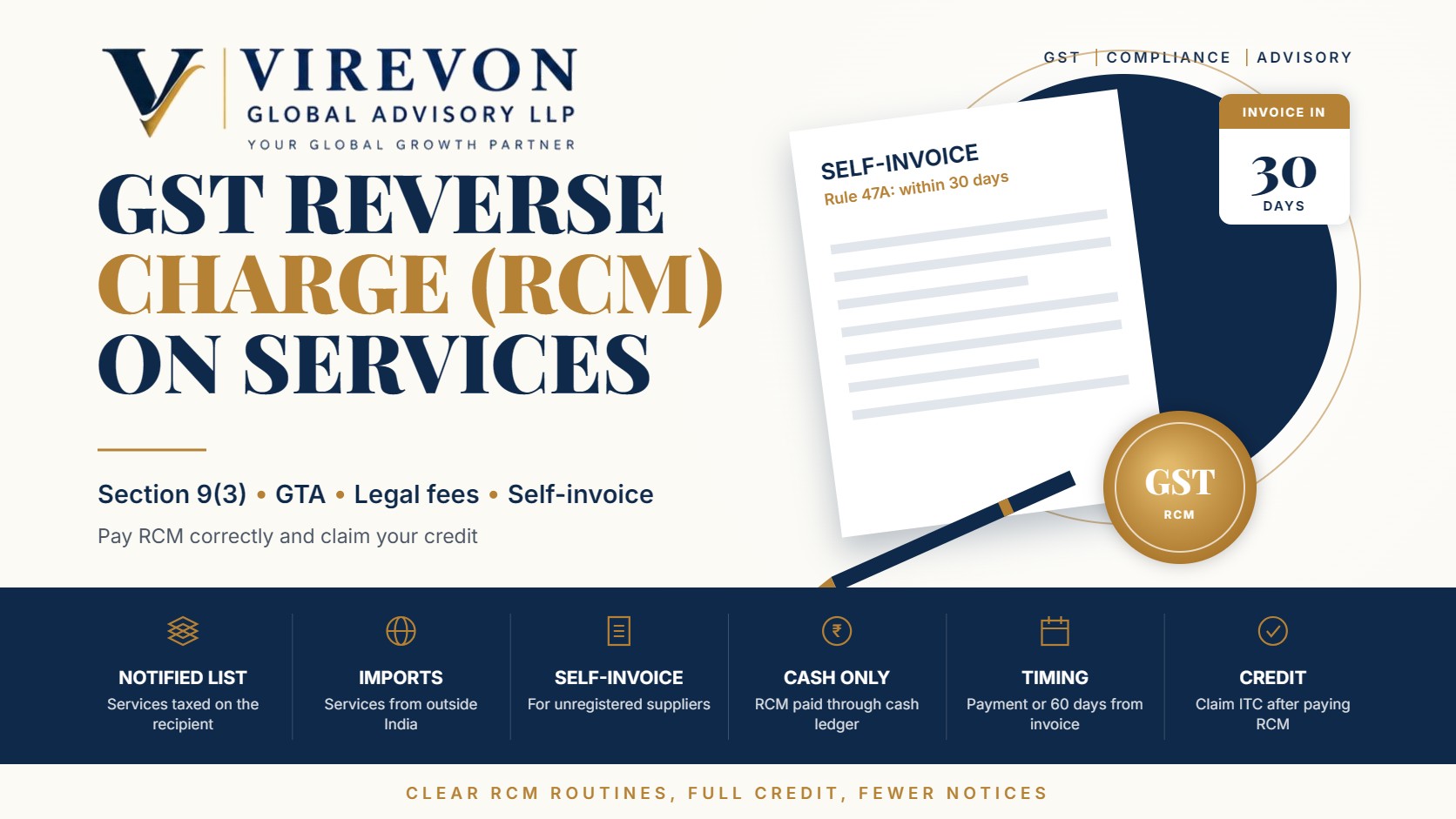
Under GST, the supplier normally charges and pays tax. The GST reverse charge mechanism (RCM) flips this for certain supplies: the recipient pays the tax directly to the government. For businesses, RCM is easy to miss because the supplier’s invoice may show no GST at all, yet the liability still exists and often surfaces later in audits and notices.
The good news is that, for most regular taxpayers, RCM is cash-flow neutral: the tax paid under reverse charge is usually available as input tax credit. This guide explains which services attract RCM, how the timing and self-invoicing rules work, and a simple monthly routine.
Key takeaways
- RCM on services arises from the notified list under section 9(3), from section 9(4) for specified supplies by unregistered persons, and on import of services.
- Common RCM services include goods transport agency services, legal services by advocates, director services, security services from non-corporate suppliers, sponsorship and renting of commercial property by unregistered landlords.
- Tax under RCM must be paid in cash through the electronic cash ledger, not from input tax credit.
- When the supplier is unregistered, the recipient issues a self-invoice within 30 days of receiving the supply.
- Credit of RCM tax is available in the same return period once paid, subject to the usual conditions.
Services commonly covered by GST reverse charge
The list of services notified under section 9(3) is long, but these entries affect most businesses:
| Service | Supplier | Recipient liable (broadly) |
|---|---|---|
| Goods transport agency (GTA), where GTA has not opted for forward charge | GTA | Factories, companies, firms, registered persons and other specified recipients |
| Legal services | Individual advocate or firm of advocates | Business entity with turnover above the exemption limit |
| Services as director | Director of a company or body corporate | The company or body corporate |
| Security services (supply of security personnel) | Person other than a body corporate | Registered persons, excluding composition taxpayers and some others |
| Sponsorship services | Any person | Body corporate or partnership firm |
| Insurance agent and recovery agent services | Agent | Insurance company, bank or NBFC |
| Renting of commercial property | Unregistered person | Registered person, excluding composition taxpayers |
| Import of services | Person outside India | Recipient in India (non-business recipients are dealt with separately) |
The exact conditions for each entry, including exclusions, are in the notification, so check the precise wording before concluding for an unusual case.
A note on GTA and commercial rent
For GTA services, the transporter may opt to pay GST under forward charge by filing the prescribed declaration; otherwise the recipient pays at 5% under RCM. After GST 2.0, a GTA choosing forward charge can opt for 5% without credit or 18% with credit. Always ask transporters which option they have taken, and keep their declaration on file.
RCM on commercial property rented from an unregistered landlord applies from 10 October 2024. Composition taxpayers were excluded from this entry from 16 January 2025.
When the tax is payable: time of supply
For services under reverse charge, the time of supply is broadly the earlier of:
- the date of payment to the supplier; or
- the date immediately after 60 days from the date of the supplier’s invoice.
If neither can be determined, the date of entry in the recipient’s books applies. For imports of services from associated enterprises, special timing rules apply. In practice, this means an unpaid legal fee invoice still creates RCM liability once 60 days pass.
Self-invoice, payment voucher and returns
The documentation depends on whether the supplier is registered.
- Registered supplier: the supplier issues its invoice mentioning that tax is payable on reverse charge. The recipient pays the tax and reports it.
- Unregistered supplier: the recipient issues a self-invoice. Rule 47A requires this within 30 days from the date of receipt of the supply. The recipient also issues a payment voucher when paying the supplier.
- Import of services: the recipient pays IGST under reverse charge; a self-invoice is generally prepared for the record.
In the returns, RCM liability is reported in GSTR-3B under inward supplies liable to reverse charge, paid in cash, and the credit is claimed in the input tax credit section of the same return where eligible. Registered suppliers’ RCM invoices also appear in GSTR-2B, which helps with reconciliation.
Worked example
A Delhi-based private limited company receives the following in August:
- Freight of ₹40,000 from a GTA that has not opted for forward charge: RCM at 5% is ₹2,000.
- Legal fees of ₹1,00,000 from an individual advocate: RCM at 18% is ₹18,000.
- Sitting fees of ₹50,000 paid to an independent director: RCM at 18% is ₹9,000.
The company pays ₹29,000 in cash through GSTR-3B for August and, subject to conditions, claims the same ₹29,000 as input tax credit in that return. The net cash cost is only the time value of money, but missing the payment would create interest and possible penalty exposure, along with a lost credit if time limits pass.
Common mistakes and how to avoid them
- Not flagging RCM vendors in the vendor master: tag advocates, directors, GTAs and unregistered landlords so the accounting system reminds you every time.
- Using credit to pay RCM: RCM must be paid in cash; ITC can be used only for forward charge liability.
- Missing self-invoices: without a self-invoice within 30 days, the credit claim can be questioned.
- Assuming small amounts are exempt: there is no general small-value exemption for notified RCM services, though specific exemptions exist for some cases.
- Blocked credits: RCM paid on items blocked under section 17(5) is still payable, but no credit is available. Our guide to blocked credits under section 17(5) explains which ones.
A simple monthly RCM routine
- Run a report of payments and invoices from RCM-tagged vendors.
- Identify imports of services from foreign vendor invoices and card statements, including software subscriptions.
- Raise self-invoices for unregistered suppliers within 30 days.
- Compute RCM liability using the time of supply rules and deposit in cash with GSTR-3B.
- Claim credit in the same return where eligible, and reconcile with GSTR-2B for registered suppliers.
- Keep a yearly RCM register for the annual return and any departmental audit.
For a wider view of credit matching, see our note on GSTR-2B vs GSTR-3B ITC reconciliation.
Frequently asked questions
Can I pay GST under reverse charge using input tax credit?
No. Tax payable under reverse charge must be paid in cash through the electronic cash ledger. The tax so paid can then be claimed as credit, subject to conditions.
Is RCM applicable on legal fees paid to an advocate?
Yes, for legal services by an individual advocate or a firm of advocates to a business entity, subject to the exemption for smaller entities in the notification.
Do I need to issue a self-invoice for RCM?
Yes, when the supplier is unregistered. Rule 47A requires the self-invoice within 30 days from receipt of the supply.
Is GST payable under RCM on foreign software subscriptions?
For a registered business importing services, IGST is generally payable under reverse charge on the value of the imported service.
If you would like a quick review of your RCM vendors and credits, our GST team would be happy to help you set up a clean monthly routine.
This article is general information based on the law as of September 2026, and is not legal or tax advice. Please check the facts of your own case with a professional before acting.