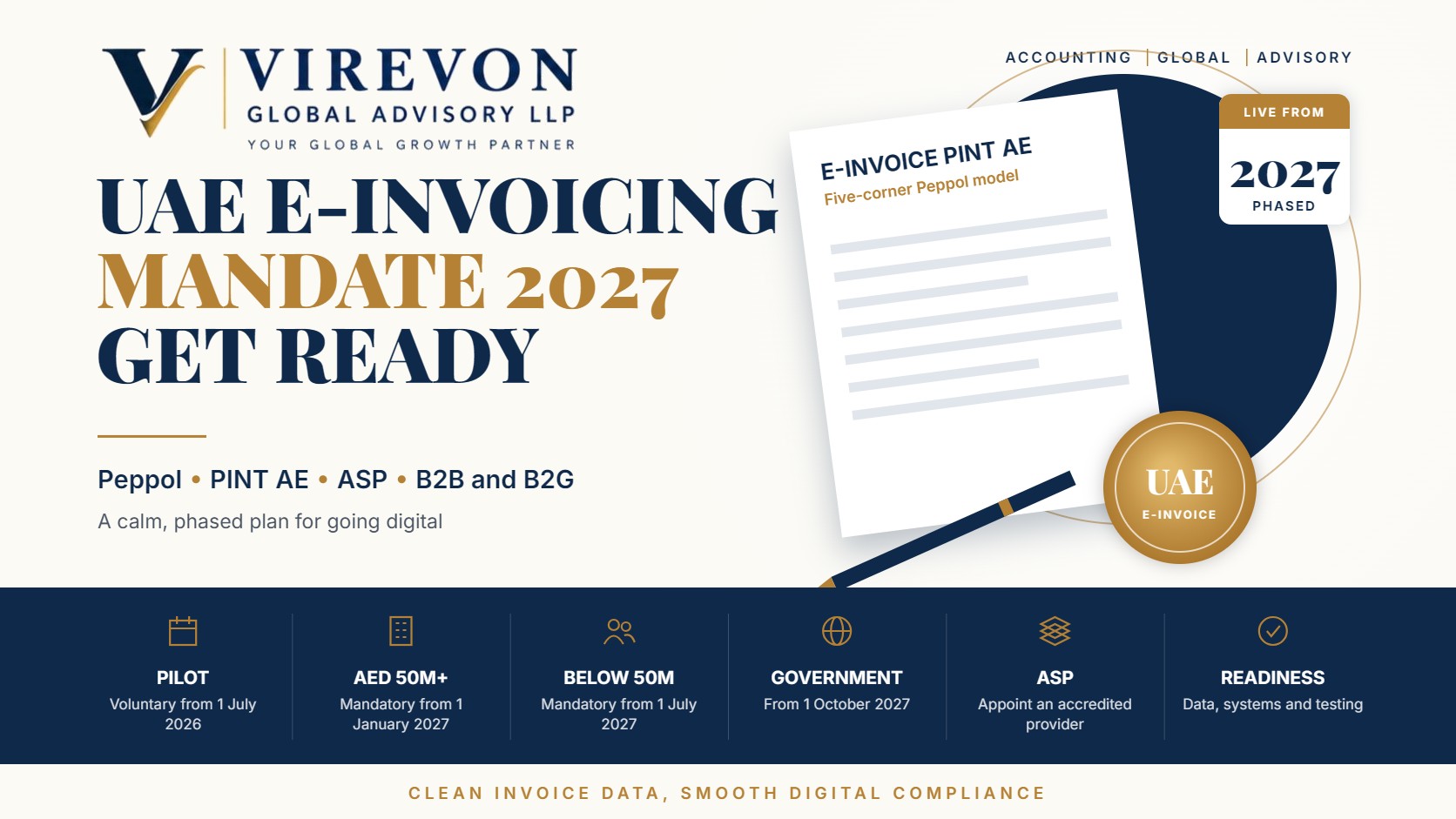
UAE e-invoicing is moving from plan to practice. Instead of emailing PDF invoices, businesses will exchange structured electronic invoices through accredited service providers, with invoice data reported to the Federal Tax Authority (FTA) in near real time. The rollout is phased, starting with larger businesses from 1 January 2027.
The change is significant, but manageable with a clear plan. This guide explains the timeline, how the model works, what the penalties look like and the practical steps to get ready without disrupting your billing.
Key takeaways
- The framework was set out in Ministerial Decisions No. 243 and 244 of 2025, with penalties under Cabinet Decision No. 106 of 2025.
- A voluntary pilot started on 1 July 2026; businesses with revenue of AED 50 million or more go live on 1 January 2027.
- Businesses below AED 50 million go live on 1 July 2027, and government entities on 1 October 2027.
- Each business must appoint an Accredited Service Provider (ASP); the deadline for the first group was extended to 30 October 2026.
- The initial scope covers B2B and B2G transactions; B2C is outside the first phase.
The UAE e-invoicing timeline
| Group | Appoint ASP by | Mandatory from |
|---|---|---|
| Voluntary pilot participants | — | 1 July 2026 |
| Businesses with revenue of AED 50 million or more | 30 October 2026 | 1 January 2027 |
| Businesses with revenue below AED 50 million | 31 March 2027 | 1 July 2027 |
| Government entities | 31 March 2027 | 1 October 2027 |
Revenue for grouping purposes is based on the rules in the ministerial decision, so businesses near the AED 50 million mark should confirm their category early. Businesses can also choose to join before their mandatory date.
How the system works: the five-corner model
The UAE has adopted a decentralised model based on the Peppol network:
- Corner 1: the supplier creates the invoice in its accounting or ERP system.
- Corner 2: the supplier’s ASP validates the invoice and converts it to the UAE standard (PINT AE).
- Corner 3: the buyer’s ASP receives the invoice.
- Corner 4: the buyer receives it into its system.
- Corner 5: the FTA receives the tax data from the ASPs.
Because both sides need an ASP, buyers as well as sellers have to be ready. A business that only purchases in scope still needs to be able to receive e-invoices.
What counts as an e-invoice
A PDF, scanned copy or image is not an e-invoice under this framework. The invoice must be a structured file in the prescribed format, exchanged through the ASP network. Credit notes follow the same process and are required for cancellations, reductions or corrections.
Scope in the first phase
- In scope: B2B and B2G supplies, whether taxable or not, subject to the exclusions in the decision.
- Outside the initial scope: B2C transactions and certain specific categories, such as some financial and international passenger transport services, which follow separate rules.
- VAT groups: a transition period applies for transactions within a VAT group.
Electronic invoices must be issued within the time prescribed from the date of supply, and records must be retained in line with the UAE’s record-keeping rules.
Penalties to be aware of
Cabinet Decision No. 106 of 2025 sets administrative penalties, including:
- AED 5,000 per month of delay for failing to implement the system or appoint an ASP by the deadline.
- AED 100 per invoice or credit note not issued or transmitted electronically, capped at AED 5,000 per month.
- AED 1,000 per day for delays in reporting a system failure or notifying the ASP of data changes.
The amounts are modest compared with the operational disruption of a rushed implementation, which is the bigger reason to plan early.
A practical readiness plan
Step 1: Confirm your phase and scope
Check annual revenue, the type of customers (B2B, B2G, B2C) and any VAT group. Map which invoices and credit notes will be in scope.
Step 2: Clean your master data
E-invoicing rejects poor data. Review customer TRNs, legal names, addresses, item descriptions, tax codes and units of measure. This single step prevents most validation errors.
Step 3: Choose an ASP
Select an FTA-accredited provider that integrates with your ERP or accounting software. Compare onboarding support, pricing per invoice, archiving and reporting features.
Step 4: Update systems and processes
- Configure invoice templates to capture the mandatory fields.
- Set up integration or connectors between your software and the ASP.
- Define how incoming e-invoices will be received, approved and booked.
- Align credit note and cancellation workflows with the new rules.
Step 5: Test, train and go live
Run test invoices with key customers and suppliers, train the billing and payables team, and plan a short parallel run before the mandatory date.
How e-invoicing links with VAT and corporate tax
Structured invoice data gives the FTA near real-time visibility of transactions. That makes consistency between invoices, VAT returns and financial statements more important than ever. Businesses should reconcile e-invoice data with VAT returns every period and ensure the books support the corporate tax return. Our guide to UAE corporate tax basics covers the annual filing side. For official updates, refer to the Ministry of Finance e-invoicing page and FTA guidance.
Frequently asked questions
When does UAE e-invoicing become mandatory?
From 1 January 2027 for businesses with revenue of AED 50 million or more, 1 July 2027 for smaller businesses and 1 October 2027 for government entities.
Do small businesses need to do anything now?
Yes, planning should start now. Businesses below AED 50 million must appoint an ASP by 31 March 2027 and go live by 1 July 2027.
Is a PDF invoice sent by email an e-invoice?
No. An e-invoice must be a structured electronic file in the prescribed format, exchanged through accredited service providers.
Does e-invoicing apply to B2C sales?
B2C transactions are outside the first phase. The initial mandate covers B2B and B2G transactions.
If your UAE business is preparing for e-invoicing, our global accounting team would be glad to help you clean your data, align your books and plan a smooth go-live.
This article is general information based on the law as of September 2026, and is not legal or tax advice. Please check the facts of your own case with a professional before acting.