
Tag: NRI

  • ITR for NRIs: Which ITR Form, What to Report and Common Mistakes

    ITR for NRIs: Which ITR Form, What to Report and Common Mistakes

    Many non-resident Indians still earn income in India: rent from a flat, interest on NRO deposits, dividends, or gains on shares and mutual funds. Filing an ITR for NRI status is often the only way to claim back excess TDS, carry forward losses and keep a clean record for future property sales or visa and loan applications.

    The process is not complicated once you know which form applies, what counts as taxable in India and where the usual errors happen. This guide covers the return for the financial year 2025-26, which is still filed under the Income-tax Act 1961.

    Key takeaways

    • Residential status decides everything; confirm it before choosing a form.
    • Most NRIs file ITR-2; ITR-3 applies only if there is business or professional income in India. ITR-1 and ITR-4 are not available to non-residents.
    • Only Indian-source income (income received, accruing or arising in India) is taxable for a non-resident; foreign income and foreign assets are not reported while non-resident.
    • The section 87A rebate is for residents only, so an NRI may owe tax even where a resident with the same income would not.
    • A belated return for FY 2025-26 can still be filed up to 31 December 2026, with a late fee.

    Step 1: Confirm your residential status

    Before anything else, work out whether you were a non-resident for FY 2025-26. The basic test looks at the number of days you were in India during the year (182 days) and, in some cases, a combination of 60 or 120 days in the year with 365 days over the previous four years. Indian citizens with Indian income above ₹15 lakh who are not taxable in any other country may be treated as deemed residents. Some returning Indians qualify as “resident but not ordinarily resident” (RNOR), which has its own reporting rules.

    Our guide on NRI residential status rules walks through each test with examples.

    Which ITR form should an NRI file?

    Your Indian incomeForm
    Salary for work in India, rent, interest, dividends, capital gainsITR-2
    Business or professional income in India (including partner remuneration)ITR-3
    Only interest income, with low total incomeUsually ITR-2 (ITR-1 is not allowed)
    Presumptive income under section 44AD or 44ADAITR-3 (ITR-4 is not allowed)

    Choosing the wrong form is one of the most common reasons for a defective return notice, so this step is worth a second look.

    What to report in an ITR for NRI

    Income from house property

    Report rent from Indian property, less municipal taxes paid, with the standard deduction of 30% and interest on a housing loan where eligible. Tenants paying rent to an NRI must deduct TDS, so check that the TDS appears in your tax credit statement.

    Interest and dividends

    Interest on NRO savings and fixed deposits is taxable. Interest on NRE accounts and FCNR deposits is generally exempt for non-residents, but should still be reviewed each year against the account type. Dividends from Indian companies are taxable and usually carry TDS.

    Capital gains

    Gains on Indian shares, mutual funds and property are taxable in India. For listed equity shares and equity-oriented funds, long-term gains above ₹1.25 lakh are taxed at 12.5% and short-term gains at 20% under the rates applying since 23 July 2024. Property sales by NRIs attract TDS at the buyer’s end; our article on TDS on NRI property sales explains how to seek a lower deduction certificate.

    Salary

    Salary for services rendered in India is taxable here even if paid abroad. Salary for work done outside India is generally not taxable in India for a non-resident.

    What you do not report

    While you are a non-resident, foreign income, foreign bank accounts and Schedule FA (foreign assets) do not need to be reported. This changes once you become resident and ordinarily resident, so plan for the year you return.

    TDS, tax credits and DTAA relief

    TDS on payments to NRIs is often deducted at higher rates under section 195, which is why many NRIs are due a refund. To claim it:

    1. Download Form 26AS and the Annual Information Statement (AIS) and match every TDS entry with your records.
    2. Report each credit in the correct schedule, including the relevant section code.
    3. If you rely on a lower treaty rate under a Double Taxation Avoidance Agreement (DTAA), keep a Tax Residency Certificate from your country of residence and file Form 10F where required. See our guide on DTAA benefit, TRC and Form 10F.
    4. Where your country taxes the same income, keep Indian tax payment evidence to claim credit there.

    Tax rates and the rebate point

    NRIs use the same slab rates as residents under the new or old regime, but they cannot claim the rebate under section 87A. Under the new regime, an NRI with ₹12 lakh of taxable Indian income would pay about ₹62,400 including cess, whereas a resident with the same income would pay nothing after the rebate. Some deductions, such as certain investment-linked ones under the old regime, are also restricted for non-residents. It is worth comparing both regimes before filing.

    Common mistakes in NRI returns

    • Filing ITR-1 out of habit from resident years.
    • Wrong residential status, particularly in the year of leaving or returning to India.
    • Missing TDS credits because the deductor used a different PAN or quarter; always reconcile with AIS.
    • Treating NRO interest as exempt in the same way as NRE interest.
    • No pre-validated Indian bank account, which delays refunds. The refund goes to an Indian account; validate it on the e-filing portal in advance.
    • Not e-verifying within the time allowed, which leaves the return incomplete.
    • Ignoring capital loss carry forward, which requires a return filed by the original due date.

    Frequently asked questions

    Is it compulsory for an NRI to file an income tax return?

    It is required if total Indian income exceeds the basic exemption limit, and it is advisable where TDS has been deducted and a refund is due or losses need to be carried forward.

    Can an NRI file ITR-1?

    No. ITR-1 is available only to resident individuals. Most NRIs use ITR-2, or ITR-3 if they have business or professional income in India.

    Is NRE account interest taxable in India?

    Interest on NRE accounts is generally exempt for a person who is non-resident, while NRO interest is taxable.

    What if I missed the original due date for FY 2025-26?

    You can still file a belated return up to 31 December 2026, with a late fee of up to ₹5,000 (₹1,000 if total income does not exceed ₹5 lakh). Some losses cannot be carried forward in a belated return.

    If you are an NRI and would like help choosing the right form, reconciling TDS or claiming a refund, we would be glad to assist.

    This article is general information based on the law as of September 2026, and is not legal or tax advice. Please check the facts of your own case with a professional before acting.

  • NRI Property Sale TDS: Lower Deduction Certificate and Repatriation

    NRI Property Sale TDS: Lower Deduction Certificate and Repatriation

    Selling a flat or plot in India while living abroad is common, but the tax mechanics surprise many families. The biggest one is NRI property sale TDS: when the seller is a non-resident, the buyer must deduct tax at source at much higher rates than the 1% that applies between residents, and often on the full sale price unless a lower deduction certificate is obtained.

    This guide explains the rates, what changed for buyers in 2026, how a lower deduction certificate helps, and the steps to repatriate the sale proceeds.

    Key takeaways

    • When a non-resident sells property in India, the buyer deducts TDS under the non-resident provisions (old section 195, now section 393(2) of the Income-tax Act 2025), not the 1% resident rule.
    • For long-term capital gains (property held for more than 24 months), the base rate is 12.5%, plus surcharge and 4% cess; short-term gains are taxed at slab rates, so TDS is usually at the highest rate.
    • From 1 October 2026, resident individual and HUF buyers can deposit and report this TDS using their PAN through Form 141, without obtaining a TAN.
    • A lower deduction certificate (Form 128, formerly Form 13) lets TDS be deducted on the actual estimated gain rather than the full price.
    • Proceeds can be repatriated from the NRO account within the USD 1 million per financial year facility, with Forms 145 and 146 (formerly 15CA and 15CB).

    How NRI property sale TDS works

    The buyer, whether resident or non-resident, must deduct tax when paying a non-resident seller. The obligation arises at the time of payment or credit, whichever is earlier, including on advances and instalments.

    Without a certificate, buyers commonly deduct on the full sale consideration, because they cannot verify the seller’s cost of acquisition. That can lock up a large amount in TDS far exceeding the actual tax, which is then recovered only through a refund after filing the return.

    Rates in brief

    Type of gainHolding period for propertyBase tax rateTDS in practice
    Long-term capital gainMore than 24 months12.5% (without indexation)12.5% plus surcharge and 4% cess
    Short-term capital gain24 months or lessSlab ratesUsually 30% plus surcharge and 4% cess

    Surcharge depends on the amount of consideration and is capped at 15% for capital gains. For a sale above ₹1 crore, the effective long-term TDS rate works out to about 14.95% of the amount on which TDS is deducted.

    What changed for buyers in 2026

    Until recently, every buyer purchasing from an NRI had to obtain a TAN, file a quarterly non-resident TDS return and issue a TDS certificate. For individual homebuyers, this was a real hurdle.

    For transactions from 1 October 2026, the CBDT has revised the forms so that resident individual and HUF buyers can pay and report TDS on purchases from non-residents using their PAN through Form 141, the challan-cum-statement that replaced Form 26QB. The deadline is 30 days from the end of the month in which tax is deducted, and the buyer then issues the certificate in Form 132 to the seller. Transactions before this date follow the earlier TAN-based process, so check which regime applies to your payment dates.

    Buyers who are companies, firms or other entities continue to deduct and report through their TAN.

    The lower deduction certificate

    A seller who expects the actual tax to be much lower than the TDS can apply online for a certificate for lower or nil deduction in Form 128. The Assessing Officer considers the cost of acquisition, improvement costs and any planned reinvestment in eligible assets, and issues a certificate specifying the rate and amount for that buyer.

    Worked example. Priya, an NRI in Canada, sells a flat in Noida for ₹1.5 crore. She bought it in 2012 for ₹70 lakh.

    • Without a certificate: the buyer deducts about 14.95% on ₹1.5 crore, roughly ₹22.4 lakh.
    • With a certificate based on a long-term gain of about ₹80 lakh: TDS reduces to roughly ₹12 lakh, and less still if she reinvests in a new residential house or eligible bonds.

    Apply early. Processing takes time, and the certificate must be in hand before the buyer pays. Share the certificate with the buyer so that it is quoted correctly in the TDS filing.

    Reducing the tax itself

    • Section 54: long-term gains reinvested in a residential house in India, within the prescribed time, can be exempt, subject to the conditions and overall cap.
    • Section 54EC: investment of long-term gains in specified bonds within six months, up to the annual limit.
    • Capital gains account scheme: if reinvestment is planned but not done by the return due date, deposit the amount in the scheme.
    • Treaty relief: under most tax treaties, gains from immovable property are taxable in the country where the property is situated, so India retains the right to tax. Credit for Indian tax may be available in your country of residence.

    Filing an Indian return is essential to claim any excess TDS as a refund. Your residential status for the year decides the return form and which income is reported.

    Repatriating the sale proceeds

    1. Receive proceeds in your NRO account (or NRE, where specifically permitted).
    2. Obtain the accountant’s certificate in Form 146 (formerly 15CB), confirming that tax has been paid or deducted.
    3. File Form 145 (formerly 15CA) on the income-tax portal.
    4. Submit these with the bank’s remittance form and sale documents.

    Under FEMA, NRIs can remit up to USD 1 million per financial year from NRO balances, including property sale proceeds, subject to documentation. Special rules apply where property was bought from foreign or NRE funds, and for inherited property, so keep the purchase and inheritance documents ready.

    Frequently asked questions

    Is TDS on property bought from an NRI 1% like a resident sale?

    No. The 1% rate applies only when the seller is resident. For a non-resident seller, TDS is deducted at the rates applicable to capital gains, plus surcharge and cess.

    Do I still need a TAN to buy property from an NRI?

    For transactions from 1 October 2026, resident individual and HUF buyers can use their PAN and file Form 141. Earlier transactions and entity buyers follow the TAN-based process.

    How long does a lower deduction certificate take?

    It varies with the case and workload. Apply as soon as the sale is agreed and before the first payment, including any advance.

    How much of the sale money can an NRI send abroad?

    Up to USD 1 million per financial year from the NRO account, including property sale proceeds, after completing the tax and bank documentation.

    If you are an NRI planning to sell property in India, or buying from one, we would be glad to help with the certificate, TDS filings and repatriation steps.

    This article is general information based on the law as of September 2026, and is not legal or tax advice. Please check the facts of your own case with a professional before acting.

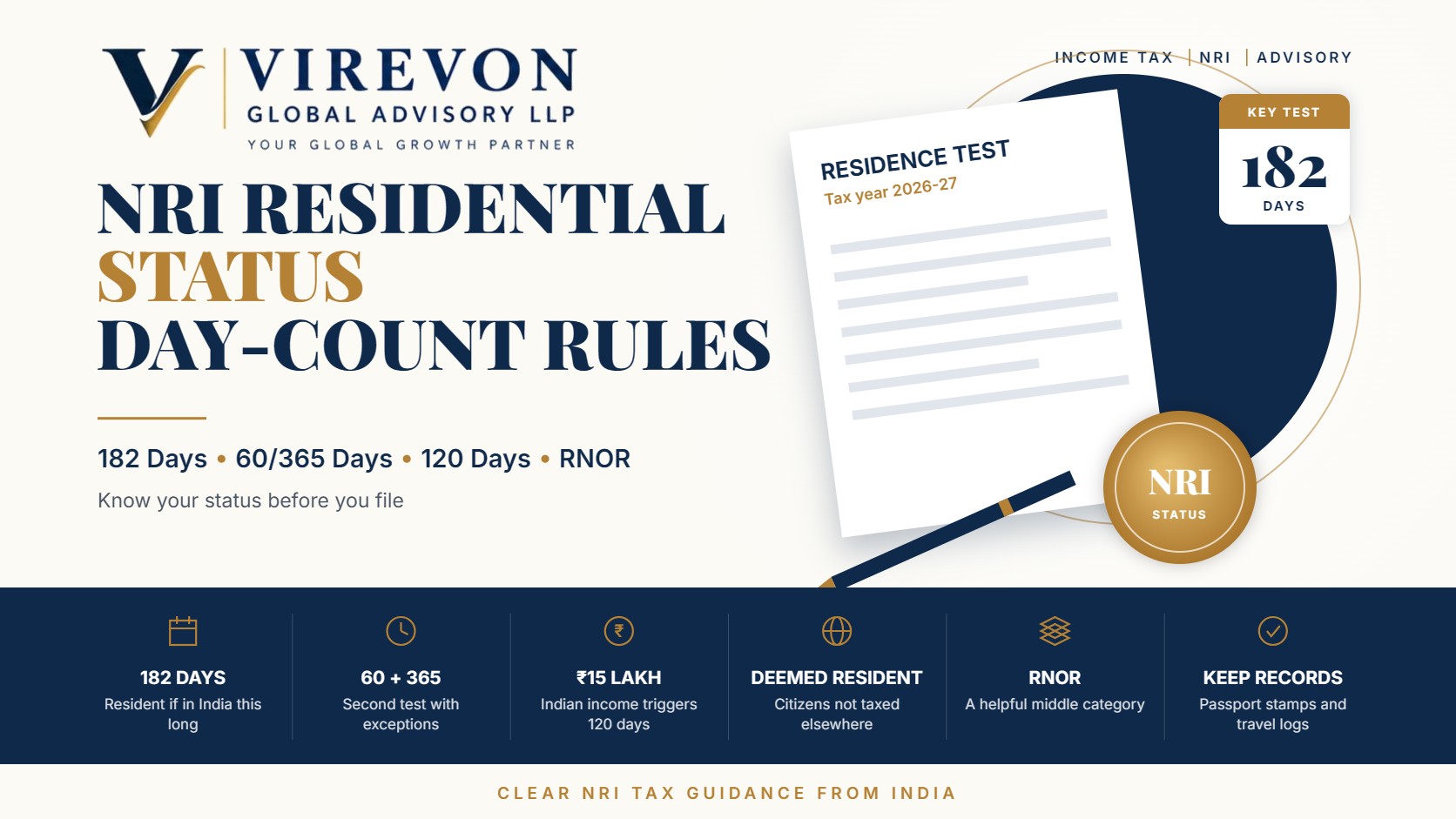
  • NRI Residential Status: How the Day-Count Rules Work

    NRI Residential Status: How the Day-Count Rules Work

    Your tax liability in India depends far more on your residential status than on your citizenship or passport. NRI residential status is decided each year by counting the days you spend in India, with a few special rules for Indian citizens, persons of Indian origin and those with significant Indian income. Get the status right, and everything else, from which income is taxable to which return form applies, falls into place.

    This guide explains the day-count tests, the 120-day and deemed resident rules, the resident but not ordinarily resident (RNOR) category, and how to plan visits sensibly. The rules are the same in substance under the Income-tax Act 2025, which applies from the 2026-27 tax year.

    Key takeaways

    • You are resident in a tax year if you are in India for 182 days or more, or for 60 days or more in the year and 365 days or more in the four preceding years.
    • For Indian citizens leaving India for employment (or as crew), and for Indian citizens and persons of Indian origin visiting India, the 60-day limb is replaced with 182 days.
    • If such a visitor’s Indian income (excluding foreign-source income) exceeds ₹15 lakh, the 60-day limb becomes 120 days, and a resident under this rule is treated as RNOR.
    • An Indian citizen with Indian income above ₹15 lakh who is not liable to tax in any other country is deemed resident (as RNOR).
    • A non-resident is taxed in India only on income that arises, accrues or is received in India.

    Why residential status matters

    • Residents and ordinarily residents (ROR) are taxed in India on worldwide income and must report foreign assets.
    • Resident but not ordinarily resident (RNOR) individuals are taxed broadly on Indian income, plus foreign income from a business controlled or profession set up in India.
    • Non-residents (NR) are taxed only on Indian-source income or income received in India.

    The status is determined separately for each tax year (1 April to 31 March). Under the Income-tax Act 2025, the “tax year” replaces the old previous year and assessment year concepts; our explainer on the tax year concept covers this change.

    The basic NRI residential status tests

    An individual is resident in India for a tax year if either condition is met:

    1. Present in India for 182 days or more in the year; or
    2. Present in India for 60 days or more in the year and for 365 days or more in the four immediately preceding years.

    If neither is met, the individual is a non-resident. Days of arrival and departure are generally both counted as days in India, so keep a precise travel log.

    Exceptions to the 60-day limb

    PersonSecond test becomes
    Indian citizen leaving India for employment abroad, or as a crew member of an Indian ship182 days (so only the 182-day test effectively applies)
    Indian citizen or person of Indian origin visiting India, Indian income up to ₹15 lakh182 days
    Indian citizen or person of Indian origin visiting India, Indian income above ₹15 lakh120 days, with 365 days in the preceding four years

    “Indian income” here means total income other than income from foreign sources.

    Deemed residency for Indian citizens

    An Indian citizen whose Indian income exceeds ₹15 lakh and who is not liable to tax in any other country because of domicile, residence or a similar criterion is deemed to be resident in India, regardless of the number of days spent here. Such a person is treated as RNOR, so foreign income generally remains outside the Indian tax net.

    This rule mainly affects individuals living in countries that do not levy personal income tax. If this applies to you, keep evidence of your tax position abroad and review your Indian income each year.

    RNOR: the helpful middle category

    A resident individual is RNOR if either:

    • They were non-resident in 9 out of the 10 preceding years; or
    • They were in India for 729 days or less in the preceding 7 years.

    In addition, individuals who become resident only because of the 120-day rule, and those who are deemed resident, are treated as RNOR.

    RNOR status is particularly useful for returning NRIs. It often provides one to three years in which foreign income, such as interest on overseas deposits or rent from a property abroad, is not taxed in India, giving time to restructure overseas assets.

    Worked examples

    Example 1: frequent visitor with modest Indian income. Ravi, an Indian citizen working in Dubai, spends 150 days in India in the 2026-27 tax year. His Indian income is ₹6 lakh. Because he is a visiting citizen with Indian income below ₹15 lakh, the 60-day limb is replaced by 182 days. At 150 days, he is a non-resident.

    Example 2: visitor with significant Indian income. Meera, a person of Indian origin living in Singapore, spends 130 days in India. Her Indian income from rent and capital gains is ₹22 lakh, and she was in India for 400 days in the preceding four years. The 120-day limb applies, and she meets it, so she is resident but treated as RNOR.

    Example 3: returning NRI. Arjun moves back to India permanently in June 2026 after 12 years abroad. He is resident for 2026-27 (over 182 days), but having been non-resident in at least 9 of the previous 10 years, he is RNOR for the year.

    Practical tips for NRIs

    • Track days carefully: use passport stamps, boarding passes and a simple spreadsheet. Differences of a few days can change the status.
    • Estimate Indian income early in the year if you plan long visits, to see whether the ₹15 lakh threshold may be crossed.
    • Update your bank status: once you become resident, NRE and FCNR accounts need to be redesignated under FEMA rules, which are separate from tax residence.
    • Check the treaty: if you are resident in both India and another country, the tie-breaker rules in the relevant DTAA decide where you are treated as resident for treaty purposes.
    • Choose the right return: residential status determines the return form and schedules, including foreign asset reporting for ROR individuals. See our overview of key changes under the Income-tax Act 2025.

    Frequently asked questions

    Is residential status based on the calendar year?

    No. It is based on the Indian tax year, which runs from 1 April to 31 March.

    Do the arrival and departure days count?

    Generally yes. Both the day of arrival and the day of departure are usually treated as days of presence in India.

    Does the ₹15 lakh threshold include foreign income?

    No. It refers to total income other than income from foreign sources, such as Indian salary, rent, interest and capital gains.

    Did the Income-tax Act 2025 change the residence rules?

    The substance of the tests, including the 120-day and deemed resident rules, was carried forward. Terminology changed, with the tax year replacing the previous year.

    If you are an NRI planning your visits or returning to India and want clarity on your residential status, we would be glad to help you work it out.

    This article is general information based on the law as of September 2026, and is not legal or tax advice. Please check the facts of your own case with a professional before acting.