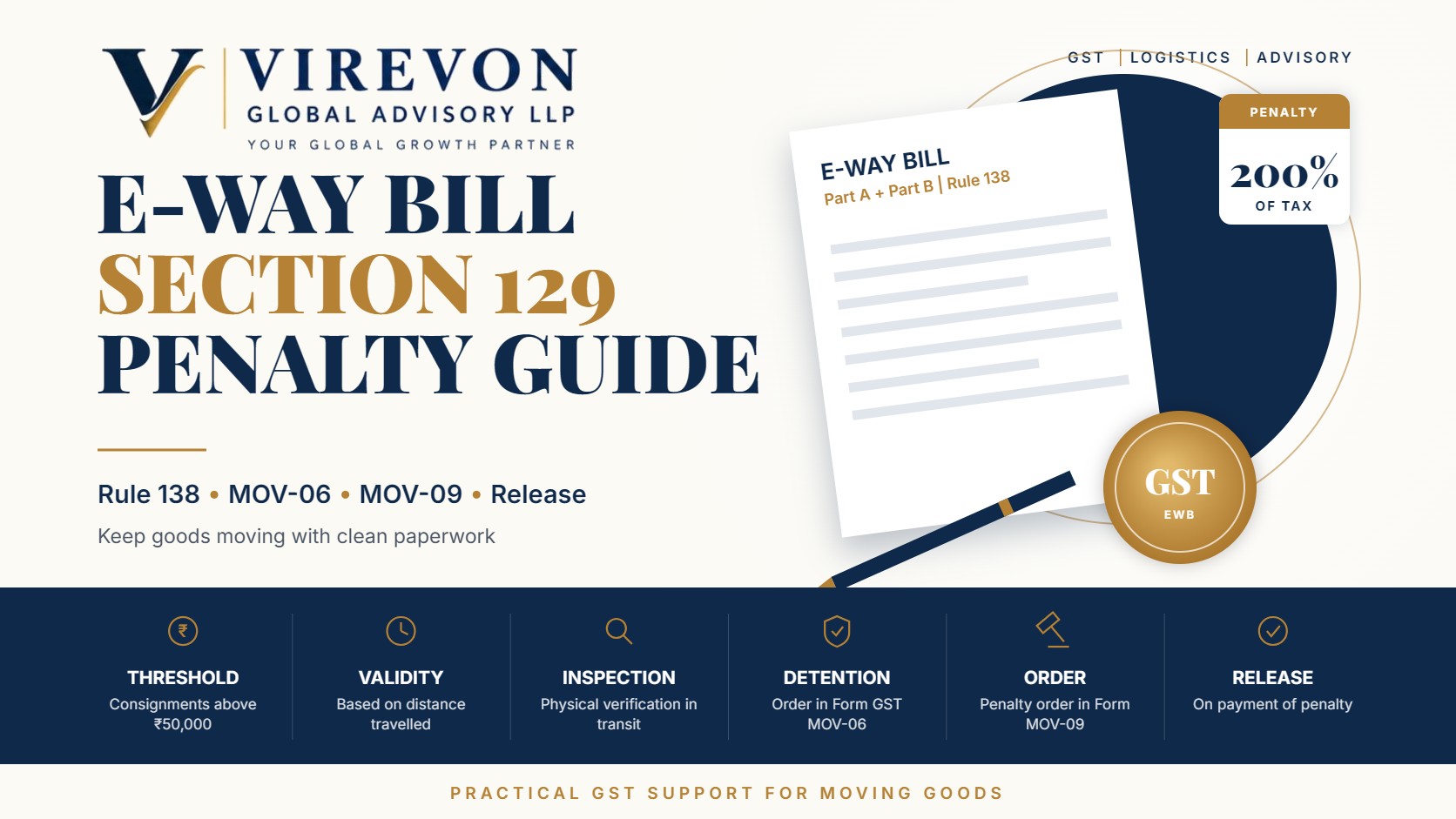
For businesses that move goods, the e-way bill is as important as the invoice. A missing, expired or incorrect e-way bill can lead to goods being stopped on the road, and the e-way bill penalty under section 129 of the CGST Act is steep: in most taxable cases it equals 200% of the tax payable on the goods. The good news is that almost every detention is preventable with simple controls.
This guide covers when an e-way bill is required, how validity works, what happens when goods are detained, how the penalty is calculated, and how to respond calmly if a vehicle is intercepted.
Key takeaways
- An e-way bill is generally required for movement of goods where the consignment value exceeds ₹50,000, subject to exemptions and State-specific rules for intra-State movement.
- Validity depends on distance: for normal cargo, one day for every 200 km or part of it.
- Under section 129, goods and the vehicle can be detained for contravention of the Act or rules during transit; release requires payment of penalty.
- Where the owner comes forward, penalty for taxable goods is 200% of the tax payable; otherwise it is the higher of 50% of the value of goods or 200% of the tax.
- If the penalty is not paid within 15 days of the order, the goods or conveyance can be sold or disposed of under the amended provisions.
When an e-way bill is required
Rule 138 of the CGST Rules requires an e-way bill before movement of goods of consignment value above ₹50,000, whether the movement is for a supply, for reasons other than supply (such as job work or branch transfer), or because of an inward supply from an unregistered person. Consignment value is the invoice value including GST but excluding the value of exempt supplies billed together.
The e-way bill has two parts:
- Part A: invoice details, GSTINs of supplier and recipient, place of delivery, HSN and value.
- Part B: transporter and vehicle details.
Part B can be left blank where goods move up to 50 km within the same State from the supplier’s place of business to a transporter’s premises, but it must be updated before onward movement. Certain goods are exempt from the e-way bill requirement, and some States prescribe their own thresholds for intra-State movement, so check the rules that apply to your routes.
Validity and extension
| Type of cargo | Validity |
|---|---|
| Normal cargo | 1 day for every 200 km or part thereof |
| Over-dimensional cargo | 1 day for every 20 km or part thereof |
Validity can be extended by the generator before expiry (within the window allowed by the portal) where goods could not reach on time for genuine reasons, such as a breakdown. The portal also limits how old the underlying document can be and how long an e-way bill can be extended overall, so generate e-way bills promptly after invoicing.
Recent system changes
GSTN announced changes during 2026, including making ship-to GSTIN details mandatory in bill-to/ship-to cases and a facility to close an e-way bill on delivery. These were subsequently placed on hold. Keep an eye on the advisories on the e-way bill portal and make sure your ERP or API integration is ready when a revised date is announced.
When goods can be detained under section 129
Proper officers can intercept vehicles and verify documents and goods in transit. Common reasons for detention include:
- No e-way bill, or an e-way bill that has expired.
- Goods in the vehicle not matching the invoice or e-way bill (quantity, description or HSN).
- Vehicle number in Part B different from the vehicle carrying the goods, without an update.
- Movement without a valid invoice or delivery challan.
Minor, clerical errors such as a small spelling mistake in a name, an error in the pin code where the address is otherwise correct, or a one-digit mistake in the document number have been clarified by CBIC as not warranting proceedings under section 129; a small general penalty may be levied instead. Keep that distinction in mind when discussing a mismatch with the officer.
How the section 129 penalty is calculated
Section 129 was substantially amended with effect from 1 January 2022. Tax and penalty are no longer separate; the penalty is the release amount.
| Situation | Taxable goods | Exempt goods |
|---|---|---|
| Owner of goods comes forward | 200% of tax payable | 2% of value of goods or ₹25,000, whichever is lower |
| Owner does not come forward | Higher of 50% of value of goods or 200% of tax payable | 5% of value of goods or ₹25,000, whichever is lower |
Worked example: goods worth ₹4,00,000 at 18% GST are detained because the e-way bill expired. Tax payable is ₹72,000. If the owner comes forward, the penalty is ₹1,44,000. If the owner does not, it is the higher of ₹2,00,000 (50% of value) and ₹1,44,000, so ₹2,00,000.
Goods can also be released against a bond and security equal to the penalty, where permitted.
The procedure and timelines
- Verification: the officer records a statement of the person in charge of the vehicle and conducts physical verification, recorded in the MOV series of forms.
- Detention order: if a contravention is found, a detention order is issued in Form GST MOV-06.
- Notice: a notice in Form GST MOV-07 is issued within 7 days of detention, specifying the penalty proposed.
- Order: the officer must pass an order in Form GST MOV-09 within 7 days of service of the notice, after giving an opportunity of being heard.
- Payment and release: once the penalty is paid, goods are released and proceedings are concluded.
- Non-payment: if the penalty is not paid within 15 days of the order, the goods or conveyance may be sold or disposed of.
If you pay under protest and believe the detention was wrong, an appeal under section 107 remains available. Our guide on GST demand orders and appeals explains the process.
What to do if your vehicle is stopped
- Stay calm and cooperative: ask the driver to share the invoice, e-way bill and transport documents promptly.
- Send documents immediately: many detentions end at verification when correct documents are produced quickly.
- Check the reason in writing: request copies of the physical verification report and MOV-06.
- Reply to MOV-07 on time with evidence, such as proof that the e-way bill expired due to a breakdown or that the mismatch is clerical.
- Decide on release: weigh the cost of detention against paying under protest and appealing.
Checklist to prevent detention
- Generate the e-way bill after the invoice and before goods leave.
- Match HSN, quantity and value on invoice, e-way bill and packing list.
- Update Part B whenever the vehicle changes, including at transhipment.
- Track expiry dates for long routes and extend before expiry.
- Train drivers to carry the invoice or its reference and the e-way bill number.
- Where e-invoicing applies, generate e-way bills from the e-invoice data; our e-invoicing applicability guide explains the linkage.
Frequently asked questions
Is an e-way bill needed for goods below ₹50,000?
Generally not for inter-State movement, but some movements, such as certain job work consignments and handicraft goods, need one regardless of value, and States may set their own intra-State rules.
Can the penalty under section 129 be reduced?
The rates are fixed by the section. However, clerical errors should not lead to section 129 proceedings at all, and a well-supported reply to MOV-07 can result in the proceedings being dropped.
How long can the officer take to pass the order?
The order in MOV-09 must be passed within seven days of service of the MOV-07 notice.
Can I appeal after paying the penalty?
Yes. Paying to secure release does not take away your right to appeal against the order under section 107.
If your goods have been detained or you want a quick review of your e-way bill controls, our GST team is ready to help you respond with confidence.
This article is general information based on the law as of September 2026, and is not legal or tax advice. Please check the facts of your own case with a professional before acting.