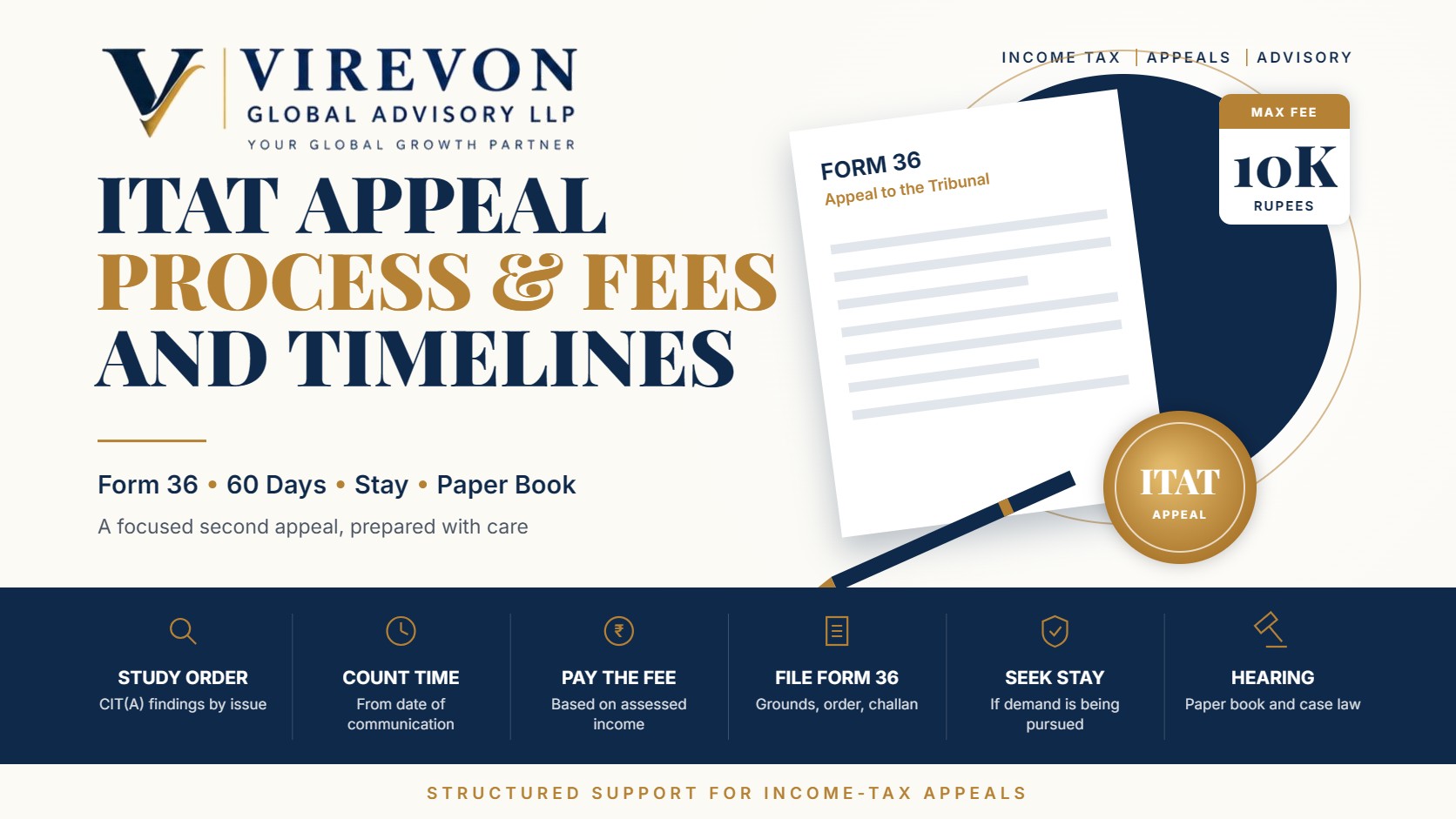
The Income Tax Appellate Tribunal is the final fact-finding authority in income-tax disputes. An ITAT appeal is usually filed after the Commissioner (Appeals) has decided the first appeal, and the Tribunal’s view on facts is generally final, with further appeals to the High Court limited to substantial questions of law. That makes this stage especially important to get right.
This guide explains who can file, the time limits under the Income-tax Act, 1961 and the new Income-tax Act, 2025, the fee structure, how to obtain a stay of demand and how to prepare for the hearing.
Key takeaways
- Either the taxpayer or the department can appeal to the ITAT against orders of the CIT(A) and certain other orders, such as revision orders and DRP-directed assessments.
- Under the 1961 Act, an ITAT appeal is filed in Form 36 within 60 days of the date on which the order is communicated; the 2025 Act uses Form 115 and a time limit counted from the end of the month of communication.
- Fees range from ₹500 to a maximum of ₹10,000, depending on assessed income.
- The other side can file cross-objections within 30 days of receiving notice of the appeal.
- The Tribunal can grant a stay of demand, typically on deposit of at least 20% of the amount or suitable security.
Orders that can be appealed to the ITAT
Common examples include:
- Orders of the CIT(A) or the Joint Commissioner (Appeals) on assessments, penalties and other matters.
- Revision orders under section 263, where the Principal Commissioner sets aside an assessment as erroneous and prejudicial to revenue.
- Assessment orders passed in pursuance of Dispute Resolution Panel directions.
- Orders relating to registration of charitable trusts and approvals under certain sections.
The department appeals only where the tax effect crosses monetary limits. Under CBDT Circular No. 09/2024 dated 17 September 2024, the threshold for a departmental appeal to the ITAT is ₹60 lakh, subject to specified exceptions.
ITAT appeal time limits and fees
| Item | Position under the 1961 Act |
|---|---|
| Form | Form 36 (cross-objections in Form 36A) |
| Time limit | 60 days from the date the order is communicated |
| Condonation of delay | Possible on showing sufficient cause, with an affidavit |
| Fee: assessed income up to ₹1 lakh | ₹500 |
| Fee: above ₹1 lakh up to ₹2 lakh | ₹1,500 |
| Fee: above ₹2 lakh | 1% of assessed income, up to ₹10,000 |
| Fee: other matters | ₹500 |
| Stay application | ₹500 |
| Cross-objections | Within 30 days of receiving notice of the appeal; no fee in most cases |
For orders under the Income-tax Act, 2025, the appeal lies under section 362 in Form 115, within two months from the end of the month in which the order is communicated. The fee slabs remain broadly the same. Always check which Act and form apply to the order you are challenging.
How to file an ITAT appeal
Step 1: Analyse the CIT(A) order
List each issue decided against you and the reasons given. Consider whether the finding is on facts, law or both. Drop weak issues; a focused appeal is more persuasive.
Step 2: Draft grounds and a short statement
Grounds should be numbered, concise and specific to the amount and the error. For example: ‘The learned CIT(A) erred in confirming the disallowance of ₹8,40,000 under section 40(a)(ia) without appreciating that the payee had offered the receipt in its return.’
Step 3: Assemble the appeal set
- Form 36 duly signed and verified.
- Certified or downloaded copy of the CIT(A) order and the assessment order.
- Grounds of appeal before the AO/CIT(A) and before the Tribunal.
- Fee challan.
Step 4: File through the ITAT e-filing portal
The Tribunal’s e-filing system allows appeals, stay applications and documents to be filed online. Keep the acknowledgement and watch for the notice of hearing.
Stay of demand before the Tribunal
An appeal to the ITAT does not automatically stop recovery. If the Assessing Officer is pursuing the demand:
- First request a stay from the AO and, if needed, from the Principal Commissioner.
- If recovery continues, apply to the Tribunal for a stay, showing a prima facie case, balance of convenience and possible hardship.
- The Tribunal can grant a stay, generally subject to deposit of not less than 20% of the disputed amount or furnishing security of equal value.
- A stay is granted for up to 180 days, extendable to a total of 365 days if the delay in disposal is not attributable to the taxpayer.
Preparing for the hearing
- Paper book: an indexed, paginated set of documents that were before the lower authorities, with a certificate to that effect.
- Case law compilation: judgments relied on, with relevant paragraphs marked.
- Written synopsis: a two to three page note per issue, summarising facts, the lower authorities’ view and your submission.
- Additional evidence: allowed only with the Tribunal’s permission and for good reason, so ideally everything should have been filed earlier.
Many benches hold hearings physically as well as through video conference. Be ready with the short facts; hearings often move quickly.
After the ITAT order
- If the order has a mistake apparent from the record, a miscellaneous application can be filed within six months from the end of the month in which the order was passed.
- The order is given effect by the AO, usually leading to a revised demand or refund; follow up if this is delayed.
- A further appeal lies to the High Court within 120 days, only on a substantial question of law.
If you are still at the first appeal stage, our guide to filing Form 35 before CIT(A) explains that process, and our note on penalty under section 270A covers the penalty side.
Frequently asked questions
What is the time limit for an ITAT appeal?
Under the 1961 Act, 60 days from the date the order is communicated. For orders under the 2025 Act, two months from the end of the month in which the order is communicated. Delays can be condoned for sufficient cause.
What is the maximum fee for an ITAT appeal?
Where assessed income exceeds ₹2 lakh, the fee is 1% of assessed income subject to a maximum of ₹10,000. Lower slabs apply for smaller incomes.
Can I raise new grounds before the ITAT?
The Tribunal can admit additional grounds, particularly pure questions of law arising from facts already on record, but it is best to include all grounds at the start.
Is it necessary to pay the demand before filing an ITAT appeal?
There is no statutory pre-deposit for filing, but recovery can continue unless a stay is obtained, which usually requires paying a part of the demand.
If you are considering an appeal to the ITAT, our team would be glad to help you assess the issues and prepare the appeal.
This article is general information based on the law as of September 2026, and is not legal or tax advice. Please check the facts of your own case with a professional before acting.