Tag: ITR

  • Income Tax Refund Delayed? Common Reasons and How to Track and Fix It

    Income Tax Refund Delayed? Common Reasons and How to Track and Fix It

    An income tax refund delay is one of the most common concerns after the filing season. You have filed your return, the refund is shown in your computation, and yet nothing has reached the bank. In most cases the cause is a simple, fixable issue such as verification, bank details or a pending communication from the Centralised Processing Centre (CPC).

    This guide covers the usual reasons refunds get held up, how to read the refund status on the portal, and the practical steps to get things moving. It applies to returns for FY 2025-26 (AY 2026-27), which continue to be processed under the Income-tax Act 1961.

    Key takeaways

    • Refunds are issued only after the return is e-verified and processed by CPC.
    • The refund is paid only to a pre-validated bank account linked to your PAN, and your PAN must be operative.
    • Mismatches between your return and TDS/AIS data often lead to adjustments or a pending proposal that needs your response.
    • A refund may be set off against an older demand, after prior intimation.
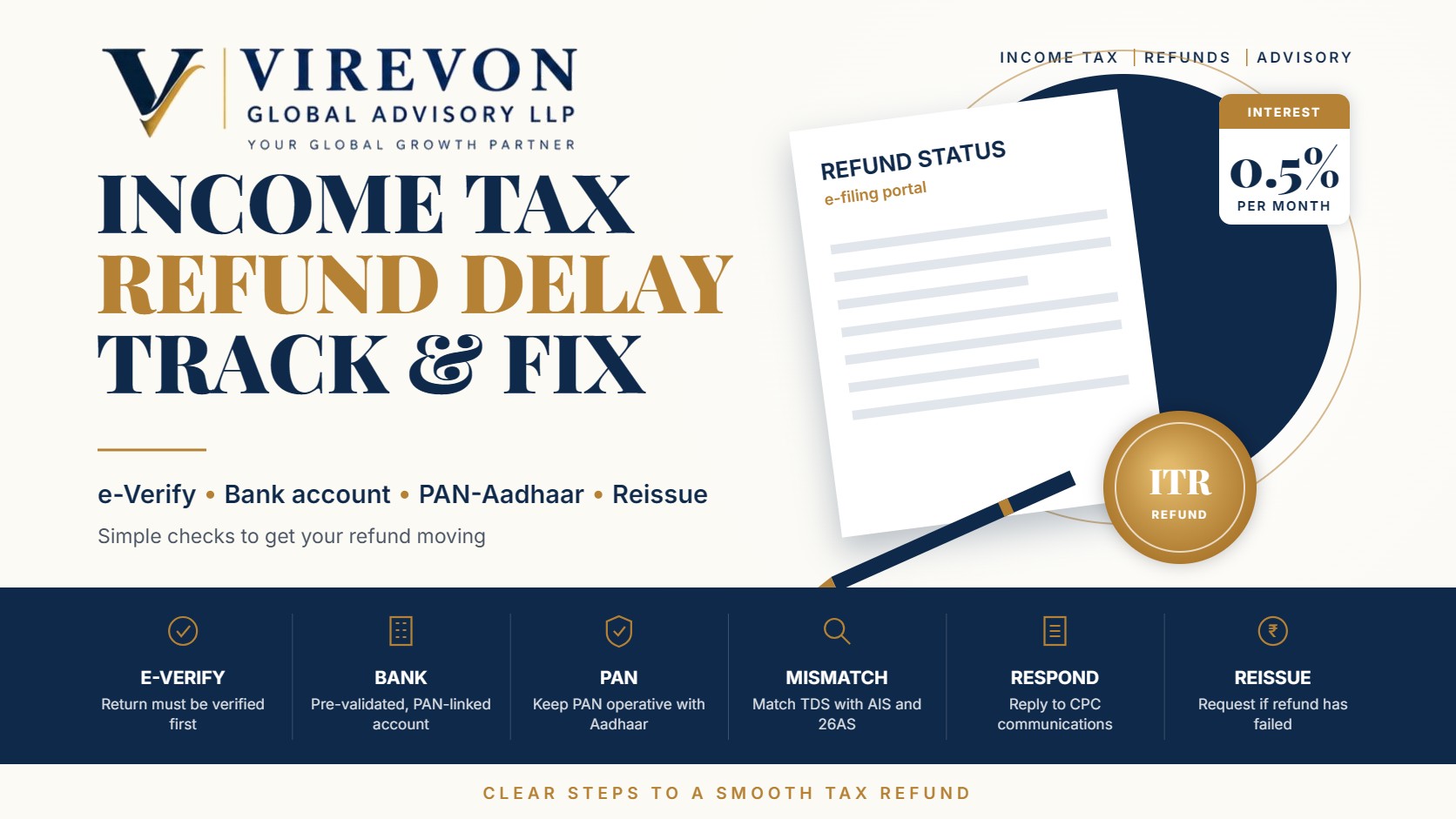
    • Where a refund is due, interest is generally payable at 0.5% per month under section 244A, subject to conditions.

    First, check where your refund stands

    Log in to the e-filing portal and go to e-File > Income Tax Returns > View Filed Returns. Each return shows its life cycle: filed, verified, processed, refund issued or refund failed. You can also check the refund status for a year through the refund status service linked from the portal.

    Understanding the status tells you what to do next:

    StatusWhat it meansWhat to do
    Return filed, not verifiedProcessing has not startedE-verify within the time allowed
    Verified, under processingCPC is processingWait; check email and pending actions
    Processed with refund determinedRefund sent to the bankAllow some days for credit
    Processed with adjustmentRefund reduced or nilRead the intimation; rectify if wrong
    Refund failedBank credit did not go throughFix bank details and request a reissue
    Response pendingCPC has raised a queryRespond in Pending Actions or Worklist

    Common reasons for an income tax refund delay

    1. Return not e-verified

    A return is not treated as valid until it is verified. Verification through Aadhaar OTP, net banking or a digital signature is instant; a physical ITR-V takes longer. Returns verified late may also be treated as filed on the verification date.

    2. Bank account not pre-validated

    Refunds are credited only to a bank account that is pre-validated on the portal and linked to your PAN. A closed account, an IFSC change after a bank merger, or a name mismatch can cause a refund to fail. Check My Profile > My Bank Account and re-validate if needed.

    3. PAN inoperative

    If PAN is not linked with Aadhaar, it can become inoperative, and refunds are not issued while it remains so. Once linked and operative again, the refund can be processed.

    4. Mismatch with TDS, AIS or Form 26AS

    If you claim TDS that does not appear in the tax credit statement, or report income lower than the AIS, CPC may propose an adjustment. The refund then waits until you respond or the return is processed with the adjustment. Our guide to section 143(1) intimations explains these adjustments.

    5. Defective return notice

    If the return has a technical or data defect, a notice under section 139(9) is issued, and the refund waits until you correct it. See our guide to defective return notices.

    6. Adjustment against an outstanding demand

    If an earlier year shows a demand, CPC may adjust the refund against it after giving you prior intimation. Responding promptly, especially where the old demand is already paid or reduced, helps release the refund. Our guide on outstanding tax demand covers how to respond.

    7. Additional review

    Some returns are picked for further verification based on risk parameters or large refund claims. In such cases, keep an eye on your email and the portal for any request for information or clarification.

    How to fix a failed refund: refund reissue

    If the status shows refund failed, the portal allows a refund reissue request:

    1. Go to Services > Refund Reissue and create a request.
    2. Select the relevant return and a pre-validated bank account.
    3. E-verify the request through Aadhaar OTP, EVC or a digital signature.
    4. Track the status; the refund is re-sent to the selected account.

    Before raising the request, make sure the account is active, the name matches your PAN records, and the account is enabled for electronic credit.

    Interest on delayed refunds

    Where a refund arises from excess TDS, TCS or advance tax, interest under section 244A is generally payable at 0.5% per month or part of a month, usually from 1 April of the assessment year (or the date of filing, if the return was filed late) to the date the refund is granted. Interest is not paid if the refund is less than 10% of the tax determined, and any delay attributable to the taxpayer is excluded. Interest on refund is taxable in the year it is received.

    A quick checklist to avoid refund delays next year

    • File early and e-verify immediately.
    • Keep one primary bank account pre-validated and EVC-enabled.
    • Confirm PAN-Aadhaar linkage well before the filing season.
    • Match income and TDS with AIS and the tax credit statement before filing.
    • Clear or respond to any old demands shown on the portal.
    • Check your registered email and mobile regularly during processing.

    Frequently asked questions

    How long does an income tax refund take?

    Straightforward returns are often processed within a few weeks of e-verification. The legal time limit for processing is nine months from the end of the financial year in which the return was filed.

    Why does my refund show as failed?

    Usually because of bank account issues such as a closed account, IFSC change, name mismatch or an account that is not pre-validated. Fix the details and file a refund reissue request.

    Will I get interest if my refund is delayed?

    Generally yes, at 0.5% per month under section 244A, subject to conditions such as the refund being at least 10% of the tax determined.

    Can the department adjust my refund against old dues?

    Yes, after giving prior intimation. Respond with reasons if the old demand is already paid, reduced or under appeal.

    If your income tax refund is stuck or has been adjusted incorrectly, our team will be glad to review the status and help you with the right response.

    This article is general information based on the law as of September 2026, and is not legal or tax advice. Please check the facts of your own case with a professional before acting.
  • Defective Return Notice under Section 139(9): Causes and How to Fix It

    Defective Return Notice under Section 139(9): Causes and How to Fix It

    A defective return notice under section 139(9) can look alarming when it lands in your inbox, but in most cases it is simply the Centralized Processing Centre (CPC) telling you that something in your income tax return is incomplete or inconsistent. The law gives you a short window to correct it, and once the correction is filed, the return is treated as if it had been valid from the start.

    This guide explains the common reasons returns are flagged as defective, how to read the notice, how to respond on the e-filing portal, and how to avoid the problem next year. Returns for FY 2025-26 were filed under the Income-tax Act 1961, so section 139(9) continues to govern these notices; the Income-tax Act 2025 carries the same idea forward in its section on return of income.

    Key takeaways

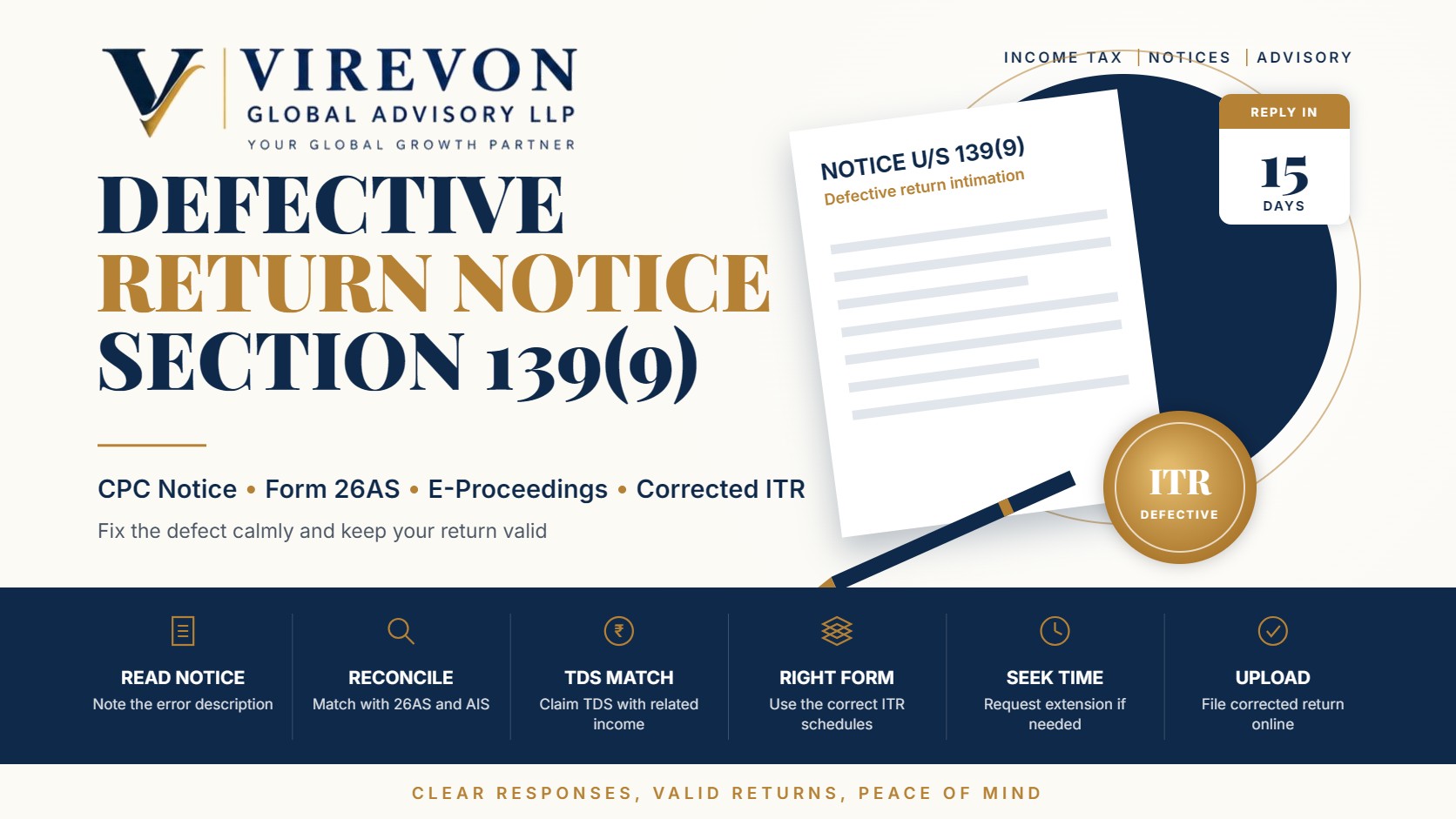
    • A defective return notice under section 139(9) gives you 15 days from receipt of the notice to fix the defect; you can ask for more time if you need it.
    • If the defect is not cured in time, the return can be treated as invalid, as though it was never filed, which may affect loss carry-forward, refunds and interest.
    • Most defects are technical: TDS claimed without matching income, gross receipts lower than those in Form 26AS, missing balance sheet or profit and loss details, or a name mismatch with PAN.
    • The response is filed online through e-Proceedings on the income tax portal by uploading a corrected return.
    • A careful pre-filing check against Form 26AS and AIS prevents most defect notices.

    What a defective return notice under section 139(9) means

    Section 139(9) allows the Assessing Officer (in practice, CPC Bengaluru for most returns) to treat a return as defective where essential information is missing or where the return does not match the basic requirements of the ITR form. The notice sets out the defect, the error description and what is expected from you.

    The important point is that a defective return is not the same as a tax demand. The department is not saying that you owe more tax. It is saying that the return, as filed, cannot be processed properly until the gap is fixed. If you correct it within the time allowed, the corrected return is treated as the original, filed on the original date.

    Common reasons a return is marked defective

    Most notices fall into a handful of patterns. The table below lists the ones seen most often and how they are usually resolved.

    Defect flaggedWhy it happensTypical fix
    TDS credit claimed but related income not shownSalary, interest or professional receipts appear in Form 26AS but the income head is blank or lowerReport the income under the correct head, or reduce the TDS claim to what matches
    Gross receipts lower than receipts in Form 26ASBusiness or professional turnover in the return is below the amounts on which tax was deductedReconcile and report the full receipts, explaining timing or GST differences in your working
    Tax payable shown with nil incomeComputation error or an income schedule left incompleteComplete the income schedules so that the computation is consistent
    Balance sheet or P&L not filledBusiness income declared under regular provisions without financial statement detailsFill the balance sheet and profit and loss schedules, or opt for presumptive taxation where genuinely eligible
    Name mismatch with PANName in the return differs from the PAN databaseCorrect the name or update PAN records before refiling
    Audit details missingTax audit applicable but report details not givenEnsure the audit report is uploaded and its particulars are quoted

    How to respond on the e-filing portal

    The response is simple once you have the corrected figures ready. Follow these steps:

    1. Log in to the income tax e-filing portal and open Pending Actions > e-Proceedings.
    2. Select the notice under section 139(9) and read the error description and the probable resolution given.
    3. Choose whether you agree that the return is defective. If you agree, prepare the corrected ITR in the same form (or a different form if the defect relates to the wrong form being used).
    4. Upload the corrected return against the notice, quoting the same acknowledgement details the portal prompts for.
    5. Verify the response (Aadhaar OTP, EVC or DSC, as applicable) and save the submission receipt.

    If you disagree with the defect, you can say so and give reasons. This is appropriate where the CPC has misread something, for example where income was correctly shown but under a different schedule. Keep the explanation short and factual, and attach a reconciliation where it helps.

    When you need more time

    If you cannot gather documents within 15 days, request an adjournment through the same e-Proceedings screen before the time runs out. A short, reasoned request, such as awaiting a corrected TDS statement from the deductor, is usually the best approach.

    What happens if you do not respond

    If the defect is not rectified within the period allowed, the return may be treated as invalid. The practical effects can include:

    • losing the ability to carry forward business or capital losses, since those need a valid return filed within time;
    • delay or loss of refund, because an invalid return is not processed;
    • interest for delay in filing, and a possible late fee, if a fresh return then has to be filed;
    • exposure to proceedings for non-filing if no valid return remains on record.

    Where a correction is made after the 15-day period but before any assessment is completed, the law allows the Assessing Officer to condone the delay and treat the return as valid. It is still far better to act within the window.

    A practical example

    A consultant files ITR-3 reporting professional receipts of ₹18 lakh. Form 26AS shows ₹21 lakh on which TDS under section 194J was deducted, because two clients deducted tax on invoices that the consultant booked in the next financial year. The CPC issues a defective notice citing receipts lower than those in Form 26AS.

    The fix is not necessarily to pay tax on ₹21 lakh. The consultant reconciles the two invoices, reports receipts as per the books, and claims only the TDS relating to income offered this year, carrying the balance TDS to the year in which the income is offered. The corrected return is uploaded through e-Proceedings with a short explanation. Handled this way, the return becomes valid and processing continues normally. If the return is later processed with adjustments, our guide on the section 143(1) intimation explains what to check next.

    How to avoid defect notices next year

    A few habits prevent most notices:

    • Reconcile income with Form 26AS and the Annual Information Statement (AIS) before filing, not after.
    • Match TDS claimed to the income offered in the same year, and use the TDS carry-forward option where timing differs.
    • Choose the correct ITR form for your income type; business income under regular provisions needs full balance sheet and P&L schedules.
    • Where a tax audit applies, file the audit report first and quote its details correctly. Our tax audit checklist for FY 2025-26 covers the sequence.
    • Keep the name, date of birth and bank details on the portal consistent with PAN.

    Frequently asked questions

    What is the time limit to reply to a notice under section 139(9)?

    The notice normally allows 15 days from the date of receipt. You can request an extension through e-Proceedings before the period ends.

    Do I have to pay any fee to correct a defective return?

    No fee is payable for responding to a defective return notice. Tax, if any becomes payable because of the correction, must be paid before uploading the corrected return.

    Can I file a revised return instead of responding to the notice?

    If the time for filing a revised return is still open, a revised return can also cure the issue. In most cases, responding directly to the notice is the cleaner route because it links the correction to the defect raised.

    Will a defective return notice lead to scrutiny?

    Not by itself. It is a processing issue. Once the corrected return is accepted, it is processed like any other return, although normal selection rules for scrutiny still apply.

    If you have received a defective return notice and would like help reconciling your figures and filing a clean response, we would be glad to assist.

    This article is general information based on the law as of September 2026, and is not legal or tax advice. Please check the facts of your own case with a professional before acting.