Tag: IP

  • Trademark Opposition in India: Process, Timelines and Counter-Statement

    Trademark Opposition in India: Process, Timelines and Counter-Statement

    Once a trademark application is accepted, it is advertised in the Trade Marks Journal so that anyone who believes the mark should not be registered can object. This stage is called trademark opposition, and it is where many brand disputes in India are decided. For an applicant, it can feel like a setback; for a brand owner watching the Journal, it is an important tool to stop a confusingly similar mark.

    This guide explains the opposition process under section 21 of the Trade Marks Act 1999 and the Trade Marks Rules 2017, with its strict timelines, and how both sides can prepare.

    Key takeaways

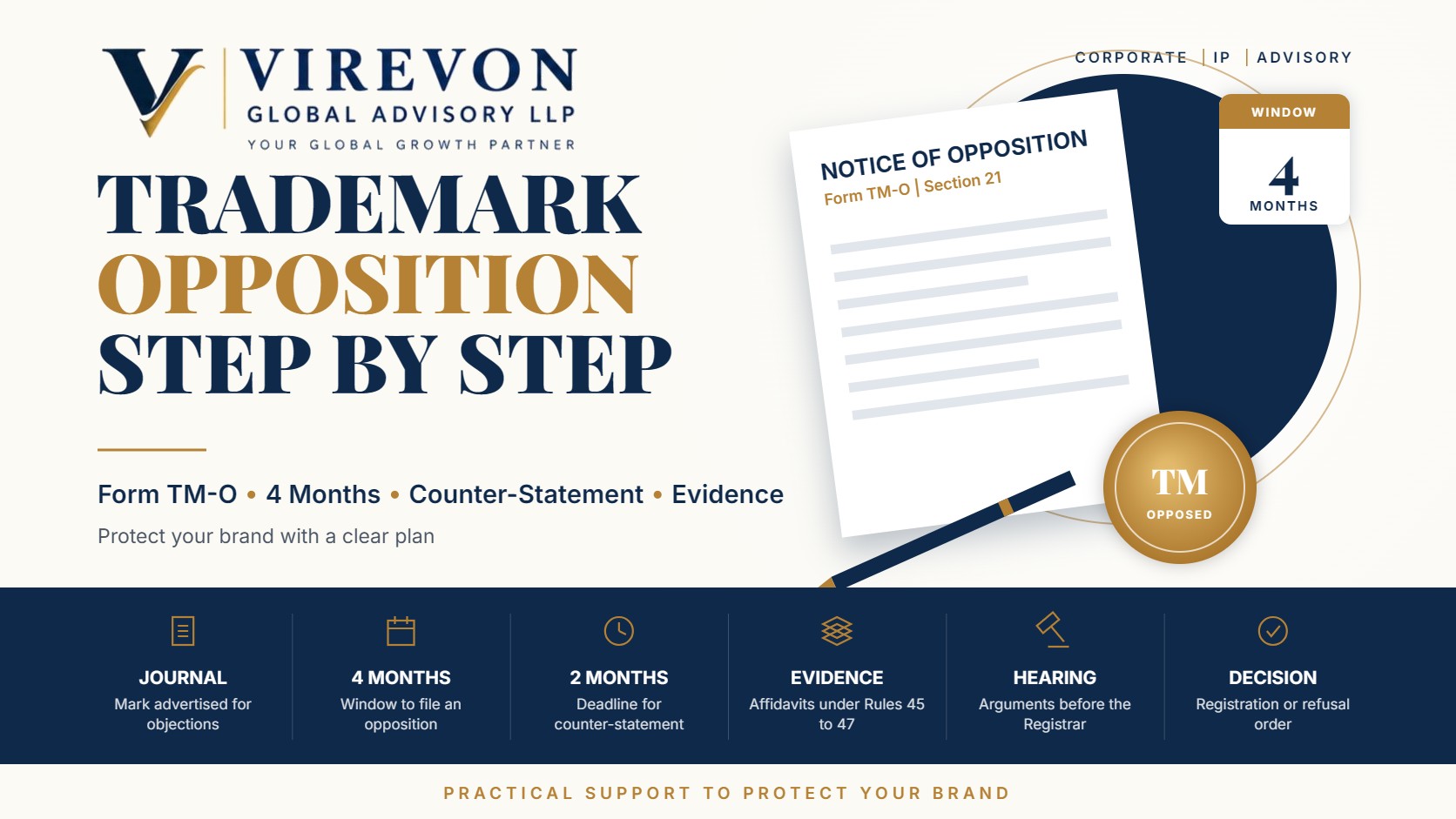
    • An opposition must be filed on Form TM-O within four months of the date the mark is advertised in the Journal; this period cannot be extended.
    • The official fee is ₹2,700 per class for e-filing (₹3,000 for physical filing).
    • The applicant must file a counter-statement within two months of receiving the notice of opposition, or the application is treated as abandoned.
    • Evidence follows in three rounds under Rules 45, 46 and 47, each with tight deadlines, before a hearing before the Registrar.
    • Organised evidence of use and reputation, gathered early, is the most valuable asset for either side.

    Who can file a trademark opposition and on what grounds

    Section 21 allows any person to oppose, not just the owner of a registered mark. Opponents often include earlier users, holders of similar registered marks, and occasionally trade associations.

    Common grounds include:

    • Similarity with an earlier mark for identical or similar goods or services, likely to cause confusion.
    • Prior use and passing off: the opponent used a similar mark before the applicant.
    • Absolute grounds: the mark is descriptive, lacks distinctiveness or is customary in the trade.
    • Bad faith: the applicant copied a known mark or had no intention to use it.
    • Well-known or reputed marks: taking unfair advantage of a mark with reputation, even for different goods.

    The trademark opposition process step by step

    StageWho actsTime limitIf missed
    Notice of opposition (Form TM-O)Opponent4 months from advertisementRight to oppose is lost
    Service of noticeRegistryAfter filing–
    Counter-statementApplicant2 months from receipt of noticeApplication treated as abandoned
    Evidence in support of opposition (Rule 45)Opponent2 months from service of counter-statementOpposition treated as abandoned
    Evidence in support of application (Rule 46)Applicant2 months from service of opponent’s evidenceApplication treated as abandoned
    Evidence in reply (Rule 47)Opponent1 month from service of applicant’s evidenceEvidence stage closes
    HearingBothAs scheduled by the RegistrarParty may be treated as having abandoned

    Instead of filing evidence, a party can intimate that it relies on the facts already stated. That is an important option where the pleadings and documents already make the case.

    Drafting the counter-statement

    The counter-statement is the applicant’s formal answer. It is filed on Form TM-O with the same fee and should respond to every paragraph of the notice of opposition.

    A good counter-statement:

    1. Admits or denies each allegation specifically; blanket denials are weak.
    2. Sets out the applicant’s story: adoption of the mark, the reason behind it, date of first use and the growth of the business.
    3. Distinguishes the marks visually, phonetically and conceptually, and explains differences in goods, customers and trade channels.
    4. Challenges the opponent’s claims, for example by questioning claimed use dates or pointing out that the opponent’s mark is registered for unrelated goods.
    5. Requests that the opposition be dismissed with costs.

    The two-month deadline is treated as strict, so plan for the counter-statement as soon as the notice is received. Track the date on which the notice was served, including by email.

    Evidence: building a record that persuades

    Evidence in opposition is filed by affidavit with supporting documents. Useful material includes:

    • Sales invoices spread across years and regions.
    • Advertising spend and samples of campaigns, catalogues, packaging and social media.
    • Online presence: website archives, marketplace listings and reviews with dates.
    • Registrations of the mark or trade name, domain names and company names.
    • Market surveys or trade affidavits, used carefully and only where credible.

    Index the evidence clearly and relate every exhibit to a point in your pleadings. Quality beats volume; the hearing officer must be able to see the chronology quickly.

    Hearing, decision and what comes after

    After the evidence stage, the Registrar fixes a hearing. Each side presents arguments, and written submissions are often filed. Hearings are commonly conducted by video conference.

    The Registrar then passes a reasoned order either allowing the opposition (refusing the application, fully or partly) or dismissing it (allowing the mark to proceed to registration). An aggrieved party can appeal to the High Court within the time allowed; the earlier appellate board was abolished in 2021.

    Settlement is always possible at any stage. Many oppositions end with a co-existence agreement, a restriction of goods, or a modification of the mark.

    Practical tips for applicants and brand owners

    • For applicants: monitor your application status weekly after acceptance, respond to any objection promptly (see our guide to a trademark objection reply), and keep use records from day one.
    • For brand owners: set up a Journal watch for your key marks and classes so you can act within the four-month window.
    • For both: consider commercial discussions early; a practical settlement can save time and cost.
    • Search before filing: a careful search, explained in our trademark registration guide, reduces the chance of opposition in the first place.

    Frequently asked questions

    Can the four-month opposition period be extended?

    No. Under the current rules, a notice of opposition must be filed within four months of the advertisement, and there is no provision to extend this period.

    What happens if I miss the counter-statement deadline?

    The application is treated as abandoned. The two-month period runs from receipt of the notice of opposition, so it is best to start preparation immediately.

    Can I use my brand while it is under opposition?

    Yes. Opposition concerns registration; it does not by itself stop you from using the mark, though you should consider any separate infringement or passing off claims carefully.

    How long does an opposition take?

    It varies widely with the Registry’s workload and the parties’ conduct. The pleadings and evidence stages alone take several months; settlement can conclude a matter much sooner.

    Whether you have received a notice of opposition or want to oppose a similar mark, reach out and we will help you plan a clear, well-documented response.

    This article is general information based on the law as of September 2026, and is not legal or tax advice. Please check the facts of your own case with a professional before acting.
  • Trademark Objection Reply: Responding to an Examination Report in India

    Trademark Objection Reply: Responding to an Examination Report in India

    Seeing the status “Objected” on your trademark application can feel discouraging, but it is a very common stage of the process. A well-prepared trademark objection reply addresses each concern raised by the Trade Marks Registry and, in many cases, moves the application to acceptance without a hearing.

    This article explains how to read the examination report, the usual grounds of objection under sections 9 and 11 of the Trade Marks Act 1999, the timeline for filing a response, and how to build a reply that is both persuasive and well supported.

    Key takeaways

    • An examination report lists objections on absolute grounds (section 9) and/or relative grounds (section 11); each must be answered separately.
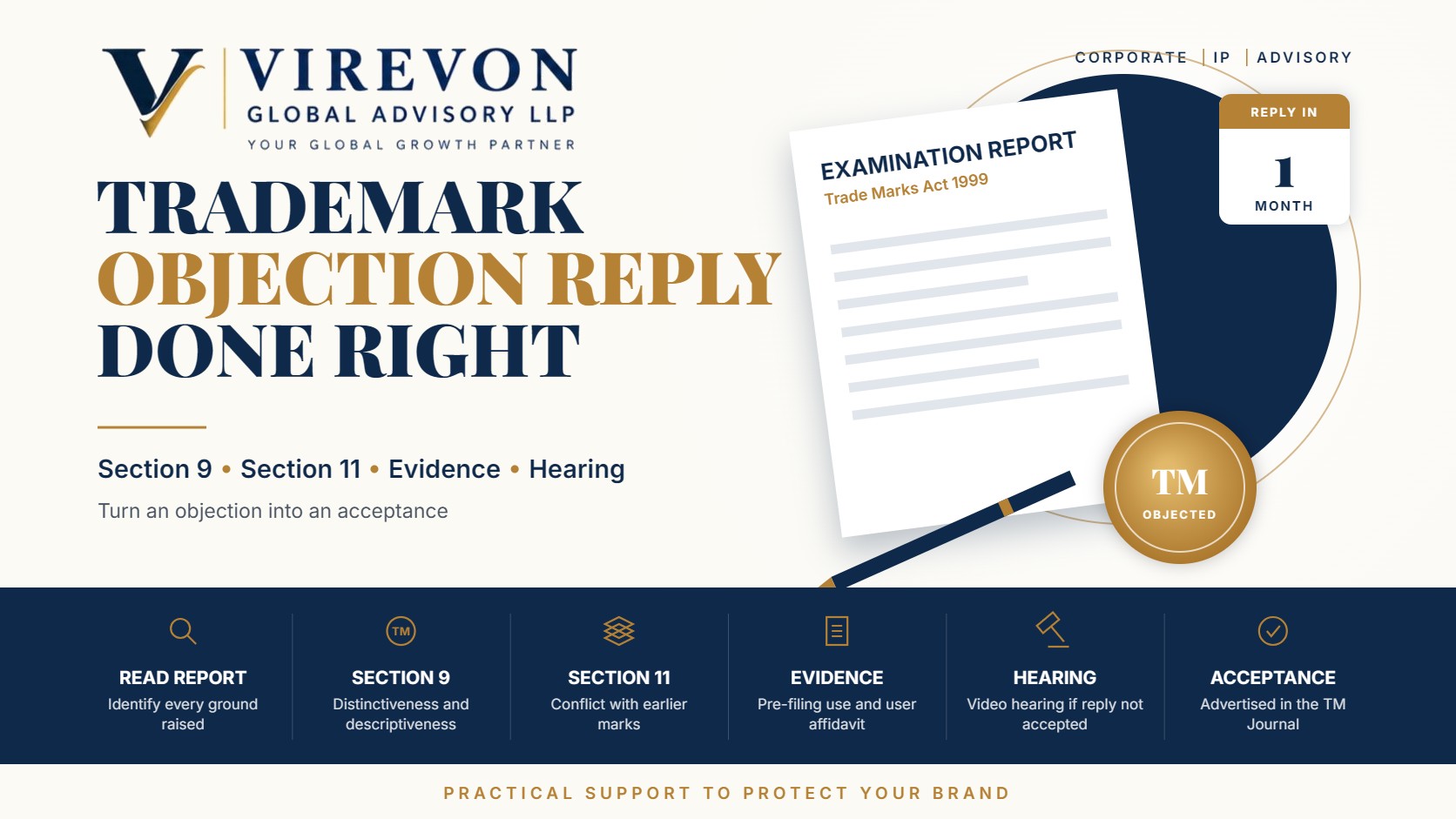
    • The reply is generally due within one month of receiving the report; the Registrar may allow a short extension on request.
    • If no reply is filed, the application can be treated as abandoned, so track the date from when the report is sent, including by email.
    • Strong replies combine legal arguments with evidence such as prior use, sales figures, a user affidavit or a consent letter.
    • If the reply is not accepted, a show cause hearing is scheduled, which can be attended by video conference.

    Understanding the examination report

    After an application is filed, an examiner checks it against the Act and the Registry’s records. The resulting examination report is available on the IP India portal against your application number and is also sent to the applicant or agent on record.

    Read the report line by line. It usually contains:

    • The grounds of objection, with the section relied on.
    • For section 11 objections, a search report listing earlier conflicting marks, their classes and proprietors.
    • Any formal requirements, such as clarification of the goods or services description, a request for translation or transliteration, or a power of authority.

    Formal requirements are often the simplest to fix, but leaving them unanswered can delay an otherwise acceptable application.

    Common grounds of objection

    GroundWhat the examiner is sayingTypical response approach
    Section 9(1)(a): lacks distinctivenessThe mark cannot identify your goods or services as coming from youShow the mark is inventive or has become distinctive through use
    Section 9(1)(b): descriptiveThe mark describes quality, kind, purpose or other characteristicsArgue the mark is suggestive rather than directly descriptive; consider a disclaimer
    Section 9(1)(c): customary in tradeThe words are commonly used in the tradeShow your particular combination or stylisation is distinctive
    Section 11(1): similar to an earlier markLikelihood of confusion with a cited mark for similar goods or servicesCompare the marks as a whole, distinguish the goods, trade channels and customers, or obtain consent

    At the examination stage, the Registry raises only the relative ground in section 11(1). Wider arguments based on a well-known mark or reputation are usually raised by third parties at the opposition stage.

    How to draft a strong trademark objection reply

    A good reply is organised, specific and supported. We suggest this structure:

    1. Background: the applicant, the mark, the class and the date of first use claimed.
    2. Response to each ground: one heading per objection, with arguments tied to the facts of your mark.
    3. Comparison tables: for section 11 objections, compare your mark and each cited mark on visual, phonetic and conceptual grounds, and on the goods or services covered.
    4. Evidence: invoices, advertisements, website and marketplace listings, social media reach and sales figures, ideally organised by year and region.
    5. Relief sought: a clear request that the objection be waived and the mark accepted for advertisement.

    Evidence that carries weight

    • User affidavit confirming the date of first use, annual turnover and promotional expenditure, supported by documents.
    • Consent letter from the proprietor of a cited mark, where a commercial understanding is possible.
    • Status of cited marks: if a cited mark is abandoned, refused or withdrawn, point this out; if it appears unused, a separate rectification action may be possible.
    • Co-existence on the register of similar marks in the same class, which can show that the common element is not exclusive to anyone.

    Acquired distinctiveness must be shown from use before the application date, so organise older evidence carefully.

    Narrowing the specification

    Sometimes the simplest solution is to restrict the goods or services, for example from “clothing” to a specific category, to move away from a cited mark. Amendments are requested on Form TM-M with the prescribed fee.

    Timeline and what happens next

    • Reply window: generally one month from receipt of the examination report. Where the report is sent by email, it is treated as served when sent, so monitor the portal and your inbox closely.
    • Extension: the Registrar may grant additional time on a request made on Form TM-M, but this is discretionary.
    • After filing: the examiner reviews the reply. If satisfied, the mark is accepted and advertised in the Trade Marks Journal, where third parties may file an opposition.
    • Hearing: if the reply does not resolve the objection, a show cause hearing is fixed. Hearings are commonly held through video conferencing, and a short written submission after the hearing helps.
    • Refusal: if the mark is refused, the applicant can seek a written statement of grounds and consider an appeal to the High Court within the prescribed time.

    For the wider journey from filing to certificate, see our trademark application status and registration timeline guide.

    Practical tips for a smoother outcome

    • Search before filing: a pre-filing search, explained in our trademark registration guide, avoids many section 11 objections.
    • Keep use records from day one: dated invoices and campaign material are the backbone of any distinctiveness argument.
    • Answer every point: a reply that ignores even one ground can lead to a hearing.
    • Be concise: examiners handle large volumes; a clear, well-indexed reply is easier to accept.
    • Track the application weekly on the IP India portal until acceptance and advertisement.

    Frequently asked questions

    What is the deadline for a trademark objection reply?

    Generally one month from receipt of the examination report. An extension may be requested on Form TM-M, but it is at the Registrar’s discretion, so aim to file within the original period.

    What happens if I do not reply?

    The Registrar can treat the application as abandoned. Revival may still be possible in some cases, but it is far easier to file the reply on time.

    Can I use my brand while the application is objected?

    Yes. An objection does not stop you from using the mark, and continued, well-documented use can strengthen your position.

    Is a hearing always required?

    No. Many objections are resolved on the written reply alone. A hearing is scheduled only if the examiner is not satisfied or the applicant asks for one.

    If your trademark application has received an examination report, reach out and we will help you prepare a clear, well-supported reply.

    This article is general information based on the law as of September 2026, and is not legal or tax advice. Please check the facts of your own case with a professional before acting.