
Tag: Internal controls

  • Accounts Payable Automation: How to Pay Vendors Accurately and on Time

    Accounts Payable Automation: How to Pay Vendors Accurately and on Time

    Paying suppliers sounds simple until volumes grow. Invoices arrive by email, courier and portal; approvals sit in inboxes; TDS and GST checks are done by hand; and vendors call to ask when they will be paid. Accounts payable automation brings order to this process by capturing invoices digitally, matching them to purchase orders and receipts, routing approvals automatically and scheduling payments.

    For Indian businesses, automation also helps with compliance that directly affects tax: deducting TDS correctly, protecting input tax credit, and paying micro and small enterprise vendors within the legal time limits. This guide explains how to design an automated payables process that is accurate, well controlled and vendor friendly.

    Key takeaways

    • Automate the full cycle: invoice capture, matching, approval, tax checks, payment and reconciliation.
    • Use three-way matching of purchase order, goods receipt and invoice for inventory and capital purchases.
    • Build TDS and GST checks into the workflow, including GSTR-2B matching before credit is claimed.
    • Track MSME vendors and pay them within 15 days, or the agreed period capped at 45 days, to avoid tax disallowance.
    • Keep strong controls over vendor master changes and duplicate payments, which are the main fraud risks.

    Why automate accounts payable

    Manual payables processes tend to produce the same problems in every growing business:

    • invoices lost or entered late, leading to missed discounts and unhappy vendors;
    • duplicate payments when the same invoice arrives through two channels;
    • TDS deducted at the wrong rate or not at all;
    • input tax credit lost because supplier invoices were not matched with GSTR-2B;
    • limited visibility of upcoming cash outflows.

    Automation addresses these by creating a single digital path for every invoice, with rules applied consistently and a full audit trail.

    Designing the automated payables workflow

    StepManual approachAutomated approach
    Invoice receiptPaper and scattered emailsDedicated AP email inbox and vendor portal, with OCR capture
    Data entryTyped by accountantExtracted automatically, validated against vendor master
    MatchingVisual checksAutomatic two-way or three-way match with tolerance limits
    ApprovalEmails and signaturesRule-based routing by amount, department and cost centre
    Tax checksCase-by-caseTDS section and rate mapped per vendor and expense type; GST validated
    PaymentIndividual bank transfersScheduled batch payment runs through bank integration
    ReconciliationMonth-end matchingDaily bank feed matching and vendor statement reconciliation

    Three-way matching in practice

    For goods and capital purchases, the system compares:

    1. the purchase order (what was ordered and at what price);
    2. the goods receipt note (what was actually received);
    3. the supplier invoice (what is being charged).

    If quantity and price agree within set tolerances, the invoice is approved for payment automatically. Exceptions go to the buyer or requester to resolve. For services and recurring expenses without purchase orders, two-way matching against a contract or approved budget works well.

    Building tax compliance into accounts payable automation

    Payables is where many Indian tax obligations are triggered, so the workflow should handle them automatically:

    • TDS: map each vendor and expense type to the correct TDS provision and rate, including thresholds such as those for purchases of goods and rent. Validate PAN status and apply lower deduction certificates only within their limits.
    • GST input tax credit: match supplier invoices with GSTR-2B and act on them in the Invoice Management System before claiming credit. Hold payment or follow up where a supplier has not reported the invoice.
    • 180-day rule: if a supplier is not paid within 180 days of the invoice date, the related credit must be reversed until payment is made. A related reversal applies when a supplier has not paid its own GST; our guide to ITC and Rule 37A explains it.
    • Reverse charge: flag vendors whose services attract reverse charge so that self-invoices and tax payments are generated on time.
    • E-invoices: where suppliers are covered by e-invoicing, check that invoices carry a valid IRN and QR code.

    Paying MSME vendors on time

    Under the MSMED Act, buyers must pay micro and small enterprises within the agreed period, which cannot exceed 45 days from acceptance, or within 15 days where there is no written agreement. Delayed payment attracts compound interest at three times the RBI bank rate. For income-tax purposes, the rule introduced as section 43B(h) of the 1961 Act, and carried into the Income-tax Act 2025, disallows such payables until actual payment if they remain unpaid beyond the permitted period.

    An automated system helps by:

    • tagging vendors with their Udyam classification and enterprise category;
    • calculating due dates from the date of acceptance and payment terms;
    • prioritising MSME invoices in each payment run;
    • producing a year-end report of overdue MSME payables for tax and disclosure purposes.

    Controls that protect cash

    Automation reduces errors, but it also needs strong controls:

    1. Vendor master changes: require independent verification, such as a call-back on a known number, before changing bank details. This is the most common payment fraud route.
    2. Duplicate detection: flag invoices with the same vendor, number, date or amount.
    3. Segregation of duties: the person who adds vendors should not approve payments, and neither should reconcile the bank.
    4. Approval limits: set clear thresholds and require dual approval for high-value payments.
    5. Bank-side controls: use maker-checker on net banking and review authorised users regularly.
    6. Reconciliation: match payments to bank feeds daily; our note on bank reconciliation best practices covers this in detail.

    Rolling out automation step by step

    • Start with a process map: document how invoices arrive, who approves them and where delays occur.
    • Clean the vendor master: remove duplicates, confirm PAN, GSTIN, bank details and MSME status.
    • Pick tools that fit: many accounting platforms offer AP modules or integrations; larger businesses may use dedicated AP software connected to their ERP.
    • Pilot with one entity or department, measure invoice cycle time and exceptions, then expand.
    • Measure results: track cost per invoice, days to approve, on-time payment rate, and early payment discounts captured.
    • Tie it to the close: accruals for goods received without invoices should flow automatically into the month-end close checklist.

    Frequently asked questions

    What is accounts payable automation?

    It is the use of software to capture supplier invoices, match them to orders and receipts, route approvals, apply tax checks and schedule payments with minimal manual work.

    Is accounts payable automation suitable for small businesses?

    Yes. Many accounting platforms include affordable invoice capture and approval features, and even partial automation of capture and payment runs saves significant time.

    How does automation help with MSME payment rules?

    It tags MSME vendors, calculates due dates within the 15 or 45-day limits, and prioritises those invoices, reducing the risk of interest and tax disallowance.

    Can automation help protect GST input tax credit?

    Yes. Automated matching with GSTR-2B and payment tracking against the 180-day rule help ensure credit is claimed correctly and not lost.

    If you would like to streamline vendor payments and build compliance checks into your payables process, our accounting team would be glad to help.

    This article is general information based on the law as of September 2026, and is not legal or tax advice. Please check the facts of your own case with a professional before acting.
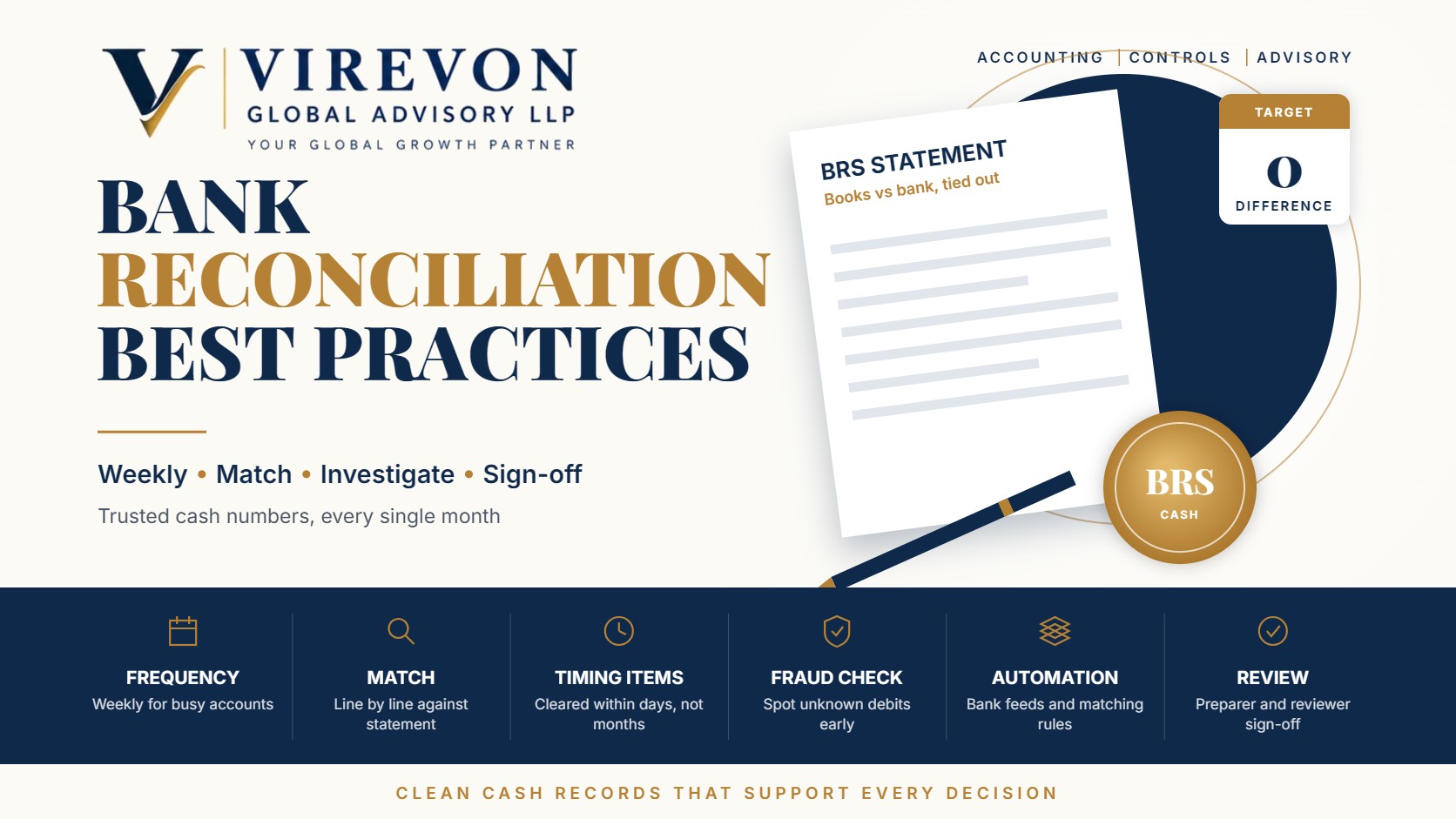
  • Bank Reconciliation Best Practices: Catching Errors Before They Become Problems

    Bank Reconciliation Best Practices: Catching Errors Before They Become Problems

    Cash is the one number in the accounts that can be checked against an independent source every day. A bank reconciliation compares your books with the bank statement and explains every difference. Done regularly, it catches missed entries, duplicate payments, bank charges and even fraud while they are still small and easy to fix.

    Many growing businesses, though, treat reconciliation as a month-end or year-end chore, which is exactly when differences are hardest to trace. This guide sets out best practices that make the process quick, reliable and useful.

    Key takeaways

    • Reconcile every bank, card, wallet and payment gateway account, at least monthly and weekly for busy accounts.
    • Start from the closing balance per bank, adjust for timing items, and agree to the balance per books.
    • Timing differences should clear within days; old reconciling items are a warning sign.
    • Investigate unknown debits immediately and use the bank’s cheque safeguards to reduce fraud risk.
    • Use bank feeds and matching rules, but keep a human review and sign-off.

    Why regular bank reconciliation matters

    A reconciled bank balance underpins almost everything else in the accounts:

    • Accurate profit: bank charges, interest and direct debits often appear in the bank before the books.
    • Receivables: customer receipts can be matched to invoices only when bank credits are recorded promptly.
    • Tax compliance: unrecorded expenses or receipts affect GST, TDS and income-tax figures.
    • Fraud detection: unauthorised debits or altered cheques are spotted fastest on the bank statement.
    • Lender confidence: banks and investors expect cash balances in management reports to agree with statements.

    A step-by-step method

    1. Collect complete statements for the period, preferably downloaded directly from net banking in a structured format.
    2. Confirm opening balances agree with the previous reconciliation, so errors do not carry forward unnoticed.
    3. Match transactions in the books with those on the statement by amount, date and reference.
    4. List unmatched items in the books, such as cheques issued but not presented, and deposits recorded but not yet credited.
    5. List unmatched items on the statement, such as bank charges, interest, direct debits, NEFT receipts not yet recorded, and returned cheques.
    6. Post entries for genuine items that belong in the books, such as charges and interest.
    7. Prepare the reconciliation statement and confirm the difference is nil.
    8. Review and sign off, with the reviewer checking old and unusual items.

    A worked bank reconciliation statement

    At 31 August, the cash book of a Noida trading company shows ₹8,42,500 while the bank statement shows ₹9,18,300.

    ParticularsAmount (₹)
    Balance as per bank statement9,18,300
    Less: cheques issued but not yet presented(1,12,000)
    Add: cash deposited on 31 August, credited on 1 September45,000
    Adjusted bank balance8,51,300
    Balance as per cash book8,42,500
    Add: NEFT receipt from a customer not yet recorded12,000
    Less: bank charges not yet recorded(1,180)
    Less: returned customer cheque not yet recorded(2,020)
    Adjusted book balance8,51,300

    Both sides agree at ₹8,51,300. The customer receipt, bank charges and returned cheque are then entered in the books, leaving only the genuine timing items for the next month.

    Common differences and what they tell you

    • Unpresented cheques: normal in small numbers. Cheques older than their validity period should be reviewed and reversed where appropriate. Since October 2025, cheque clearing moved to a continuous, same-day model, so long-outstanding cheques are even more unusual.
    • Deposits in transit: should clear within a day or two; if not, check with the bank.
    • Unidentified receipts: often customer payments without a reference; follow up quickly so customer ledgers stay correct.
    • Duplicate payments: the same vendor paid twice through different channels; recover promptly.
    • Gateway and marketplace settlements: received net of fees, refunds and taxes, so they need a separate settlement reconciliation before matching to the bank.
    • Round-sum or unusual debits: investigate the same day.

    Fraud red flags and safeguards

    Bank reconciliation is one of the simplest anti-fraud controls available, provided the person reconciling is not the same person who makes payments.

    • Separate duties: one person prepares payments, another approves, and a third reconciles.
    • Watch for payees that do not match approved vendor names, changes in vendor bank details, and payments just below approval limits.
    • Use the bank’s Positive Pay facility for cheques: details of high-value cheques are shared with the bank in advance so that altered cheques are flagged. The RBI framework covers cheques of ₹50,000 and above, and banks may make it mandatory for higher values.
    • Restrict net-banking access, use maker-checker controls, and review user lists each quarter.
    • Report suspicious debits to the bank immediately; prompt reporting improves the chances of recovery.

    Automation, with a human in the loop

    Modern accounting software makes reconciliation much faster:

    • Bank feeds import transactions daily.
    • Matching rules auto-suggest matches for recurring receipts and payments.
    • Bulk import of UPI and gateway reports simplifies high-volume accounts.

    Automation still needs oversight. Review auto-matched items for accuracy, keep rules up to date, and avoid creating rules that post unidentified items to suspense by default. Our comparison of QuickBooks Online vs Xero covers how each handles bank feeds.

    Building reconciliation into your routine

    • Reconcile high-volume accounts weekly, and all accounts before the month-end close begins.
    • Keep reconciliations in a consistent format and folder, with preparer and reviewer names and dates.
    • Set a rule that any reconciling item older than 30 days must be explained in writing.
    • Include the reconciliation summary in the monthly MIS pack.
    • Make bank reconciliation day 2 of your close calendar; our month-end close checklist shows how it fits into the wider process.

    Frequently asked questions

    How often should a business do a bank reconciliation?

    At least monthly for every account. Weekly or even daily reconciliation is better for accounts with high transaction volumes.

    What is the most common reason for bank reconciliation differences?

    Timing differences, such as cheques issued but not yet presented and deposits not yet credited, followed by bank charges and receipts that have not been recorded.

    Who should prepare the bank reconciliation?

    Ideally someone who does not prepare or approve payments, so that the reconciliation acts as an independent check.

    What should I do with very old unreconciled items?

    Investigate each item, correct genuine errors, reverse stale cheques where appropriate, and document the reason for any adjustment.

    If your bank reconciliations are running behind or you would like a cleaner process, our accounting team would be glad to help.

    This article is general information based on the law as of September 2026, and is not legal or tax advice. Please check the facts of your own case with a professional before acting.