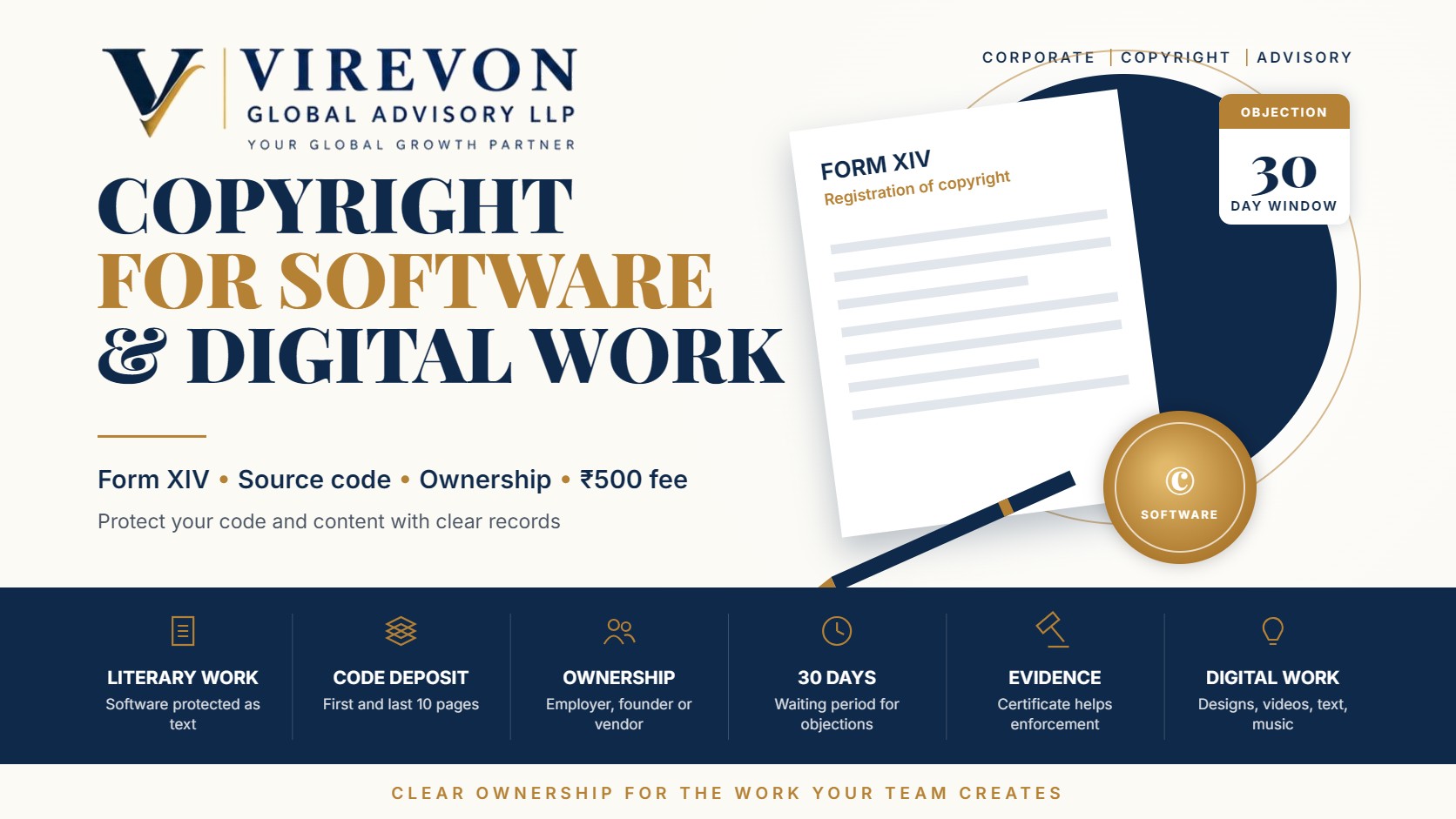
For technology companies, creators and agencies, code and content are often the most valuable assets on the balance sheet, even if they never appear there. Copyright registration for software and digital content does not create copyright, which arises automatically when an original work is created, but it gives you a public record and a certificate that serves as prima facie evidence in disputes. It also makes investor due diligence, licensing and assignments much smoother.
This guide explains what copyright protects in software and digital works, who owns it, and how to register it with the Copyright Office in India.
Key takeaways
- Computer programs are protected as literary works under the Copyright Act, 1957; registration is optional but valuable as evidence.
- Applications are filed online in Form XIV; the government fee for a literary work, including software, is ₹500 per work.
- For software, the applicant deposits the first 10 and last 10 pages of source code, or the entire code if shorter, without redaction.
- There is a 30-day waiting period for objections before examination.
- Ownership depends on who created the work and under what contract; employer, founder and vendor arrangements should be documented.
What copyright protects in software and digital content
Copyright protects the expression of an idea, not the idea itself. For software, this means:
- Protected: source code, object code, the specific structure and arrangement of code, documentation, user manuals, and original screen displays and graphics.
- Not protected by copyright: ideas, algorithms, methods of operation, functionality and business concepts. Some technical inventions may be protectable in other ways, but copyright will not cover them.
Digital content is covered in the category that fits it best:
| Type of work | Copyright category | Examples |
|---|---|---|
| Software and apps | Literary work | Source code, object code, technical documentation |
| Written content | Literary work | Blog articles, e-books, course material |
| Visual content | Artistic work | Illustrations, logos as artwork, UI graphics, photographs |
| Video content | Cinematograph film | Explainer videos, courses, advertisements |
| Audio content | Sound recording or musical work | Podcasts, jingles, background scores |
A logo can be registered both as an artistic work under copyright and as a trademark. The two protect different things, and many brands use both. Our trademark registration guide explains the trademark side.
Who owns the copyright
The author is usually the first owner, but the Copyright Act has important exceptions:
- Employees: where a work is created by an employee in the course of employment under a contract of service, the employer is generally the first owner, unless there is an agreement to the contrary.
- Freelancers and agencies: a contractor who is not an employee typically owns what they create unless the rights are assigned in writing. Many start-ups discover this only during due diligence.
- Founders: code written by founders before incorporation belongs to them personally until assigned to the company.
- Assignments: must be in writing, signed, and should specify the rights, territory and duration. If the duration is not specified, it is taken as five years, and if the territory is not specified, it is taken as India, so draft carefully.
Before registering in a company’s name, make sure the chain of ownership from each contributor to the company is documented.
Step-by-step: copyright registration for software
- Prepare the work: finalise the version to be registered and note its title, version number and date of first publication, if published.
- Gather documents: source code extract, details of the applicant and author, assignment or employment documents, a no-objection certificate from the author if the applicant is different, and a power of attorney if an agent files.
- File Form XIV online on the Copyright Office portal, selecting literary work with computer software as the sub-category, and pay the fee.
- Deposit source code: upload the first 10 and last 10 pages of source code, or the entire code if it is under 20 pages. The current rule does not permit blacked-out or redacted portions, so choose the extract with care.
- Waiting period: after filing, a 30-day period allows others to object.
- Examination: the examiner reviews the application and may issue a discrepancy letter; respond within the time allowed.
- Registration: once cleared, the work is entered in the Register of Copyrights and the extract of the register is issued.
If an objection is filed, both sides are heard before the Registrar decides.
Registering websites, apps and evolving code
Software changes constantly, so a practical approach helps:
- Register stable, significant versions rather than every release. A new version with substantial original changes can be registered as a separate work.
- For apps, consider registering the code as a literary work and distinctive graphics or artwork separately as artistic works.
- For websites, register the underlying code, and original text, images or videos where they are valuable, rather than the website as a single undefined work.
- Keep version control records. Commit histories, release notes and dated backups are strong supporting evidence of authorship and creation dates.
Duration, enforcement and international protection
For literary works, including software, copyright generally lasts for the lifetime of the author plus 60 years; certain categories, such as anonymous works and works of government or public undertakings, run for 60 years from publication. Copyright applies automatically in other Berne Convention countries without separate registration there, although some countries offer their own registration systems that help with local enforcement.
A registration certificate helps when sending a legal notice, seeking takedown of copied apps or content, or pursuing civil remedies. It also supports benefits linked to intellectual property for start-ups; see our guide to DPIIT start-up recognition.
Frequently asked questions
Is copyright registration compulsory for software in India?
No. Copyright exists automatically once original code is written. Registration is optional but provides a certificate that serves as strong evidence of ownership.
How much source code must be submitted for registration?
The first 10 and last 10 pages of the source code, or the whole code if it is less than 20 pages, without redacted portions.
Who owns code written by a freelancer for my company?
Generally the freelancer, unless the rights are assigned to your company in a written agreement. Put assignment clauses in all development contracts.
Can I register copyright in a mobile app’s design?
Original graphics, icons and artwork can be registered as artistic works, and the app’s code as a literary work. Functionality and ideas are not protected by copyright.
If you want to protect your software or digital content and tidy up ownership records, our team would be glad to guide you through copyright registration.
This article is general information based on the law as of September 2026, and is not legal or tax advice. Please check the facts of your own case with a professional before acting.