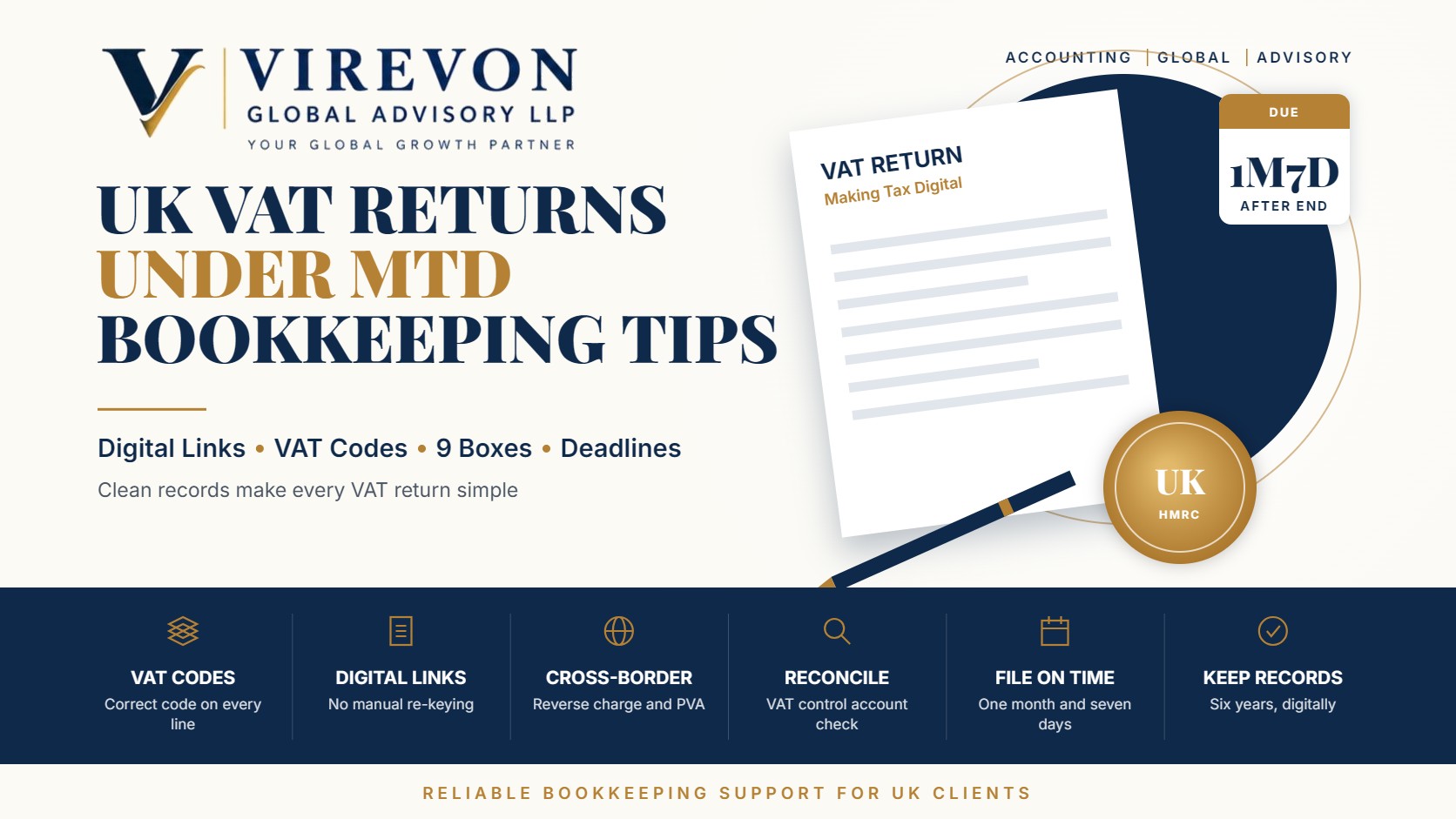
Every VAT-registered business in the UK now files through Making Tax Digital. A UK VAT return MTD submission is made from compatible software, using figures drawn from digital records without manual re-keying. When the bookkeeping behind it is sound, the return itself takes minutes; when it is not, errors, penalty points and corrections follow.
This guide focuses on the bookkeeping habits that make VAT returns accurate: how to set up VAT codes, handle cross-border transactions, reconcile the VAT account and meet deadlines under the points-based penalty system.
Key takeaways
- MTD for VAT applies to all VAT-registered businesses, regardless of turnover, and requires digital records and digital links between them.
- The compulsory registration threshold has been £90,000 of taxable turnover since 1 April 2024.
- Returns and payments are generally due one month and seven days after the end of the VAT period.
- Late returns build penalty points; a £200 penalty applies once the threshold is reached (4 points for quarterly filers).
- Late payment penalties start if VAT remains unpaid after day 15, with a daily rate of 10% a year from day 31.
What MTD for VAT requires
Digital records
You must keep, in software or linked spreadsheets:
- Business name, address, VAT number and the VAT schemes used.
- For each supply made and received: the date, value and rate of VAT.
- Any adjustments, such as bad debt relief, partial exemption or errors corrected.
Digital links
Where data moves between programs, for example from a sales system to a spreadsheet to bridging software, the transfer must be digital (imports, API links, formula links). Copy-and-paste or retyping totals does not meet the rules.
Setting up VAT codes correctly
Most errors start with the wrong tax code on a transaction. A sound code set typically includes:
| Code | Use | Return impact |
|---|---|---|
| Standard 20% | Most UK sales and purchases | Boxes 1 and 4, net in 6 and 7 |
| Reduced 5% | Domestic fuel and certain energy-saving items | Boxes 1 and 4 |
| Zero-rated | Most food, books, children’s clothing, exports of goods | Net value only in 6 or 7 |
| Exempt | Certain financial, insurance, education and health supplies | Net value only |
| Outside scope | Wages, dividends, certain non-business items | Not in the return |
| Reverse charge (services) | Services bought from overseas suppliers | Boxes 1 and 4, net in 6 and 7 |
| Postponed import VAT | Goods imported under postponed VAT accounting | Boxes 1 and 4, net in 7 |
Check supplier invoices for the correct rate rather than assuming 20%, and use ‘no VAT’ codes for items such as train fares where no VAT is charged.
Cross-border transactions
These need particular care:
- Services bought from abroad: a UK business buying, say, bookkeeping or software services from an overseas supplier usually accounts for VAT under the reverse charge, declaring output VAT and reclaiming it as input VAT in the same return (fully, if the business makes only taxable supplies).
- Imported goods: under postponed VAT accounting, import VAT is declared and reclaimed on the return using the monthly PVA statement from HMRC, rather than paid at the border.
- Exports of goods: usually zero-rated if you keep evidence of export within the required time.
- Services supplied to overseas business customers: often outside the scope of UK VAT under the general place of supply rule, but still shown as a net value in the return.
A monthly bookkeeping routine for VAT
- Record all sales and purchases with invoices attached in the software.
- Reconcile bank accounts so that nothing is missing or duplicated.
- Review VAT codes on new suppliers and unusual transactions.
- Import PVA statements for any goods brought into the UK.
- Reconcile the VAT control account: the balance should equal the VAT due for the open period, plus any unpaid prior liability.
- Before filing, compare the draft return with the previous quarter and investigate large swings.
A quick worked example
A London design studio’s quarter shows UK sales of £60,000 plus £12,000 VAT, UK purchases of £8,000 plus £1,600 VAT, and £5,000 of bookkeeping services bought from an Indian provider. Under the reverse charge, it adds £1,000 to output VAT and £1,000 to input VAT. The return shows Box 1 of £13,000, Box 4 of £2,600 and net VAT payable of £10,400, the same amount as without the reverse charge, but with the transaction correctly reported.
Deadlines and penalties
For quarterly filers, the return and payment are due one month and seven days after the quarter ends (for example, a quarter ending 30 September is due by 7 November). Direct Debit collection happens a few days later.
- Late submission: each late return adds a penalty point. The threshold is 2 points for annual, 4 for quarterly and 5 for monthly filers; at the threshold, a £200 penalty applies and each further late return adds another £200 while you remain there.
- Late payment: no penalty if paid within 15 days; 3% of the amount outstanding at day 15 if paid between days 16 and 30; a further 3% at day 30 and a daily rate of 10% a year from day 31 if still unpaid.
- Interest applies separately on late payments, and repayment interest may be due to you when HMRC pays late.
If cash flow is tight, contacting HMRC early about a time to pay arrangement can limit penalties.
Correcting errors
Errors below the reporting threshold can generally be corrected in the next return. Larger errors, or those made deliberately, need to be reported separately to HMRC. Keeping a short note of every adjustment and its reason makes a later enquiry much easier to handle.
For sole traders and landlords also moving to quarterly income tax reporting, see our guide to Making Tax Digital for Income Tax. If you are choosing a ledger, our comparison of QuickBooks Online vs Xero covers VAT features in both.
Frequently asked questions
Do small businesses below the VAT threshold need MTD for VAT?
Only if they are VAT-registered. Voluntarily registered businesses below £90,000 must follow MTD for VAT like everyone else.
When is a quarterly VAT return due?
One month and seven days after the end of the VAT quarter. The payment is due by the same date.
Can I still use spreadsheets for VAT?
Yes, if the spreadsheet is connected to HMRC through bridging software and all transfers of data are by digital links.
How long do I keep VAT records?
Generally for six years. Records must be kept digitally for the MTD requirements.
If you run a UK business and want clean books and on-time VAT returns under MTD, we would be happy to support you.
This article is general information based on the law as of September 2026, and is not legal or tax advice. Please check the facts of your own case with a professional before acting.