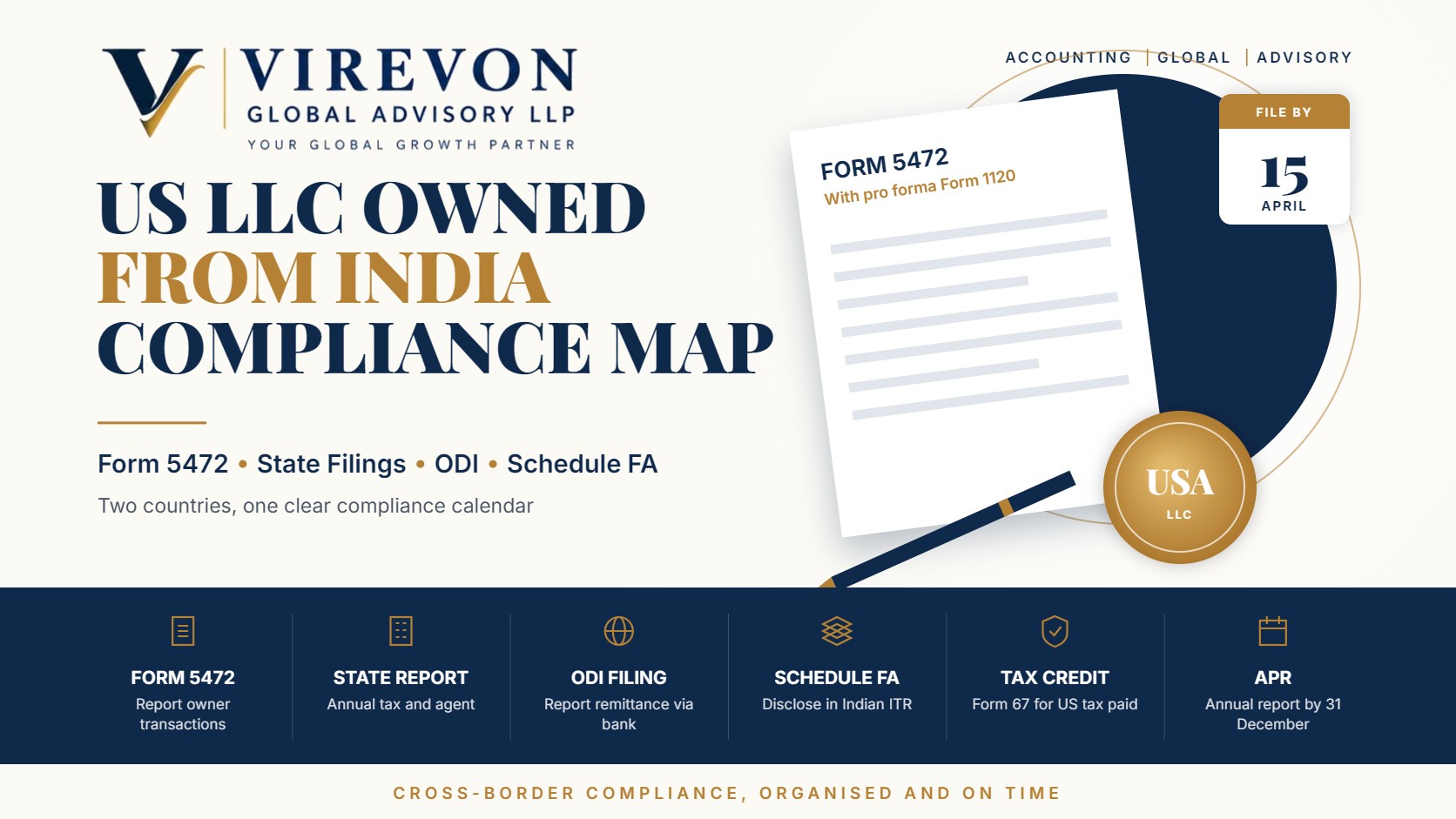
A US LLC owned by an Indian resident is a popular structure for founders selling software, services or products to American customers. It is quick to form, gives access to US payment gateways and marketplaces, and signals credibility to US buyers. What is sometimes overlooked is that the structure carries filing duties in both countries, even in a year with little or no activity.
The compliance is manageable once it is mapped out clearly. This guide covers the US federal and state filings, the Indian foreign exchange rules for making the investment, and the Indian income-tax reporting that follows, with a simple annual calendar at the end.
Key takeaways
- A single-member LLC owned by a non-US person is a disregarded entity for US income tax, but it must still file Form 5472 with a pro forma Form 1120 every year; the penalty for missing it starts at $25,000.
- A multi-member LLC is treated as a partnership by default and files Form 1065, with additional withholding rules where it earns US-connected income.
- States require annual reports or franchise taxes and a registered agent; Delaware’s LLC annual tax is $300, due 1 June.
- On the Indian side, investing in a US LLC is an overseas direct investment under FEMA and must be reported through your bank.
- The LLC interest must be disclosed in Schedule FA of your Indian income-tax return, and foreign tax credit, if claimed, needs Form 67.
US federal filings for a US LLC owned by an Indian resident
Single-member LLC
By default, the IRS disregards a single-member LLC for income-tax purposes. For a foreign owner, US regulations nevertheless treat it as a corporation for one purpose: reporting transactions with its foreign owner. That creates an annual obligation:
- Form 5472 reporting all transactions between the LLC and its owner or related parties, including money contributed to set up the LLC, capital introduced, loans and distributions.
- A pro forma Form 1120 that carries only basic details, marked “Foreign-owned U.S. DE”.
- Due by the corporate return due date (15 April for calendar-year entities), extendable with Form 7004.
The penalty for not filing is $25,000, with further penalties if the failure continues after IRS notice. This is the single most important deadline for foreign-owned LLCs.
Whether the owner also has to file a US income-tax return (Form 1040-NR) depends on whether the LLC is engaged in a US trade or business. An Indian resident providing services from India through the LLC, with no US office, staff or dependent agent, is often not in that position, but facts vary and should be reviewed each year.
Multi-member LLC
An LLC with two or more members is taxed as a partnership unless it elects otherwise. It files Form 1065 and issues Schedule K-1 to each member. If the partnership has income effectively connected with a US business, it must withhold tax on the foreign partners’ shares and file related forms. An LLC can also elect to be taxed as a corporation, which changes the filings entirely.
State and other US requirements
| Item | What is needed | Typical timing |
|---|---|---|
| Registered agent | A US address in the formation state for legal notices | Continuous, renewed annually |
| Delaware LLC annual tax | $300 flat tax | By 1 June each year |
| Wyoming annual report | Report with a licence tax, minimum $60 | First day of the anniversary month |
| Other states | Annual or biennial reports, varying fees | As per the state calendar |
| Sales tax | Registration where economic nexus is triggered | Monthly, quarterly or annual |
If you sell goods online, read our guide on US sales tax nexus for online sellers, as sales tax is separate from federal income tax.
Beneficial ownership (BOI) reporting to FinCEN was narrowed by an interim rule in March 2025 that exempted companies formed in the United States. Keep an eye on any final rule, but most US-formed LLCs currently have no BOI filing.
The Indian side: FEMA and overseas investment
For an Indian resident individual, putting money into a US LLC is an overseas direct investment (ODI) under the Foreign Exchange Management (Overseas Investment) Rules and Regulations, 2022. The key points are:
- The investment is made under the Liberalised Remittance Scheme limit of USD 250,000 per financial year.
- The foreign entity must be engaged in a bona fide business activity. Resident individuals cannot make ODI in an entity engaged in financial services activity.
- Individuals are restricted from making ODI in a foreign entity that has its own subsidiary or step-down subsidiary where the individual has control.
- The remittance is made through an authorised dealer bank, which reports it in the prescribed ODI form.
- An Annual Performance Report is generally required for each overseas entity by 31 December, based on its financial statements.
Delays in reporting can be regularised by paying a late submission fee, so it is worth getting this right from the first remittance.
The Indian side: income-tax reporting
As an Indian resident, you are taxed in India on worldwide income. Practical points include:
- Schedule FA: disclose your interest in the LLC, the initial and peak investment, and income from it in the foreign assets schedule of your return. Non-disclosure can attract penalty under the black money law.
- Foreign income: report dividends, distributions or other income from the LLC in the appropriate schedule. How LLC profits are taxed in India, on distribution or otherwise, depends on the structure and facts; take advice before finalising the approach.
- Foreign tax credit: if US tax has been paid, credit may be available under the India-US tax treaty, subject to filing Form 67 within the prescribed time.
- Control from India: where key management decisions are made in India, questions of residence and permanent establishment can arise; keep board and member decisions properly documented.
Annual compliance calendar
- January to March: close the LLC’s books for the calendar year and reconcile bank and payment gateway accounts.
- By 15 April: file Form 5472 with pro forma 1120 (or Form 1065 for multi-member LLCs), or file Form 7004 for an extension.
- By 1 June: pay the Delaware annual tax, if applicable, and check other state reports.
- July to September: file your Indian return with Schedule FA and Form 67, where relevant.
- By 31 December: submit the Annual Performance Report through your bank.
Good bookkeeping makes every item on this list easier. Our note on outsourced bookkeeping for US small businesses explains a cost-effective setup.
Frequently asked questions
Does my LLC need to file if it had no income?
Yes, a foreign-owned single-member LLC generally files Form 5472 with a pro forma 1120 every year, and the formation and capital contribution are themselves reportable transactions.
Can an Indian resident own 100 percent of a US LLC?
Yes, subject to the FEMA overseas investment rules, including the LRS limit and the restriction on financial services entities.
Do I need a US tax ID?
The LLC needs an EIN to file Form 5472 and open US bank accounts. An individual ITIN is needed only in specific cases, such as filing a personal US return.
Is Form 5472 filed electronically?
It can be filed with a pro forma 1120 by mail or fax as per the IRS instructions for foreign-owned disregarded entities.
If you own or plan to set up a US LLC from India and would like help mapping the US and Indian compliance, our cross-border team would be happy to help.
This article is general information based on the law as of September 2026, and is not legal or tax advice. Please check the facts of your own case with a professional before acting.