For a new venture in Canada, the federal Goods and Services Tax, or its harmonized version in some provinces, is often the first tax registration to think about. The Canada GST/HST small business rules are designed to be light for very small operators and straightforward for growing ones, provided you know when to register and which rate to charge.
This guide covers the small supplier threshold, 2026 rates by province, input tax credits, the Quick Method, filing frequencies and deadlines, with a worked example.
Key takeaways
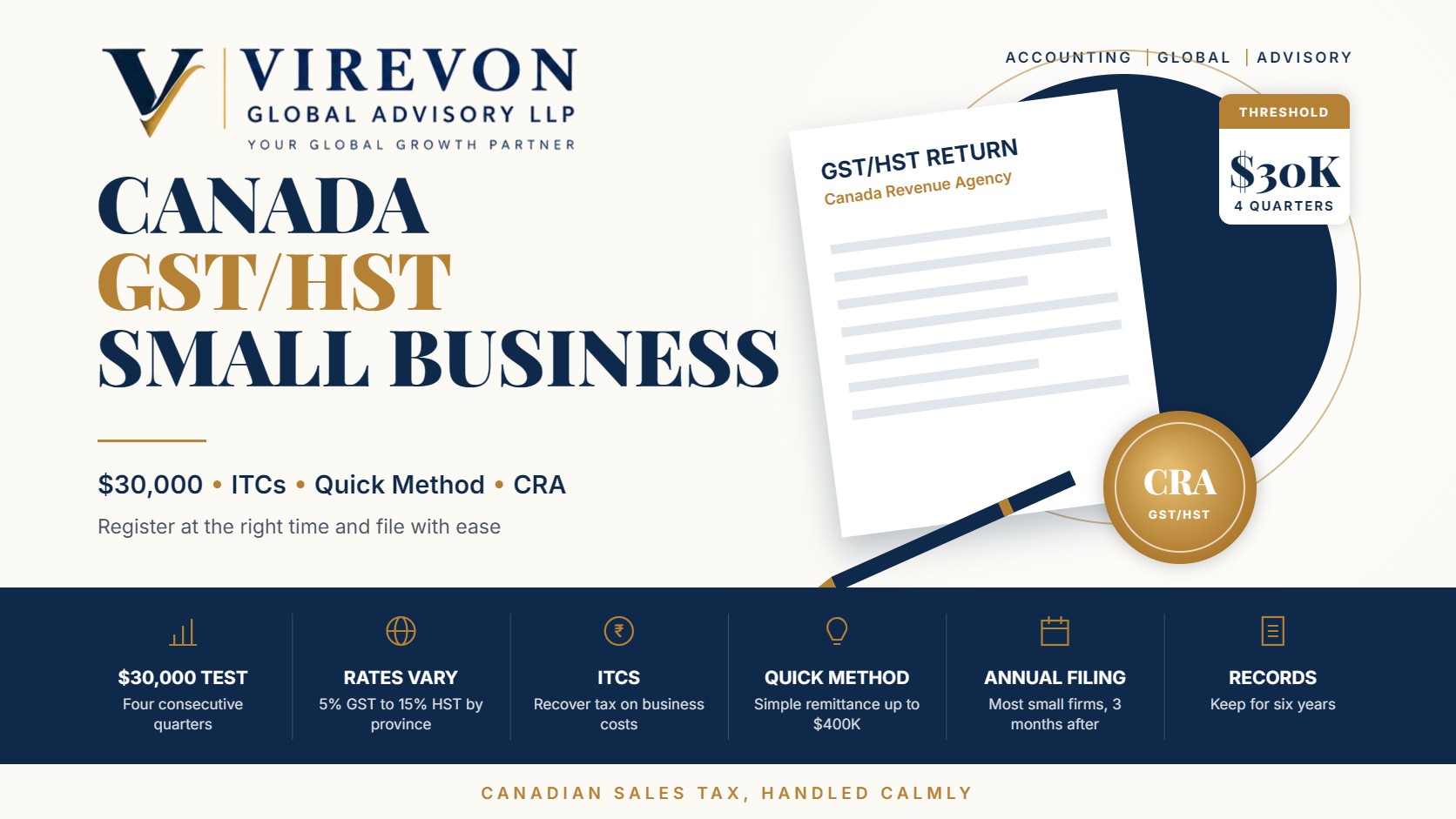
- You can stay unregistered as a small supplier while taxable supplies stay at or below $30,000 in a single calendar quarter and over the last four consecutive calendar quarters.
- The rate depends on where the supply is made: 5% GST in Alberta and the territories, 13% HST in Ontario, 14% HST in Nova Scotia (since 1 April 2025) and 15% HST in New Brunswick, Newfoundland and Labrador, and Prince Edward Island.
- Registered businesses can claim input tax credits (ITCs) for GST/HST paid on business costs.
- Businesses with annual taxable supplies up to $1.5 million are generally assigned annual reporting periods.
- The Quick Method can simplify remittance for eligible businesses with taxable supplies up to $400,000.
When must a small business register?
The test looks at worldwide taxable supplies of the business and its associates:
- Single quarter test – if you exceed $30,000 in one calendar quarter, you stop being a small supplier immediately, and GST/HST applies from the supply that took you over.
- Four-quarter test – if you exceed $30,000 over four consecutive calendar quarters (but not in one quarter), you stop being a small supplier at the end of the month after that quarter.
Once you cease to be a small supplier, you must register promptly; the CRA allows only a short window. Registration is online through Business Registration Online or My Business Account, giving you a Business Number with an RT account.
Voluntary registration
A business below the threshold can register voluntarily. This can make sense when:
- Customers are mostly GST/HST-registered businesses that can claim the tax back
- Start-up costs carry significant GST/HST you would like to recover
- You want to appear established to larger clients
The trade-off is charging tax and filing returns from day one.
2026 GST/HST rates by province
| Province or territory | Tax | Rate |
|---|---|---|
| Alberta, Yukon, NWT, Nunavut | GST | 5% |
| British Columbia, Manitoba, Saskatchewan | GST (plus separate provincial sales tax) | 5% |
| Quebec | GST (plus separate QST) | 5% |
| Ontario | HST | 13% |
| Nova Scotia | HST | 14% |
| New Brunswick, Newfoundland and Labrador, PEI | HST | 15% |
The rate is decided by the place of supply rules, which usually look at where goods are delivered or, for many services, where the customer is located. Provincial sales taxes in BC, Manitoba, Saskatchewan and Quebec’s QST have separate registration rules.
Input tax credits
ITCs let a registrant recover GST/HST paid on purchases used in commercial activities: rent, equipment, software, professional fees, inventory and so on. To claim:
- Hold supporting documents with the supplier’s GST/HST number for purchases above the documentation thresholds
- Claim only the business-use portion of mixed-use items
- Claim within the time limits, generally up to four years for most small businesses
ITCs are not available for GST/HST on exempt supplies, such as most residential rents and many financial services.
The Quick Method
Eligible businesses with annual taxable supplies (including GST/HST) of $400,000 or less can elect the Quick Method. Instead of tracking ITCs on routine expenses, they remit a fixed percentage of their GST/HST-included sales, set by the CRA based on province and business type. ITCs on capital purchases can still be claimed separately.
It suits service businesses with low input costs, such as consultants and designers. It may not suit businesses with large taxable purchases, where the regular method can give more credit. Run both calculations for a typical year before electing.
Filing frequency and due dates
| Annual taxable supplies | Assigned reporting period | Return due |
|---|---|---|
| $1.5 million or less | Annual (monthly or quarterly optional) | 3 months after fiscal year end |
| Over $1.5 million to $6 million | Quarterly | 1 month after the quarter |
| Over $6 million | Monthly | 1 month after the month |
Special rule: an individual with business income and a 31 December fiscal year end files by 15 June, but must pay any balance by 30 April. Annual filers may also need to make quarterly instalments once net tax reaches the CRA’s threshold.
Worked example: an Ontario consultant
Maya runs a consulting business in Toronto. Her taxable fees reach $34,000 over the last four quarters, with no single quarter above $30,000. She registers and starts charging 13% HST.
In her first full year:
- Fees billed: $80,000; HST collected $10,400
- Business expenses with HST: software, co-working rent and equipment; HST paid $2,100
- Net tax under the regular method: $10,400 – $2,100 = $8,300
Under the Quick Method, she would remit the prescribed percentage of her HST-included revenue of $90,400, and could still claim ITCs on capital purchases. With low expenses, the Quick Method is likely to leave her slightly better off, which she can confirm with the current CRA rate for her category.
Records and good habits
- Keep records for six years from the end of the year they relate to
- Show your GST/HST number on invoices and the tax separately where required
- Reconcile GST/HST collected with sales and bank deposits each period
- Set aside tax collected in a separate account so the remittance is ready
For Canadian businesses outsourcing bookkeeping, our article on outsourced bookkeeping for small businesses explains how a remote team can support these routines. The CRA’s GST/HST pages are the official reference.
Frequently asked questions
What is the GST/HST registration threshold in Canada?
A business remains a small supplier, and need not register, while taxable supplies are $30,000 or less in a calendar quarter and over four consecutive calendar quarters.
Which GST/HST rate should I charge?
It depends on the place of supply: 5% GST in non-participating provinces and territories, and HST of 13% in Ontario, 14% in Nova Scotia, and 15% in New Brunswick, Newfoundland and Labrador, and PEI.
How often do small businesses file GST/HST returns?
Businesses with annual taxable supplies of $1.5 million or less are generally assigned annual reporting periods, with returns due three months after the fiscal year end.
Is the Quick Method worth it?
Often for service businesses with low taxable expenses and supplies up to $400,000. Compare it with the regular method before electing.
If your Canadian business needs help with GST/HST registration, bookkeeping or returns, our global accounting team would be glad to set up a simple routine with you.
This article is general information based on the law as of September 2026, and is not legal or tax advice. Please check the facts of your own case with a professional before acting.