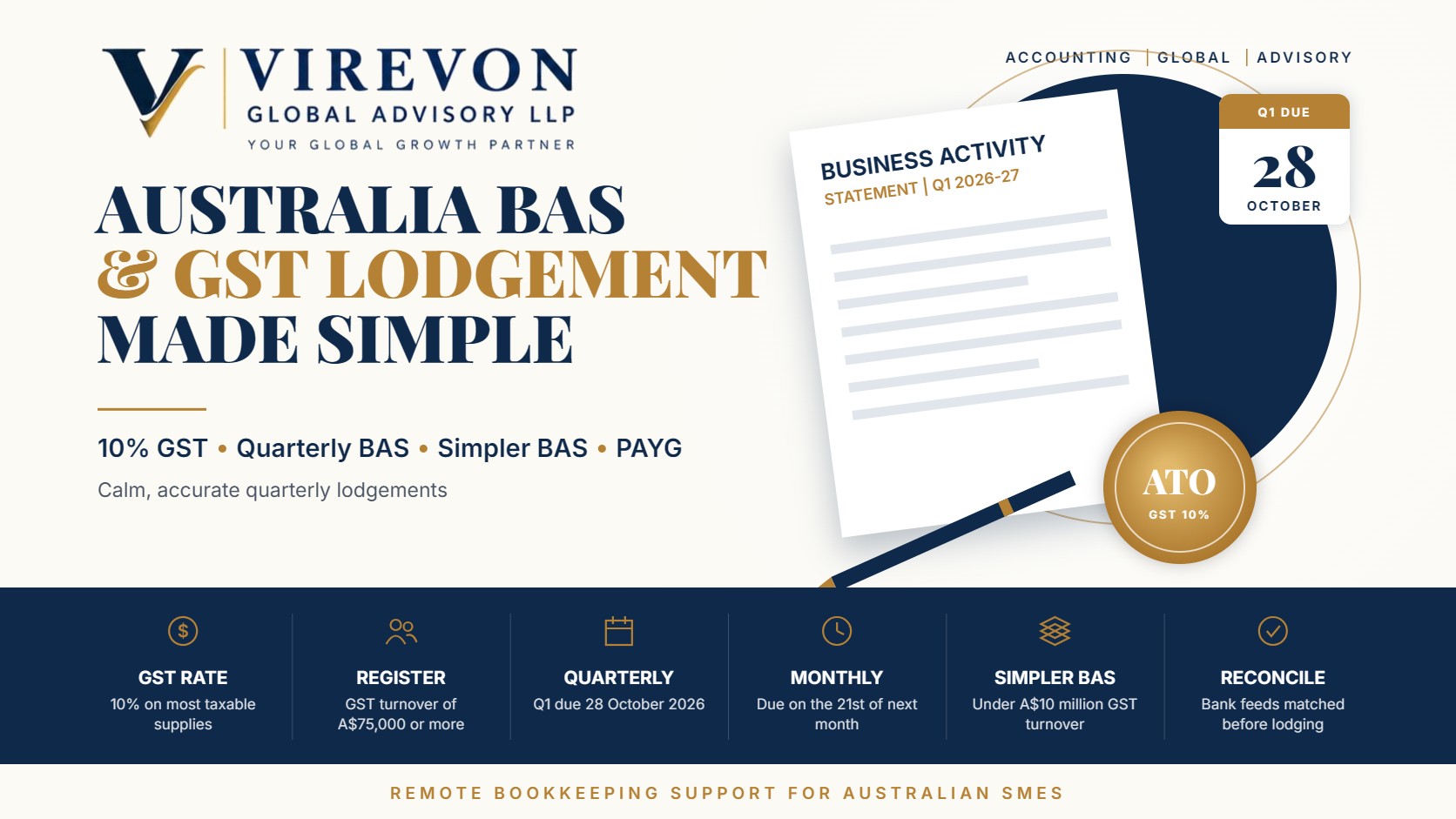
For most Australian small businesses, Australia BAS lodgement is the most regular conversation they have with the Australian Taxation Office (ATO). The business activity statement (BAS) brings together GST, PAYG withholding, PAYG instalments and a few other taxes in one form, usually every quarter. Done well, it becomes a routine that takes a few hours; done in a rush, it becomes a source of penalties and stress.
This guide explains how GST works for small businesses, the 2026-27 lodgement calendar, the labels you will actually use, and a simple bookkeeping routine that keeps each BAS accurate and on time.
Key takeaways
- A business must register for GST once its GST turnover reaches A$75,000 (A$150,000 for non-profits); taxi and ride-sourcing drivers must register regardless of turnover.
- GST is charged at 10% on most taxable sales, and GST credits can be claimed on business purchases supported by valid tax invoices.
- Most small businesses lodge quarterly; Q1 of 2026-27 (July to September) is due on 28 October 2026, with a later date for online lodgement through a registered agent or eligible channel.
- Businesses with GST turnover under A$10 million can use Simpler BAS, which reports only total sales, GST on sales and GST on purchases.
- General interest charge incurred from 1 July 2025 is no longer tax-deductible, which makes on-time lodgement and payment even more valuable.
GST basics for small businesses
Goods and services tax is a broad-based tax of 10% on most goods, services and other items sold or consumed in Australia. Once registered, a business charges GST on its taxable sales, claims credits for the GST included in its business purchases, and pays (or is refunded) the difference through the BAS.
Some supplies are GST-free, such as most basic food, some health and education services and exports. Others are input-taxed, such as residential rent and most financial supplies, where no GST is charged and related credits generally cannot be claimed. Correct tax codes in your accounting software are the foundation of an accurate BAS.
To claim a GST credit on a purchase of more than A$82.50 (including GST), you need a valid tax invoice. For smaller purchases, other records such as a receipt are usually enough.
Australia BAS lodgement due dates for 2026-27
Quarterly lodgers follow a fixed calendar. The standard dates below apply to self-lodgers; businesses that lodge online or through a registered tax or BAS agent may receive additional time under the ATO’s lodgement arrangements, so confirm your own dates in Online services for business or with your agent.
| Quarter | Period | Standard due date |
|---|---|---|
| Q1 | July to September 2026 | 28 October 2026 |
| Q2 | October to December 2026 | 28 February 2027 (moves to the next business day if it falls on a weekend) |
| Q3 | January to March 2027 | 28 April 2027 |
| Q4 | April to June 2027 | 28 July 2027 |
Monthly lodgement is compulsory for businesses with GST turnover of A$20 million or more, and some smaller businesses choose it to improve cash flow from refunds. Monthly BAS is due on the 21st of the following month. Very small voluntarily registered businesses may be eligible to report GST annually.
The BAS labels you will actually use
A full BAS can look intimidating, but most small businesses use only a handful of fields.
GST section
- G1 Total sales: all sales including GST.
- 1A GST on sales: GST you owe.
- 1B GST on purchases: GST credits you are claiming.
Under Simpler BAS, available where GST turnover is under A$10 million, these three are all you report for GST. Your software still needs correct tax codes behind the scenes, but the form itself is shorter.
PAYG sections
- W1 and W2: total salary and wages paid, and the amount withheld from them. Businesses using Single Touch Payroll will find these figures in their payroll reports.
- T7 or 5A: PAYG instalments towards the business’s own income tax, if the ATO has placed the business in the instalment system.
Other labels, such as fuel tax credits, fringe benefits tax instalments and wine equalisation tax, apply only to specific businesses.
A quarterly bookkeeping routine that works
A calm BAS starts well before the due date. We suggest a simple rhythm:
- Weekly: code bank feed transactions in your software and attach receipts or tax invoices.
- Month-end: reconcile every bank account, credit card and payment gateway, and review unusual tax codes.
- Quarter-end, week one: run the GST reconciliation report, check that GST on sales matches your invoicing system and that capital purchases are coded correctly.
- Quarter-end, week two: reconcile payroll figures to Single Touch Payroll, review PAYG instalments and prepare the draft BAS.
- Before lodgement: compare the draft with the prior quarter; investigate large movements rather than lodging and hoping.
- After lodgement: pay by the due date and file the lodged BAS and working papers together.
Our comparison of QuickBooks Online vs Xero covers how both platforms prepare BAS drafts directly from coded transactions.
Cash or accruals: choosing a GST accounting method
Businesses with GST turnover below A$10 million can generally account for GST on a cash basis, reporting GST only when payment is received or made. Larger businesses use the accruals basis, reporting GST when an invoice is issued or received.
The cash basis often suits service businesses with slow-paying customers, because GST is not paid to the ATO before the customer pays. The accruals basis gives an earlier claim for credits on purchases. Whichever method you choose, make sure your software settings match what you have told the ATO.
Common BAS errors and how to avoid them
- Claiming GST on non-registered suppliers’ invoices: check the supplier’s ABN and GST status for larger purchases.
- Coding private or input-taxed expenses as taxable: bank fees, residential rent and personal expenses carry no GST credit.
- Missing capital purchases: vehicles and equipment should be reported correctly; a coding slip here can distort a quarter significantly.
- Payroll mismatches: W1 and W2 should agree with Single Touch Payroll records.
- Late lodgement: failure-to-lodge penalties and general interest charge add up, and GIC is no longer deductible.
Errors in a lodged BAS can usually be corrected in a later BAS within set limits, or by revising the original statement. The ATO is generally supportive of businesses that correct mistakes promptly.
Frequently asked questions
When is the BAS for July to September 2026 due?
The standard due date for Q1 of 2026-27 is 28 October 2026. Businesses lodging online or through a registered agent may have a later date, so confirm yours in ATO online services.
Do I have to register for GST if my turnover is under A$75,000?
Generally no, unless you provide taxi or ride-sourcing services. You can still register voluntarily, which lets you claim GST credits but means you must charge GST and lodge a BAS.
What is Simpler BAS?
It is the default GST reporting method for businesses with GST turnover under A$10 million. You report only total sales, GST on sales and GST on purchases.
Can an offshore bookkeeper prepare my BAS?
An offshore team can do the bookkeeping, reconciliations and draft BAS working papers. Lodgement on behalf of clients for a fee must be done by a registered tax or BAS agent, or by the business itself.
If you would like reliable remote bookkeeping and BAS-ready working papers for your Australian business, we would be glad to help you set up a smooth quarterly routine.
This article is general information based on the law as of September 2026, and is not legal or tax advice. Please check the facts of your own case with a professional before acting.