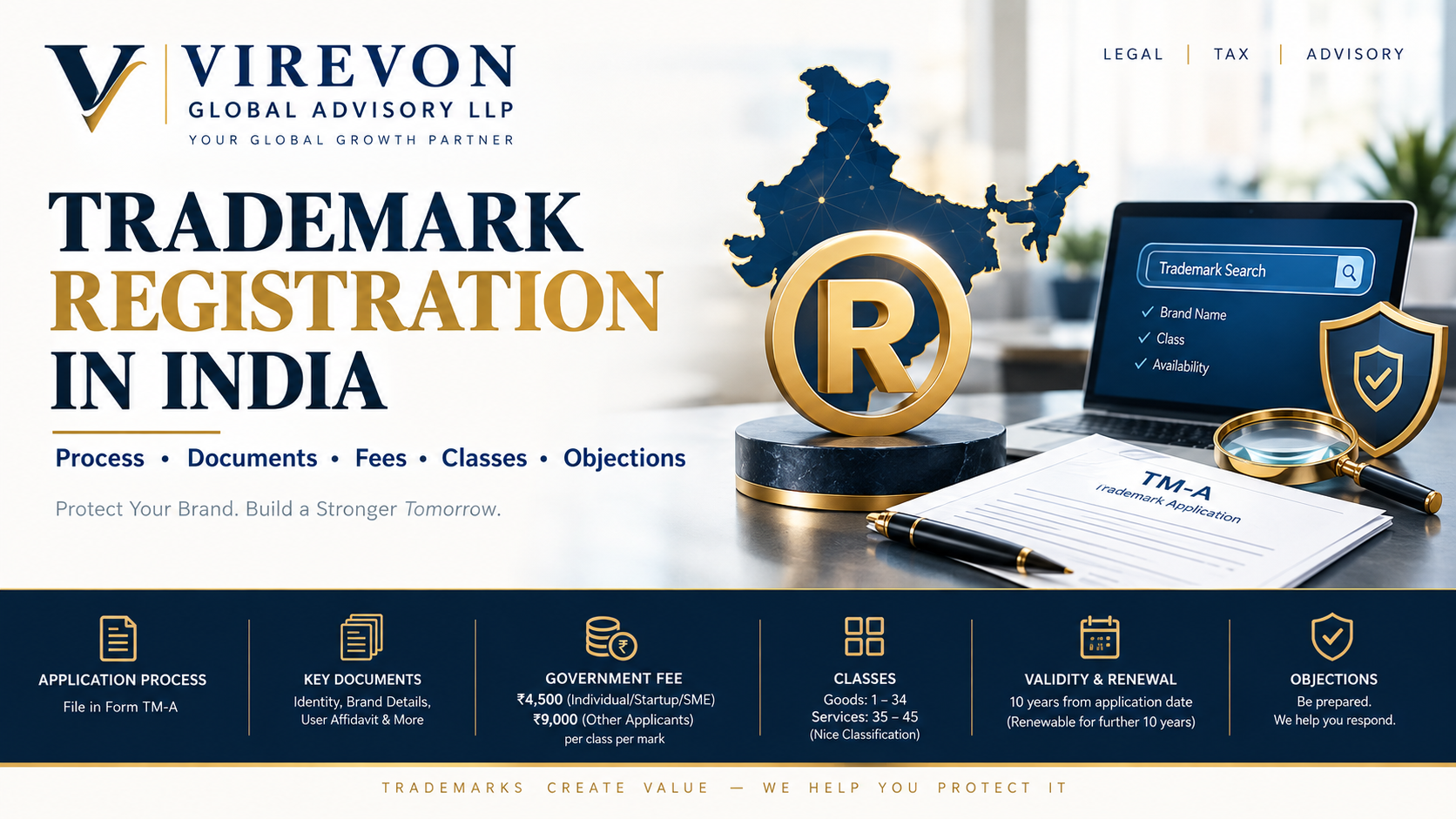
Protect your brand. Build your identity. Secure your business.
A brand is more than just a name or logo. For many businesses, the brand represents years of investment in marketing, customer relationships, goodwill and reputation. As a business grows, protecting that brand becomes an important part of its long-term strategy.
Trademark Registration in India provides a statutory framework for protecting eligible trademarks in relation to specified goods or services. Individuals, startups, companies, LLPs, partnership firms and other eligible applicants can apply for trademark registration through the Indian Trade Marks Registry.
Whether you are launching a startup, building an e-commerce brand, expanding an established business or protecting an existing brand, understanding the trademark registration process can help you make better decisions before filing.
Quick Take: A successful trademark strategy starts before the application is filed. Trademark search, ownership, classification, specification of goods/services and the basis of use should be carefully evaluated before submitting Form TM-A.
Trademark Registration in India – At a Glance
| Particular | Key Information |
|---|---|
| Primary legislation | Trade Marks Act, 1999 |
| Rules | Trade Marks Rules, 2017 |
| Application Form | TM-A |
| Goods Classes | Classes 1–34 |
| Service Classes | Classes 35–45 |
| Standard validity | 10 years |
| Renewal | Further 10-year periods |
| E-filing fee – Individual/Startup/Small Enterprise | ₹4,500 per class per mark |
| E-filing fee – Other applicants | ₹9,000 per class per mark |
| Opposition period | 4 months from publication |
| Application basis | Proposed to be used / prior use, as applicable |
The government fee figures above are the prescribed e-filing fees shown by IP India and are payable per class and per mark. Professional fees, where applicable, are separate.
What Is a Trademark?
A trademark is a sign capable of distinguishing the goods or services of one person from those of another.
A trademark may include:
- Brand names
- Words
- Letters
- Numerals
- Logos
- Symbols
- Device marks
- Slogans
- Colour combinations
- Shapes of goods or packaging
- Sound marks
- Other eligible distinctive marks
The purpose of a trademark is to help consumers identify the source of goods or services and distinguish them from those of other businesses.
Example
Suppose a company launches a clothing brand called “ABCORA” with a distinctive logo.
The business may need to evaluate:
ABCORA → Word Mark
and
ABCORA Logo → Device/Logo Mark
depending on its intended protection strategy.
Why Is Trademark Registration Important for a Business?
Trademark registration can provide important legal and commercial advantages.
1. Protect Your Brand Identity
Registration provides statutory protection for the registered mark in relation to the goods or services covered by the registration.
2. Build a Valuable Business Asset
A trademark can become an important intangible asset of a business.
It may also be relevant to:
- Licensing
- Assignment
- Franchising
- Business restructuring
- Investment
- Commercial transactions
3. Strengthen Enforcement Rights
Registration can provide a stronger statutory basis for taking action against certain unauthorized uses of the registered trademark.
4. Support Business Expansion
A protected brand can be particularly relevant when a business expands into:
- E-commerce
- New cities
- New states
- Franchising
- Distributors
- New product lines
- International markets
5. Build Consumer Recognition
A consistent and protected brand can help a business develop long-term recognition and goodwill.
6. Protect Long-Term Brand Value
The longer a business invests in a brand, the more commercially important that brand may become.
For this reason, trademark protection should ideally be considered before substantial investment is made in marketing and brand development.
Who Can Apply for Trademark Registration in India?
A trademark application can be filed by eligible individuals and entities, including:
| Applicant | Can Apply? |
|---|---|
| Individual | ✓ |
| Proprietorship | ✓ |
| Startup | ✓ |
| Small Enterprise | ✓ |
| Partnership Firm | ✓ |
| LLP | ✓ |
| Private/Public Company | ✓ |
| Trust/Society | ✓ |
| Foreign Applicant | ✓ |
IP India’s guidance states that individuals, startups, SMEs, companies, partnership firms, trusts/societies and foreign applicants can apply for trademark registration. Applications may be filed directly or through a registered trademark agent or attorney.
Trademark Classes in India
One of the most important decisions before filing a trademark application is selecting the correct trademark class.
India follows the Nice Classification system.
| Classes | Category |
|---|---|
| 1–34 | Goods |
| 35–45 | Services |
Why Is Class Selection Important?
Trademark registration is connected with the goods or services covered by the application.
For example, businesses may need to consider classes relating to:
- Clothing and apparel
- Cosmetics
- Food products
- Pharmaceuticals
- Software
- Technology services
- Advertising
- Business management
- Retail services
- Education
- Financial services
- Legal services
- Restaurant services
- Manufacturing
- Consultancy
The correct class should be determined from the actual and intended goods or services of the business.
Important: Choosing a trademark class simply because another business has used it can be risky. The classification should correspond with the applicant’s actual business activities and intended protection.
Trademark Search in India: The Most Important Step Before Filing
Before applying for trademark registration, a trademark availability search should be conducted.
However, a proper search is not simply an exact-name search.
A preliminary assessment may consider:
Exact Match + Phonetic Similarity + Visual Similarity + Related Goods/Services + Relevant Class
Example
Suppose a business wants to register:
VIREZA
Searching only for “VIREZA” may not be sufficient.
Potentially relevant marks may include names that are:
- Phonetically similar
- Visually similar
- Conceptually similar
- Used for related goods or services
A Proper Trademark Search Can Help Identify:
- Existing registered trademarks
- Pending applications
- Similar trademarks
- Relevant classes
- Potential examination issues
- Possible conflicts
IP India’s own filing process places checking availability, assessing similarity/conflicts and selecting the appropriate class among the initial steps.
Trademark Registration Process in India
The overall process can be understood through the following stages:
01 — Brand & Trademark Selection
↓
02 — Trademark Search
↓
03 — Class Selection
↓
04 — Ownership & Documents
↓
05 — Form TM-A Filing
↓
06 — Examination
↓
07 — Objection Reply / Hearing, If Required
↓
08 — Trade Marks Journal Publication
↓
09 — Opposition Period
↓
10 — Registration
↓
11 — Renewal
IP India’s official step-by-step process follows this general sequence.
Step 1: Select the Trademark
First, determine exactly what you want to protect.
This may be:
- Brand name
- Word mark
- Logo
- Device mark
- Tagline
- Slogan
- Other eligible distinctive mark
For an important brand, businesses should evaluate whether protection should be sought for the word element, logo element or both.
Step 2: Conduct a Trademark Search
Search the relevant trademark records before filing.
The search should consider both identical and potentially conflicting marks.
A trademark search can help answer:
“Is this brand reasonably suitable for filing, or are there existing marks that may create a conflict?”
It is important to remember that a search does not guarantee registration.
Step 3: Select the Correct Class
Determine which Nice Classification class or classes apply.
A business offering multiple products or services may need to evaluate more than one class.
For example:
| Business Activity | Class Assessment |
|---|---|
| Clothing | Relevant goods class |
| Cosmetics | Relevant goods class |
| Advertising services | Class 35 may be relevant |
| Software/technology services | Relevant class based on actual service |
| Education | Relevant education/services class |
| Restaurant services | Relevant hospitality/services class |
The exact class should be determined from the actual nature of the goods or services.
Step 4: Identify the Correct Trademark Owner
This step is frequently overlooked.
Before filing, determine who should own the trademark:
- Individual
- Proprietorship
- Partnership
- LLP
- Company
- Other eligible entity
The owner should ideally correspond with the intended commercial ownership of the brand.
Practical Point: If a founder owns the trademark personally but the company builds the entire business around that brand, future licensing, assignment or ownership arrangements may require additional consideration.
Step 5: Prepare Documents and Information
Depending on the application, the required information may include:
- Applicant name
- Applicant address
- Entity details
- PAN/identification details
- Trademark representation
- Goods/services description
- User status
- Prior-use details, where applicable
- User affidavit and supporting documents, where required
- Startup/small-enterprise documents, where applicable
- Power of Attorney, where applicable
IP India’s filing guidance specifically identifies applicant details, trademark representation, goods/services description and applicable user affidavit/Power of Attorney requirements.
Step 6: File Form TM-A
A new trademark registration application is filed through Form TM-A.
The application may be filed online through the Trade Marks Registry’s e-filing system.
Before submission, review:
✓ Applicant details
✓ Trademark representation
✓ Class
✓ Goods/services description
✓ User status
✓ Supporting documents
✓ Applicant category
✓ Government fee
IP India’s official filing process identifies TM-A as the application form for new trademark registration.
Trademark Registration Fees in India
The government filing fee depends on the applicant category.
Current E-Filing Government Fee
| Applicant Category | Fee per Class per Mark |
|---|---|
| Individual | ₹4,500 |
| Startup | ₹4,500 |
| Small Enterprise | ₹4,500 |
| Other Applicants | ₹9,000 |
The official IP India fee schedule specifies these amounts for TM-A applications and states that the fee applies for each class and each mark.
Example
If an eligible startup files:
1 trademark × 2 classes
Government e-filing fee:
₹4,500 × 2 = ₹9,000
If an applicant in the “other applicants” category files the same application:
₹9,000 × 2 = ₹18,000
Note: Professional fees, if any, are separate from government filing fees.
Step 7: Trademark Examination
After filing, the Trade Marks Registry examines the application.
The examination process may consider:
- Distinctiveness
- Earlier trademarks
- Similarity
- Classification
- Goods/services specification
- Statutory requirements
- Other applicable grounds
The official workflow identifies substantive examination under relevant provisions including Sections 9 and 11.
Step 8: Trademark Objection
If the Registry raises an objection, the applicant may need to respond.
A trademark objection may arise due to issues such as:
Absolute Grounds
For example:
- Lack of distinctiveness
- Descriptive character
- Generic nature
- Other statutory restrictions
Relative Grounds
For example:
- Similarity with an earlier trademark
- Likelihood of confusion
- Other conflicts under applicable law
The response should be based on the actual examination report and facts of the application.
How to Respond to a Trademark Objection
A professional trademark objection response may involve:
- Reviewing the examination report
- Identifying each objection
- Reviewing the cited trademarks
- Analysing similarity
- Reviewing the goods/services
- Preparing legal submissions
- Providing evidence where relevant
- Filing the response within the prescribed time
- Preparing for a hearing if scheduled
If the objection is not resolved through the written response, the application may proceed to a show-cause hearing.
Step 9: Trademark Journal Publication
If the application proceeds to publication, it is advertised in the Trade Marks Journal.
This allows third parties an opportunity to oppose the application.
Under the current Trade Marks Rules, a notice of opposition is generally required to be filed within four months from the date of publication/re-advertisement.
Trademark Opposition vs. Trademark Objection
These two terms are often confused.
| Trademark Objection | Trademark Opposition |
|---|---|
| Raised during examination | Raised after publication |
| Raised by the Trade Marks Registry | Filed by a third party |
| Usually addressed through examination response | Can become a contested proceeding |
| May involve a hearing | May involve pleadings, evidence and hearing |
| Based on examination of the application | Based on opposition grounds raised by opponent |
Understanding this distinction is important when monitoring a trademark application.
Step 10: Trademark Registration
If the application successfully completes the applicable stages and there is no successful opposition or other legal barrier, the trademark proceeds toward registration.
The Trade Marks Act provides for registration where the application has been accepted and the opposition period has expired without opposition, or where opposition proceedings have been decided in favour of the applicant.
How Long Is a Trademark Valid in India?
A registered trademark is generally valid for:
10 Years
The registration can be renewed for further periods of 10 years.
IP India’s current guidance confirms that trademark registration is valid for 10 years from the date of application and may be renewed for additional 10-year periods.
Trademark Lifecycle
Application
→ Examination
→ Publication
→ Registration
→ 10-Year Protection
→ Renewal
→ Further 10-Year Period
Renewal can continue for successive periods, subject to the applicable law and prescribed requirements.
Proposed-to-Be-Used vs. Prior Use Trademark
A trademark application may be filed on different factual bases.
| Basis | Meaning |
|---|---|
| Proposed to be used | Applicant intends to use the trademark |
| Prior use | Applicant claims the trademark has already been used |
Where prior use is claimed, appropriate evidence and a user affidavit may be required.
Evidence of Prior Use May Include
Depending on the circumstances:
- Sales invoices
- Product packaging
- Advertisements
- Website records
- Product catalogues
- Marketing material
- Sales records
- Other commercial documents
A prior-use claim should be made carefully and should be capable of being supported with appropriate evidence.
Common Trademark Registration Mistakes
❌ 1. Filing Without a Trademark Search
An application may face avoidable issues if potentially conflicting marks are not identified before filing.
❌ 2. Choosing the Wrong Class
Trademark protection is connected with the goods/services covered by the registration.
❌ 3. Filing Only the Logo
If the brand name itself is commercially important, businesses should evaluate whether word-mark protection is also appropriate.
❌ 4. Making an Unsupported Prior-Use Claim
Prior use should not be claimed without appropriate supporting evidence.
❌ 5. Ignoring an Examination Report
An objection requires timely attention.
❌ 6. Ignoring Journal Publication
Businesses should monitor the application even after examination because third-party opposition may arise after publication.
❌ 7. Forgetting Renewal
A trademark portfolio should have a proper renewal calendar.
Trademark Registration for Startups
For startups, trademark registration should ideally be considered during the early stages of brand development.
This becomes particularly important when a startup is investing in:
- Website development
- Social media
- Digital advertising
- Packaging
- E-commerce
- Influencer marketing
- Product development
- Distribution
- Franchise development
Startup Trademark Checklist
Brand Name → Search → Class → Owner → Application → Monitor → Protect → Renew
Early planning can help reduce the risk of building substantial commercial goodwill around a brand without first considering its trademark position.
Trademark Registration for E-Commerce Businesses
E-commerce businesses often build significant value around a product or brand name.
This is particularly relevant for:
- Amazon sellers
- Flipkart sellers
- D2C brands
- Private-label businesses
- Online retailers
- Marketplace businesses
- Social-commerce businesses
A growing e-commerce business should consider trademark protection alongside:
- Product listings
- Packaging
- Brand stores
- Digital advertising
- Social media
- Influencer campaigns
- Distributor relationships
Trademark registration can form one part of a broader brand-protection strategy.
Trademark Registration vs. Company Registration
These are two different legal processes.
| Company/LLP Registration | Trademark Registration |
|---|---|
| Establishes a legal business entity | Protects an eligible trademark |
| Relates to business structure | Relates to specified goods/services |
| Governed by applicable entity laws | Governed by trademark law |
| Does not automatically create trademark rights | Provides statutory trademark protection subject to law |
| Example: Company/LLP incorporation | Example: Brand name registration |
Important
Registering a company name does not automatically mean that the company’s brand is registered as a trademark.
A business should evaluate its company-name and trademark strategy separately.
Trademark Registration for International Expansion
Indian trademark registration does not automatically provide worldwide trademark protection.
If a business plans to expand internationally, it should consider trademark protection in relevant countries or territories based on its actual and planned markets.
An international trademark strategy may consider:
- Current countries of operation
- Planned expansion markets
- Brand ownership
- Relevant goods/services
- Existing trademarks
- Licensing
- Franchising
- International filing strategy
For businesses planning cross-border expansion, trademark protection should be considered alongside the overall international business structure.
Trademark Renewal in India
Trademark registration should not be treated as a one-time activity.
A business should maintain a trademark portfolio containing:
| Information | Purpose |
|---|---|
| Trademark name | Identify the brand |
| Application number | Track the application |
| Registration number | Track registered rights |
| Filing date | Determine relevant dates |
| Class | Identify protected goods/services |
| Owner | Confirm ownership |
| Renewal date | Prevent missed deadlines |
| Status | Monitor current position |
Regular monitoring is particularly important for businesses holding multiple trademarks.
Frequently Asked Questions
How much does trademark registration cost in India?
The current government e-filing fee for a new TM-A application is ₹4,500 per class per mark for individuals, startups and small enterprises, and ₹9,000 per class per mark for other applicants. Professional fees are separate.
How long is trademark registration valid?
A registered trademark is generally valid for 10 years from the date of application and can be renewed for further 10-year periods.
Can an individual register a trademark?
Yes. Individuals are eligible to apply for trademark registration.
Can a startup register a trademark?
Yes. Startups can apply for trademark registration and eligible startups can avail the applicable government fee category.
Can I register a trademark before starting my business?
Yes, an application can generally be filed on a proposed-to-be-used basis, subject to the applicable legal requirements.
Can one trademark be registered in multiple classes?
A trademark application can cover multiple classes, with the prescribed fee applicable for each class and mark.
What happens if my trademark receives an objection?
The applicant may need to file an appropriate response to the examination report and may be required to attend a hearing if the matter proceeds to that stage.
What happens if someone opposes my trademark?
The matter may proceed as a trademark opposition proceeding involving the prescribed pleadings, evidence and hearing process. The applicable procedure depends on the circumstances of the opposition.
Is trademark registration mandatory for every business?
Trademark registration is not generally mandatory merely to operate a business. However, businesses building valuable brands should consider trademark protection as part of their intellectual-property strategy.
Does company registration protect my brand?
No. Company/entity registration and trademark registration are separate processes.
Trademark Registration Checklist
Before filing your application, review the following:
| Check | Status |
|---|---|
| Brand name finalized | ☐ |
| Logo finalized, if applicable | ☐ |
| Trademark search completed | ☐ |
| Similar marks reviewed | ☐ |
| Correct class identified | ☐ |
| Goods/services specification prepared | ☐ |
| Correct owner identified | ☐ |
| Use status determined | ☐ |
| Prior-use evidence collected, if applicable | ☐ |
| Startup/Small Enterprise status verified | ☐ |
| Applicant documents prepared | ☐ |
| TM-A reviewed | ☐ |
| Government fee calculated | ☐ |
| Application filed | ☐ |
| Application status monitored | ☐ |
| Examination report reviewed | ☐ |
| Objection response filed, if required | ☐ |
| Hearing monitored, if required | ☐ |
| Journal publication monitored | ☐ |
| Opposition period monitored | ☐ |
| Registration status confirmed | ☐ |
| Renewal date recorded | ☐ |
How Virevon Global Advisory LLP Can Help
At Virevon Global Advisory LLP, we assist businesses, startups, companies, LLPs and entrepreneurs with structured business, legal, tax and compliance advisory.
Our Trademark Support Includes:
Trademark Search
Preliminary assessment of the proposed brand and potentially conflicting marks.
Class Selection
Assistance in identifying the relevant goods/services classification.
Application Preparation
Support in preparing information and documentation for trademark filing.
TM-A Filing Support
Assistance with the trademark application process.
Examination & Objection Support
Review and assistance in responding to examination objections.
Hearing Support
Assistance in preparing for applicable trademark hearings.
Opposition Support
Documentation and coordination relating to trademark opposition matters.
Renewal Support
Monitoring and assistance with trademark renewal requirements.
IP & Business Advisory
Trademark considerations integrated with the wider business and brand strategy.
Why Choose a Structured Trademark Strategy?
A trademark application should not be viewed as merely completing an online form.
A better approach is:
SEARCH
Identify potentially conflicting marks.
ANALYSE
Evaluate similarity, classes and business use.
PLAN
Determine ownership and protection strategy.
FILE
Prepare and submit the appropriate application.
MONITOR
Track examination, publication and opposition.
PROTECT
Maintain registration and respond to issues when they arise.
RENEW
Maintain the trademark through timely renewal.
Build Your Brand. Protect Your Identity.
Your brand may represent years of investment, customer trust and business reputation.
Whether you are:
Launching a Startup | Building an E-Commerce Brand | Expanding an Existing Business | Protecting a Product Name | Developing a Franchise | Entering New Markets
trademark protection should be considered as part of your long-term business strategy.
Need assistance with Trademark Registration in India?
Virevon Global Advisory LLP can assist with trademark search, classification, application support, examination objections, opposition-related matters, renewal and related intellectual-property advisory.
Visit: www.virevonglobal.com
VIREVON GLOBAL ADVISORY LLP
Legal | Tax | Advisory
Final Takeaway
Trademark registration in India is not merely about obtaining a registration certificate. It is about building a structured strategy for protecting one of your business’s most valuable intangible assets — its brand.
A careful approach to trademark search, classification, ownership, application drafting, examination, objection management, publication, opposition monitoring and renewal can help businesses manage their trademark portfolio more effectively.
If you are planning to launch or expand a brand, consider evaluating its trademark position before investing heavily in marketing and commercial expansion.
Disclaimer
This article is intended for general informational and educational purposes only and does not constitute legal advice or create an advocate-client relationship. Trademark registration depends on the specific facts, mark, applicant, goods/services, prior marks, evidence and proceedings involved. Government fees, forms, procedures and applicable requirements may change. Readers should verify the latest requirements with the Indian Trade Marks Registry/IP India before filing or taking action.
Official sources: IP India, Trade Marks Act, 1999 and Trade Marks Rules, 2017.