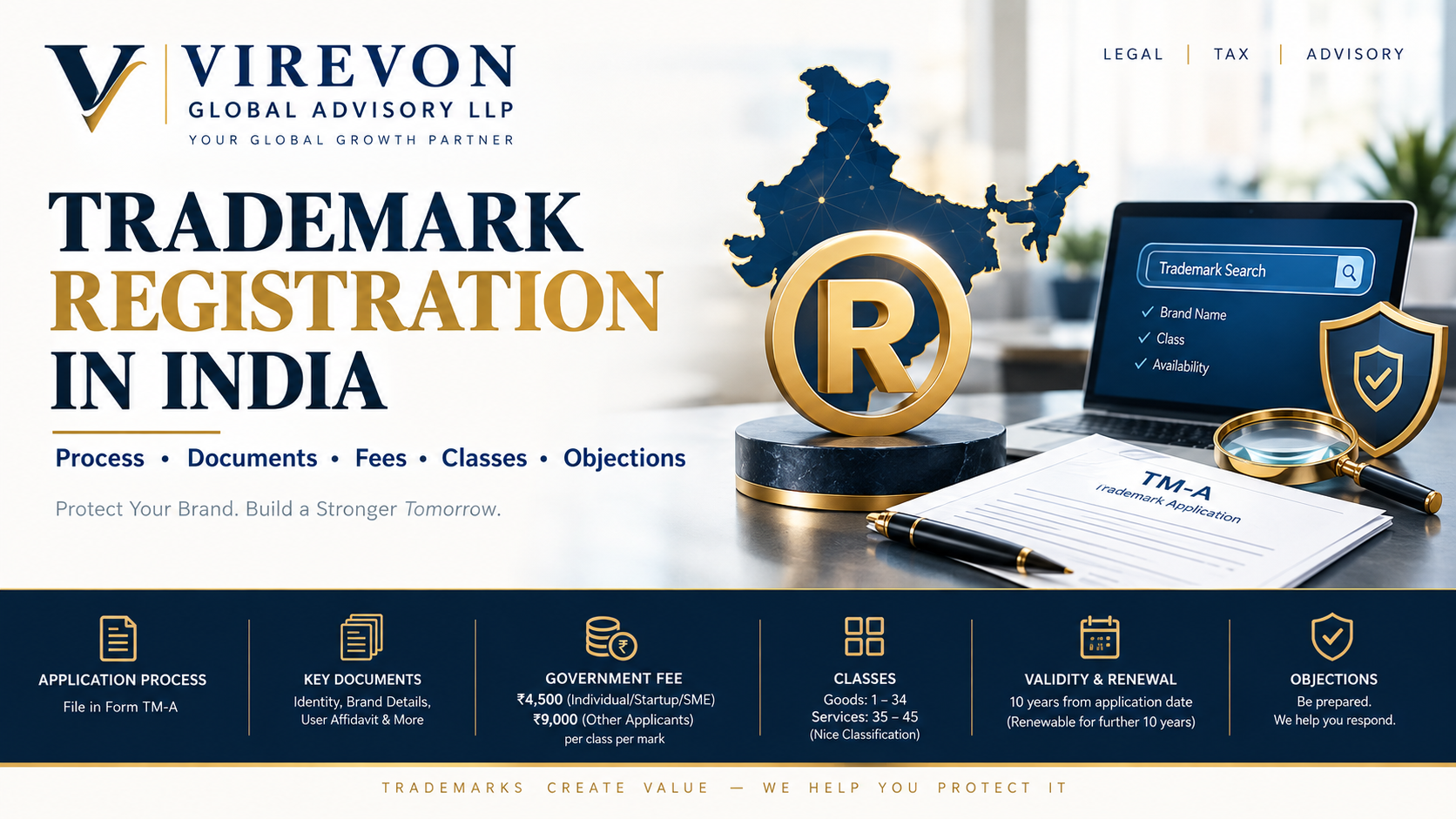
Trademark registration in India is an important step for protecting a brand name, logo, slogan, product identity or business name. However, simply filing a trademark application does not mean that the trademark is immediately registered.
After filing, a trademark application passes through several stages such as Formalities Check, Examination, Examination Report, Objected, Hearing, Accepted, Advertised, Opposed and Registered.
Understanding these trademark application status meanings can help applicants know what is happening with their application and what action may be required.
This guide explains the trademark registration process in India, the approximate timeline for each stage, the meaning of common trademark statuses and what an applicant should do at each stage.
Quick Overview: Trademark Registration Timeline in India
A typical trademark application may move through the following process:
Trademark Search
      ↓
Select Trademark Class
      ↓
Prepare Documents
      ↓
File TM-A Application
      ↓
Application Number Generated
      ↓
Formalities Check
      ↓
Examination
      ↓
Examination Report
      ↓
 ┌───────────────┐
 │ No Objection  │
 └───────┬───────┘
         ↓
      Accepted
         ↓
Trade Marks Journal
         ↓
4-Month Opposition Period
         ↓
 ┌────────────────────┐
 │ No Opposition       │
 └─────────┬──────────┘
           ↓
      REGISTERED ®

OR

Examination Objection
        ↓
Reply to Examination Report
        ↓
Hearing, if required
        ↓
Acceptance / Refusal
The official IP India workflow follows this general structure, including formalities examination, substantive examination, examination objections, hearing, acceptance, journal publication and opposition proceedings. (IP India)
1. What Is a Trademark Application?
A trademark application is an application filed with the Indian Trade Marks Registry to obtain legal protection for a mark used or intended to be used in connection with particular goods or services.
A trademark may include:
- Brand name
- Business name
- Logo
- Symbol
- Tagline
- Slogan
- Word mark
- Device mark
- Combination of words and logo
- Certain non-traditional marks where legally registrable
The application is generally filed using Form TM-A.
The applicant must identify the relevant Nice Classification class or classes covering the goods or services for which protection is sought. IP India’s filing guidance specifically identifies trademark search, class selection, applicant details, representation of the mark and Form TM-A filing as key parts of the process. (IP India)
2. Trademark Application Status: Complete Timeline
The following table provides a simplified understanding of the major stages.
| Stage / Status | Approx. Indicative Time | What It Means | Applicant’s Action |
|---|---|---|---|
| Application Filed | Day 0 | Application has been submitted | Keep application number safely |
| Formalities Check | Few weeks to several months | Registry checks basic filing requirements | Monitor status |
| Vienna Codification | Variable | Applies mainly where the application contains a device/logo element | Usually no immediate action |
| Marked for Examination | Variable | Application is awaiting substantive examination | Monitor |
| Examination Report Issued | Variable | Registrar has examined the application | Read objections carefully |
| Objected | Usually after examination | Registry has raised one or more objections | File reply within prescribed period |
| Hearing | Variable | Objection could not be resolved solely on written reply or hearing is required | Attend/represent at hearing |
| Accepted | Variable | Application has been accepted for registration | Monitor Journal publication |
| Advertised / Published | Variable | Mark has been published for public opposition | Monitor opposition period |
| Opposed | Depends on third-party action | Someone has formally opposed registration | Defend opposition |
| Registered | After successful completion | Trademark has been entered on the Register | Maintain and renew trademark |
| Refused | Variable | Application has been refused | Consider available review/appeal remedies |
| Abandoned | Variable | Application stopped progressing because required action was not taken | Examine restoration/remedy options |
Important: These are practical indicative periods, not statutory guarantees. The actual time may vary significantly depending on Registry workload, examination, objections, hearings, opposition and other procedural issues.
3. Status: “Application Filed”
Meaning
This is the starting point of the trademark registration process.
The application has been submitted to the Trade Marks Registry and an application number has generally been generated.
What should you do?
Keep copies of:
- Trademark application
- Application number
- Filing date
- Applicant details
- Trademark representation
- Goods/services description
- Class details
- User claim, if applicable
- Power of Attorney, where applicable
The filing date is particularly important because it establishes the application’s position in the registration process.
Typical Timeline
Day 0 onward
The application then proceeds for processing and examination.
4. Status: “Formalities Check”
Meaning
The Registry first checks whether the application satisfies basic procedural and filing requirements.
This may include checking:
- Applicant details
- Application form
- Prescribed fee
- Trademark representation
- Class information
- Documents
- Other filing requirements
IP India’s official workflow identifies Formality Check as an early stage of the trademark application process. (IP India)
Possible Outcomes
Formalities Check
       ↓
 ┌───────────────┐
 │ Complete      │
 └───────┬───────┘
         ↓
    Examination

OR

 ┌───────────────┐
 │ Deficiency    │
 └───────┬───────┘
         ↓
  Deficiency Reply
         ↓
     Review
If a deficiency is raised, the applicant may need to correct or respond to it within the applicable time.
5. Status: “Vienna Codification”
What Does Vienna Codification Mean?
If the trademark contains a logo, symbol, graphical element or other figurative component, the mark may undergo Vienna Codification.
The Vienna Classification is an international classification system used for figurative elements of trademarks.
For example:
Brand + Logo
may be processed differently from a simple:
WORD MARK
This stage does not mean that the trademark has been registered.
It is essentially part of the Registry’s processing and classification workflow.
6. Status: “Marked for Examination”
This means the application is moving toward substantive examination by the Trade Marks Registry.
The Registry examines the application against relevant legal requirements and searches earlier trademarks to identify potentially conflicting marks.
Under the Trade Marks Rules, examination includes searching earlier trademarks to determine whether identical or deceptively similar marks exist for the relevant goods or services. (IP India)
7. Status: “Examination Report”
This is one of the most important stages in the trademark registration process.
The Registrar may raise objections under provisions including:
- Section 9 – absolute grounds for refusal
- Section 11 – relative grounds for refusal
- Other applicable provisions depending on the facts of the application
Common Trademark Objections
Examples include:
- Trademark is descriptive
- Trademark lacks distinctiveness
- Trademark is generic
- Trademark is deceptively similar to an earlier mark
- Conflict with an existing trademark
- Incorrect or overly broad specification
- Classification-related issues
- Formal or procedural deficiencies
The official Trade Marks Rules provide for an examination report where the Registrar objects to acceptance or proposes conditions, amendments or limitations. (IP India)
8. Status: “Objected”
What Does “Objected” Mean?
Objected does NOT mean that the trademark has been finally rejected.
It means the Trademark Registry has raised an objection that must be addressed.
This is a critical distinction.
What Should the Applicant Do?
The applicant should:
- Download the Examination Report.
- Identify every objection.
- Analyse the cited trademarks, if any.
- Prepare a legally supported reply.
- Provide evidence of use where relevant.
- Submit supporting documents where necessary.
- Request/attend a hearing if the matter proceeds to hearing.
Under Rule 33, the applicant must respond to an examination report within the prescribed period; failure to respond can result in the application being treated as abandoned. (IP India)
Simplified Flow
Examination Report
       ↓
    Objection
       ↓
Prepare Reply
       ↓
Registry Review
       ↓
 ┌───────────────┐
 │ Objection     │
 │ Resolved      │
 └───────┬───────┘
         ↓
      Accepted

OR

Reply Not Accepted
       ↓
Show Cause Hearing
       ↓
Decision
9. Trademark Examination Report Reply
A strong trademark objection reply should not simply state:
“Our trademark is different.”
A professional response generally analyses:
- Applicant’s mark
- Earlier cited mark
- Visual similarity
- Phonetic similarity
- Structural similarity
- Conceptual similarity
- Goods/services
- Trade channels
- Consumer profile
- Nature of business
- Actual use, if applicable
- Distinctiveness
- Relevant legal provisions
- Supporting evidence
For businesses that have already used a trademark, proof of use can become particularly important depending on the objection and factual circumstances.
10. Status: “Hearing”
What Does Hearing Mean?
If the objection is not resolved on the written response alone, the Registry may provide an opportunity for a hearing.
The applicant or authorised representative may present arguments and clarify the issues raised by the Registry.
The hearing may result in:
Hearing
   ↓
 ┌───────────────┐
 │ Accepted      │
 └───────┬───────┘
         ↓
 Publication

OR

 ┌───────────────┐
 │ Refused       │
 └───────────────┘
The applicant should carefully monitor hearing notices and comply with the prescribed procedural requirements.
11. Status: “Accepted”
What Does “Accepted” Mean?
This is an important positive procedural stage.
It generally means the application has been accepted for advertisement/registration process, either unconditionally or subject to applicable conditions.
However:
Accepted ≠ Registered
The trademark still has to pass through the publication and opposition stage.
IP India’s workflow shows acceptance followed by publication in the Trade Marks Journal and then the opposition period. (IP India)
12. Status: “Advertised” or “Published”
Once accepted, the trademark application is published in the Trade Marks Journal.
The purpose is to provide an opportunity for third parties to oppose the registration.
This is an important distinction:
Application Filed
Means:
“I have applied.”
Accepted
Means:
“The Registry has accepted the application for the next stage.”
Advertised
Means:
“The application has been published for public opposition.”
Registered
Means:
“The trademark has been entered on the Register.”
13. Opposition Period – Usually 4 Months
After publication in the Trade Marks Journal, a third party may oppose the trademark within the prescribed opposition period.
The current Trade Marks Rules provide a four-month period for filing a notice of opposition from publication/re-advertisement in the Trade Marks Journal. (IP India)
Opposition Flow
Trademark Journal Publication
             ↓
       Opposition Window
             ↓
      ┌──────┴──────┐
      ↓             ↓
 No Opposition    Opposition
      ↓             ↓
 Registration     Opposition
                    ↓
             Counterstatement
                    ↓
                 Evidence
                    ↓
                 Hearing
                    ↓
                 Decision
14. Status: “Opposed”
Meaning
An Opposed status means a third party has filed an opposition against the trademark application.
This does not automatically mean that the applicant has lost.
The applicant gets an opportunity to defend the application through the prescribed opposition procedure.
Opposition proceedings can involve:
- Notice of Opposition
- Counterstatement
- Evidence
- Replies/evidence
- Hearing
- Registrar’s decision
- Further legal remedies where available
IP India’s materials describe opposition proceedings under Section 21 and the applicable Trade Marks Rules. (IP India)
Why Do Trademarks Get Opposed?
Common reasons may include:
- Similarity with an existing trademark
- Prior use
- Prior registration
- Likelihood of confusion
- Bad-faith allegations
- Descriptiveness
- Lack of distinctiveness
- Similar goods/services
- Proprietary or commercial interest
The actual grounds depend upon the opposition notice and facts of the case.
15. Status: “Registered”
What Does “Registered” Mean?
This is the stage at which the trademark has successfully completed the registration process and has been entered on the Register of Trade Marks.
The proprietor can then use the registered trademark rights available under applicable Indian trademark law, subject to the scope of registration and other legal limitations.
The trademark can generally be represented with:
®
after registration.
Important
Do not use ® merely because a trademark application has been filed.
An application may use terms such as:
TM
while a registered trademark may use:
®
subject to applicable law.
16. Status: “Refused”
Meaning
A Refused status means the Registrar has refused the application after considering the applicable objections, responses and/or hearing.
This does not necessarily mean that every possible legal remedy has ended.
Depending on the order and circumstances, the applicant may have options such as review, appeal or other appropriate legal proceedings.
The appropriate remedy depends upon:
- Date of order
- Nature of order
- Grounds of refusal
- Procedural history
- Applicable law
- Available limitation period
Professional legal advice should be taken promptly after a refusal order.
17. Status: “Abandoned”
What Does Abandoned Mean?
An application may be treated as abandoned when the applicant fails to take a required procedural step within the applicable period.
Examples may include failure to:
- Respond to an examination report
- Attend a required hearing
- Comply with a Registry direction
- Remedy certain deficiencies
The Trade Marks Rules specifically provide circumstances in which failure to respond to an examination report or attend a hearing can lead to abandonment. (IP India)
Important
Abandoned does not mean “rejected after full merits examination.”
The procedural history should be examined before deciding what remedy or fresh filing strategy may be appropriate.
18. Complete Trademark Status Flowchart
Here is a simplified flowchart for understanding the entire process:
                 START
                   │
                   ▼
          Trademark Search
                   │
                   ▼
        Select Nice Class(es)
                   │
                   ▼
         Prepare TM-A Application
                   │
                   ▼
             FILE APPLICATION
                   │
                   ▼
            Application No.
                   │
                   ▼
           Formalities Check
                   │
          ┌────────┴────────┐
          │                 │
       Deficiency          Clear
          │                 │
          ▼                 ▼
    Rectification       Examination
                            │
                            ▼
                    Examination Report
                            │
              ┌─────────────┴─────────────┐
              │                           │
        No Objection                  Objection
              │                           │
              ▼                           ▼
          Accepted                 Reply Filed
              │                           │
              │                    ┌──────┴──────┐
              │                    │             │
              │                 Accepted      Hearing
              │                    │             │
              │                    │        ┌────┴────┐
              │                    │        │         │
              │                    │    Accepted   Refused
              │                    │        │
              └────────────┬───────┘
                           ▼
                  Trade Marks Journal
                           │
                           ▼
                 4-Month Opposition
                           │
                 ┌─────────┴─────────┐
                 │                   │
            No Opposition          Opposition
                 │                   │
                 ▼                   ▼
             REGISTERED         Opposition Case
                                     │
                                     ▼
                               Final Decision
                                     │
                           ┌─────────┴─────────┐
                           ▼                   ▼
                      Registration          Refusal
19. How Long Does Trademark Registration Take in India?
There is no single guaranteed trademark registration timeline applicable to every application.
A straightforward application without objections or opposition can progress considerably faster than a contested application.
A practical way of looking at the process is:
| Situation | Possible Overall Time |
|---|---|
| Straightforward application with smooth processing | Several months |
| Application with examination objection | Longer than a straightforward application |
| Application requiring hearing | Further time may be required |
| Application facing opposition | Potentially substantially longer |
| Complex contested matter | Can extend for years |
Therefore, applicants should not rely on statements such as:
“Every trademark is registered in exactly X months.”
The Registry’s own workflow contains multiple decision points, and the time required at each stage can vary. (IP India)
20. Can Trademark Registration Be Expedited?
Yes.
The Trade Marks Rules provide for expedited processing through Form TM-M, subject to the applicable prescribed fee and conditions.
The Rules state that an application for expedited processing is to be examined expeditiously and ordinarily within three months from submission of the expedited-processing request, with subsequent proceedings also intended to be dealt with expeditiously subject to the applicable guidelines. (IP India)
However:
Expedited processing does not guarantee registration.
An objection, hearing, opposition or other legal issue can still affect the ultimate outcome.
21. Trademark Application Status vs. Trademark Registration Status
One of the biggest misunderstandings among business owners is treating every status as registration.
| Status | Registered? | Basic Meaning |
|---|---|---|
| Application Filed | ❌ No | Application submitted |
| Formalities Check | ❌ No | Initial procedural processing |
| Vienna Codification | ❌ No | Figurative/logo classification stage |
| Marked for Examination | ❌ No | Awaiting/under examination |
| Objected | ❌ No | Examination objection exists |
| Hearing | ❌ No | Matter requires/has hearing |
| Accepted | ❌ No | Accepted for next stage |
| Advertised | ❌ No | Published for opposition |
| Opposed | ❌ No | Third-party opposition filed |
| Registered | ✅ Yes | Trademark registered |
| Refused | ❌ No | Registration refused |
| Abandoned | ❌ No | Application treated as abandoned |
22. Most Important Trademark Statuses in One Line
For quick reference:
New Application / Filed
→ Application has been submitted.
Formalities Check
→ Registry is checking procedural requirements.
Vienna Codification
→ Figurative/logo elements are being classified where applicable.
Marked for Examination
→ Application is awaiting substantive examination.
Exam Report
→ Registrar has examined the application.
Objected
→ Registry has raised an objection.
Reply Filed
→ Applicant has responded to the examination objection.
Hearing
→ Applicant is required to present arguments before the Registry.
Accepted
→ Application has been accepted for the next stage.
Advertised
→ Application has been published in the Trade Marks Journal.
Opposed
→ A third party has challenged the application.
Registered
→ Trademark has been registered.
Refused
→ Registration has been refused.
Abandoned
→ Application has stopped due to failure to comply with a required procedural step or other applicable reason.
23. Trademark Registration: Common Mistakes to Avoid
Mistake 1: Filing Without a Trademark Search
A business may invest heavily in a brand only to discover that a similar trademark already exists.
A proper trademark search in India should consider:
- Identical marks
- Phonetically similar marks
- Similar spelling
- Similar business categories
- Related goods/services
- Existing applications
- Existing registrations
Mistake 2: Choosing the Wrong Trademark Class
Trademark protection is connected to the goods/services covered by the registration.
For example:
A technology company, restaurant, clothing brand and financial service provider may require different classes depending on their activities.
Therefore, Nice Classification and the correct description of goods/services are important parts of trademark filing strategy.
Mistake 3: Treating “Objected” as “Rejected”
This is one of the most common misunderstandings.
Objected ≠ Rejected
An objection creates an opportunity to respond.
The quality and legal basis of the response can be important to the subsequent outcome.
Mistake 4: Ignoring the Examination Report
An examination report should not be ignored.
The Trade Marks Rules prescribe a response period, and failure to respond can result in the application being treated as abandoned. (IP India)
Mistake 5: Ignoring Trade Marks Journal Publication
Even after acceptance, applicants should monitor the Trade Marks Journal because the application becomes open to opposition.
Mistake 6: Using ® Before Registration
A pending trademark application is not the same as a registered trademark.
Use the appropriate designation based on the actual legal status of the mark.
24. Trademark Registration Checklist for Businesses
Before filing:
☐ Conduct trademark availability search
☐ Check similar marks
☐ Identify correct Nice class
☐ Decide Word Mark vs Logo Mark
☐ Verify applicant’s legal name
☐ Prepare trademark representation
☐ Prepare goods/services description
☐ Determine whether use claim applies
☐ Collect supporting documents
☐ File Form TM-A
☐ Preserve application number and filing date
After filing:
☐ Monitor application status
☐ Download examination report if issued
☐ Respond to objections within time
☐ Monitor hearing notices
☐ Check Trade Marks Journal publication
☐ Monitor opposition period
☐ Download registration certificate after registration
☐ Maintain trademark records
☐ Monitor renewal deadline
25. Word Mark vs Logo Mark – Which Application Should You Consider?
A business may have:
Brand Name: VIREVON
and
Logo: Stylised VIREVON design
These may involve different trademark protection considerations.
Word Mark
Protects the word/name as a trademark, subject to the scope and legal protection available.
Device/Logo Mark
Protects the particular graphical representation of the mark.
Businesses should consider their branding strategy before deciding whether to file one or multiple applications.
26. Trademark Registration for Startups and MSMEs
Trademark registration is particularly relevant for:
- Startups
- D2C brands
- E-commerce businesses
- Amazon sellers
- Flipkart sellers
- Manufacturers
- Service businesses
- SaaS companies
- Restaurants
- Clothing brands
- Cosmetic brands
- FMCG businesses
- Professional service firms
- Digital businesses
- Export businesses
For an expanding business, trademark protection should ideally be considered before significant investment is made in:
- Packaging
- Advertising
- Social media
- Website
- Marketplaces
- Distribution
- Franchise expansion
- International expansion
27. Trademark Registration for E-Commerce Businesses
For online sellers, trademark protection can be particularly relevant because a brand may be used across:
- Amazon
- Flipkart
- Meesho
- Shopify
- Own website
- Social media
- Digital advertising
- Product packaging
- Marketplace listings
A properly planned trademark strategy can form part of a broader brand protection and intellectual property strategy.
28. Trademark Protection in India and Global Expansion
Indian businesses expanding internationally should distinguish between:
Indian trademark registration
and
international trademark protection.
Trademark rights are generally territorial. Registration in India does not automatically provide equivalent trademark rights in every foreign country.
Businesses looking for international trademark protection may consider national/regional filings or the Madrid System, depending on the countries involved and eligibility.
Under WIPO’s Madrid System, an applicant generally starts with a national or regional “basic mark” and can seek protection in designated member jurisdictions. Each designated country’s IP office applies its own domestic law and can grant or refuse protection. (WIPO)
29. India Trademark Registration vs International Trademark Registration
| Factor | India Trademark | International / Madrid Route |
|---|---|---|
| Main purpose | Protection in India | Seeking protection across designated jurisdictions |
| Authority | Indian Trade Marks Registry | WIPO + designated national offices |
| Basic filing | TM-A | Madrid international application |
| Examination | Indian law | Domestic law of each designated country |
| Geographic protection | India | Designated countries/regions |
| Automatic worldwide protection? | No | No |
| Local objections possible? | Yes | Yes |
| International expansion | Separate foreign strategy may be needed | Madrid may simplify multi-country filing |
WIPO specifically notes that each designated Madrid System member conducts substantive examination under its own domestic law and may issue a provisional refusal. (WIPO)
30. Frequently Asked Questions About Trademark Status
How long does trademark registration take in India?
There is no fixed universal timeline. A straightforward application may progress within several months, while objections, hearings or opposition can significantly extend the process.
What does “Objected” mean in trademark status?
It means that the Registry has raised an objection against the application. It does not automatically mean that the application has been finally rejected.
What happens after a trademark is accepted?
The application generally proceeds toward publication in the Trade Marks Journal, where third parties have an opportunity to oppose it. (IP India)
How long is the trademark opposition period in India?
Under the Trade Marks Rules, a notice of opposition is generally filed within four months from publication/re-advertisement in the Trade Marks Journal. (IP India)
Does “Accepted” mean my trademark is registered?
No.
Accepted and Registered are different stages.
Can an accepted trademark still be opposed?
Yes.
Publication creates the opportunity for third-party opposition.
What happens if my trademark is opposed?
The applicant may need to defend the application through opposition proceedings, which can involve counterstatement, evidence and hearing.
What does “Abandoned” mean?
It generally indicates that the application has been treated as abandoned because a required procedural action was not taken or another applicable abandonment provision has operated.
Can a refused trademark application be challenged?
Depending on the order and circumstances, legal remedies such as review or appeal may be available. The applicable remedy and limitation period should be examined immediately.
Can I register my trademark internationally?
International protection can be pursued through national/regional filing routes or, where eligible, the WIPO Madrid System. A single international filing does not mean automatic protection in every country. (WIPO)
31. The Most Important Takeaway
The trademark application journey should not be understood simply as:
Filed → Registered
Instead, it is better understood as:
FILED
  ↓
FORMALITIES
  ↓
EXAMINATION
  ↓
OBJECTION? ── YES → REPLY → HEARING
  │                         ↓
  NO                    ACCEPTANCE
  │                         ↓
  └─────────────────────────┘
             ↓
       JOURNAL PUBLICATION
             ↓
     4-MONTH OPPOSITION
             ↓
       NO OPPOSITION
             ↓
          REGISTERED
The most important point is to monitor the application continuously and respond to every Registry communication within the applicable deadline.
A trademark application is not simply a filing exercise. Trademark search, class selection, drafting of goods/services, examination reply, evidence of use, opposition management and post-registration monitoring can all influence the protection strategy.
32. Professional Trademark Assistance
Businesses planning trademark registration in India should consider obtaining professional assistance for:
- Trademark availability search
- Trademark classification
- Word mark registration
- Logo/device mark registration
- TM-A filing
- Examination report analysis
- Trademark objection reply
- Hearing representation
- Trademark opposition
- Counterstatement
- Trademark renewal
- Trademark assignment
- Trademark licensing
- Trademark watch services
- International trademark registration
- Madrid Protocol applications
- Trademark infringement and enforcement strategy
For startups, e-commerce businesses and established brands, trademark protection should be considered as part of the broader intellectual property and brand protection strategy.
Conclusion
Understanding trademark application status in India helps applicants avoid unnecessary delays and missed deadlines.
The key stages are:
Application Filed → Formalities Check → Examination → Examination Report → Objection/Reply → Hearing, if required → Acceptance → Trade Marks Journal → Opposition Period → Registration
Not every application follows exactly the same timeline. Applications without objections may move more smoothly, while applications involving examination objections, hearings or opposition can take substantially longer.
The safest approach is therefore to track the application regularly, understand each status and take the required action within the applicable statutory or procedural deadline.
For businesses building a long-term brand, trademark registration should be treated not merely as a certificate but as part of a broader intellectual property, brand protection and commercial expansion strategy.
Official Sources
- IP India – Trademark Application Workflow
- Trade Marks Rules, 2017
- Trade Marks Act, 1999
- IP India – Trademark Filing Process
- WIPO – Madrid System
This article is provided for general informational purposes and does not constitute legal advice. Trademark outcomes and timelines depend on the facts of each application, the applicable law and the proceedings before the Trade Marks Registry.
SEO keyword set
Primary keywords: trademark registration in India, trademark application status, trademark registration process, trademark registration timeline, trademark application timeline, trademark status India, trademark application status India
High-intent keywords: trademark registration online, trademark application India, trademark search India, trademark objection, trademark objection reply, trademark examination report, trademark hearing, trademark opposition, trademark journal, trademark registration fees, trademark renewal India, trademark lawyer India
Long-tail keywords:
trademark registration process in India step by step, how to check trademark application status, trademark status meaning in India, how long does trademark registration take in India, what does objected mean in trademark, what does accepted mean in trademark, what happens after trademark acceptance, trademark opposition period India, trademark examination report reply, trademark application abandoned meaning, trademark application refused meaning, trademark registration timeline India 2026, trademark registration for startups India, trademark registration for ecommerce business, international trademark registration from India
Global keywords: international trademark registration, global trademark registration, Madrid Protocol trademark, WIPO trademark registration, international trademark protection, global brand protection, trademark registration worldwide, Madrid System India
Suggested URL slug:/trademark-application-status-registration-timeline-india/
Leave a Reply